TensorWave’s 10-slide Seed deck is a masterclass in 'market gap' storytelling. By positioning NVIDIA not just as a competitor but as a supply-constrained monopoly, TensorWave creates a compelling narrative for an alternative. The deck leans heavily on its status as an official AMD MI300X launch partner, using a quote from AMD CEO Dr. Lisa Su to establish immediate credibility. While the deck lacks traditional financial projections or a specific use-of-funds slide, it compensates with deep technical comparisons, showing how their AMD-based infrastructure outperforms NVIDIA H100s in specific LL…
Key takeaways
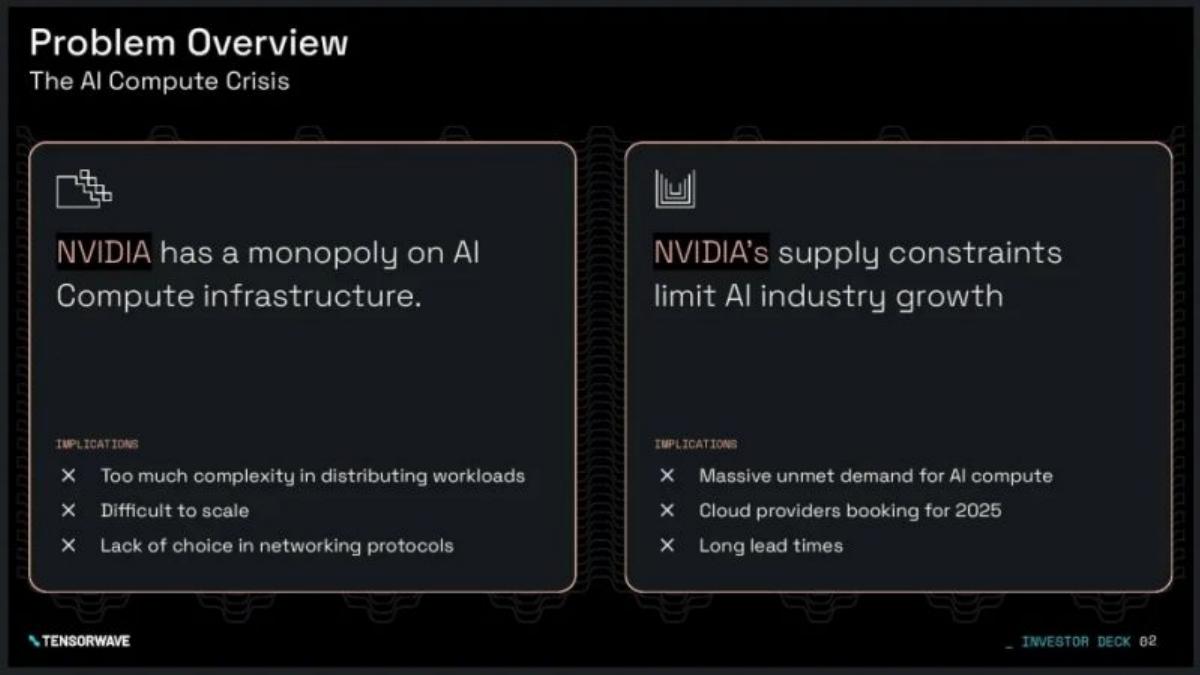
- The deck identifies NVIDIA's monopoly and supply constraints as the primary market friction (Slide 2).
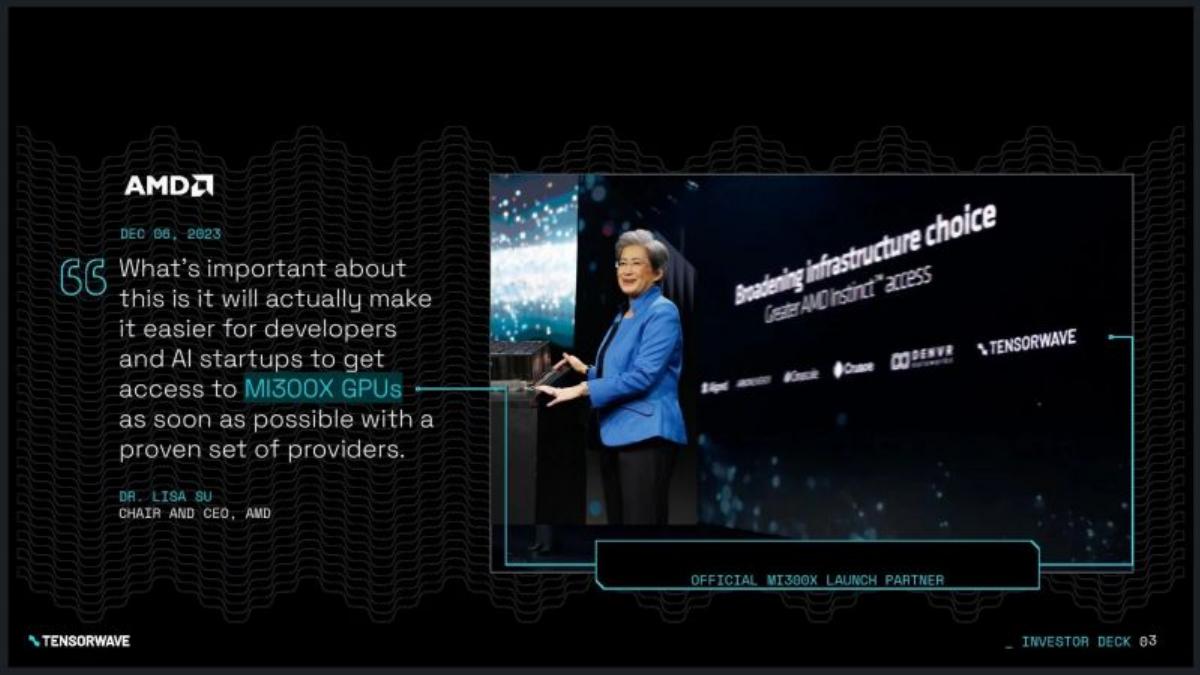
- TensorWave leverages a high-profile endorsement from AMD CEO Dr. Lisa Su to validate their position as an official launch partner (Slide 3).
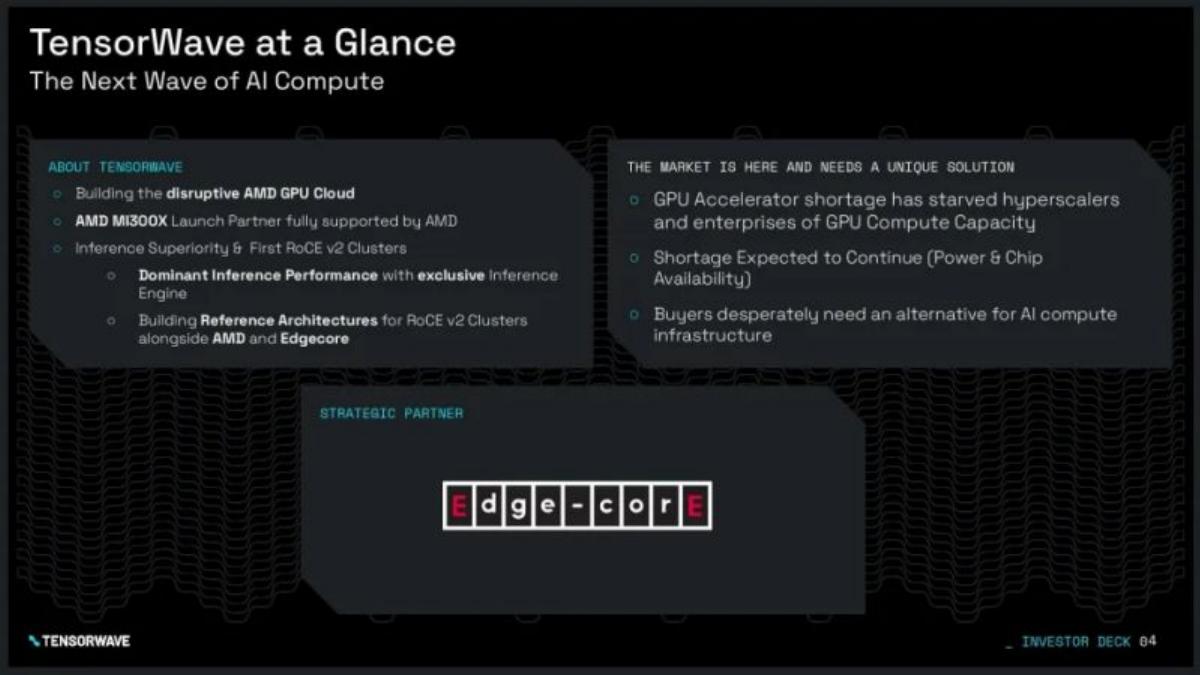
- The company claims 'Inference Superiority' and the first RoCE v2 clusters in their cloud architecture (Slide 4).
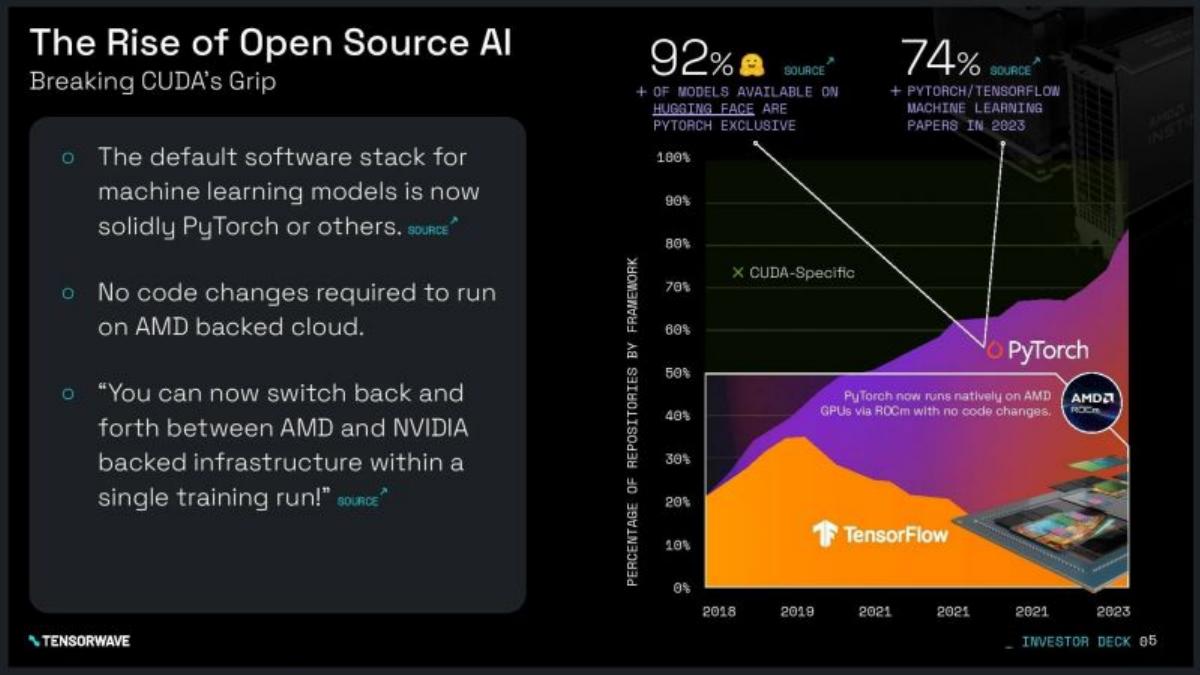
- A critical argument is made for the portability of AI workloads, noting that 92% of models on Hugging Face are PyTorch exclusive and run natively on AMD via ROCm (Slide 5).
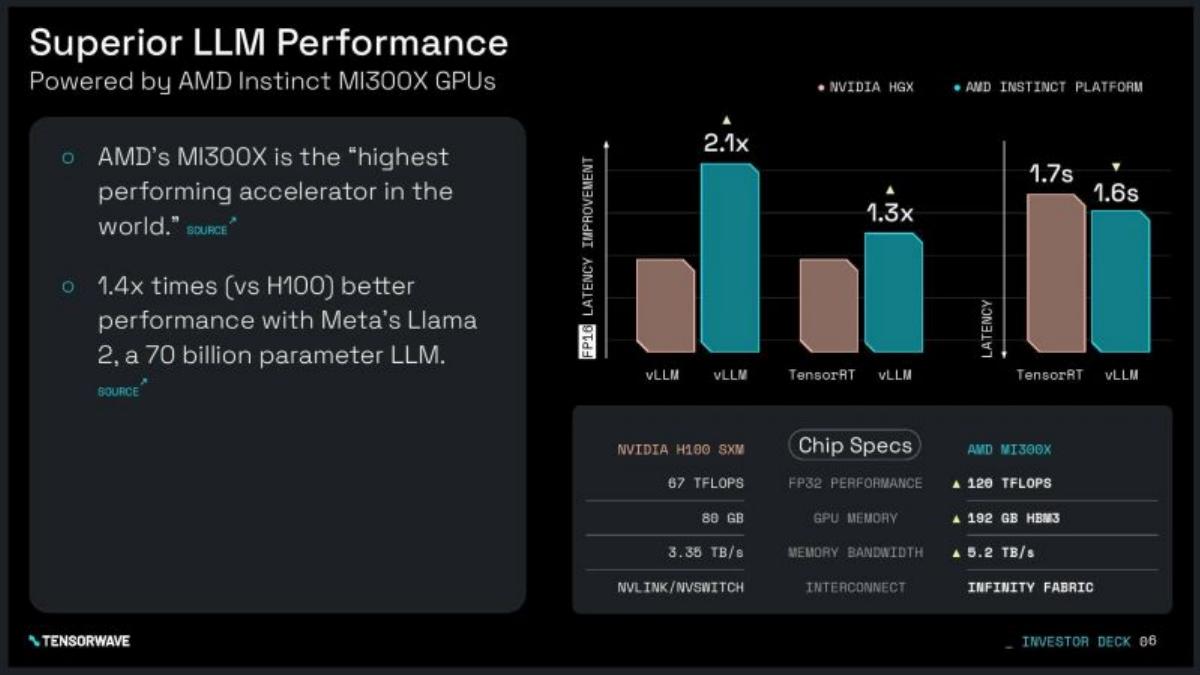
- Technical benchmarks claim the AMD MI300X offers 1.4x better performance than the NVIDIA H100 for Meta's Llama 2 70B model (Slide 6).
- The MI300X is shown to have 192 GB of HBM3 memory compared to the H100's 80 GB (Slide 6).
- The founding team highlights a combined $65M+ raised across previous ventures and three specific exits (Slide 7).
- Market data projects the global AI market will cross $1 trillion by 2028 with a 36.6% CAGR (Slide 8).
The Macro Thesis: Solving the AI Compute Crisis
TensorWave’s pitch deck arrives at a time when the demand for AI compute far outstrips the supply of NVIDIA hardware. The deck is not just a product pitch; it is a macro-economic argument for the necessity of a secondary ecosystem in the AI cloud space. By focusing on AMD hardware, TensorWave positions itself as the primary beneficiary of the 'spillover' demand from NVIDIA’s supply chain issues.
Slide 1: Title Slide
The deck opens with a minimalist black background and the tagline: "The Next Wave of AI Compute." It establishes a clean, professional brand identity immediately. The use of the term "Investor Deck" in the bottom right corner indicates this is a standard fundraising document.
Slide 2: Problem Overview - The AI Compute Crisis
This slide sets the stage by identifying two core problems. First, it claims "NVIDIA has a monopoly on AI Compute infrastructure," which leads to complexity and a lack of choice in networking protocols. Second, it highlights that "NVIDIA’s supply constraints limit AI industry growth," citing that cloud providers are already booking for 2025 and customers are facing massive unmet demand. This slide is effective because it frames TensorWave’s existence as a market necessity rather than just another startup.
Slide 3: The AMD Endorsement
Validation is the theme of slide 3. It features a large photo of Dr. Lisa Su, Chair and CEO of AMD , at an official launch event. The slide quotes her from December 6, 2023, stating that providers like TensorWave will make it easier for developers to access MI300X GPUs . Being named an "Official MI300X Launch Partner" provides a level of institutional credibility that is rare for a Seed-stage company.
Slide 4: TensorWave at a Glance
This slide summarizes the value proposition. It mentions building a "disruptive AMD GPU Cloud" and claims "Inference Superiority." A key technical detail included here is the building of "Reference Architectures for RoCE v2 Clusters" alongside AMD and Edgecore. It reiterates that the market is starved for capacity and that buyers are desperate for alternatives.
Slide 5: Breaking CUDA’s Grip
The most significant hurdle for any non-NVIDIA compute provider is NVIDIA's proprietary software stack, CUDA. TensorWave tackles this head-on by showing a graph of the rise of PyTorch and TensorFlow . It claims that 92% of models available on Hugging Face are PyTorch exclusive and that "No code changes [are] required to run on AMD backed cloud." This slide is designed to de-risk the investment by proving that the software moat is no longer insurmountable.
Slide 6: Superior LLM Performance
This is the technical 'meat' of the deck. It compares the AMD MI300X to the NVIDIA H100 SXM . The slide claims the MI300X is the "highest performing accelerator in the world" with 1.4x better performance on Meta’s Llama 2 70B model. The table at the bottom lists specific specs: 120 TFLOPS for AMD vs 67 for NVIDIA, and 192 GB HBM3 memory for AMD vs 80 GB for NVIDIA. These figures are intended to show that TensorWave isn't just a 'budget' alternative, but a performance leader.
Slide 7: A Proven and Successful Team
The team slide features Darrick Horton (CEO), Piotr Tomasik (COO), and Jeff Tatarchuk (CGO). The headline claim is that they "Built the Largest Tech Startup in Nevada By Valuation." They highlight $65M+ raised across previous ventures and decades of experience at companies like Meta, PayPal, Venmo, IBM, and Lockheed Martin. This slide aims to prove they have the operational maturity to manage the capital-intensive nature of data centers.
Slide 8: Market Size
TensorWave uses three charts to illustrate the scale of the opportunity. They project the Global AI market to cross $1 Trillion by 2028 with a 36.6% CAGR . They also show that 76% of companies expect to increase AI spend in the next fiscal year and that market revenue for AI processors and data centers is "soaring," reaching a projected $38 Billion by 2026 . The sources are cited generally as "Source," which is a minor weakness in an otherwise data-heavy deck.
Slide 9: Contact Information
The deck concludes with a simple "Learn More" slide, providing the email addresses for the CEO and COO. It maintains the visual consistency of the rest of the deck.
Slide 10: BestPitchDeck.com Call to Action
This is a standard attribution slide for the source of the deck and does not contain company-specific information.
What Works in This Deck
The deck is exceptionally strong at borrowing authority . By placing the AMD CEO on slide 3 and listing major tech logos (Meta, PayPal, IBM) on the team slide, TensorWave overcomes the 'unknown startup' stigma. The technical comparison on slide 6 is also highly effective; it uses specific, measurable metrics (TFLOPS, GB of HBM3) to move the conversation from marketing fluff to hardware reality. Finally, the focus on the portability of workloads (Slide 5) is a brilliant move to address the biggest objection investors have to non-NVIDIA plays.
What Is Missing from This Deck
Despite raising $43M, the deck is missing several standard components. There is no 'Ask' slide detailing how the $43M will be spent (e.g., how many chips will be purchased, which data centers will be leased). There are no financial projections or unit economics showing the margin profile of renting AMD chips versus the cost of power and hardware depreciation. Additionally, there is no roadmap ; investors are left to guess when the cloud will be fully operational or what the next 18-24 months of scaling look like. The competitive landscape is also simplified to just NVIDIA, ignoring other emerging GPU clouds like CoreWeave or Lambda Labs.
What a Founder Should Copy
Founders should emulate the problem-framing on slide 2. Instead of just saying "we are a cloud provider," TensorWave frames itself as the solution to a global supply chain crisis. The spec-for-spec comparison on slide 6 is also a best practice for any hardware or infrastructure startup; it forces the investor to look at the raw data rather than just the brand name. Lastly, the software compatibility argument on slide 5 is a perfect example of how to proactively address a 'deal-breaker' objection before the investor even asks about it.
Frequently asked questions
- How does TensorWave address the 'CUDA Moat'?
- TensorWave addresses the CUDA moat on slide 5 by highlighting the rise of open-source AI frameworks. They point out that 92% of Hugging Face models are PyTorch exclusive and that PyTorch now runs natively on AMD GPUs via ROCm with no code changes required. This argument suggests that the software barrier to switching from NVIDIA to AMD has effectively collapsed for the majority of modern AI workloads.
- What are the specific hardware advantages claimed over NVIDIA?
- On slide 6, TensorWave provides a direct spec comparison between the NVIDIA H100 SXM and the AMD MI300X. Key advantages cited include 120 TFLOPS of FP32 performance (vs 67 for NVIDIA), 192 GB of HBM3 memory (vs 80 GB), and 5.2 TB/s memory bandwidth (vs 3.35 TB/s). They also claim a 2.1x latency improvement in specific vLLM benchmarks.
- Who are the key partners mentioned in the deck?
- The deck identifies two primary strategic partners. The most prominent is AMD, where TensorWave is an 'Official MI300X Launch Partner' (Slide 3). The second is Edgecore, with whom TensorWave is building reference architectures for RoCE v2 (Remote Direct Memory Access over Converged Ethernet) clusters (Slide 4).
- What is the team's track record according to the slides?
- The team, led by Darrick Horton, Piotr Tomasik, and Jeff Tatarchuk, claims to have built the 'Largest Tech Startup in Nevada by Valuation.' Slide 7 notes they have founded six companies, raised over $65M in previous ventures, and achieved three exits, specifically naming influential, LetsRolo, and Activeside as previous successes.
- Is there a clear business model or pricing strategy in the deck?
- No. The deck is primarily a technical and strategic positioning document. It identifies as a 'B2B SaaS' model in the catalogue listing, but the slides themselves do not detail per-hour GPU pricing, contract structures, or projected revenue. It focuses entirely on the availability of compute and the technical superiority of the AMD-based cloud.