The Tesla × SolarCity acquisition deck is a masterclass in strategic narrative, designed to overcome investor skepticism regarding a multi-billion dollar merger. Rather than focusing on SolarCity’s standalone financials, the deck positions the acquisition as the missing piece in a 'fully vertically integrated' energy ecosystem. By highlighting $150 million in expected cost synergies and the technical benefits of combining solar, storage, and transportation, Tesla shifts the conversation from a bailout to a synergistic leap. The presentation relies heavily on Tesla’s existing 'Track Record of…
Key takeaways
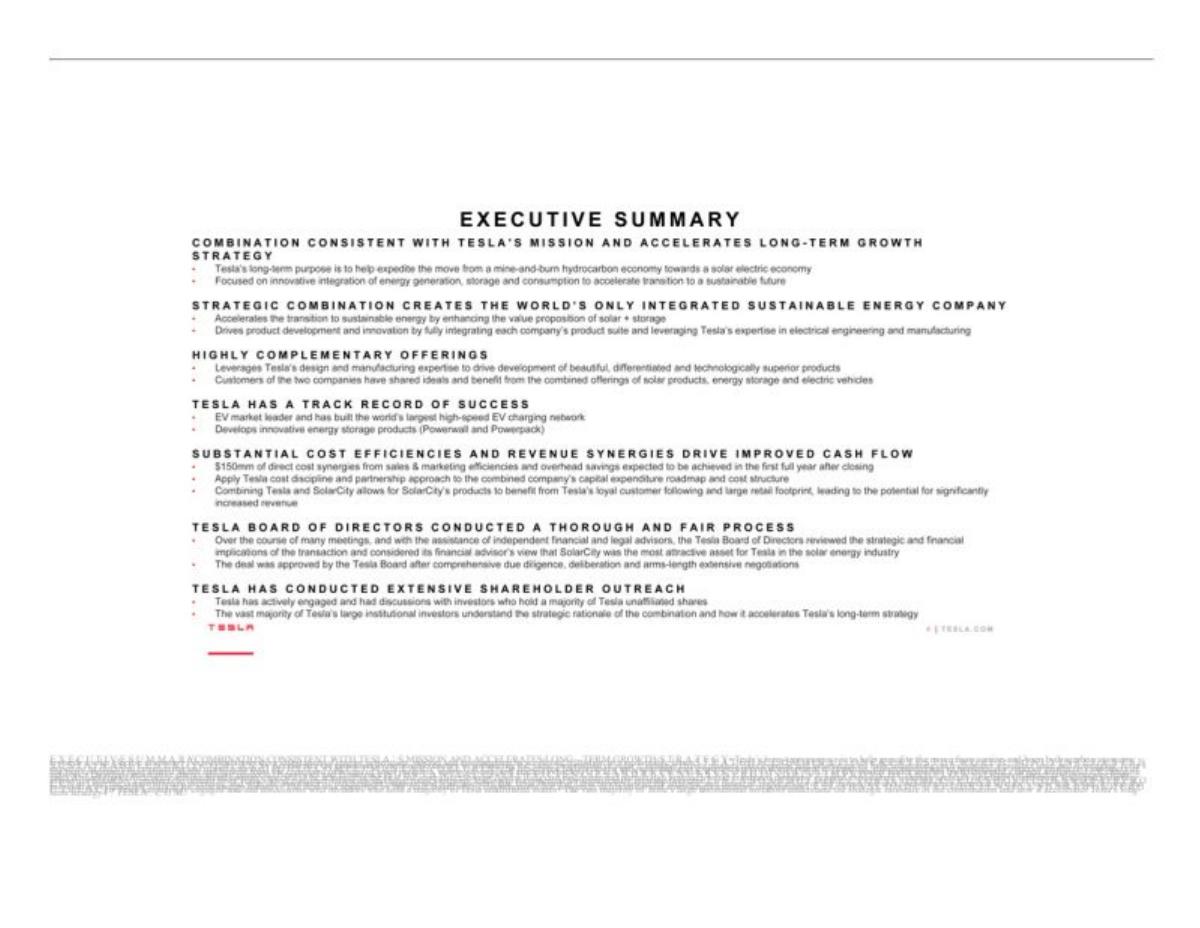
- The core thesis is the creation of the 'world's only integrated sustainable energy company' by combining generation, storage, and transportation (Slide 10).
- Tesla projects $150 million of direct cost synergies to be achieved in the first full year after closing (Slide 14).
- The deck emphasizes a shift from SolarCity’s traditional leasing model to selling solar systems to improve profitability (Slide 12).
- A Hawaii Case Study is used to prove the technical viability of a first-of-its-kind utility-scale solar + storage system (Slide 14).
- Tesla uses its market share growth—from 8% in 2013 to 18% in 2015—to validate its management's execution capabilities (Slide 18).
- The 'Governance and Process' section provides a detailed timeline from May 31 to August 1, 2016, to demonstrate a thorough board review (Slide 27).
- Liquidity is addressed by showing a >$3.0 billion position and the successful diversification of the capital structure (Slide 23).
- The integration roadmap explicitly states that the combined company will operate under the Tesla name with three primary products: Autos, Batteries, and Solar (Slide 19).
Introduction: The Vertical Integration Gamble
In October 2016, Tesla was at a crossroads. It was preparing for the massive production ramp of the Model 3 while simultaneously proposing a $2.6 billion acquisition of SolarCity, a solar installer chaired by Elon Musk and led by his cousins. To the market, this looked like a bailout of a struggling, debt-heavy company. To Tesla, it was the final piece of a 'Master Plan.' This deck, presented to proxy advisory firms, was the primary tool used to convince institutional investors that the merger was a strategic necessity rather than a family favor.
Slide 1: Title and Legal Context
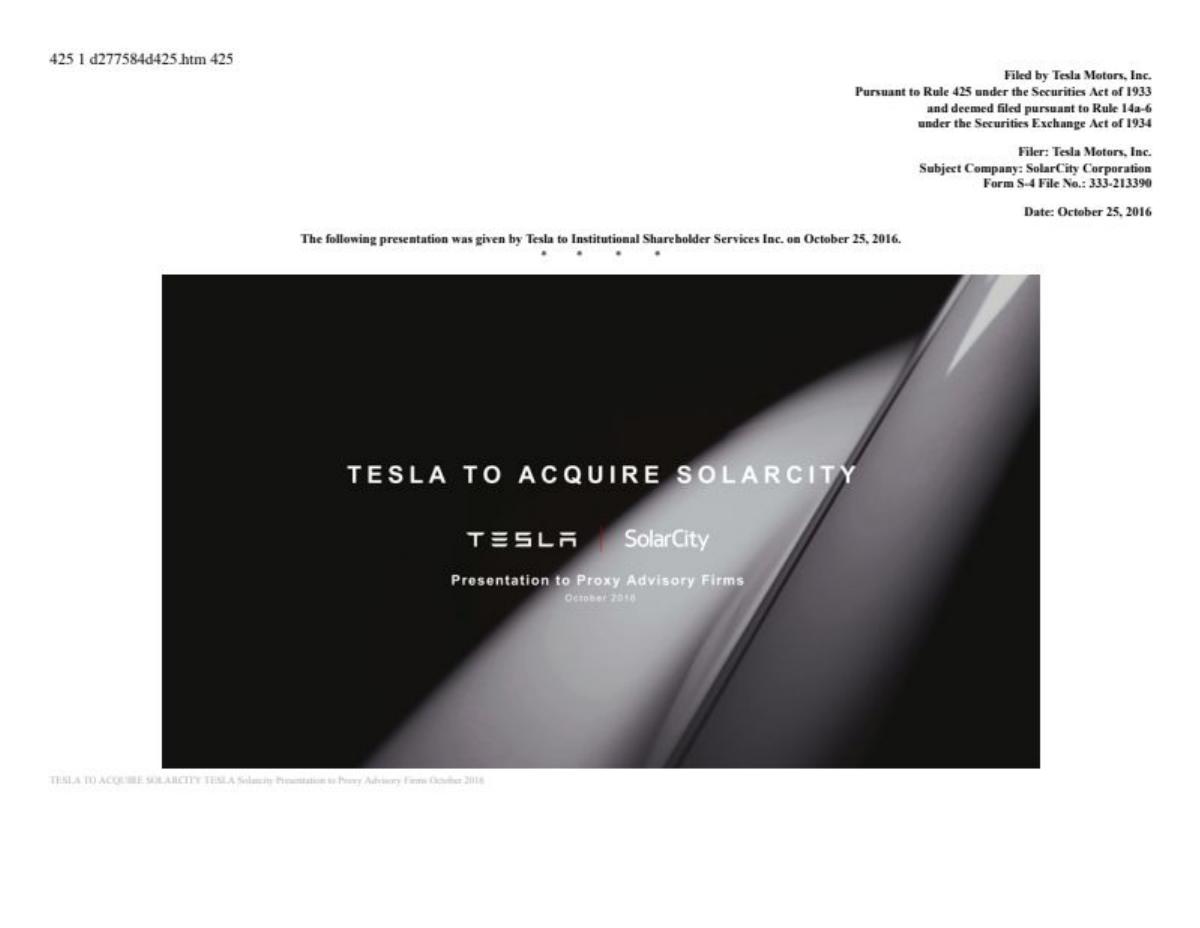
The cover slide is austere, featuring a high-contrast, abstract image of what appears to be a vehicle or solar component. The text is functional: 'TESLA TO ACQUIRE SOLARCITY.' Notably, the slide includes SEC filing headers (Form S-4), signaling that this is a formal regulatory communication. The date, October 25, 2016, places this presentation just weeks before the shareholder vote.
Slide 3: Today's Presenters
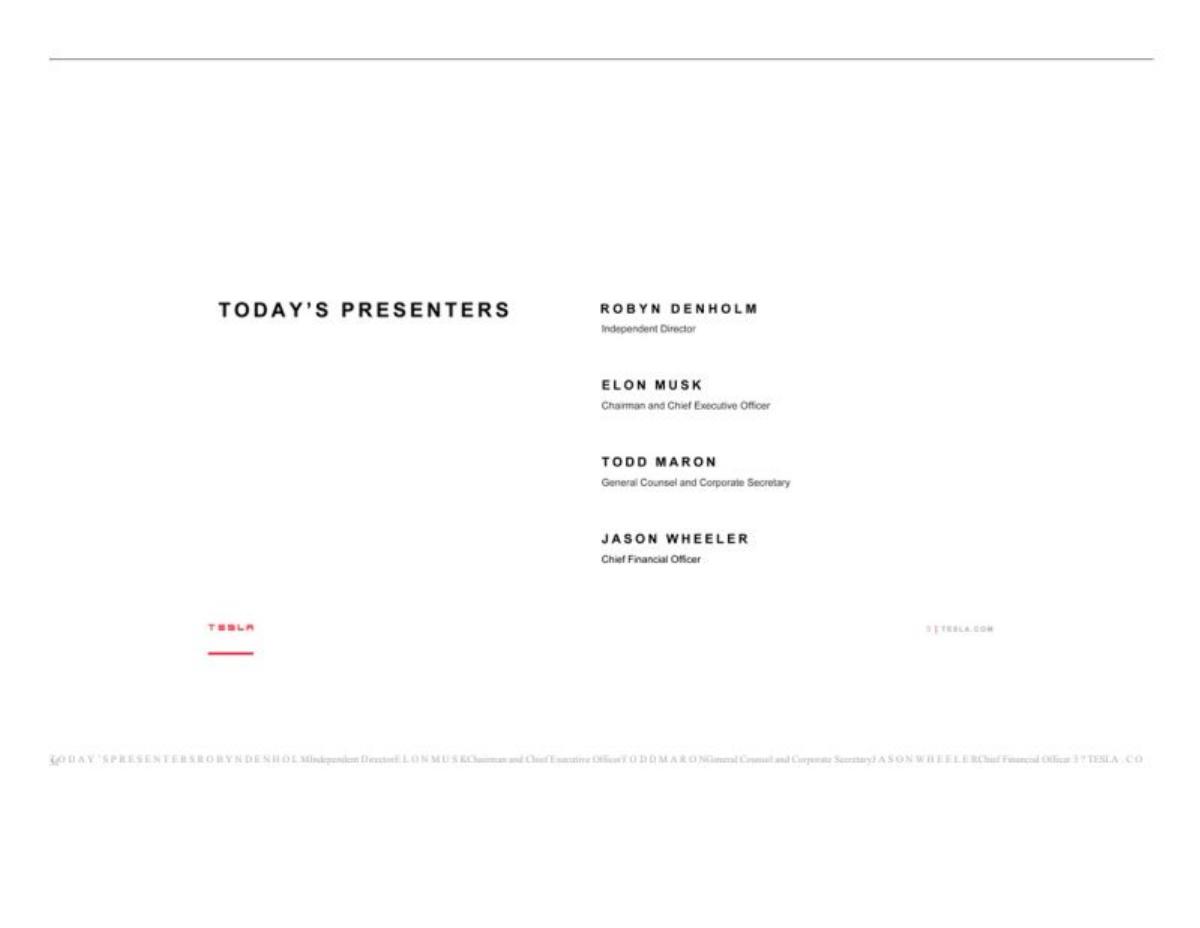
The team slide lists Robyn Denholm (Independent Director), Elon Musk (Chairman and CEO), Todd Maron (General Counsel), and Jason Wheeler (CFO). By including Denholm and Maron alongside Musk, Tesla emphasizes that the acquisition is a corporate initiative backed by independent board oversight and legal counsel, not just a founder's whim.
Slide 5: The Agenda
The presentation is structured into four logical blocks: Strategic Rationale, Financing and Liquidity, Governance and Process, and Conclusion. This structure is designed to answer the three biggest investor fears: 'Why do this?', 'Can we afford it?', and 'Was this a fair deal?'
Slide 8: Today's Energy Landscape
Tesla begins with the 'Problem' slide. It uses a graph of 'Record High CO2 Levels' to establish the macro urgency. Key data points include: 82% of energy consumed in the US is from fossil fuels, and 94% of CO2 emissions result from fossil fuel combustion. It specifically identifies the 'Solar Landscape' problem: aesthetics and cost are poor, and intermittency limits the sun's potential. This sets the stage for a solution that combines solar with batteries.
Slide 10: The Integrated Vision
This is the 'Thesis' slide of the entire deck. It claims the merger 'CREATES THE WORLD'S ONLY INTEGRATED SUSTAINABLE ENERGY COMPANY.' It visualizes a three-pillar ecosystem: Sustainable Energy Generation (Solar), Energy Storage (Powerwall), and Sustainable Transportation (Tesla vehicles). The slide argues that energy storage 'solves both these problems' (intermittency and night-time access), making the solar + storage combination a superior product to standalone solar.
Slide 12: Shareholder Value and Cost Reduction
Tesla moves from vision to economics. This slide lists five value drivers. Most importantly, it mentions the 'SHIFT FROM LEASING TO SELLING SOLAR.' This was a pivotal strategic pivot intended to improve SolarCity's profitability and reduce its reliance on constant capital raises. It also mentions that the Gigafactory will enable 'low cost energy storage' by producing cells at scale.
Slide 14: The $150 Million Synergy Claim
This slide provides the 'hard' numbers investors were looking for. It explicitly states: '$150mm of direct cost synergies expected to be achieved in first full year after closing.' It argues that a combined company eliminates 'margin stacking'—where two separate companies each take a profit margin on a combined solar+storage sale. It also features a 'Hawaii Case Study' as a proof of concept for utility-scale solar + storage integration.
Slide 18: Tesla's Track Record
To build trust, Tesla reminds investors of its own execution history. It claims to be the 'World's Fastest Growing Car Company,' showing Model S market share growing from 8% in 2013 to 18% in 2015. It also highlights the Gigafactory's progress, stating it will produce more lithium-ion cells by 2018 than the entire world's output in 2013. The message is clear: 'We know how to scale impossible businesses.'
Slide 19: Roadmap for Integration
This slide outlines the 'Day 1' plan. It specifies that the combined company will operate under the 'Tesla' name and market three products: Autos, Batteries, and Solar. It mentions a 'joint integration team' led by corporate development and HR, emphasizing that the merger is already being operationally planned.
Slide 21 & 23: Financing and Liquidity
These slides address the 'Can we afford it?' question. Slide 21 highlights that Tesla has '3x expansion of cash and available liquidity' in 2016. Slide 23 shows a bar chart of 'Corporate Financing Capabilities,' noting a recent ~$1.7bn equity offering to accelerate the Model 3 ramp. It also shows a 'Strong Liquidity Position' of >$3.0bn. By showing the ladder of 'Convertible Debt Maturities' out to 2021, Tesla attempts to prove that SolarCity’s debt load won't cause a near-term liquidity crisis.
Slide 27: Governance and Process
This is a defensive slide. It provides a day-by-day timeline of the negotiations, starting from May 31, 2016. It details how the Tesla Board rejected initial counterproposals and negotiated the exchange ratio down from 0.131x to the final 0.110x. This level of detail is rare in pitch decks but was necessary here to combat 'self-dealing' allegations.
Slide 29: Market Sentiment
Tesla uses social proof by quoting analysts from Cowen, Forbes, Deutsche Bank, and Barclays. A quote from Deutsche Bank (June 22, 2016) notes that the acquisition 'makes execution on the Powerwall side much easier and not harder.' This slide aims to show that despite the controversy, sophisticated market participants see the logic.
Slide 33 & 35: Company Overview and Bios
The deck concludes with a 'Tesla Overview' (Slide 33) listing 13,058 employees and $4bn in 2015 revenue. The 'Bios of Presenters' (Slide 35) provides deep professional histories. Elon Musk’s bio highlights his roles at SpaceX and PayPal, while Jason Wheeler’s bio emphasizes his 13 years at Google, including his role as VP of Finance. This anchors the ambitious plan in the experience of the leadership team.
What Tesla Did Well
Narrative Shift: They successfully reframed a financial transaction as a product integration. By focusing on the 'Solar Roof' and 'Powerwall,' they made the merger feel like a technical necessity. · Anticipating Objections: The inclusion of a detailed governance timeline (Slide 27) and a specific synergy figure (Slide 14) shows they knew exactly what the critics would attack. · Visualizing the Ecosystem: Slide 10 is a perfect example of how to communicate a complex 'platform' strategy in a single, easy-to-understand graphic. · Leveraging Success: They used the undeniable success of the Model S (Slide 18) to buy credibility for the much riskier solar business.
What Was Missing
SolarCity Financials: The deck is notably light on SolarCity’s specific balance sheet. While it mentions 'synergies,' it avoids a deep dive into SolarCity’s existing debt obligations or historical losses. · Product Specs: While the 'Solar Roof' is mentioned, there are no technical specifications or efficiency data to prove it is actually better than existing solar panels. · Integration Costs: The deck highlights $150M in synergies but does not estimate the one-time costs required to integrate two large, disparate organizations.
What Founders Should Copy
The 'Problem/Solution' Macro Frame: Start with a massive global problem (Slide 8) to make your specific product feel like a moral and economic imperative. · Vertical Integration Logic: If you are pitching a merger or a multi-product strategy, use the 'No Margin Stacking' argument (Slide 14). It is a very persuasive way to explain why being bigger leads to lower prices for customers. · Case Studies as Proof: Don't just claim your tech works; show it working in a specific, high-stakes environment like the Hawaii project (Slide 14). · Strategic Pivot Clarity: If a part of your business isn't working, be explicit about how you are changing it (e.g., 'Shift from Leasing to Selling' on Slide 12). Investors value a clear change in direction over a 'more of the same' approach to a failing model.
Frequently asked questions
- What was the primary justification for the SolarCity acquisition?
- The primary justification was vertical integration. Tesla argued that by owning the entire energy value chain—generation (solar), storage (Powerwall/Powerpack), and consumption (EVs)—they could eliminate 'margin stacking,' reduce customer acquisition costs, and provide a seamless user experience through a single app and brand.
- How did Tesla address concerns about SolarCity's cash burn?
- Tesla addressed this by projecting $150 million in cost synergies and announcing a strategic shift in SolarCity’s business model. They planned to move away from the capital-intensive leasing model toward direct sales of solar systems, which they claimed would improve cash flow and reduce the need for external fundraising.
- What role did the Gigafactory play in this pitch?
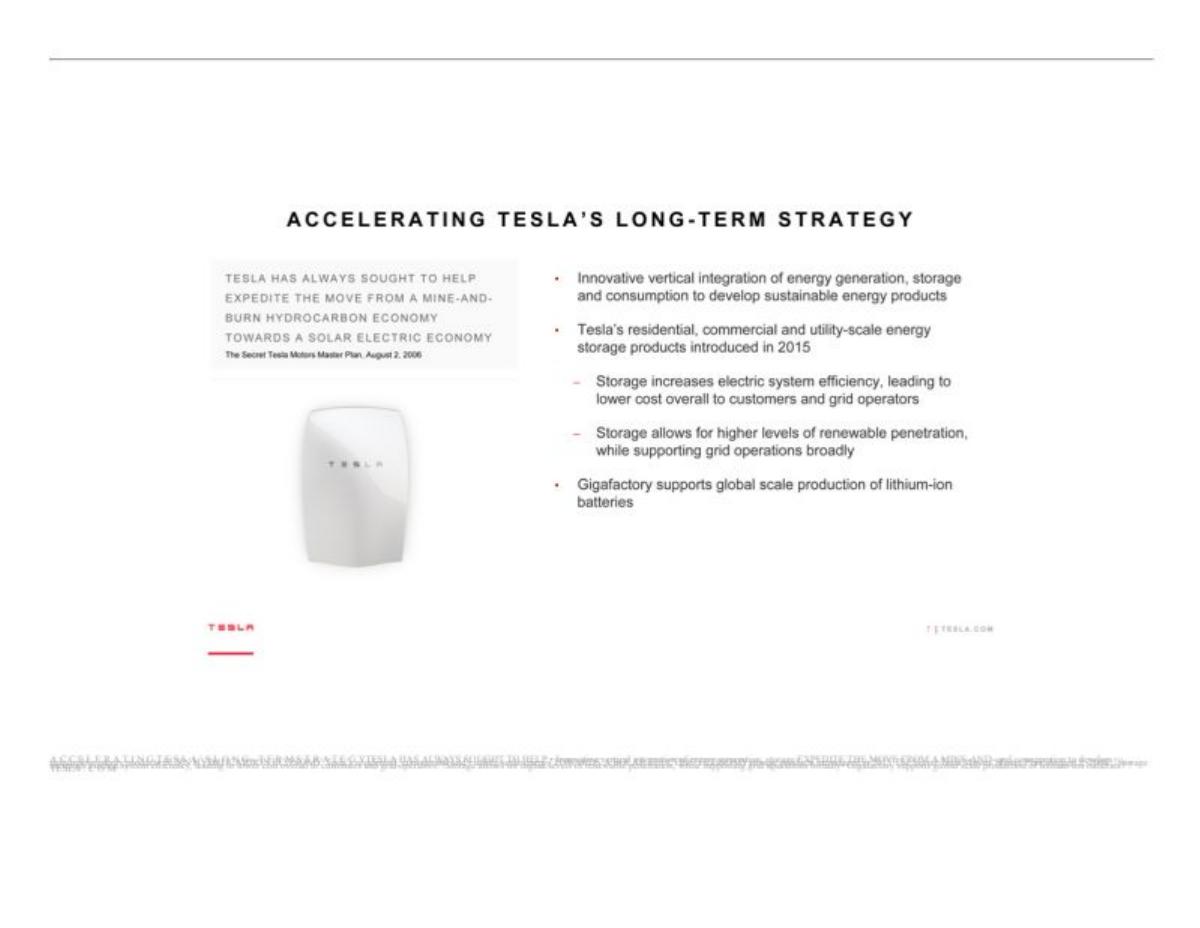
- The Gigafactory was positioned as a competitive moat. The deck claimed that by producing its own lithium-ion cells, Tesla could achieve the low-cost energy storage necessary to make solar energy viable during non-daylight hours, effectively solving the intermittency problem of renewable energy.
- How did the deck attempt to prove the merger was 'fair' to shareholders?
- The deck included a detailed 'Governance and Process' timeline showing multiple board meetings, the use of independent advisors, and several rounds of counterproposals regarding the exchange ratio. This was intended to show that the deal was the result of a rigorous, arm's-length negotiation.
- What metrics did Tesla use to demonstrate its own success?
- Tesla highlighted its status as the 'world's fastest growing car company,' citing its 18% market share in the luxury sedan segment, the delivery of over 160,000 vehicles, and the successful deployment of 715 Supercharger stations globally.