Texas Zebo's 2016 expansion deck outlines a growth strategy for two established Texas-based hospitality brands: Halcyon, a coffeehouse and bar, and Stella Public House, an artisan pizzeria. Unlike typical startup decks seeking venture equity, this proposal offers a revenue-share promissory note with a $250 minimum investment, targeting a 150% capital return funded by 1% of gross revenue. The deck leans heavily on the founders' elite professional backgrounds—including McKinsey, BCG, and Wharton—and provides granular sales data from existing Austin and San Antonio locations. While it effectivel…
Key takeaways
- The investment structure is a revenue-share promissory note paying 1% of gross revenue until 150% of capital is returned (Slide 2).
- The minimum investment threshold is set remarkably low at $250, suggesting a crowdfunding or community-focused raise (Slide 2).
- The founding team possesses high-tier corporate pedigree, including MBAs from Wharton and Stanford, and experience at McKinsey, BCG, and Dell (Slide 5).
- Historical sales data for the Austin location shows net sales for the 'Night' daypart consistently approaching $900,000 on a rolling 12-month basis (Slide 6).
- Food sales as a percentage of total revenue grew significantly in the 'Morning' daypart, rising from approximately 24% to over 30% between 2015 and 2016 (Slide 6).
- The expansion plan includes a 5,600 sq ft flagship site in Austin’s Mueller development, scheduled for a Q1 2017 opening (Slide 8).
- The San Antonio operation is cited as producing 15% net operating income from over $3 million in sales (Slide 9).
- The deck identifies specific future locations in Dallas-Greenville and Rice Village, Houston, to mitigate 'concept risk' through replication (Slide 9).
Texas Zebo: A Hospitality Expansion Case Study
The Texas Zebo deck, dated December 2016, serves as a fundraising tool for the expansion of two distinct but complementary hospitality concepts: Halcyon and Stella Public House. The presentation is structured to appeal to both institutional and smaller-scale investors by highlighting a proven track record and a structured repayment model.
Slide 1: Title and Branding
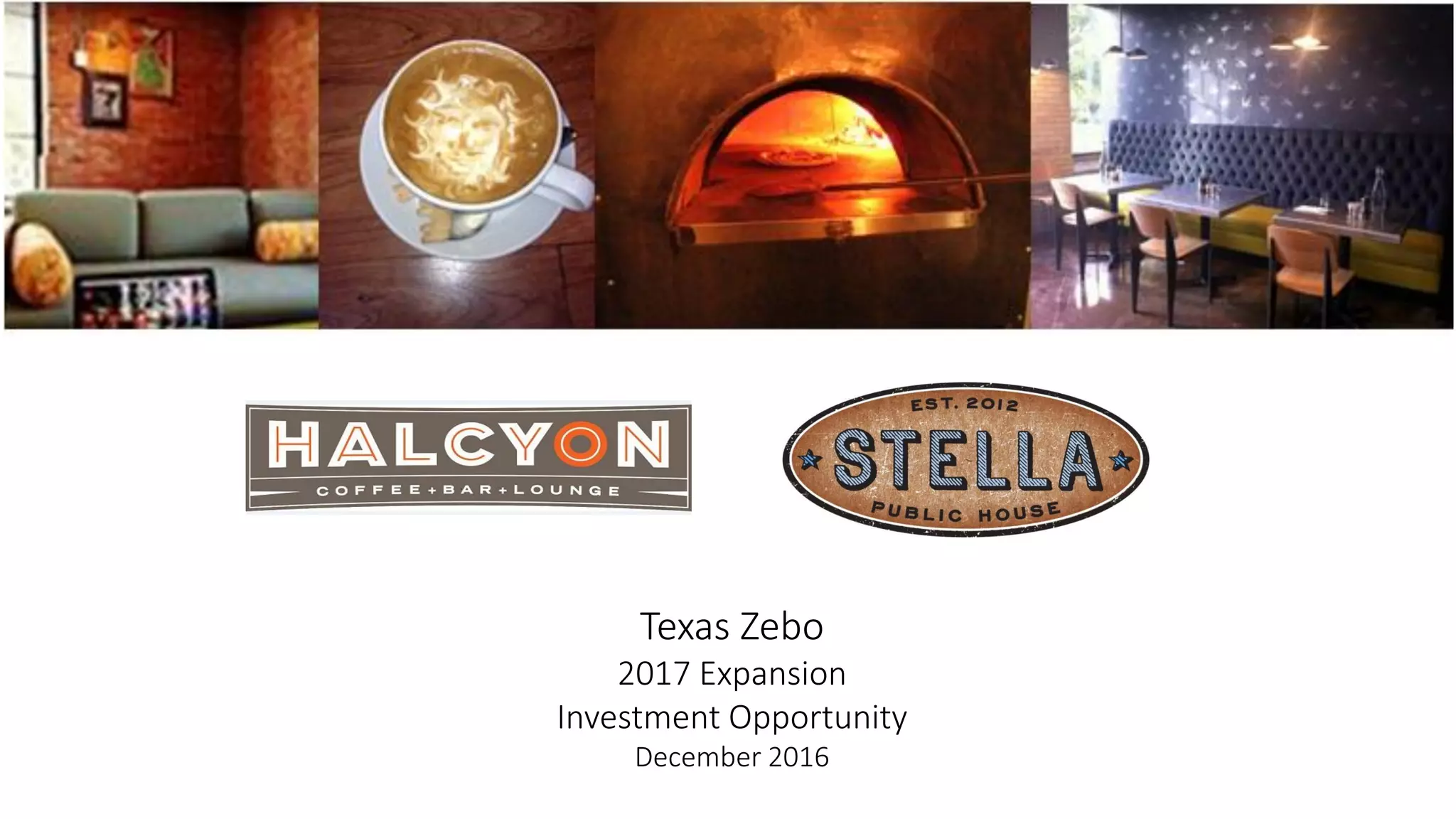
The cover slide establishes the dual-brand nature of the investment. It features the logos for Halcyon (Coffee + Bar + Lounge) and Stella Public House (Artisan Wood Fired Pizzeria) . The imagery focuses on the atmosphere: a cozy lounge area, a latte, a wood-fired oven, and a modern dining room. The slide clearly states the purpose: "2017 Expansion Investment Opportunity."
Slide 2: Summary of Opportunity
This slide acts as the executive summary. It defines the "What," "How," and "Details" of the raise. The company describes Halcyon as an "Austin iconic coffeehouse & bar" and Stella Public House as an "award winning artisan wood fired pizzeria." Crucially, it outlines the investment terms: a $250 minimum investment in a revenue share promissory note . The return profile is specified as 1% of Gross Revenue paid to investors until 150% of capital is returned . This indicates a debt-like instrument designed to provide cash flow to investors rather than long-term equity upside.
Slide 3: Concept Visualization - Halcyon
Slide 3 is a collage of photographs intended to convey the "vibe" of Halcyon. It shows a high-traffic, industrial-chic interior filled with patrons, alongside product shots of coffee, cocktails, panini, and their signature tableside s'mores. The goal here is to demonstrate that the concept is active, populated, and possesses a diverse product mix that spans from morning coffee to evening drinks.
Slide 4: Concept Validation and Press
To mitigate perceived risk, Slide 4 focuses on "Replicating Concept Success." It features clippings from the San Antonio Express-News , Current , and San Antonio Magazine . Specific dishes are highlighted, such as the "Wild mushroom mac & cheese" and "Lamb meatballs." By showcasing third-party accolades from 2013 and 2014, the founders argue that the brand equity is already established in existing markets.
Slide 5: The Founding Team
This is arguably the strongest slide in the deck. The leadership team possesses credentials typically seen in high-growth tech startups or top-tier private equity firms. John Long is a Wharton MBA and former McKinsey consultant. Kris Hardy is also a Wharton MBA with experience at BCG and a decade-long tenure as a Director at Dell. Hanson Li , a Stanford MBA and Siebel Scholar, brings investment banking and food/beverage investment experience via Salt Partners. This slide is designed to build immense trust in the operational and financial management of the company.
Slide 6: 2015 Sales Performance
Slide 6 provides data-driven evidence of growth. The left chart shows "Rolling 12-months Net Sales" for Austin, categorized by daypart (Night, HH/Dinner, Lunch, Morning). The "Night" category is the clear leader, hovering near the $900,000 mark. The right chart, "Food % of Sales by Daypart," shows a positive trend in the "Morning" category, which climbed from roughly 24% to 30% over the tracked period. This suggests the company is successfully upselling food in traditionally drink-heavy periods.
Slide 7: Brand and Product Mix
This slide breaks down revenue by category (Coffee + Bevs, Bar, Food) across three entities: Austin, San Antonio Halcyon, and San Antonio Stella. In Austin, "Coffee + Bevs" and "Bar" are the primary drivers, both trending upward toward the $420,000 and $400,000 range respectively. At San Antonio Stella, "Food" is the dominant revenue source, starting at $800,000 and growing toward $1,000,000 . This data proves the complementary nature of the two brands: one leads with beverages, the other with food.
Slide 8: The Flagship Expansion - Austin Mueller
Slide 8 details a specific use of funds: a new site in the Mueller development on Aldrich Street. The slide lists key specs: 5,600 sq ft , located in the "Anchor corner of Entertainment District," adjacent to the Dell Children’s Museum. It notes that the lease is executed, design is complete, and construction was scheduled to start in January 2017. This provides a tangible, "shovel-ready" project for investors to visualize.
Slide 9: 2016-2020 Location Growth Summary
The final slide in the provided set outlines the long-term roadmap. Key highlights include:
San Antonio producing 15% net operating income from $3M+ in sales . · Negotiations for a 10-20 year renewal of the Austin Halcyon lease. · The launch of a Dallas-Greenville location in January 2017. · Discussions for a Rice Village (Houston) location.
This summary suggests a transition from a local operator to a regional powerhouse with presence in all major Texas metros.
What Works in the Texas Zebo Deck
1. Professional Pedigree: The team slide is exceptional. In the hospitality industry, which often suffers from high failure rates due to poor management, having McKinsey and BCG alumni with Wharton and Stanford MBAs provides a significant layer of professional comfort to investors.
2. Clear Investment Structure: Many small-scale hospitality raises are vague about how investors get paid back. Texas Zebo is explicit: a revenue-share note with a 1.5x cap. This is an attractive structure for investors who want yield rather than a speculative exit ten years down the line.
3. Granular Data: The use of rolling 12-month sales charts broken down by daypart and product category (Slides 6 and 7) shows that the management has a deep handle on their analytics. They aren't just reporting top-line numbers; they are showing where the growth is coming from.
What is Missing from the Texas Zebo Deck
1. Total Capital Requirement: While the deck mentions a $250 minimum, it never states the total amount being raised. Is the goal $500,000 or $5,000,000? Without a total "Ask" figure, it is difficult to calculate the dilution or the total revenue percentage being committed to the investor pool.
2. Specific Unit Economics: While Slide 9 mentions a 15% NOI for San Antonio, the deck lacks a detailed breakdown of Prime Costs (COGS + Labor). Investors in the restaurant space typically want to see these percentages to understand how efficiently the stores are being run.
3. Risk Factors: The deck claims that replicating success "eliminates concept risk" (Slide 4). This is a bold claim. Every new market has unique labor costs, real estate hurdles, and local competition. A slide addressing these specific challenges would have added balance to the presentation.
What a Founder Should Copy
1. The Revenue-Share Model: For founders in industries where a traditional "exit" (IPO or acquisition) is unlikely, the revenue-share promissory note is a fantastic way to attract capital. It aligns the interests of the founder and the investor around top-line growth.
2. Daypart Analysis: If you are running a multi-use space (like a coffee shop that turns into a bar), use Slide 6 as a template. Showing how you maximize the utility of your square footage across 24 hours is a powerful way to demonstrate operational efficiency.
3. Location-Specific Visuals: Slide 8’s use of a site map and specific square footage details makes the expansion feel real. It moves the conversation from "we want to grow" to "we are building this specific building in this specific neighborhood."
Frequently asked questions
- What is the specific investment vehicle offered by Texas Zebo?
- Texas Zebo is offering a revenue-share promissory note. According to Slide 2, investors receive 1% of gross revenue until they have reached a 150% return on their initial capital. This differs from traditional equity investments where returns are tied to a liquidity event or dividends from net profits.
- Who are the key individuals behind the Texas Zebo holding company?
- The leadership team includes John Long (Managing Partner), a Wharton MBA and former McKinsey consultant; Kris Hardy (President), a Wharton MBA with 10 years at Dell and experience at BCG; and Hanson Li (Partner), a Stanford MBA and founder of Salt Partners with experience in investment banking (Slide 5).
- How does the company demonstrate that its restaurant concepts are successful?
- The deck uses a combination of media validation and internal sales data. Slide 4 showcases awards from the San Antonio Express-News and San Antonio Magazine, while Slide 6 and Slide 7 provide rolling 12-month sales charts for coffee, bar, and food categories across their Austin and San Antonio locations.
- What are the planned locations for the 2017 expansion?
- The primary expansion targets mentioned are a flagship site in the Mueller development in Austin (Slide 8), a new location in Dallas-Greenville launching in January 2017, and a potential site in Rice Village Phase II in Houston (Slide 9).
- What financial metrics are provided regarding profitability?
- Slide 9 states that the San Antonio location produces a 15% net operating income (NOI) on over $3 million in annual sales. However, the deck does not provide a full P&L or detailed unit economics for the proposed new locations.