Terra CO2’s 2022 Series A deck is a technical deep dive into the chemistry and scalability of low-carbon cement. Raising $46M, the company successfully positioned itself as a solution to the 7-8% of global CO2 emissions caused by cement manufacturing (Slide 7). The deck excels by moving beyond environmental idealism to address hard industrial realities: cost-competitiveness with Portland cement, utilization of existing off-the-shelf equipment (Slide 19), and a clear path to 100% cement replacement. While the provided slides omit a specific team slide or detailed financial projections, the emp…
Key takeaways
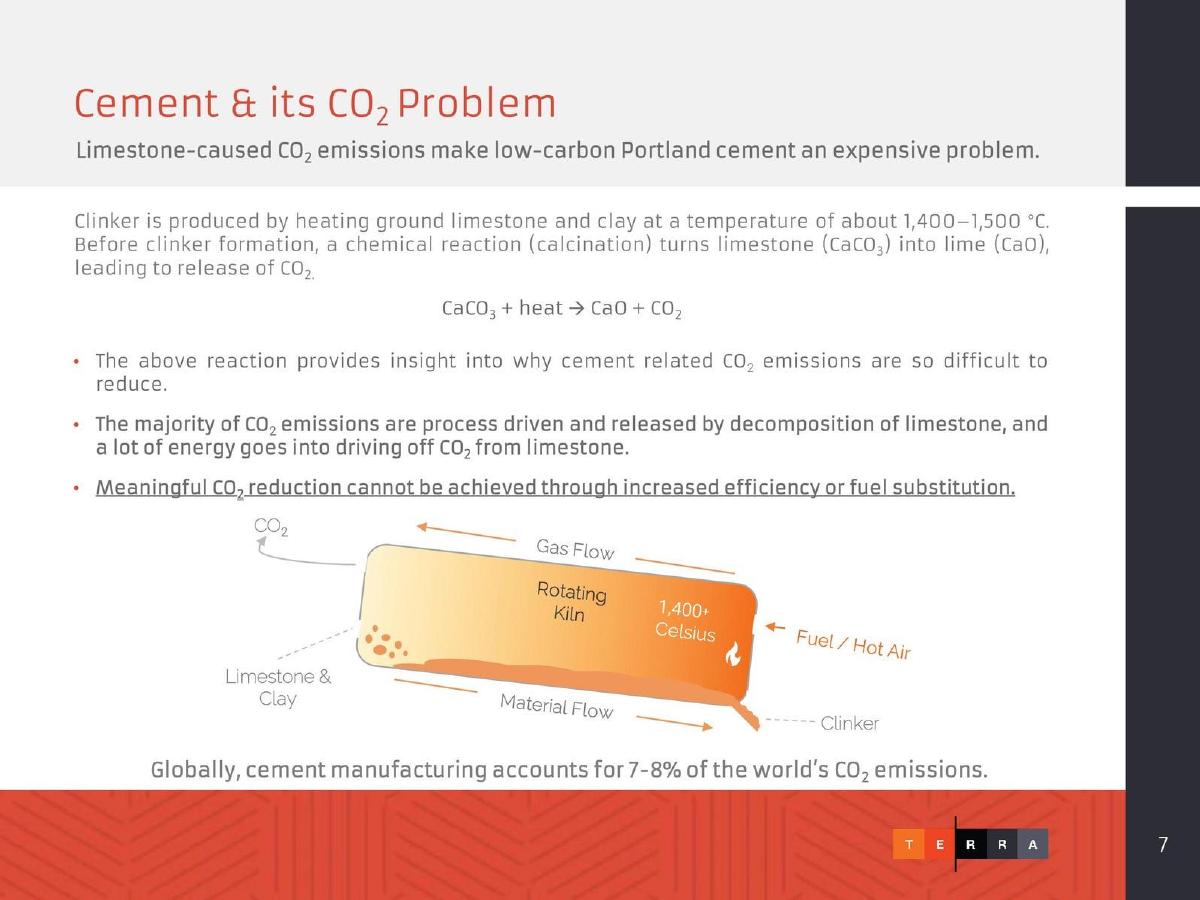
- Cement manufacturing accounts for 7-8% of global CO2 emissions, a problem the deck identifies as largely process-driven and difficult to solve through efficiency alone (Slide 7).
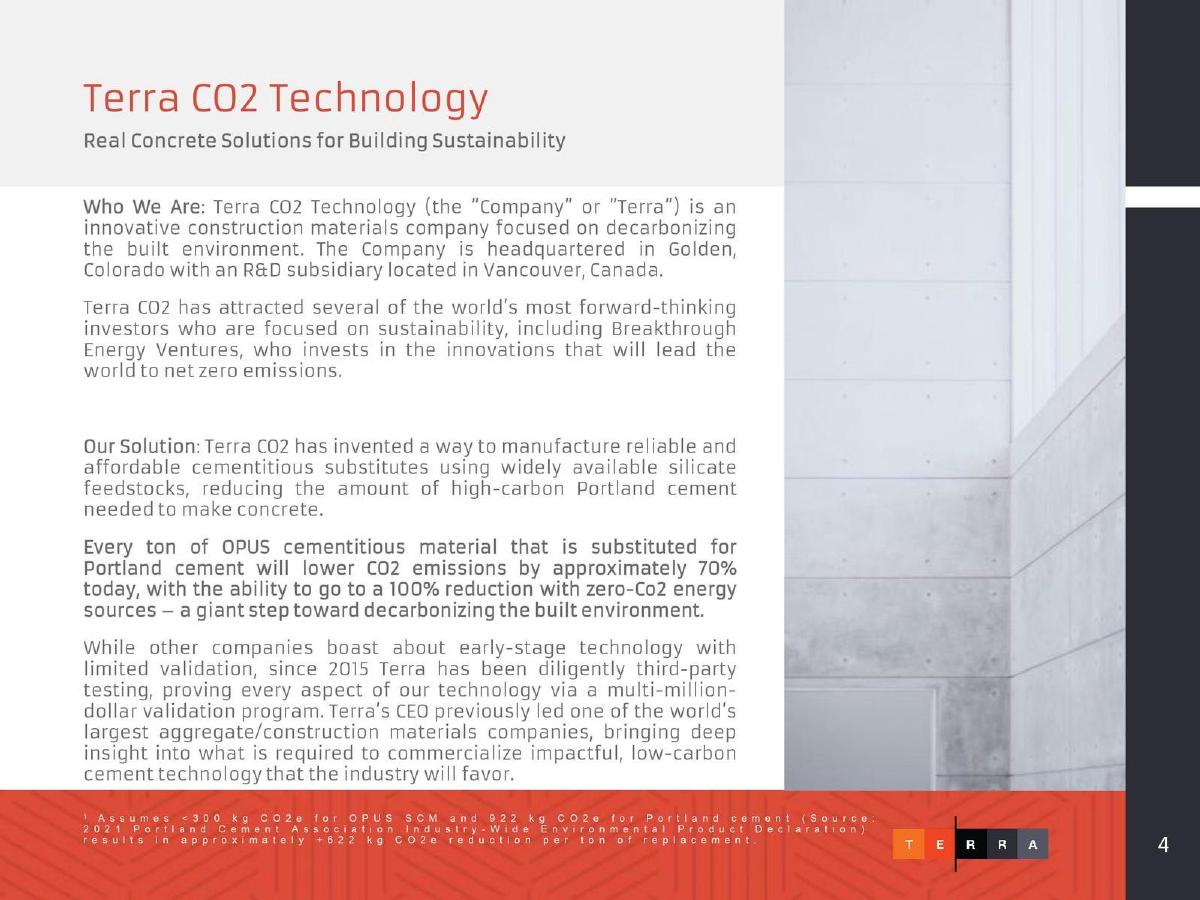
- The company claims its OPUS material lowers CO2 emissions by approximately 70% today, with a path to 100% reduction using zero-CO2 energy (Slide 4).
- Terra CO2 has been conducting third-party testing since 2015 to prove technology reliability via a multi-million-dollar validation program (Slide 4).
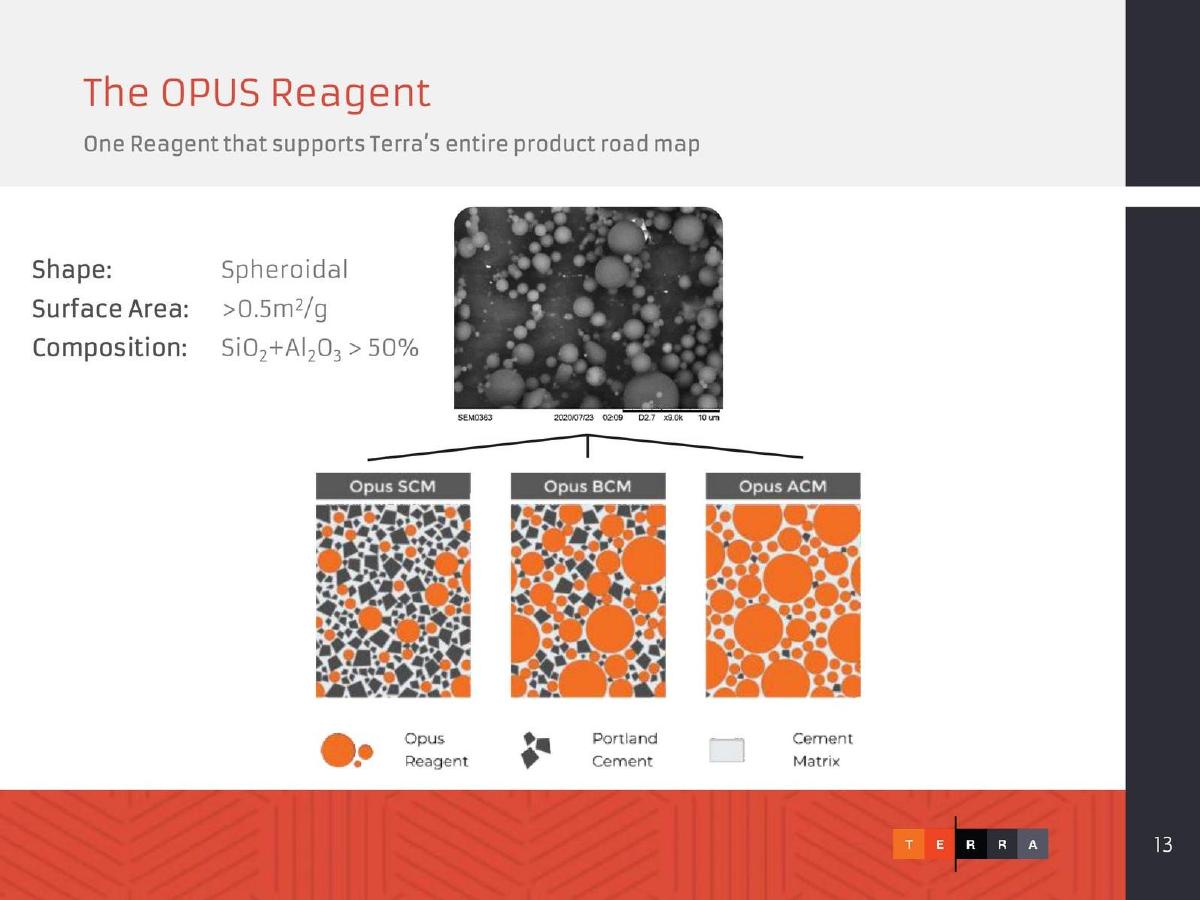
- The OPUS Reagent is a spheroidal powder with a composition of SiO2+Al2O3 > 50%, serving as the foundation for their entire product roadmap (Slide 13).
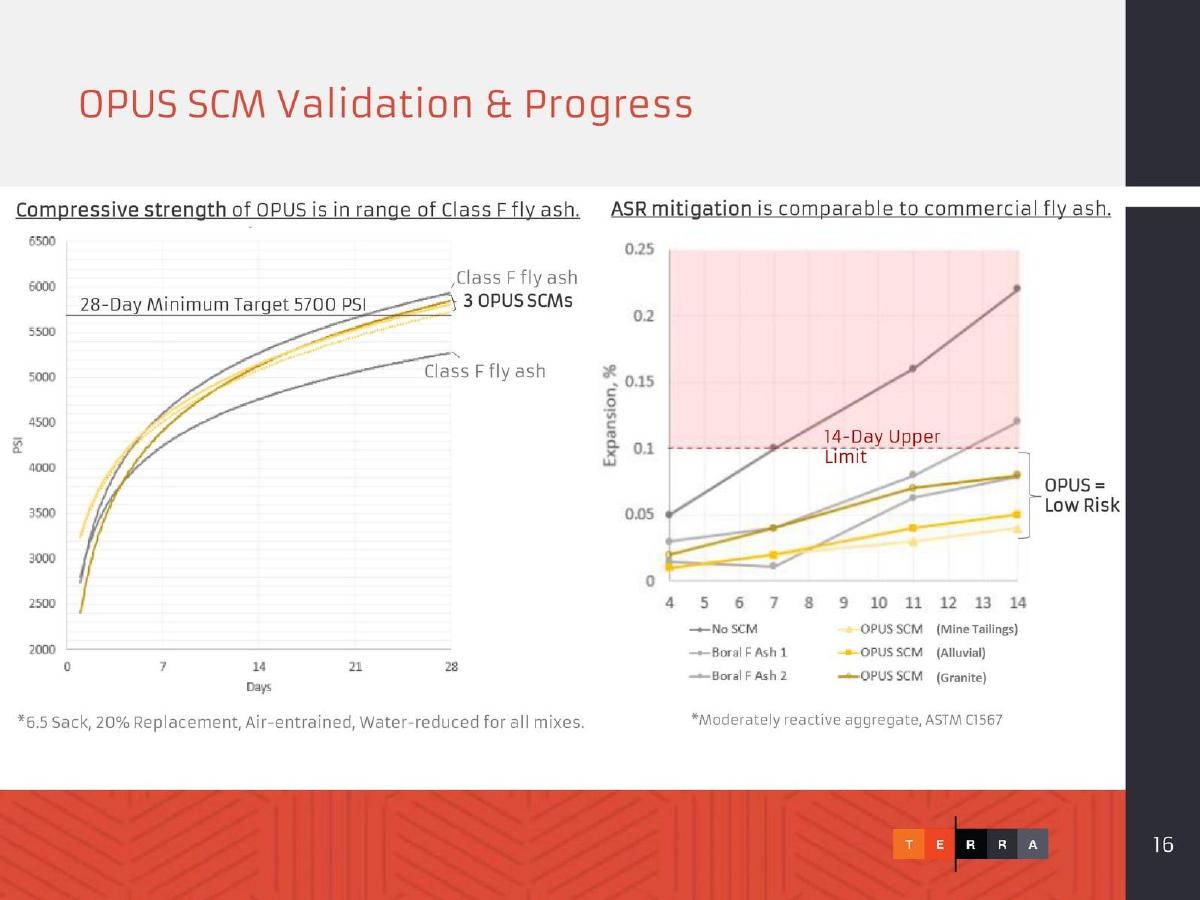
- Technical validation shows OPUS SCM meets a 28-day minimum target of 5700 PSI, performing within the range of Class F fly ash (Slide 16).
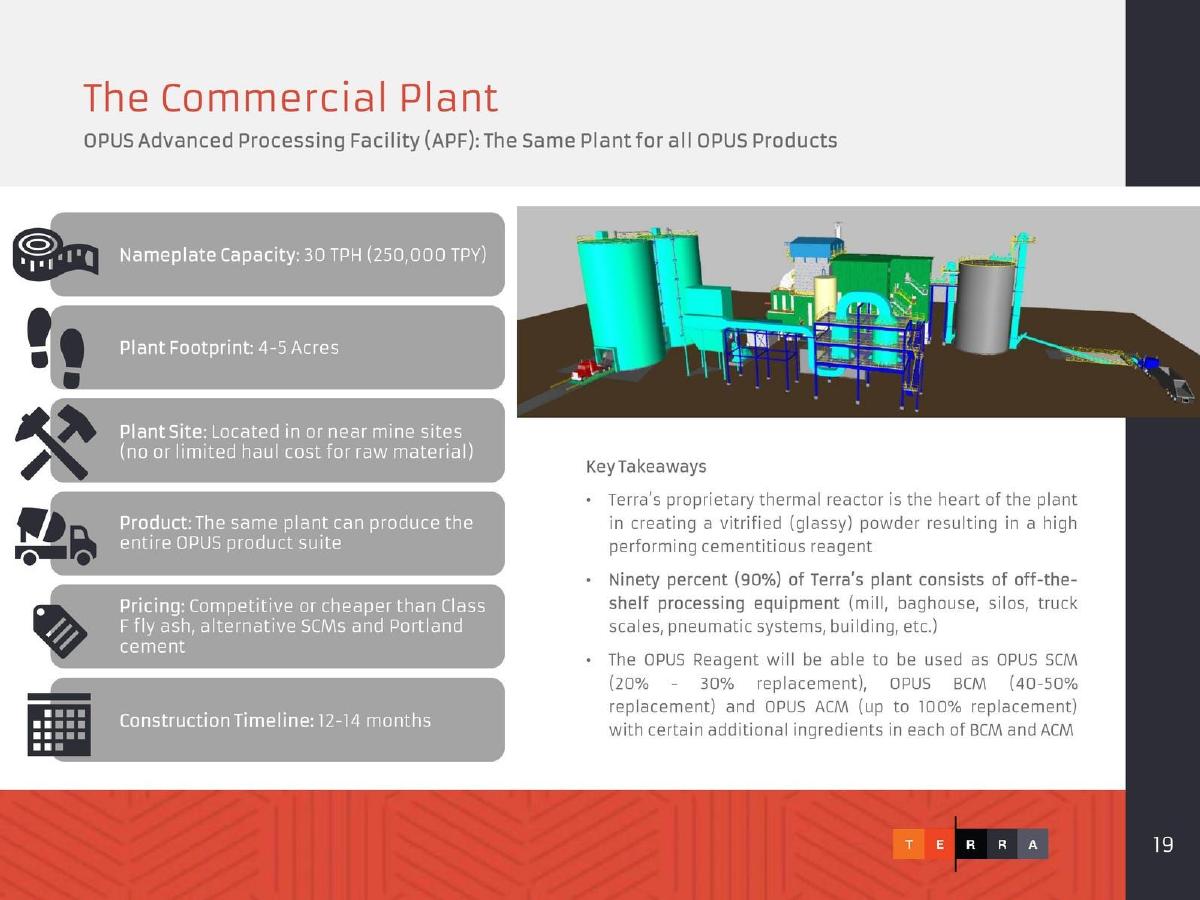
- The proposed commercial plant has a nameplate capacity of 250,000 tons per year and requires a footprint of only 4-5 acres (Slide 19).
- 90% of the production facility consists of off-the-shelf equipment like mills and baghouses, reducing custom engineering risk (Slide 19).
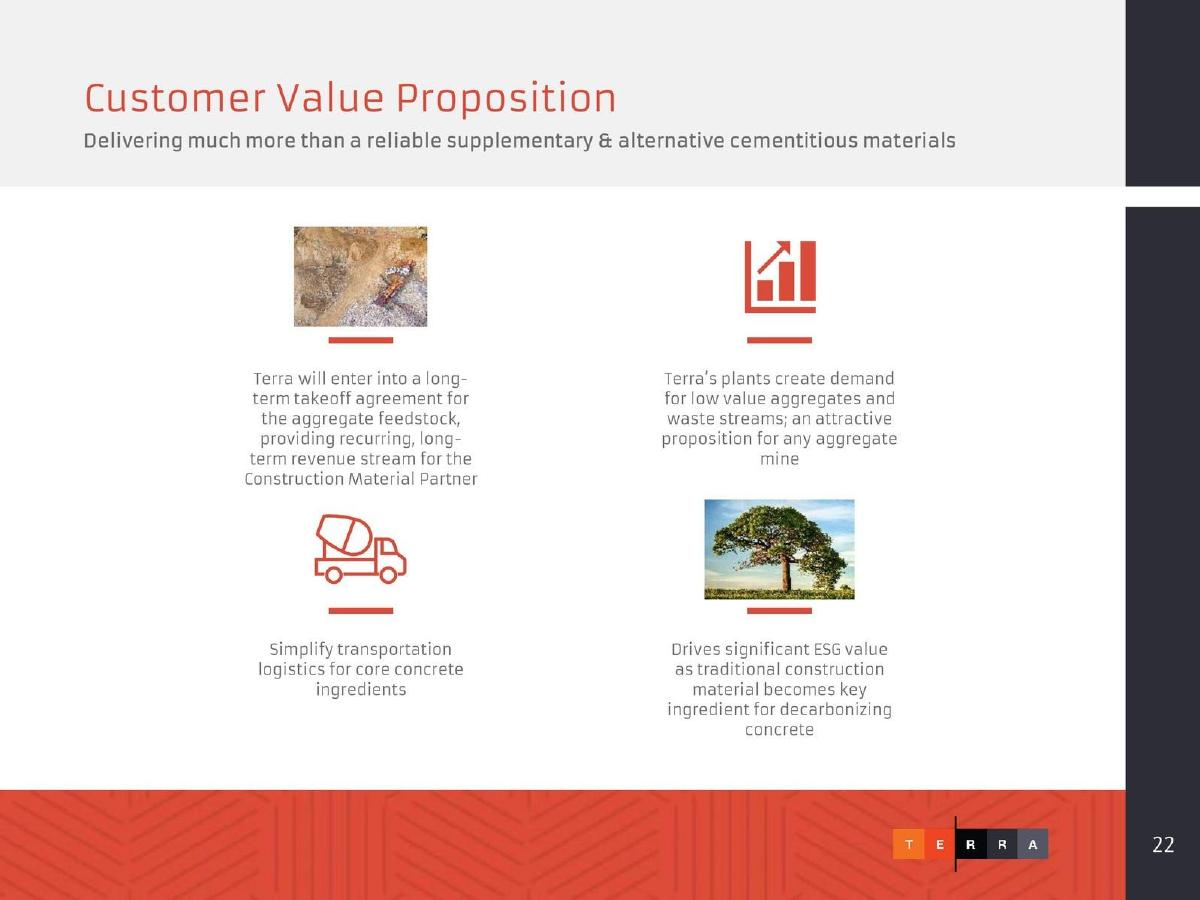
- The business model leverages long-term takeoff agreements for aggregate feedstock, creating a revenue stream for construction material partners (Slide 22).
Terra CO2: Decarbonizing the Foundation of Modern Construction
Terra CO2’s Series A pitch deck is a highly technical document tailored for sophisticated climate-tech and industrial investors. In an industry as conservative as construction, 'disruption' is often met with skepticism regarding safety and cost. Terra CO2 addresses this by focusing on the chemistry of cement and the logistics of manufacturing. The deck, dated 2022, serves as the narrative for their $46M raise, emphasizing that their solution is not just greener, but functionally equivalent and economically viable.
Slide 1-3: Branding and Positioning
The opening slides establish a professional, industrial aesthetic. The use of high-contrast photography of concrete infrastructure (bridges and pillars) grounds the 'sustainable' claims in the reality of heavy civil engineering. The tagline 'Technology for Sustainable Cement' is direct and avoids the vague buzzwords often found in early-stage decks.
Slide 4: The Executive Summary
Slide 4 acts as a comprehensive overview. It identifies the company as headquartered in Golden, Colorado, with an R&D subsidiary in Vancouver. It immediately name-drops Breakthrough Energy Ventures to establish institutional credibility. The slide makes a bold claim: a 70% reduction in CO2 emissions today, with a path to 100%. Importantly, it mentions that the CEO previously led one of the world's largest aggregate companies, signaling to investors that the leadership understands the supply chain they are trying to enter.
Slide 7: The Problem Statement
Slide 7 is a masterclass in defining a 'hard' problem. It explains the chemical reaction (calcination) where limestone (CaCO3) plus heat results in Lime (CaO) and CO2. By showing the formula, Terra CO2 proves that emissions aren't just a result of dirty energy, but a fundamental byproduct of the chemistry of traditional cement. This justifies why a new material—rather than just a more efficient kiln—is required. The slide notes that cement manufacturing accounts for 7-8% of global CO2 emissions.
Slide 13: The OPUS Reagent
This slide introduces the 'OPUS Reagent,' the core intellectual property of the company. It provides specific material characteristics: spheroidal shape, surface area metrics (>0.5m2/g), and chemical composition (SiO2+Al2O3 > 50%). By showing how this single reagent supports three different product tiers (SCM, BCM, and ACM), Terra CO2 demonstrates a scalable product roadmap that can gradually increase market share by replacing higher percentages of Portland cement over time.
Slide 16: Technical Validation
For construction materials, data is the only thing that matters. Slide 16 shows two critical charts: Compressive Strength and ASR (Alkali-Silica Reaction) mitigation. The strength chart shows OPUS SCMs tracking closely with Class F fly ash, surpassing the 5700 PSI target at 28 days. The ASR chart classifies OPUS as 'Low Risk.' These metrics are essential for convincing engineers and contractors that the material won't fail in the field.
Slide 19: The Commercial Plant
Slide 19 addresses the 'how' of scaling. The deck describes an Advanced Processing Facility (APF) with a 250,000-ton annual capacity. The most investor-friendly detail here is that 90% of the plant is 'off-the-shelf' equipment. This significantly lowers the execution risk, as the company doesn't need to invent new manufacturing hardware—only the proprietary thermal reactor at the heart of the process. The 12-14 month construction timeline provides a clear window for when capital will start producing a return.
Slide 22: Customer Value Proposition
The final content slide moves from chemistry to business. It outlines four value drivers: long-term takeoff agreements for partners, creating demand for low-value waste streams, simplifying logistics, and driving ESG value. By positioning their plants near mine sites, they turn a waste product (mine tailings) into a high-value ingredient, creating a circular economy story that appeals to both mine operators and concrete producers.
What Works in the Terra CO2 Deck
Technical Rigor: The deck does not shy away from chemical formulas or PSI charts. In the Series A stage for an industrial company, this level of detail is a requirement, not an option. It proves the founders aren't just 'software people' trying to fix a 'hardware' industry.
Risk Mitigation: By emphasizing that 90% of their plant is off-the-shelf equipment (Slide 19), they answer the investor's biggest fear: 'How much will it cost to build the first ten factories?' The answer is that it’s a standard industrial build-out with one proprietary component.
Clear Benchmarking: Comparing their product to 'Class F fly ash' (Slide 16 and 19) is brilliant. Fly ash is a well-known, widely used supplementary cementitious material. By using it as a benchmark, Terra CO2 gives potential customers and investors a familiar frame of reference for performance and price.
What is Missing from the Terra CO2 Deck
Detailed Financials: While the publisher reports a $46M raise, the provided slides do not show the unit economics of a single ton of OPUS vs. a ton of Portland cement. While Slide 19 claims pricing is 'competitive or cheaper,' investors usually want to see the margin profile at scale.
The Team Slide: Although the summary mentions the CEO's background, a dedicated team slide is missing from this selection. In a Series A, the pedigree of the engineering and operations team is a primary factor in the investment decision.
Competitive Landscape: The deck mentions 'other companies' in passing on Slide 4 but does not provide a competitive matrix. Given the rise of other low-carbon cement startups (like Brimstone or CarbonCure), a slide explaining Terra’s specific moat would have been beneficial.
Founder Takeaways: Copy These Strategies
Address the 'Green Premium' early: Terra CO2 explicitly states their pricing is competitive with traditional materials (Slide 19). If your sustainable product is 5x the cost of the incumbent, you have a niche product; if it's the same price, you have a market-changer. · Use 'Off-the-Shelf' as a selling point: If your innovation is a process or a material, try to use existing infrastructure to scale it. Highlighting that you don't need to reinvent the wheel for 90% of your factory (Slide 19) makes your company much more 'bankable.' · Validate with Industry Standards: Don't invent your own metrics. Terra CO2 used PSI (pounds per square inch) and ASTM C1567 standards (Slide 16). Using the industry's existing 'language of truth' builds immediate trust with stakeholders. · Solve a Logistics Problem, Not Just a Carbon Problem: Slide 22 mentions simplifying transportation and using mine waste. Often, the logistical savings of a new technology are more attractive to a customer’s bottom line than the carbon credits.
Frequently asked questions
- What is the primary environmental impact of Terra CO2's technology?
- According to Slide 4, Terra CO2's OPUS cementitious material lowers CO2 emissions by approximately 70% compared to traditional Portland cement. The deck notes that this can reach a 100% reduction if zero-CO2 energy sources are used for the manufacturing process, directly addressing the 7-8% of global emissions caused by the cement industry.
- How does Terra CO2 compare to traditional cement in terms of strength?
- Slide 16 provides a validation chart showing that OPUS SCM reaches a compressive strength of over 5500 PSI within 28 days. This puts it in the same performance range as Class F fly ash, meeting the 28-day minimum target of 5700 PSI required for standard construction applications.
- What kind of infrastructure is required to build a Terra CO2 plant?
- Slide 19 details the 'Advanced Processing Facility' (APF), which has a capacity of 250,000 tons per year. Crucially, 90% of the plant uses off-the-shelf equipment such as mills, baghouses, and silos. The facility requires 4-5 acres and is designed to be located near mine sites to minimize raw material haul costs.
- What is the 'OPUS Reagent' mentioned in the deck?
- As shown on Slide 13, the OPUS Reagent is the core chemical building block for Terra's products. It is a spheroidal powder with a surface area >0.5m2/g. It is used in varying concentrations to create OPUS SCM (20-30% replacement), OPUS BCM (40-50% replacement), and OPUS ACM (up to 100% replacement).
- Who are the investors behind Terra CO2?
- Slide 4 explicitly mentions Breakthrough Energy Ventures as a key investor. Publisher-reported facts from Business Insider confirm the company raised $46M in a Series A round in 2022 to further commercialize this technology.