The Bully Tracker presents a platform designed to aggregate bullying data from social media, text, and web forms to provide schools and parents with actionable insights. The deck excels at establishing a clear, emotionally resonant problem statement regarding child safety and the inadequacies of current reporting tools. However, as a fundraising document, it is critically incomplete. It fails to define a business model, provide a Total Addressable Market (TAM), or outline a specific funding ask. The product section shows functional screenshots of a reporting dashboard, but the 'Next Steps' sl…
Key takeaways
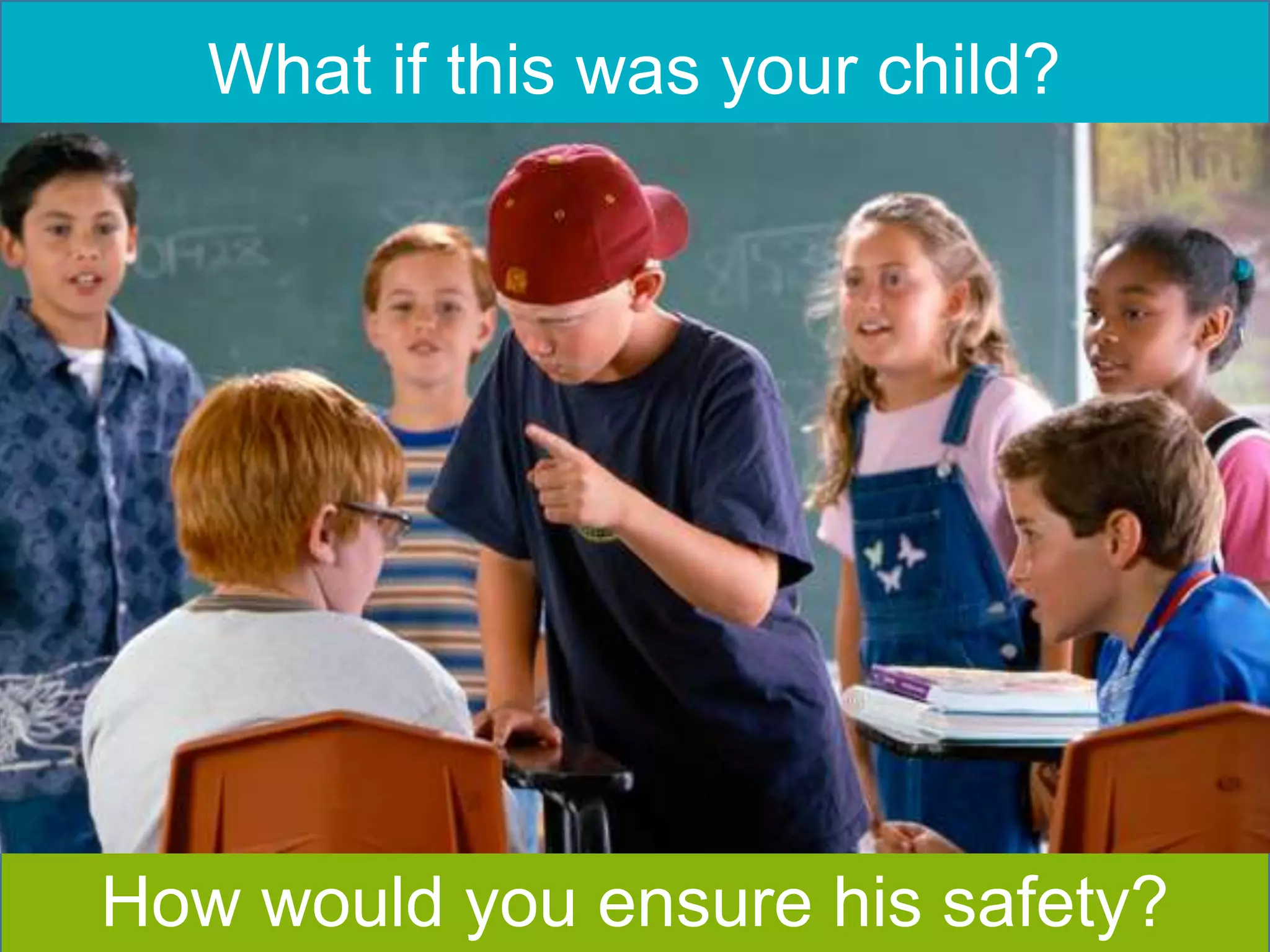
- The deck opens with an emotional hook on Slide 1, using a classroom confrontation image to ask, 'What if this was your child?'
- Slide 2 identifies three core market gaps: inadequate data capture, lack of focus on cyberbullying, and out-of-date legislation.
- The platform claims to collect data from over 30 different social media feeds, including Twitter, Reddit, and Instagram (Slide 3).
- Product screenshots on Slide 4 show a 'secure Bully Activity Monitoring dashboard' with real-time incident logs including names and timestamps.
- The executive team consists of two co-founders with backgrounds in technology strategy and eLearning, both emphasizing their status as fathers (Slide 5).
- Technical milestones on Slide 6 confirm that only demo versions of the 'CPS' and 'Tools for Schools' products have been completed.
- The deck contains no mention of a business model, pricing strategy, or revenue targets.
- There is no slide dedicated to market size (TAM/SAM/SOM) or competitive landscape analysis.
The Bully Tracker: A Mission-Driven Deck Lacking Business Fundamentals
The Bully Tracker pitch deck is a classic example of a 'mission-first' presentation. It spends a significant amount of its real estate establishing the moral and social urgency of the problem—bullying in schools and online—while neglecting the financial and operational data that professional investors require to make a decision. The deck, branded under the parent entity 'ThinkBIG,' presents a platform for data collection and incident management.
Slide 1: The Emotional Hook
The deck opens with a full-bleed image of a child being bullied in a classroom setting. The text asks, "What if this was your child? How would you ensure his safety?" This is a high-pathos opening designed to build immediate empathy. While effective for a non-profit pitch or a community presentation, for a venture capital deck, it risks being overly sentimental if not immediately followed by hard data regarding the scale of the problem.
Slide 2: The Problem Statement
Slide 2 attempts to categorize the 'Bullying awareness' gap. It lists three primary failures: "Inadequate data capture & processing," "Lack of focus on Cyber Bullying," and "Out-of-date Legislation." It also highlights that parents currently have "Limited Solutions and Control," citing traditional outlets like the P.T.A. and community organizations as insufficient. The slide uses generic clip art and logos (Twitter, Facebook, LinkedIn) to represent the digital landscape, which feels somewhat dated but clearly identifies the target pain points.
Slide 3: The Framework
The company introduces its solution through a three-step framework: Collect, Connect, and Protect. According to Slide 3, the system aims to collect data from "Website, Text messages, Voice, Email, Mobile Web, Mobile App" and "Social Media (over 30 different feeds)." The 'Connect' phase involves a secure portal for parents, researchers, and law enforcement. The 'Protect' phase promises case management and data analytics to identify trends. This is the most comprehensive look at the product's intended scope, though it raises significant questions about data privacy and the technical hurdles of scraping 30+ social feeds.
Slide 4: Product & Service Offerings
This slide provides the first look at the actual software. It showcases a "Personalized BullyTracker Page" for a specific school (Buckland Mills Elementary) and a "Bully Activity Monitoring dashboard." The dashboard screenshot includes columns for the source (Web), timestamp, incident description (e.g., "The big kids pushed my books out"), the name of the reported bully, and contact information. This slide is crucial because it proves the founders have moved beyond a concept and into a functional UI/UX, even if only in a demo capacity.
Slide 5: The Executive Team
The team slide features two co-founders: Tom Lash and David A. Ealy, Ed.D. Lash brings "20+ years technology and strategy" experience and "$100M+ P&L experience" from the Fortune 500 sector. Ealy is positioned as the domain expert in "eLearning and Education Technology" with prior exit experience. Interestingly, both founders include their status as fathers ( "Father of five" and "Father of three" ) as a core credential, reinforcing the mission-driven nature of the startup. The tagline at the bottom, "Two dads protecting kids with better technology," summarizes their brand identity.
Slide 6: Next Steps and Milestones
Slide 6 outlines the roadmap. Under 'Technical,' it notes that "Demo versions of CPS, Tools for Schools, and Custom Data Services" are completed. It also mentions exploring "Additional market verticals (non-bullying)," which suggests the founders recognize the core product might be a feature of a larger safety platform rather than a standalone business. The 'Marketing' and 'Organizational' sections are vague, mentioning "Multi-layered campaigns" and "Intellectual Property Protection" without providing specific dates or targets.
Slide 7: Contact Information
The final slide provides email addresses and placeholders for phone numbers. It uses the "ThinkBIG Education Technology" name, which appears to be the corporate entity behind TheBullyTracker.com. Like the rest of the deck, this slide is clean but lacks a final 'call to action' or a summary of the investment opportunity.
What Works in This Deck
Clear Problem Identification: The deck does an excellent job of explaining why current methods (PTAs and manual reporting) are failing in a digital-first world. · Product Visualization: Including screenshots of the dashboard (Slide 4) helps investors understand exactly what the 'Tools for Schools' look like in practice. · Founder-Market Fit: The combination of a technology executive and an EdTech specialist, both motivated by parenthood, creates a compelling narrative of why this team is building this specific product.
What Is Missing
Market Sizing (TAM): There is no mention of how many schools represent the target market or what the potential revenue opportunity is. · Business Model: The deck never explains how the company makes money. Is it a SaaS subscription for schools? A freemium model for parents? A data play for researchers? · Competition: The deck ignores existing school safety software and anonymous reporting apps, which are significant competitors in the EdTech space. · The Ask: A pitch deck is a fundraising tool, yet this document never states how much money is being raised or what the valuation expectations are. · Financial Projections: There are no charts showing projected growth, burn rate, or a path to profitability.
What a Founder Should Copy
The Three-Pillar Framework: The 'Collect, Connect, Protect' slide (Slide 3) is a great way to simplify a complex technical process into a digestible value proposition. · Direct Screenshots: Showing the actual reporting form and the administrator dashboard removes ambiguity about the product's functionality. · Leveraging Personal Motivation: If you are building a product based on personal experience (like being a parent), highlighting that can build trust with investors, provided it is backed up by professional credentials.
Final Analysis
The Bully Tracker deck is more of a 'Product Overview' than a 'Pitch Deck.' It succeeds in making the viewer care about the problem, but it fails to provide the evidence needed to treat it as a viable business. To be successful in a fundraising environment, the founders would need to add at least five more slides covering the market size, the competitive landscape, the revenue model, the go-to-market strategy, and the specific financial ask. As it stands, it is a well-intentioned demo for a tool that addresses a serious social issue, but it lacks the commercial rigor required for venture capital.
Frequently asked questions
- What is the primary product offered by The Bully Tracker?
- The primary product is a reporting and monitoring ecosystem. According to Slide 4, it includes a 'Personalized Bully Tracker Page' for schools where students or parents can report incidents via web, phone, or email. This data is then aggregated into a secure dashboard for school administrators to view and process reported bullying activity in real-time.
- How does the company plan to address cyberbullying?
- Slide 3 outlines a framework to 'Collect' data from over 30 social media feeds, specifically naming Twitter, Reddit, and Instagram. The goal is to connect parents and law enforcement to this data through real-time alerts. However, the deck does not explain the technical feasibility or privacy implications of monitoring these external platforms.
- Who are the founders and what is their experience?
- The team consists of Tom Lash and David A. Ealy, Ed.D. Slide 5 notes that Lash has 20+ years of technology strategy experience and managed a $100M+ P&L for a Fortune 500 company. Ealy is described as an eLearning and EdTech specialist with prior startup exit experience. Both founders highlight their roles as parents as part of their 'Executive Team' credentials.
- What stage is the company currently in?
- Based on Slide 6, the company is in the early prototype or seed stage. They have completed 'Demo versions' of their core products and are currently focusing on implementing user feedback. Their organizational goals include protecting intellectual property and rounding out an advisory board, suggesting they are not yet at full commercial scale.
- Is there a clear path to profitability shown in the deck?
- No. The deck is entirely focused on the social problem and the technical solution. It omits a business model slide, pricing information, and financial projections. Without these elements, it is impossible to determine how the company intends to generate revenue or achieve a return for investors.