theDOCWAY is an Udaipur-based startup positioning itself as a cost-effective alternative in the digital identity verification space. Their 11-slide deck (6 slides available for review) outlines a three-pronged service model: ID verification, identity verification via live selfie checks, and document verification (e.g., bank statements). The company claims support for government-issued IDs from 150+ countries and emphasizes a 50% price advantage over global competitors like Onfido and Jumio. While the deck highlights technical features such as machine learning and anti-fraud technology, it not…
Key takeaways
- The company offers three core services: ID Verification, Identity Verification, and Document Verification (Slide 2).
- theDOCWAY claims to verify government-issued ID cards across 150+ different countries (Slide 2).
- The product interface includes a mobile application capable of capturing and extracting data from Indian PAN cards (Slide 3).
- The technical stack is described as using 'Machine learning technology' and 'Anti-fraud technology' (Slide 4).
- The service is cross-platform, with stated availability for Android, iOS, and Desktop (Slide 4).
- A primary value proposition is pricing, which the company claims is 'Half from our competitor' (Slide 5).
- The deck identifies a lack of local competition in India, noting that the government's 'Addhar Card' E-KYC is restricted to government departments (Slide 5).
- Global competitors listed include ONFIDO, MITEK, JUMIO, and HOOYU (Slide 5).
Slide-by-Slide Analysis
Slide 1: Title and Contact Information
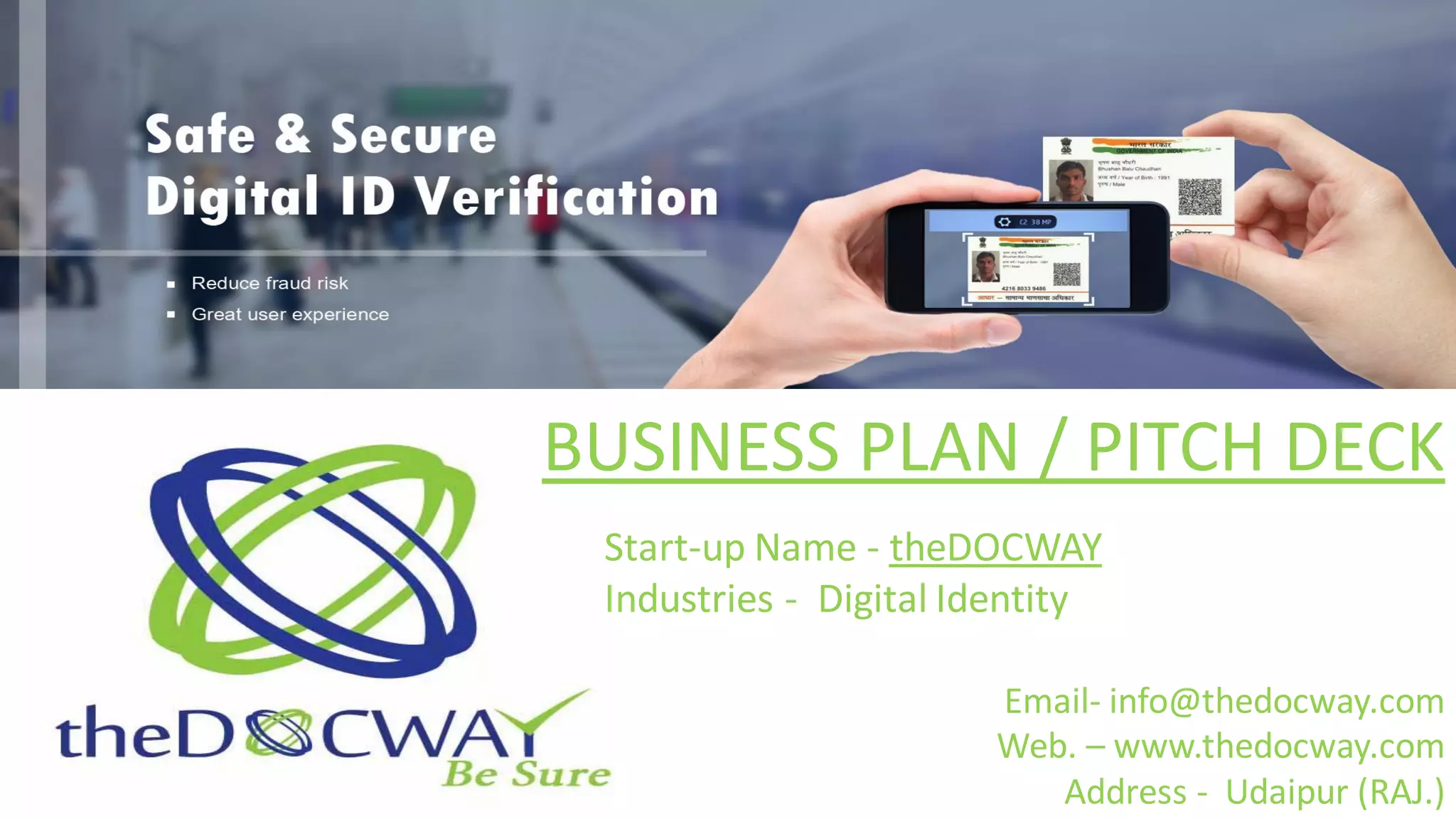
The opening slide introduces the company as theDOCWAY , operating in the Digital Identity industry. The tagline 'Be Sure' is positioned under the logo. The slide establishes the core value proposition: 'Safe & Secure Digital ID Verification' with two bullet points: 'Reduce fraud risk' and 'Great user experience.' The background image shows a person using a smartphone to scan an Indian Aadhaar card, immediately signaling the primary market and use case. Contact details include an email (info@thedocway.com), a website (www.thedocway.com), and a physical address in Udaipur (RAJ.) , India.
Slide 2: Services we Offer
This slide breaks down the product into three distinct service pillars. First is ID VERIFICATION , where the company claims to verify government-issued ID cards across 150+ different countries . Second is IDENTITY VERIFICATION , which involves verifying that the person is who they say they are via a 'live selfie check.' Third is DOCUMENT VERIFICATION , which extends beyond identity to include 'all types of documents like BANK STATEMENTS, UTILITY BILLS.' This suggests the platform is intended for comprehensive Know Your Customer (KYC) and Know Your Business (KYB) workflows.
Slide 3: Product Interface and OCR Capabilities
Slide 3 provides a visual walkthrough of the user journey through three mobile screenshots. The first screen, 'Select Id,' shows a dropdown menu for 'India' and 'National Id.' The second screen, 'Document Front Image,' shows a captured photo of a Permanent Account Number (PAN) Card for a sample user named 'RAV HARI SINGH.' The third screen, 'Document Details,' demonstrates the platform's OCR (Optical Character Recognition) capabilities, successfully extracting the Country (India), Document Type (Pan Card), Name (RAV HARI SINGH), Date of Birth (1991-10-15), Document number (EVMPS0355D), and Date of Issue (2013-04-10).
Slide 4: Technical Features and Accessibility
This slide uses a circular diagram to highlight operational and technical strengths. Key callouts include Machine learning technology and Anti-fraud technology . The company emphasizes availability, stating the service is 'Available for all platforms' (Android, iOS, and Desktop) and offers '247 available services' and '247 Monitoring.' It reiterates the global reach with 'Different Document type support from 150+ countries.' The use of standard icons for Android and Apple suggests a focus on mobile-first integration.
Slide 5: Competition and Market Positioning
The competition slide is the most text-heavy and strategically significant. It acknowledges that digital ID verification is a 'global level business' with strong competitors. The primary competitive advantage cited is that 'our pricing is Half from our competitor.' The text specifically addresses the Indian market, claiming, 'As per our research in India we can’t find competitors who work like our company.' It notes that while the Indian government has the 'Addhar Card' (Aadhaar) E-KYC solution, it is only available to government departments, leaving a gap for private sector solutions. A comparison table lists four global competitors: ONFIDO, MITEK, JUMIO, and HOOYU . Notably, the table claims that ONFIDO and HOOYU do not offer 'Doc. Verification,' while MITEK and JUMIO do.
Slide 6: Closing and Contact
The final slide is a simple closing page featuring the large company logo and updated contact information. It provides a sales-specific email (Sales@thedocway.com) and a mobile number (+918949119887). This slide reinforces the branding but does not offer new data or a call to action regarding investment.
What Works
Clear Service Definition: The deck does an excellent job of bucketizing its services. By separating ID verification, identity (liveness) verification, and document verification, the company clearly communicates that it handles the full spectrum of digital onboarding.
Localized Market Insight: The explanation of the Aadhaar card's limitations in India (Slide 5) is a strong point. It identifies a specific regulatory or access-based moat that justifies why a local player might succeed despite the presence of massive global incumbents like Jumio or Onfido.
Product Proof: Showing the OCR extraction of a PAN card (Slide 3) provides immediate evidence that the technology is tailored for the Indian market, which often requires specific handling of regional document formats that global providers might struggle with.
What is Missing
The Team: There is no mention of the founders, their technical background, or their experience in security or fintech. In early-stage fundraising, the team is often more important than the product, and its absence here is a significant red flag for investors.
Financials and Traction: The deck contains no information regarding current revenue, number of clients, or volume of verifications processed. Without traction metrics, it is impossible to validate the '50% cheaper' claim or the actual market demand for their specific solution.
The Ask: A pitch deck is a tool to raise capital, yet this deck fails to state how much money is being raised, the valuation, or the milestones the company intends to reach with the funding. It reads more like a sales presentation than an investment pitch.
Market Size: While the deck mentions 150+ countries, it fails to quantify the Total Addressable Market (TAM). Investors need to see the dollar value of the opportunity in both the Indian and global identity verification sectors.
Founder Takeaways
Focus on the Gap: theDOCWAY's strategy of identifying a 'government-only' restriction (Aadhaar) and positioning themselves as the private-sector alternative is a classic and effective way to frame a market entry. Founders should always look for these 'regulatory gaps' where global giants are locked out or slowed down.
Visualizing the 'Magic': Slide 3 is the strongest in the deck because it shows the software actually working. For any AI or OCR-based startup, showing the raw input (a blurry photo) and the structured output (clean text fields) is the best way to demonstrate technical competence without needing to show proprietary code.
Price as a Strategy: While 'half the price' is a compelling headline, founders should be careful. In security and identity, low price can sometimes be perceived as lower quality or lower reliability. A better approach would be to pair the price advantage with a 'localized accuracy' advantage to show that the product is both cheaper and better for the specific target region.
Frequently asked questions
- What specific documents can theDOCWAY verify?
- According to Slide 2, theDOCWAY verifies government-issued ID cards from over 150 countries. Additionally, they verify non-identity documents such as bank statements and utility bills. Slide 3 specifically demonstrates the extraction of details from an Indian PAN card, including name, date of birth, and document number.
- How does theDOCWAY differentiate itself from global competitors?
- The company relies on two main differentiators: price and local market focus. Slide 5 states their pricing is half that of global competitors. Furthermore, they claim that while global players exist, there are no direct competitors in India offering similar private-sector E-KYC solutions, as the government's Aadhaar system is restricted.
- What is the technical basis of the platform?
- Slide 4 highlights the use of machine learning technology and anti-fraud technology. The platform provides 24/7 monitoring and services. It is designed to be cross-platform, supporting Android, iOS, and Desktop environments to ensure broad accessibility for various business integration needs.
- What critical investor information is missing from this deck?
- The deck is missing several standard components required for a professional fundraise. There is no team slide detailing founder expertise, no financial slide showing current revenue or burn rate, no market size (TAM/SAM/SOM) analysis, and no 'Ask' slide specifying the amount of capital sought or its intended use.
- Does the company have a live product?
- Slide 3 shows screenshots of a mobile interface labeled 'Select Id', 'Document Front Image', and 'Document Details'. These images suggest a functional UI for mobile document capture and OCR (Optical Character Recognition), though the deck does not explicitly state the current number of active users or clients.