The Teladoc Primary360 deck is a masterclass in product-led positioning within a complex B2B2C healthcare environment. Rather than selling a utility app, Teladoc sells a 'unified, whole-person experience' that integrates virtual and physical care. The deck emphasizes the 'longitudinal relationship' over transactional visits, supported by data showing that 50% of participants use multiple services. By showcasing partnerships with Fortune 1000 employers like Dollar General and distributors like Aon, the deck proves market validation. However, it notably lacks a traditional 'Ask' slide or a deta…
Key takeaways
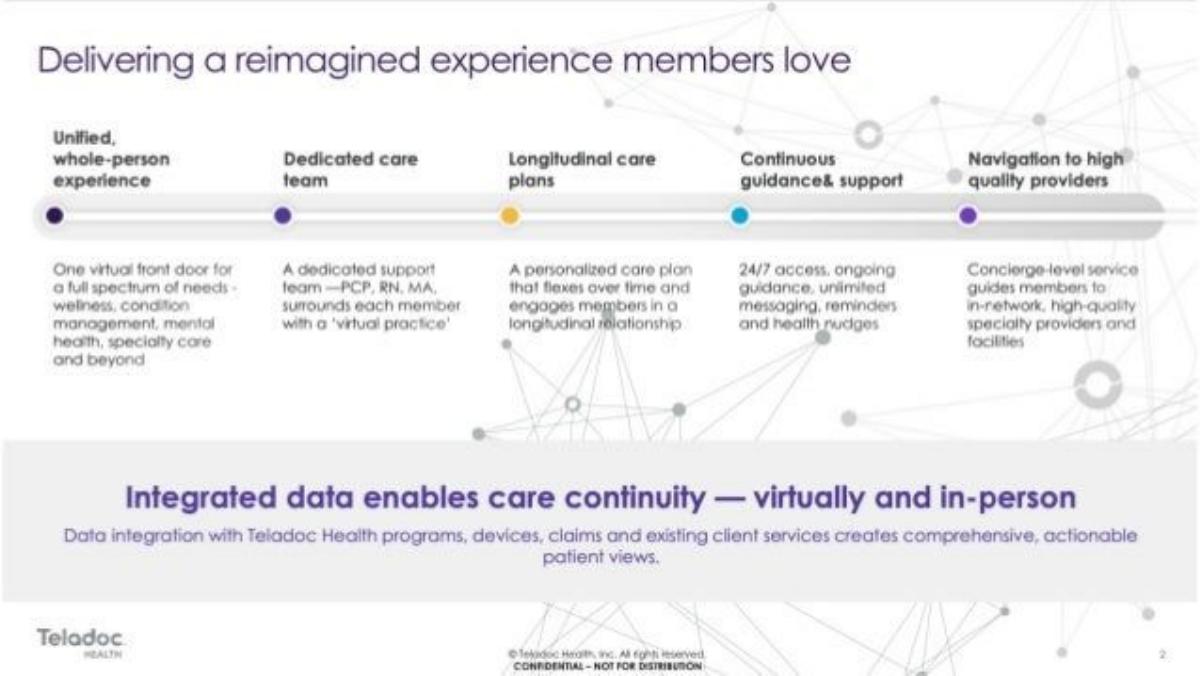
- The product is positioned as a 'virtual front door' for a full spectrum of needs including wellness, mental health, and specialty care (Slide 2).
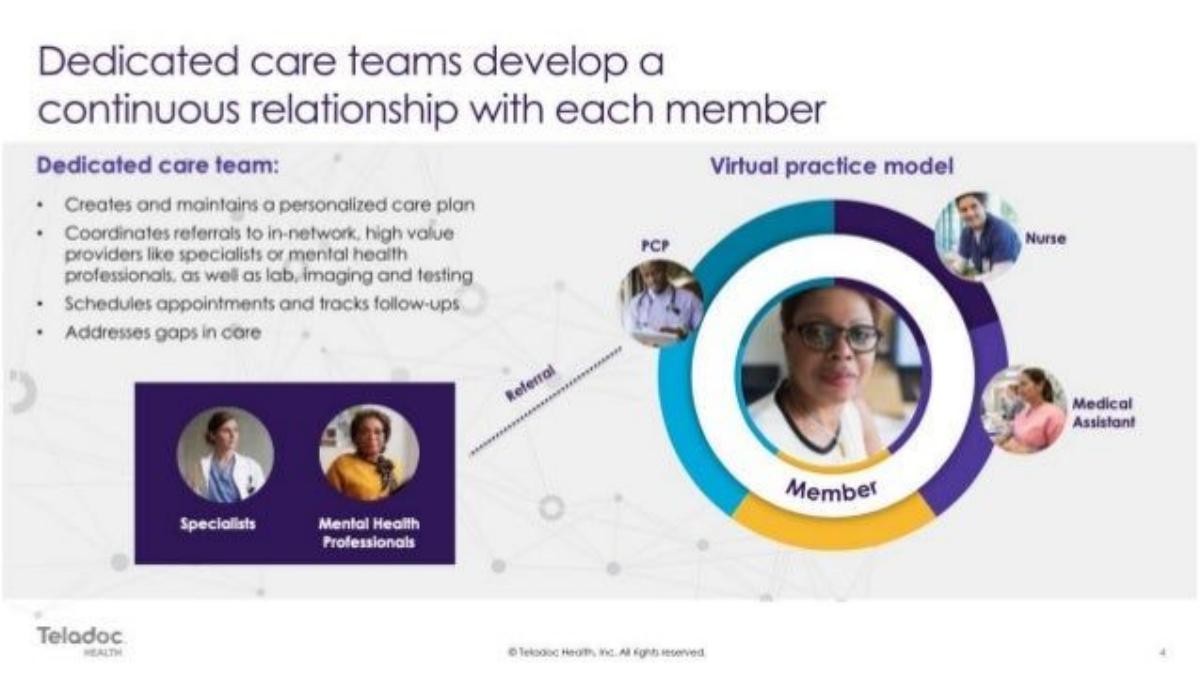
- Teladoc emphasizes a 'Dedicated care team' consisting of a PCP, RN, MA, and support staff to create a virtual practice model (Slide 4).
- Data integration is a core value prop, citing compatibility with industry-leading EMRs like Epic, Cerner, and Athena (Slide 7).
- The 'last mile' strategy includes at-home vitals monitoring, phlebotomy services, and prescription home delivery (Slide 8).
- Member impact is quantified by a 98% satisfaction rate and a new patient visit wait time of less than 7 days (Slide 9).
- The business model leverages a B2B2C approach, targeting self-insured employers, consultants, and the ACA exchange (Slide 10).
- The deck highlights that approximately 25% of members with Diabetes and Hypertension were newly diagnosed through the platform (Slide 9).
- Strategic partnerships are explicitly named, including CVS Health, Aetna, Aon, and Dollar General (Slide 10).
The Strategy of Integrated Care
The Teladoc Primary360 deck represents a shift in the telehealth narrative. In the early days of the sector, the pitch was about convenience and cost-savings for urgent care. This deck, dated 2022, moves the goalposts to whole-person care . It is less about a single video call and more about a comprehensive health ecosystem. The visual language is clean, professional, and focuses heavily on the 'human' element of the care team, despite the platform being a digital-first SaaS product.
Slide 1: Title and Branding
The cover slide introduces Primary360 , the specific product line being pitched. The imagery is intentional: a woman in a domestic setting using a laptop, accompanied by a pet. This reinforces the 'care from home' value proposition. The Teladoc Health logo is present but secondary to the product name, indicating this deck is likely a deep dive into a specific business unit or a new product launch within the larger corporate structure.
Slide 2: Reimagining the Member Experience
Slide 2 sets the stage for the 'Unified, whole-person experience.' It outlines five pillars: a virtual front door, a dedicated care team, longitudinal care plans, continuous guidance, and navigation to high-quality providers. The bottom of the slide emphasizes integrated data , claiming that data from devices, claims, and existing services creates 'comprehensive, actionable patient views.' This is a direct appeal to the 'SaaS' nature of the business—the value isn't just the doctor; it is the data layer connecting the doctor to the patient's history.
Slide 3: Powering Whole-Person Care
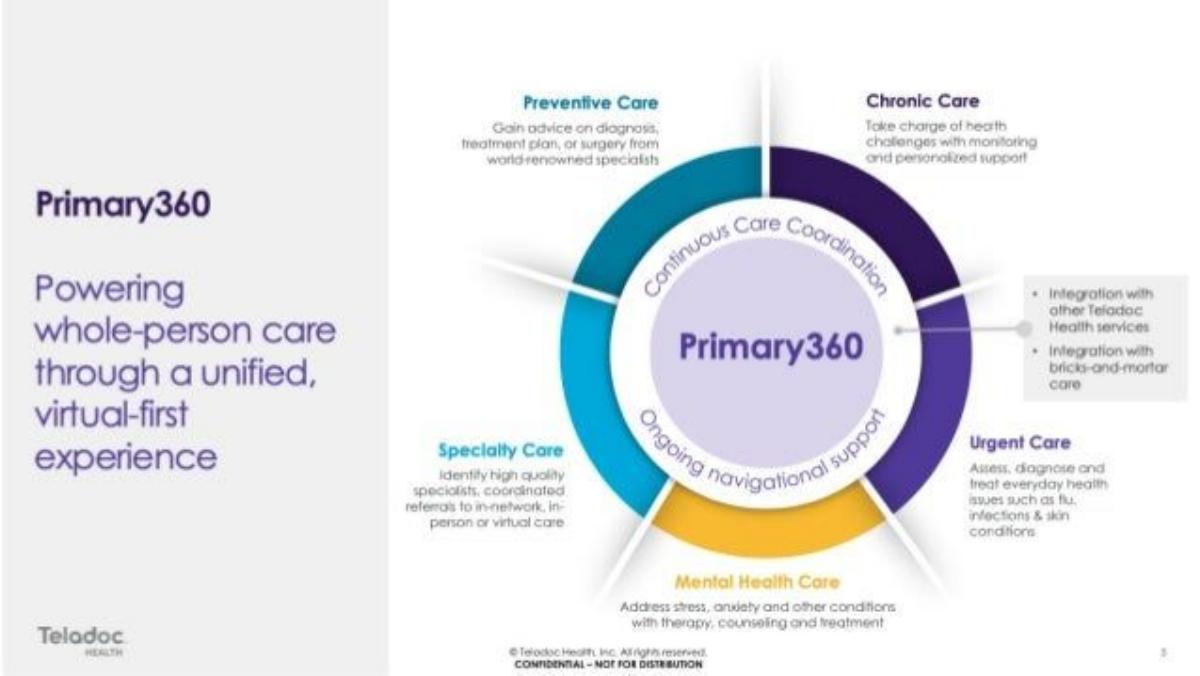
This slide uses a circular graphic to show how Primary360 sits at the center of five care types: Preventive Care, Chronic Care, Urgent Care, Mental Health Care, and Specialty Care. It explicitly mentions integration with bricks-and-mortar care . This is a crucial defensive move against the criticism that virtual care is fragmented; Teladoc is positioning itself as the 'connective tissue' between different modes of delivery.
Slide 4: The Virtual Practice Model
Slide 4 defines the 'Dedicated care team.' It lists specific roles: PCP (Primary Care Physician), RN (Registered Nurse), MA (Medical Assistant), and support staff. The slide notes that this team 'surrounds each member with a virtual practice.' By naming these specific roles, Teladoc moves away from the 'random doctor on call' perception and toward a traditional primary care office model, just delivered via software.
Slide 5: Personalized Care Plans
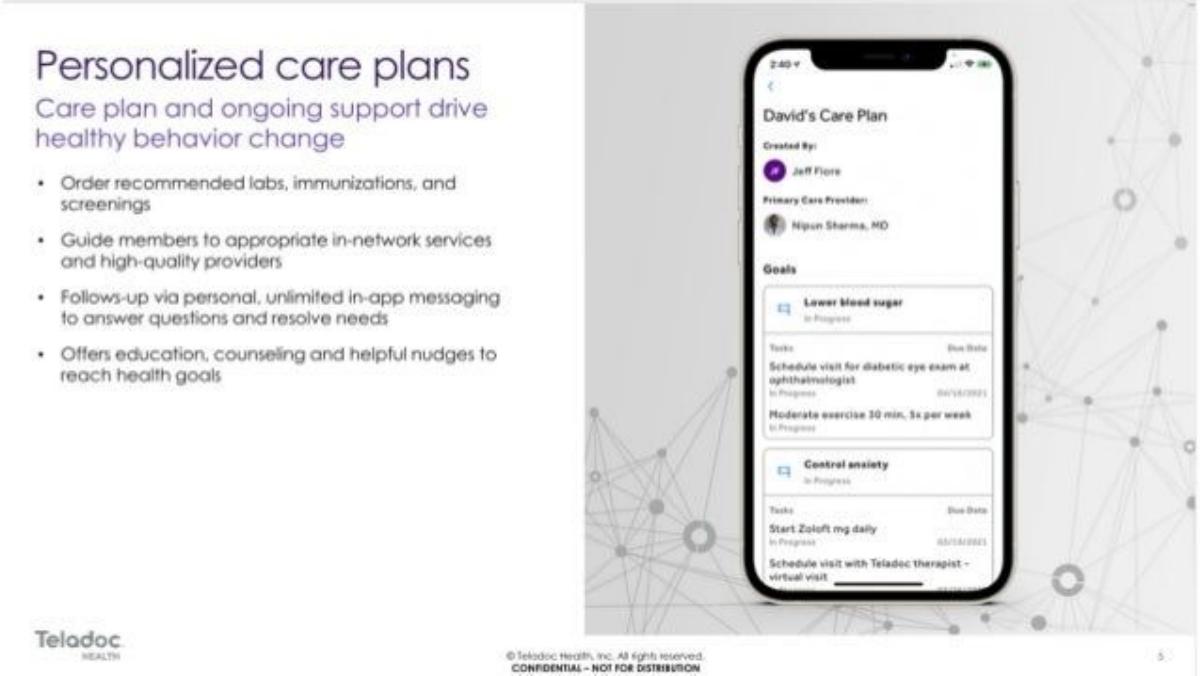
This slide focuses on the product interface. It shows a mobile UI ('David's Care Plan') with specific tasks like 'Lower blood sugar' and 'Control anxiety.' The text highlights that the platform can order labs and immunizations. This slide is meant to prove product utility —it shows that the software is an active participant in the patient's health journey, not just a video conferencing tool.
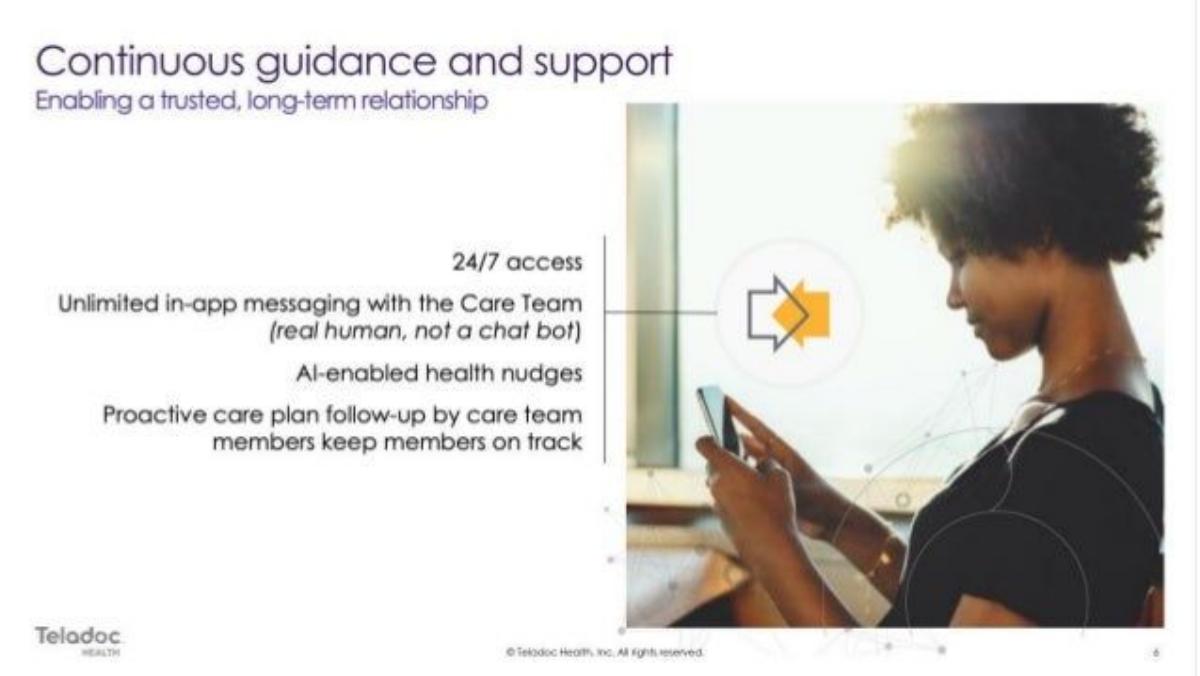
Slide 6: Continuous Guidance and Support
Slide 6 emphasizes the 24/7 nature of the service. Key features mentioned include 'Unlimited in-app messaging with the Care Team (real human, not a chat bot)' and 'AI-enabled health nudges.' This is a sophisticated blend of high-touch human service and high-scale AI automation. For an investor, this suggests a model that can scale efficiently without losing the 'human' touch that drives patient retention.
Slide 7: Navigation to Quality Care
One of the biggest challenges in healthcare is the 'referral leak.' Slide 7 explains how Teladoc solves this with a proprietary algorithm that ranks physicians by volume, years of service, and academic background. They also name-drop integration with 'industry-leading EMRs' like Epic, Cerner, and Athena . This establishes technical credibility and shows that Teladoc can play nicely with the existing healthcare infrastructure.
Slide 8: Last Mile Capabilities
Slide 8 addresses the physical limitations of telehealth. It lists 'Current & Future' capabilities: Vitals (blood pressure/heart rate monitoring), Labs (at-home kits), Prescriptions (home delivery), and Vaccinations (via retail clinics). This slide is essential for proving that a 'virtual-first' model can actually complete a 'care episode' without the patient needing to navigate the system alone.
Slide 9: Member Impact Metrics
This is the 'traction' slide. It provides six key data points:
<7 days for a new patient visit. · >50% of participants used multiple Teladoc services. · ~25% with Diabetes and Hypertension were newly diagnosed. · >10 care team interactions a year. · >50 minutes average length of new patient visit. · 98% member satisfaction.
These metrics are designed to counter the idea that virtual care is 'lite' care. The 50-minute visit length and the 25% new diagnosis rate are particularly strong indicators of clinical depth.
Slide 10: Market Impact and GTM
The final slide outlines the Go-To-Market (GTM) strategy across four channels: Self-Insured, Consultants, Employers, and Exchange. It features logos of major partners: CVS Health, Aetna, Trustmark, Aon, Dollar General, and Centene Corporation . This slide proves that the product has 'enterprise-grade' validation. Seeing a logo like Dollar General indicates that the solution is scalable to large, diverse workforces.
What Works in This Deck
The Teladoc deck excels at category definition . It doesn't just say 'we do telehealth'; it defines a new category called 'Primary360' which is a 'virtual-first primary care experience.' The use of specific clinical metrics on Slide 9 is also a major strength. In healthcare, 'satisfaction' is a vanity metric, but 'newly diagnosed chronic conditions' is a hard clinical outcome that insurers and employers value. Finally, the 'Last Mile' slide (Slide 8) proactively answers the most common objection to telehealth: 'What happens when I need a blood test?'
What Is Missing
As a fundraising document, this deck is incomplete. It lacks a Team Slide , which is usually the most important slide for early to mid-stage investors. There is no Financials slide showing revenue growth, CAC (Customer Acquisition Cost), or LTV (Lifetime Value). There is also no Competition slide, which is surprising given the crowded nature of the telehealth space (competitors like Amwell or One Medical are not mentioned). Most importantly, there is no Ask . We do not know how much capital is being raised or what the milestones for that capital would be. This suggests the deck was likely used for a strategic partnership or a specific product-led growth round rather than a standard VC pitch.
What Founders Should Copy
Founders should emulate the visual hierarchy of this deck. Each slide has a clear headline that states a benefit, followed by supporting bullet points and a high-quality visual. The 'Member Impact' slide (Slide 9) is a perfect template for showing traction: it uses icons and large-format numbers to make the data digestible. Additionally, the way Teladoc maps its product to the existing ecosystem (Slide 7 and Slide 10) is a great example of how to show 'market fit' without needing a complex narrative. They show who they integrate with (Epic/Cerner) and who they sell through (Aon/CVS), which immediately tells an investor where they sit in the value chain.
Frequently asked questions
- What is the primary business model described in the Teladoc deck?
- Based on the catalogue facts and Slide 10, Teladoc utilizes a B2B SaaS and partnership model. They monetize through subscription fees and consultation fees by partnering with health plan carriers (CVS, Aetna), benefit consultants (Aon), and large employers (Dollar General) to provide 'Virtual-First' benefit designs to employees and members.
- How does Teladoc differentiate itself from standard telehealth apps?
- Teladoc differentiates through 'longitudinal care plans' and a 'dedicated care team' (Slide 2). Unlike transactional apps, they offer a 'virtual practice model' where a member has a consistent relationship with a PCP, Nurse, and Medical Assistant, supported by AI-enabled health nudges and 24/7 messaging (Slides 4 and 6).
- What evidence of clinical impact does the deck provide?
- Slide 9 provides specific clinical metrics: over 50% of participants use multiple services, and roughly 25% of members with chronic conditions like Diabetes and Hypertension were newly diagnosed via the platform. They also note that new patient visits average over 50 minutes, suggesting depth of care over speed.
- How does Teladoc handle physical healthcare needs in a virtual model?
- Slide 8 outlines their 'Last Mile' capabilities. This includes at-home test kits, phlebotomy services, home delivery for prescriptions, and vaccinations via retail clinics. They also use a proprietary algorithm to navigate members to high-quality in-network physical facilities when in-person care is required (Slide 7).
- What is missing from this deck compared to a standard startup pitch?
- This deck lacks several standard venture components: there is no 'Team' slide featuring founder bios, no 'Competition' slide, no 'Financial Projections,' and no 'The Ask' slide. It is structured as a product-specific strategic deck for 'Primary360' rather than a company-wide investment pitch.