ReCheck’s teaser deck is a masterclass in brevity, though it leaves significant gaps in team and competitive landscape. The company positions itself as a bridge to blockchain technology, offering three distinct product tiers: SaaS, Hosted/Enterprise, and Pluggable Components. With a clear focus on data integrity and secure exchange, the deck cites a massive projected increase in global data creation—reaching 2,142 zettabytes by 2035—as its primary tailwind. Traction is demonstrated through a partnership with the Dutch Commercial Register and EY, alongside recognition from EUIPO and Computerwo…
Key takeaways
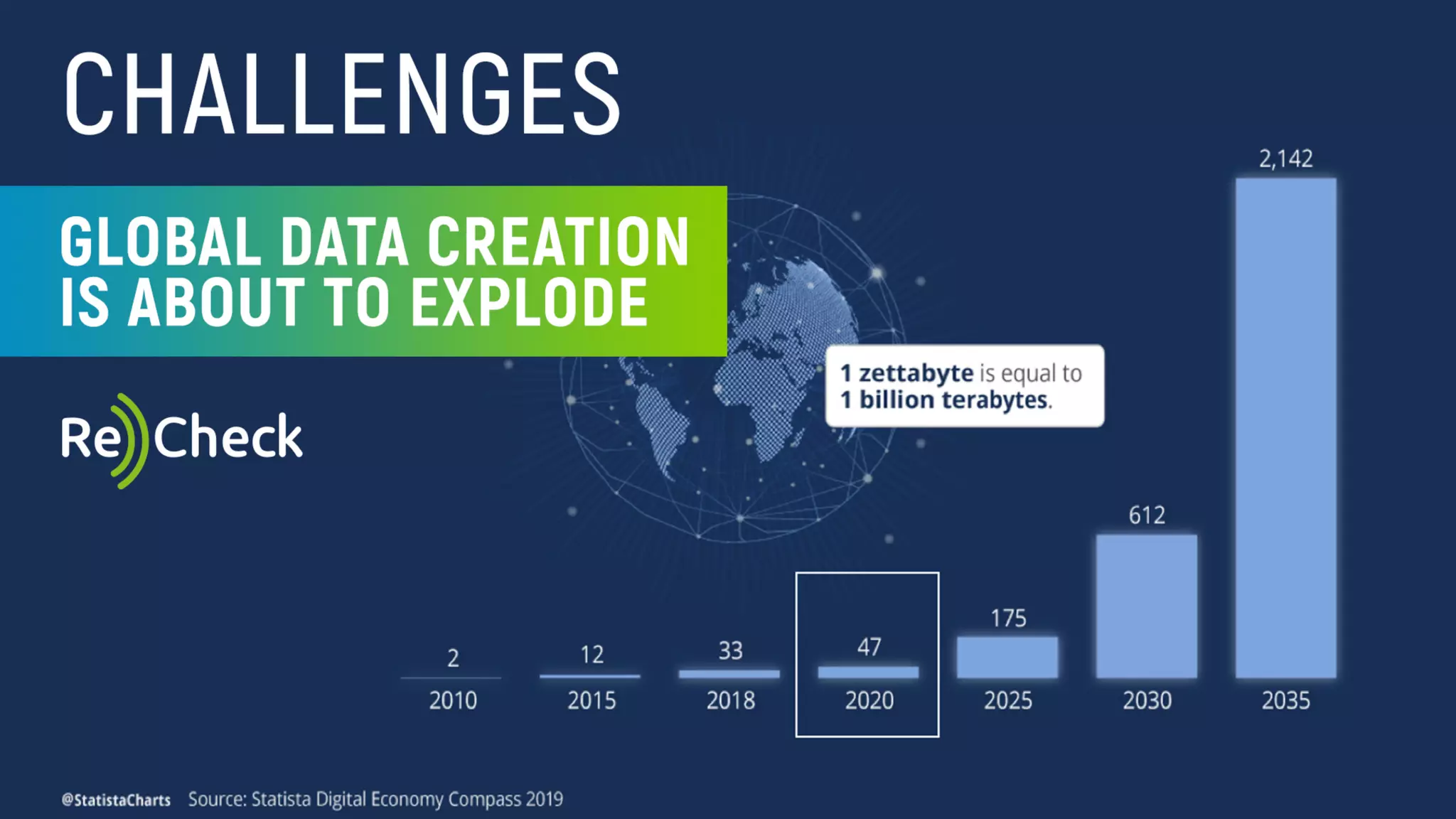
- The deck identifies a massive market expansion, citing Statista data that global data creation will grow from 33 zettabytes in 2018 to 2,142 zettabytes by 2035 (Slide 1).
- ReCheck defines its core value proposition as providing an interface to blockchain for secure sensitive data exchange and digital product documentation (Slide 2).
- The product strategy is split into three distinct delivery methods: SaaS, Hosted & Enterprise, and Pluggable Components for easy integration (Slide 3).
- The company has achieved notable recognition, including a 3rd place finish in the EUIPO and EC Blockathon 2018 and being named Most Innovative IT Project 2018 by Computerworld (Slide 4).
- Early traction is validated through co-creation pilots with high-profile entities like EY and the Dutch Commercial Register (Slide 5).
- The business model is highly granular, listing a SaaS price of 0.98 Euro per timestamped document or a 29 Euro monthly subscription (Slide 6).
- The investment ask is explicitly stated as 590,000 Euro in exchange for 11% equity (Slide 6).
- The deck completely omits a team slide, leaving the background and expertise of the founders to be inferred from the final contact slide (Slide 7).
Slide 1: Challenges and Market Context
The deck opens with a macro-trend slide titled "Challenges." Rather than focusing on a specific pain point like data breaches or high costs, ReCheck focuses on the sheer volume of data. Citing the Statista Digital Economy Compass 2019, the slide presents a bar chart showing global data creation. The figures start at 2 zettabytes in 2010, rising to 33 zettabytes in 2018. The projection then accelerates sharply: 47 zettabytes in 2020, 612 zettabytes in 2030, and a staggering 2,142 zettabytes by 2035. The slide includes a helpful callout box defining 1 zettabyte as equal to 1 billion terabytes. This sets the stage for a solution that must handle massive scale and ensure integrity across an 'exploding' data landscape.
Slide 2: Company Overview
Slide 2, titled "Company," provides a high-level summary of what ReCheck actually does. The headline is clear: "ReCheck provides interface to blockchain." It breaks its offering into three pillars: a solution for secure exchange of sensitive data, a platform to manage digital product documentation, and an API to hash (anchor) data on the blockchain. The use of icons (a lock, a magic wand, and an anchor) suggests a focus on security, ease of use, and technical stability. This slide successfully moves the conversation from the abstract 'data explosion' of the first slide to a specific technical utility.
Slide 3: Product Strategy
The "Products" slide categorizes the company's offerings into three distinct delivery models. First is the SaaS model, described as a way to "register documents on blockchain and share them securely." Second is the "Hosted & Enterprise Solutions," which focuses on "optimized paperless data flows" and "digital product documentation and identity." Third is the "Pluggable Component," designed for "easy integration of blockchain layer and features in existing or new systems." This indicates that ReCheck is not just a standalone app but a versatile infrastructure provider that can be embedded into other enterprise ecosystems.
Slide 4: Achievements & Recognition
This slide serves as the primary source of social proof for the company. It lists four major milestones: being ranked 3rd in Europe in the selection process for the EUIPO and EC Blockathon 2018; a partnership with Levski to protect sports merchandise authenticity; reaching the final stage pitch competition at TNW 2018; and being named the "Most Innovative IT Project 2018" by Computerworld and ICT Media. The inclusion of the EUIPO and Computerworld logos adds significant credibility, suggesting that the technology has been scrutinized by both government bodies and industry journalists.
Slide 5: Business Traction & Go-To-Market
Slide 5 provides more concrete details on how the product is being used in the real world. Under the "Hosted Solution" header, it identifies ReCheck as a "co-creation partner in pilots for Dutch Commercial Register and EY." This is a critical piece of information for investors, as EY and national registries have extremely high standards for data security and legal compliance. The slide also reiterates the "Pluggable Component" as a technology enabler for innovation networks and the SaaS model as a public service for timestamping. This slide bridges the gap between 'recognition' and 'actual usage.'
Slide 6: Business Model & Investment
This is the most data-dense slide in the deck. It explicitly states the investment ask: "Raising € 590k investment for 11% equity." Below this, it provides a transparent breakdown of pricing. SaaS is priced at €0.98 per document or €29 per month. The Hosted Solution involves an annual license fee of €9,400 plus €0.07 per transaction. The Pluggable Component model is particularly interesting, as it includes a €120/hour integration fee plus a 5% equity stake. This 'equity for integration' model suggests ReCheck aims to grow alongside the startups and projects that use its infrastructure.
Slide 7: Contact Information
The final slide is a standard "Thank You" page. It lists the CEO, Emiliyan Enev, and provides a direct email address (enev@recheck.io). While it serves its purpose as a call to action, it highlights the deck's biggest weakness: the lack of a dedicated team slide. Investors are left to research the CEO's background and the rest of the team independently.
What ReCheck Does Well
ReCheck excels at clarity of offering. In just seven slides, the reader understands exactly what the product is (a blockchain interface), how it is sold (SaaS, Hosted, or API), and what it costs. The inclusion of specific pilot partners like EY and the Dutch Commercial Register provides immediate enterprise-grade validation. Furthermore, the transparency regarding the investment ask and valuation is refreshing; it saves time for both the founder and the investor by setting clear expectations from the outset. The use of a macro-trend chart on Slide 1 also does a good job of framing the 'why now' without relying on overused blockchain hype.
What Is Missing from the Deck
The most significant omission is a Team slide. In early-stage fundraising, the 'who' is often as important as the 'what.' There is no mention of the technical architects, the sales leadership, or the previous successes of the founders. Additionally, the deck lacks a competitive landscape analysis. The blockchain infrastructure space was crowded in 2019, and failing to mention how ReCheck differs from competitors like Tierion or Factom is a missed opportunity. Finally, there is no 'Use of Funds' breakdown. While the ask is €590k, the deck does not explain if that money is for hiring developers, expanding sales to new regions, or further R&D.
What Other Founders Should Copy
Founders should emulate ReCheck's approach to the Business Model slide. Many decks are vague about pricing, using terms like 'contact for quote.' ReCheck’s willingness to list specific Euro amounts for transactions and monthly subscriptions demonstrates a high level of market readiness. The 'Pluggable Component' model, which includes an equity component, is also a clever way for an infrastructure company to capture upside in the ecosystems they help build. Finally, the use of third-party awards and pilot names (Slide 4 and 5) is a highly effective way to build trust quickly in a technical field where 'vaporware' is a common concern.
Frequently asked questions
- What is the primary problem ReCheck is solving?
- ReCheck addresses the explosion of global data creation and the subsequent need for secure exchange and integrity. According to Slide 1, data creation is expected to grow nearly 65x between 2018 and 2035. ReCheck provides a blockchain-based interface to ensure this data can be hashed, anchored, and exchanged securely without requiring deep blockchain expertise from the end user.
- How does ReCheck generate revenue?
- The company employs a multi-tiered revenue model detailed on Slide 6. For SaaS, they charge 0.98 Euro per document or 29 Euro per month. Hosted solutions carry a 9,400 Euro annual license fee plus 0.07 Euro per transaction. Their 'Pluggable Component' model is unique, charging 120 Euro per hour for integration services plus a 5% equity stake in the partner project.
- What evidence of market traction does the deck provide?
- Slide 5 highlights that ReCheck is a 'co-creation partner' in pilots for the Dutch Commercial Register and EY. Additionally, Slide 4 mentions a partnership with Levski to protect the authenticity of sports merchandise. These enterprise-level pilots suggest the technology has been vetted by sophisticated legal and financial institutions.
- What is the specific funding ask and valuation?
- ReCheck is seeking 590,000 Euro in exchange for 11% equity, as stated on Slide 6. This puts the pre-money valuation at roughly 4.77 million Euro and the post-money valuation at approximately 5.36 million Euro. This level of specificity is rare in teaser decks and indicates a firm stance on company worth.
- What are the most significant omissions in this pitch deck?
- The most glaring omission is the lack of a Team slide. While the CEO, Emiliyan Enev, is listed on the final slide, there is no information regarding the technical or commercial background of the founding team. The deck also lacks a competitor analysis, a detailed roadmap, and a breakdown of how the 590,000 Euro investment will be allocated.