Credibly addresses a significant financial inclusion gap in Jamaica, where 86% of the population lacks access to services like loans. The deck outlines a strategic pivot from a short-term consulting model—aimed at building a database of 190,000 farmers—to a scalable financial marketplace. By aggregating data from farmers, suppliers, exporters, and bankers, Credibly generates a proprietary credit score to de-risk lending. While the deck provides clear market sizing ($118.3M in Jamaica) and a structured two-phase revenue approach, it lacks a specific capital ask, detailed unit economics, and a…
Key takeaways
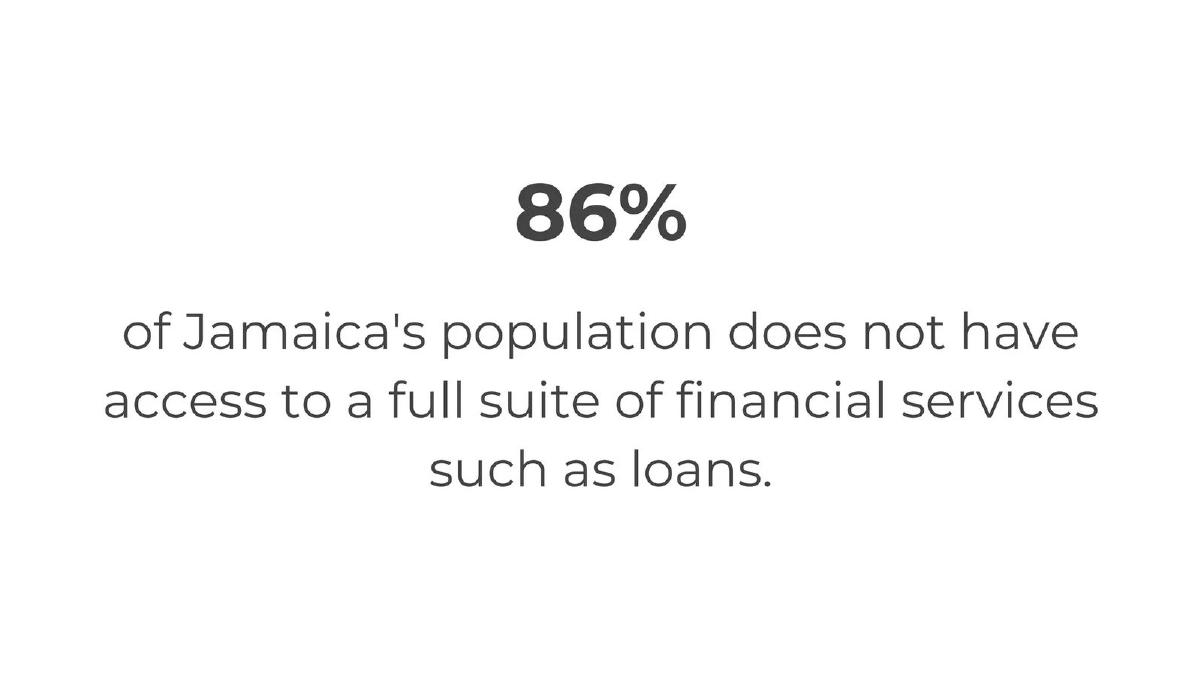
- The company identifies a massive local opportunity in Jamaica where 86% of the population is underserved by financial institutions (Slide 4).
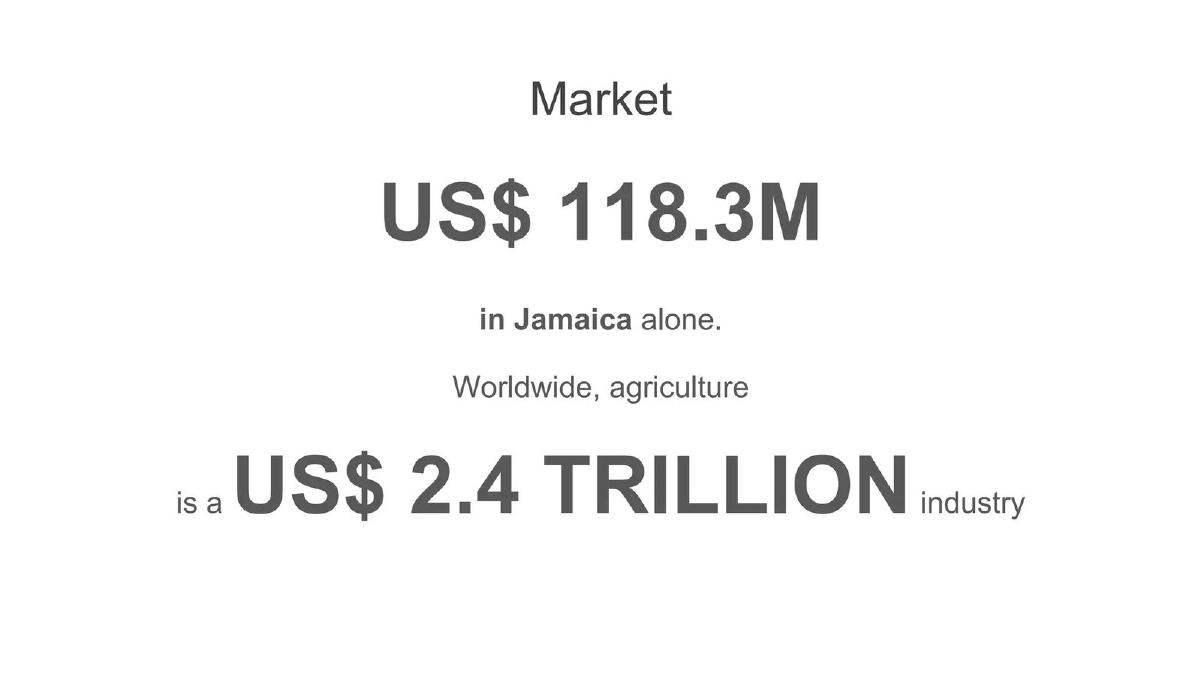
- Credibly values the Jamaican agricultural market at US$ 118.3M within a global US$ 2.4 Trillion industry (Slide 3).
- The business model is split into two phases: initial consulting to build partnerships and a subsequent marketplace to process 10,000 micro-loans monthly (Slide 7).
- A first consulting project is already underway to build verifiable profiles for 190,000 farmers across Jamaica (Slide 6).
- The solution utilizes a proprietary 'Credibly Score' derived from data points across the supply chain, including land acreage, crop types, and historical sales (Slide 12).
- The team consists of five members, including a Project Lead, Graphic Designer, Information Security Consultant, and two Software Developers (Slide 8).
- The deck omits a specific funding request, financial projections beyond a $10,000 consulting figure, and a formal exit strategy (Slide 9).
- UI mockups suggest a multi-sided platform serving farmers, creditors, and buyers with integrated tracking of reaping and packaging cycles (Slide 11).
Executive Summary
Credibly is a financial marketplace startup focused on the agricultural sector, specifically targeting the unbanked population in Jamaica. The deck presents a clear problem: a massive segment of the population (86%) is excluded from traditional financial services. Their solution is a data-driven platform that creates verifiable profiles for farmers, allowing creditors to de-risk lending through a proprietary scoring system. The deck follows a logical progression from problem to solution, though it functions more as a product introduction than a complete investment memorandum.
Slide 1: Title Slide
The title slide introduces the company name, Credibly, with the tagline "True Value." The logo incorporates a bar chart with a rising arrow, signaling growth and financial data. Varun Baker is identified as the CEO. The slide is clean and establishes the company as a "Financial Marketplace."
Slide 2: Mission Statement
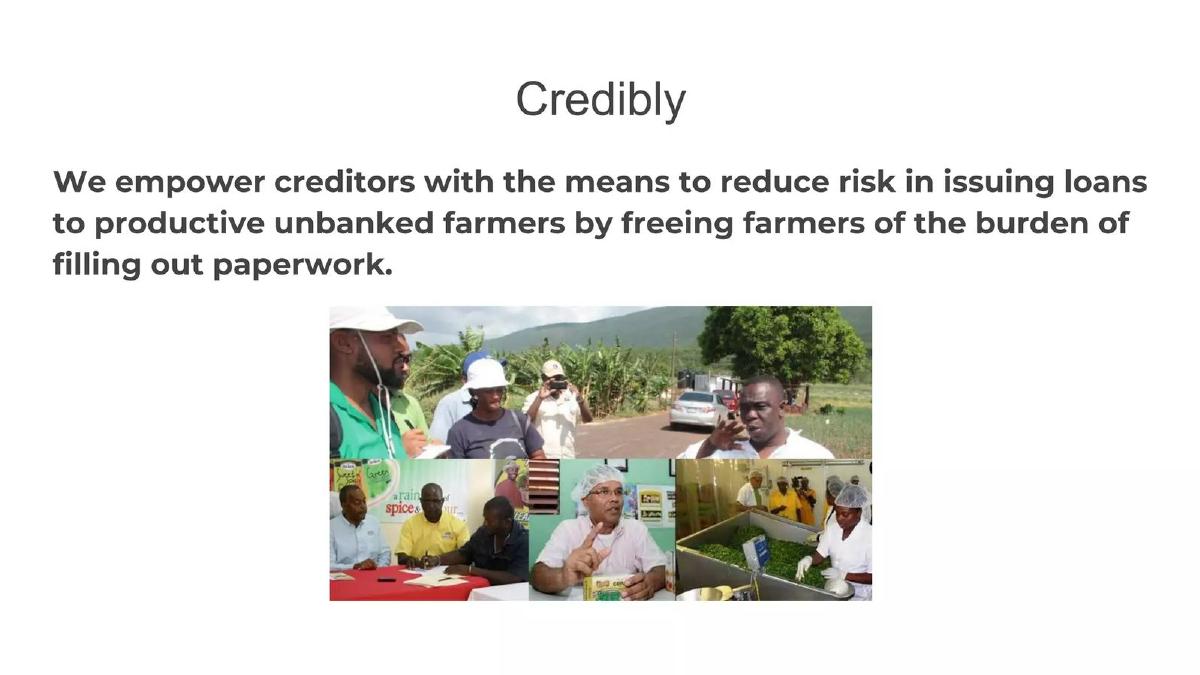
This slide defines the core value proposition: empowering creditors to reduce risk when issuing loans to unbanked farmers. It emphasizes a specific pain point—the "burden of filling out paperwork"—suggesting that Credibly acts as a digital intermediary that simplifies the onboarding process for both the borrower and the lender. The imagery shows farmers and agricultural processing, grounding the tech solution in a physical industry.
Slide 3: Market Size
Credibly provides two key figures here. First, a local market of US$ 118.3M in Jamaica. Second, a global agricultural industry figure of US$ 2.4 Trillion. While the global figure provides a sense of scale, the local figure is more relevant for their immediate go-to-market strategy. However, the slide does not specify if these figures represent the total addressable market (TAM) for loans, the value of agricultural output, or the service fee potential.
Slide 4: The Problem
This is a high-impact slide stating that 86% of Jamaica's population lacks access to a full suite of financial services. By framing the problem through the lens of financial exclusion, Credibly positions itself as an ESG-friendly (Environmental, Social, and Governance) investment that solves a systemic social issue while pursuing a commercial opportunity.
Slide 5: Our Solution & Structured Approach
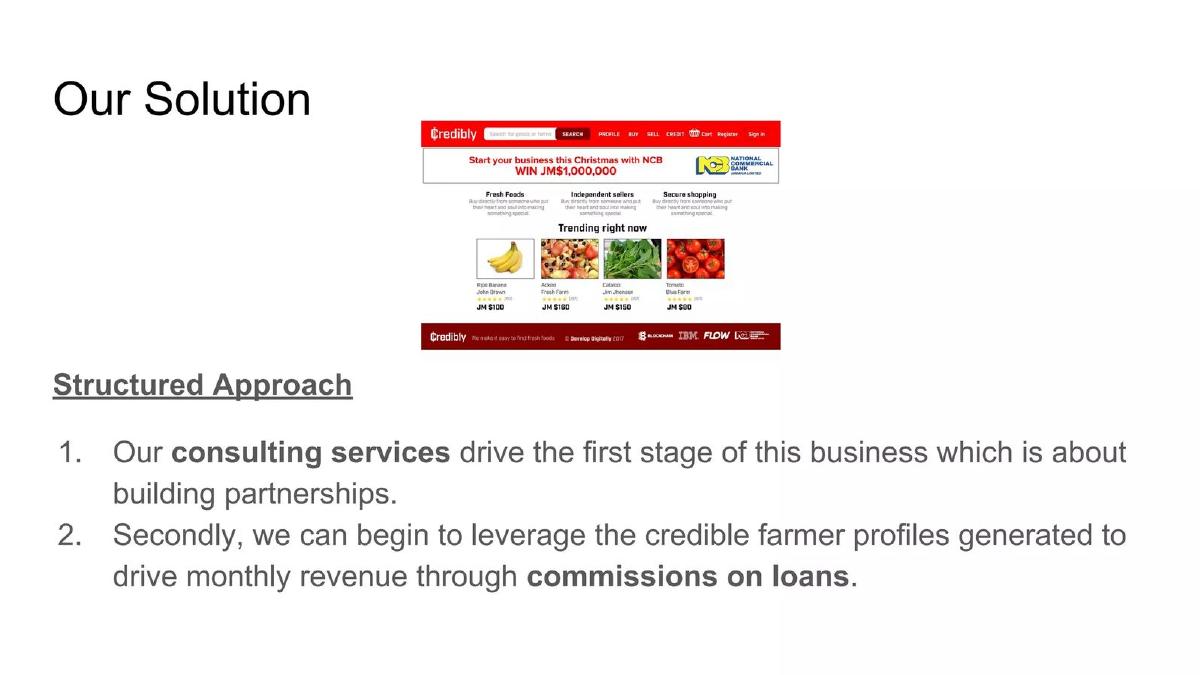
The solution is presented as a two-step business evolution. Step one is consulting to build partnerships. Step two is leveraging farmer profiles to earn commissions on loans. A screenshot of the marketplace UI is shown, featuring products like bananas, ackee, and calaloo, alongside a logo for the National Commercial Bank (NCB) of Jamaica, implying a potential or existing partnership.
Slide 6: Partnerships and Traction
This slide provides the most concrete evidence of progress. It mentions a "first consulting project underway" to build a database of 190,000 farmers. It also notes that the estimated value of purchases by agro-processors is US$ 91.7 million. This suggests that Credibly is not just looking at the farmers, but the entire value chain, including the buyers who provide the cash flow that makes farmers creditworthy.
Slide 7: The Model
The business model is presented in a simple table. The consulting phase is associated with a $10,000 revenue figure (labeled as "Consulting = $10,000"), which seems low for a venture-scale startup, possibly representing a single pilot project. The marketplace phase targets 10,000 micro-loans per month. The slide notes that the marketplace requires a "minimum viable ecosystem," acknowledging the chicken-and-egg challenge inherent in marketplaces.
Slide 8: The Team
The team consists of five individuals. The roles are heavily weighted toward technical execution: two software developers, one info-sec consultant, and one graphic designer. Varun Baker is listed as the Project Lead. The photo shows the team in a casual, hackathon-style setting, which conveys energy but lacks the professional biographies typically found in late-seed or Series A decks.
Slide 9: The Call to Action
Interestingly, this slide does not ask for money. Instead, it says "We're looking for Partners." It targets people interested in financial services, agricultural supply chains, and "keen business persons." This suggests the deck may be intended for business development or very early-stage networking rather than a formal pitch to institutional VCs.
Slide 10: Contact Information
A standard closing slide with the CEO's email and phone number. The email domain "developdigitally.com" suggests that Credibly may have spun out of a digital consultancy, which aligns with their "Phase 1: Consulting" strategy.
Slides 11-13: Product Deep Dive (Appendix)
The final three slides are detailed UI mockups. Slide 11 shows a farmer's dashboard (Fresh Fruits Ltd.) with a "Process/Cycle" tracker showing seeds, planting, reaping, and packaging. Slide 12 is the most critical technical slide, illustrating how the "Credibly Score" (shown as 216) is calculated by pulling data from farmers, suppliers, exporters, and bankers. Slide 13 shows a "Portfolio Value" of $673,500 for a specific farmer, Antoine Chung, detailing his assets (acres, machines) and records (sales, receipts, labor). These slides demonstrate that the team has thought deeply about the data points required to make an unbanked individual "credible" to a bank.
What Works Well
Clear Problem Identification: The 86% statistic on Slide 4 is a compelling hook that justifies the need for the product. · Phased Strategy: Acknowledging that a marketplace is hard to build and starting with consulting to gather data is a pragmatic way to handle the "cold start" problem. · Data Integration Logic: Slide 12 clearly explains how they will create a credit score where none existed before by using supply chain data. · Local Focus: By focusing on Jamaica first, they demonstrate a manageable and specific go-to-market strategy rather than making vague global claims.
What Is Missing
The Ask: There is no mention of how much money the company is raising, the valuation, or the use of proceeds. · Unit Economics: While they mention a goal of 10,000 loans, they don't explain the average loan size, the commission percentage, or the cost to acquire a farmer (CAC). · Competition: The deck does not mention other micro-lending platforms or how they differ from traditional credit unions in the region. · Milestones: There is no timeline showing when they expect to move from the $10,000 consulting phase to the 10,000-loan marketplace phase.
Founder Recommendations
Founders should emulate the visual clarity of the data flow seen on Slide 12. Explaining a complex algorithm or scoring system is often difficult; using a simple flowchart that shows inputs (Farmer, Supplier, etc.) leading to a single output (The Score) is highly effective. However, founders must ensure they include a specific financial ask . A pitch deck without a funding goal is a brochure, not a fundraising tool. Additionally, providing founder bios that highlight past successes or specific domain expertise in agriculture or finance would strengthen the Team slide significantly. Finally, if using a two-phase model, founders should provide a clear trigger for the transition (e.g., "Once we reach 50,000 farmer profiles, we launch the marketplace") to show investors exactly how the business scales.
Frequently asked questions
- What is the primary problem Credibly is solving?
- Credibly is addressing the lack of financial access for unbanked farmers in Jamaica. According to slide 4, 86% of the Jamaican population lacks access to a full suite of financial services. The company aims to reduce the risk for creditors by creating verifiable digital profiles for these farmers, removing the paperwork burden that often prevents them from securing loans.
- How does Credibly plan to generate revenue?
- The company employs a 'Structured Approach' outlined on slide 5 and 7. Phase one involves consulting services to build partnerships and a database, generating an initial $10,000. Phase two transitions to a marketplace model where revenue is driven by commissions on micro-loans, with a target of processing 10,000 loans per month.
- What data goes into the Credibly credit score?
- As shown on slide 12, the 'Credibly Score' is an aggregate of data from four key stakeholders: Farmers (land, crops), Suppliers (seeds, fertilizer), Exporters (amount, cost), and Bankers (existing credit history). This data is visualized in a dashboard to provide creditors with a holistic view of a farmer's productivity and risk level.
- Who is the team behind the project?
- The team is led by Varun Baker (Project Lead). He is supported by Antoine Chung (Graphic Designer & Creative Director), Jonathan Cooper (Information Security Consultant), and two software developers, Jordan Cooper and Phillip Llewellyn. The team appears to have a strong technical and design focus, though specific industry experience in fintech or agriculture isn't detailed.
- What is missing from this pitch deck?
- The deck is missing several critical fundraising elements. There is no 'Ask' slide detailing how much capital is being raised or how it will be spent. It also lacks a competitive analysis, detailed financial projections, unit economics (CAC/LTV), and a timeline for the transition from the consulting phase to the marketplace phase.