Credit Stacks (now known as Jasper) raised $4M in 2018 with a deck that prioritizes narrative and market efficiency over dense financial modeling. By identifying a $15B missed opportunity among high-earning immigrants who lack U.S. credit history, the company positioned its 'Lightning Credit Card' as a solution to a systemic banking failure. The deck's most compelling argument is its unit economics, claiming a reduction in customer acquisition cost (CAC) from hundreds of dollars to just $10 or less via B2B2C partnerships. While the deck lacks a formal 'Ask' slide or detailed revenue projectio…
Key takeaways
- The deck identifies a specific market of 3 million people in the U.S. with no access to credit on Slide 3.
- It quantifies the total addressable market as a $15B missed opportunity on Slide 4.
- The product offers a $5,000 unsecured credit line to users who are typically declined by traditional banks, as shown on Slide 6.
- Credit Stacks claims to have 100% completion on critical infrastructure including an issuing bank, processor, and Mastercard partnership on Slide 7.
- The core competitive advantage is a $10 acquisition cost achieved through B2B2C marketing channels, stated on Slide 8.
- The team slide (Slide 9) emphasizes 'Multiple Exits' and lists logos from PayPal, Chase, American Express, and the FDIC.
- The deck omits a specific funding request, use of funds, or detailed financial projections.
- The narrative uses a personal 'founder story' approach, starting with the CEO being declined for credit on Slide 2.
The Narrative-Driven Fintech Pitch
Credit Stacks (later rebranded to Jasper) provides a masterclass in using a lean, narrative-driven deck to secure early-stage capital. In 2018, the company raised $4M in Seed funding using just 10 slides. The deck does not rely on complex charts or data tables; instead, it focuses on a single, massive inefficiency in the American banking system: the inability to underwrite high-value immigrants. By combining a personal founder story with a highly efficient distribution strategy, Credit Stacks convinced VCs that they had found a backdoor into the lucrative prime credit market.
Slide 1: Title and Branding
The cover slide introduces the 'Lightning Credit Card' with the tagline 'Credit That Empowers.' The branding is minimalist, featuring a dark aesthetic and a blue lightning bolt logo. The inclusion of the CEO's email address directly on the front page signals accessibility and a direct line to leadership. The focus here is clearly on the product brand ('Lightning') rather than just the corporate entity ('Credit Stacks').
Slide 2: The Personal Hook
Slide 2 features a large black-and-white portrait of CEO Elnor Rozenrot with a red 'DECLINED' stamp across his face. The text describes him as a 'Successful entrepreneur, MBA, full of hope and dreams.' This slide serves two purposes: it establishes founder-market fit by showing the CEO has personally experienced the pain point, and it highlights the absurdity of the current system where a high-earning MBA is rejected for basic financial tools.
Slide 3: Quantifying the Pain
Moving from the personal to the systemic, Slide 3 uses high-contrast imagery to state that 3 million people have 'NO access to credit.' This slide defines the target audience size. It doesn't just say 'people'; it shows images of young, professional-looking individuals, reinforcing that this isn't a subprime play, but a 'prime-invisible' play.
Slide 4: The Market Opportunity
Slide 4 puts a dollar value on the problem: a '$15B Missed Opportunity.' By framing the lack of credit access as a loss for the banking industry rather than just a struggle for the consumer, Credit Stacks appeals to the profit motives of investors. The image of a credit card being swiped at a terminal connects the abstract number to daily transactional revenue.
Slide 5: The Philosophy
Slide 5 is a transition slide with the phrase 'ALWAYS FORWARDS NOT BACKWARDS.' It features a man in a suit running up stairs. While visually striking, this slide is light on information. It serves to set the tone for the solution—positioning Credit Stacks as a modern, progressive alternative to the 'backward-looking' FICO-based systems used by traditional banks.
Slide 6: The Product Solution
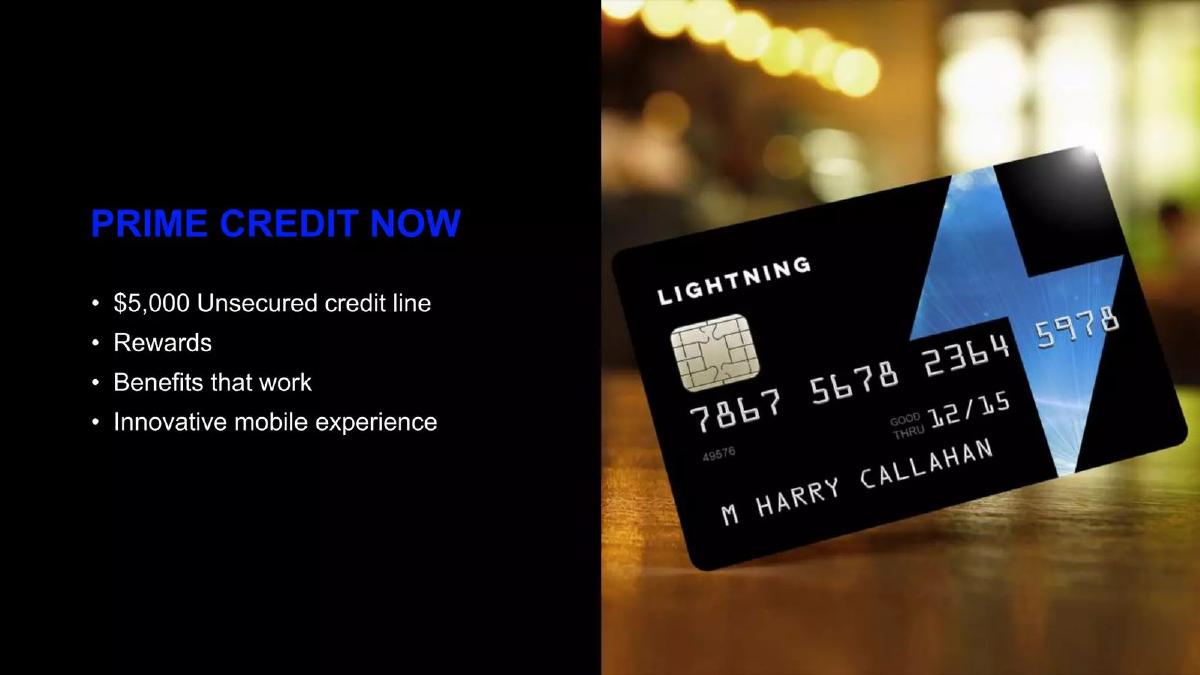
Slide 6 introduces the 'Prime Credit Now' offering. It lists four key features: a $5,000 unsecured credit line, rewards, 'benefits that work,' and an 'innovative mobile experience.' The visual shows a physical black card with the Lightning logo. The $5,000 limit is a specific, bold claim for a Seed-stage startup, suggesting they have a sophisticated underwriting model that doesn't rely on traditional scores.
Slide 7: De-risking the Infrastructure
For fintech startups, the biggest hurdle is often the 'plumbing.' Slide 7, 'We Overcame Barriers,' lists five critical components: Issuing bank, Credit line, Processor + servicer, Regulation, and Mastercard. Each is marked as '100%.' This is a crucial slide for investors because it proves the company isn't just an idea; they have already navigated the complex regulatory and partnership landscape required to actually issue a card.
Slide 8: The Economic Moat
Slide 8 is arguably the most important slide in the deck. It highlights a '$10 Acquisition Cost.' It explicitly states that by using B2B2C marketing channels, they reduce the cost from 'hundreds of dollars to $10 or less.' In the hyper-competitive credit card market, where companies like Chase and Amex spend massive amounts on direct mail and sign-up bonuses, a $10 CAC is a significant competitive advantage. This slide explains how they will win, not just what they will build.
Slide 9: The Team
The team slide features five individuals, emphasizing an 'Experienced team with multiple exits.' The logos at the bottom—PayPal, Chase, American Express, Wonga, LG, and the FDIC—provide immense credibility. Having a team that has worked both at major card issuers (Chase/Amex) and the regulatory body (FDIC) suggests they understand how to manage risk and compliance at scale.
Slide 10: The Call to Action
The final slide is a simple closing: 'Join us to help empowering people.' It includes the website and the CEO's email again. Notably, there is no 'Ask' slide in this deck. There is no mention of the $4M target or the valuation. This suggests the deck was used as a conversation starter to build interest, with the specific deal terms handled in follow-up meetings.
What Credit Stacks Does Well
The Credit Stacks deck excels at narrowing the focus . Instead of trying to solve credit for everyone, they focus on a high-value niche that traditional banks ignore. By quantifying the 'missed opportunity' at $15B, they make a niche market feel venture-scale. The deck is also highly visual, using minimal text to convey a strong narrative of 'modernizing' an archaic system. The '100% complete' checklist on Slide 7 is a brilliant way to handle the 'execution risk' objection before an investor even asks it.
What is Missing from the Deck
The most glaring omission is a Revenue Model . While they mention a $10 CAC, they don't explain how they make money (interchange fees, interest, annual fees, etc.). There is also no Competition Slide . Investors would naturally want to know how they compare to other 'new-to-country' credit providers like Petal or Deserve, which were active around the same time. Finally, the lack of a Use of Funds slide means the deck doesn't explain what the $4M will actually be used for—whether it's for hiring, marketing spend, or securing the credit facility.
Founder's Takeaway: The B2B2C Strategy
Founders should pay close attention to Slide 8. Many startups fail because their cost to acquire a customer is higher than the lifetime value of that customer. Credit Stacks solved this by identifying a 'gatekeeper' (employers of immigrants) who could provide them with a steady stream of customers for free or very low cost. If you can prove a 10x efficiency in customer acquisition compared to the industry standard, you don't need 50 slides of data to get an investor's attention; that one metric is often enough to carry the round.
Quantify the inefficiency: Don't just say a market is underserved; say exactly how much money the incumbents are leaving on the table ($15B). · Prove the plumbing: In regulated industries, show that you've already secured the necessary licenses and partnerships. · Leverage the 'Founder Story': Use your personal experience to prove you understand the customer better than a legacy corporation does. · Focus on CAC: A unique distribution channel is often more valuable to an investor than a unique product feature.
Frequently asked questions
- What is the primary problem Credit Stacks is solving?
- Credit Stacks addresses the 'credit invisible' problem for high-earning professionals moving to the U.S. Traditional banks rely on FICO scores, which new immigrants lack regardless of their income or international credit history. Slide 3 and 4 frame this as a $15B missed opportunity affecting 3 million people who are high-value customers but are currently locked out of the financial system.
- How does the company achieve such a low customer acquisition cost?
- According to Slide 8, Credit Stacks uses B2B2C marketing channels to reduce acquisition costs from 'hundreds of dollars' to '$10 or less.' By partnering with companies that hire international talent, they reach their target demographic at the point of relocation, bypassing the expensive open-market competition for credit card keywords and direct mail.
- What stage of development was the product in during this pitch?
- Slide 7, titled 'We Overcame Barriers,' indicates the company had already secured its foundational partnerships. They claim 100% completion for an issuing bank, credit line, processor/servicer, regulatory compliance, and a Mastercard partnership. This suggests the Seed round was intended for scaling rather than initial infrastructure building.
- Who is the target customer for the Lightning Credit Card?
- The deck targets 'successful entrepreneurs' and professionals, exemplified by the CEO's own story on Slide 2. These are individuals with high earning potential and MBAs who are 'full of hope and dreams' but face immediate rejection from U.S. banks due to a lack of domestic credit history.
- What is missing from the Credit Stacks pitch deck?
- The deck is notably missing a 'The Ask' slide detailing how much money they are raising and how it will be spent. It also lacks a competition slide, a detailed revenue model, and specific financial projections. It relies heavily on the strength of the team and the efficiency of the acquisition channel to carry the investment thesis.