This 18-slide deck serves as a partnership proposal and pilot program invitation for Criteo’s collaboration with OpenAI. Positioned in early 2026, the presentation argues that the traditional marketing funnel is being compressed by AI assistants, with 70% of AI-driven shopping traffic originating at ChatGPT. Criteo proposes a 'Conversational Advertising' model where ads are served directly within the LLM environment. The deck is notable for its specific technical constraints—such as a 50-product limit per campaign and a fixed $60 CPM—and its focus on data privacy, explicitly listing what is a…
Key takeaways
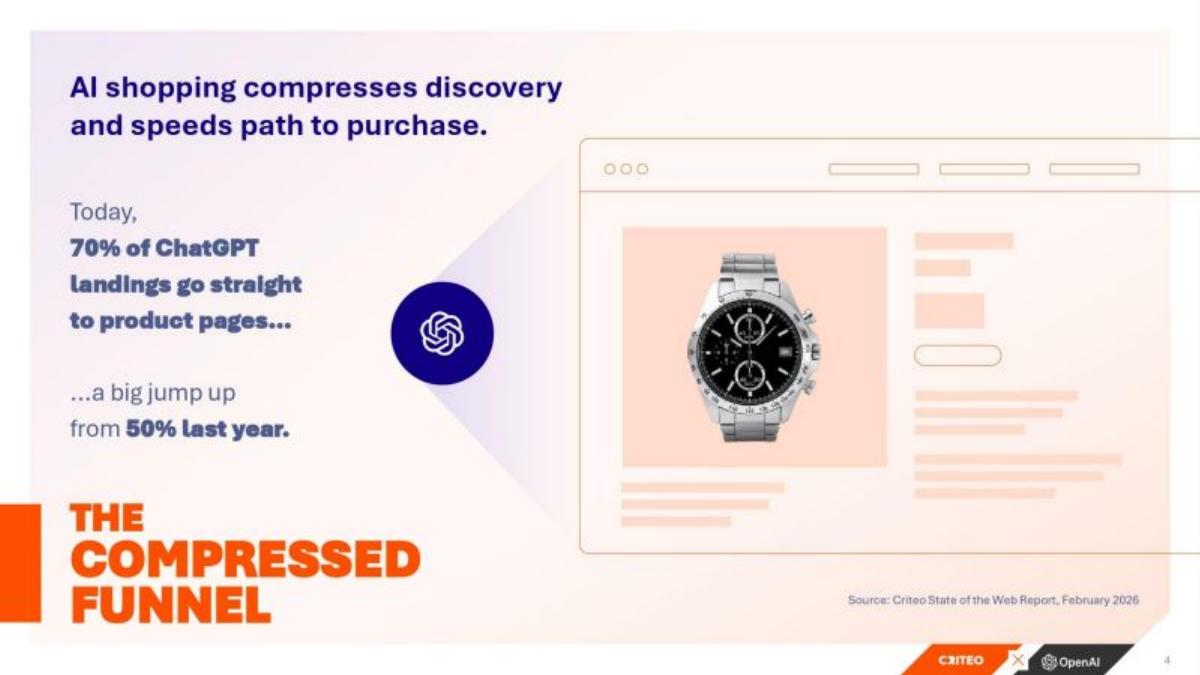
- Criteo identifies a 'Compressed Funnel' where 70% of ChatGPT landings go directly to product pages, up from 50% the previous year (Slide 4).
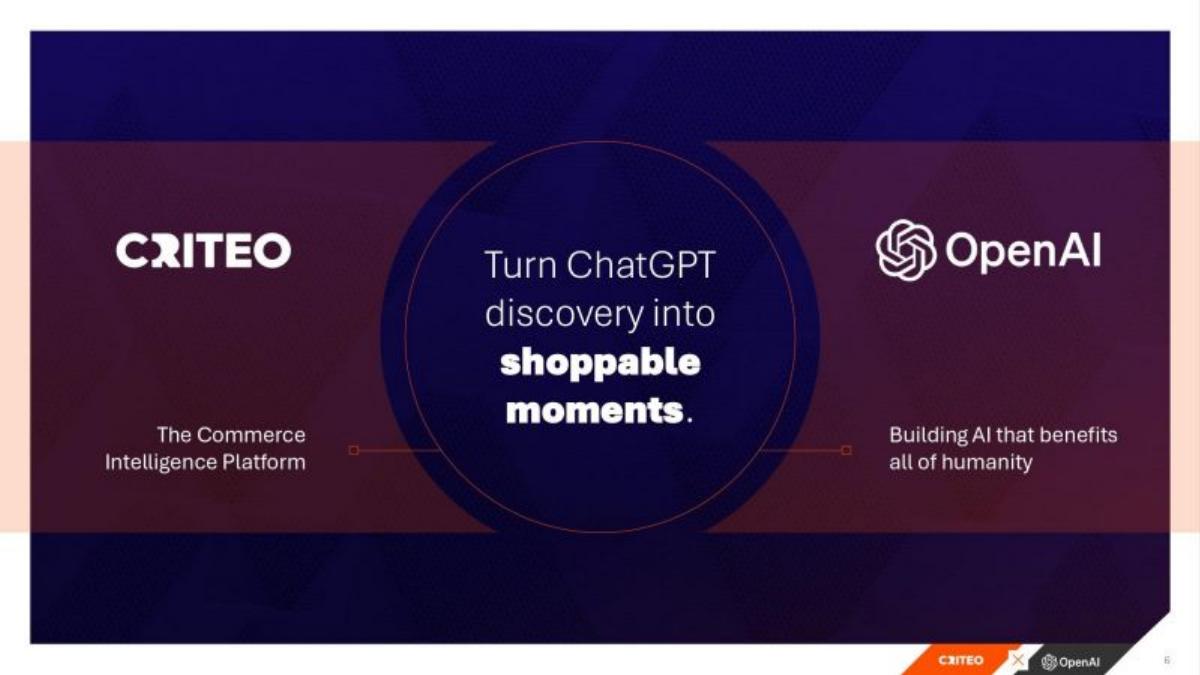
- The partnership leverages Criteo's 'Commerce Intelligence Platform' alongside OpenAI's LLM to turn discovery into shoppable moments (Slide 6).
- The pilot program offers a fixed $60 CPM standard for all campaigns within the OpenAI environment (Slide 10).
- Technical integration is designed for speed, allowing advertisers to go live in days using existing Criteo Performance Media setups (Slide 7).
- Data security is a primary focus, with a dedicated slide detailing that shopper identifiers like cookies and device IDs are not shared with OpenAI (Slide 15).
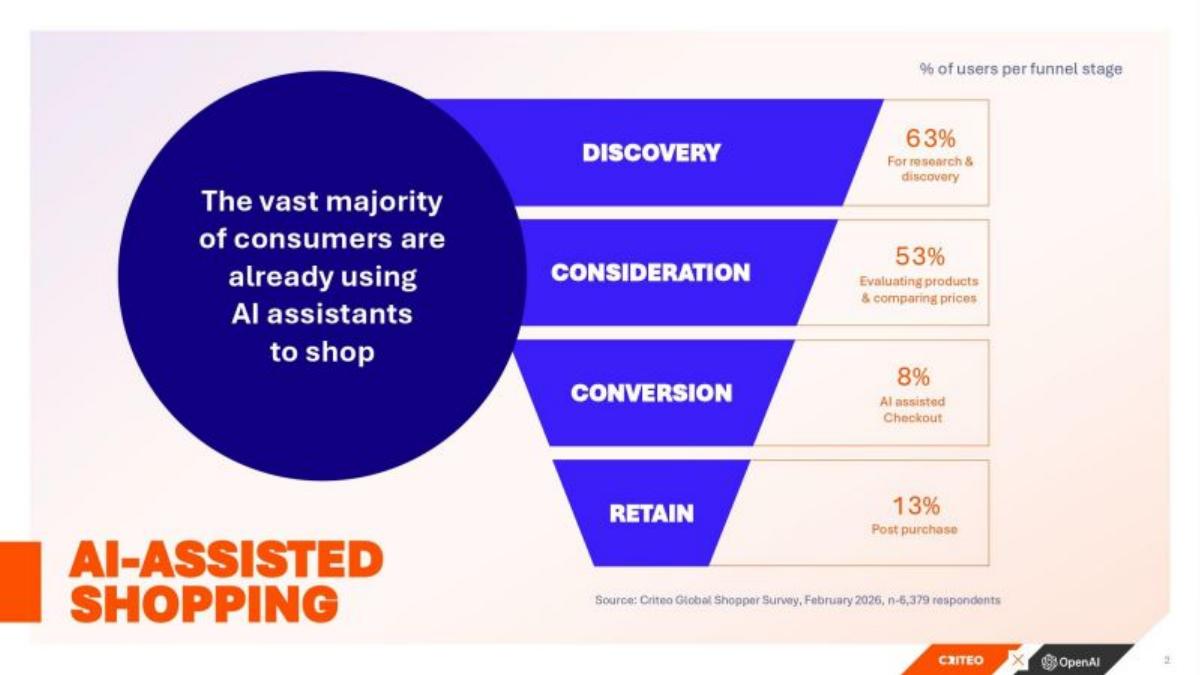
- Criteo's research indicates that 63% of users utilize AI assistants for the 'Discovery' phase of the shopping funnel (Slide 2).
- The 'How It Works' slide outlines a 6-step process from campaign data transfer to measurement return (Slide 10).
- The deck omits traditional fundraising elements like a team slide, financial projections, or a specific capital ask, functioning instead as a B2B sales/partnership deck.
The Shift to Conversational Commerce
The Criteo pitch deck for its 2026 partnership with OpenAI represents a significant pivot for a company traditionally known for retargeting and display ads. The narrative is built around the concept of "Conversational Advertising," a response to the changing habits of consumers who increasingly use AI assistants as their primary interface for the web. The deck is structured as a pilot program invitation, targeting existing Criteo clients to test a new frontier in retail media.
Slides 1-5: The Market Reality of AI Shopping
Slide 1 introduces the partnership with a bold headline: "Welcome to the Future of Conversational Advertising." The co-branding of Criteo and OpenAI is prominent, signaling a high-level strategic alignment. The imagery of stacked credit cards suggests a focus on bottom-of-the-funnel conversion.
Slide 2 provides the quantitative foundation for the pitch. Using a "Criteo Global Shopper Survey" from February 2026 (n=6,379), it breaks down AI usage by funnel stage. It claims 63% of users use AI for discovery and 53% for consideration. Interestingly, conversion (8%) and retention (13%) remain low, highlighting that the current strength of AI lies in the top and middle of the funnel.
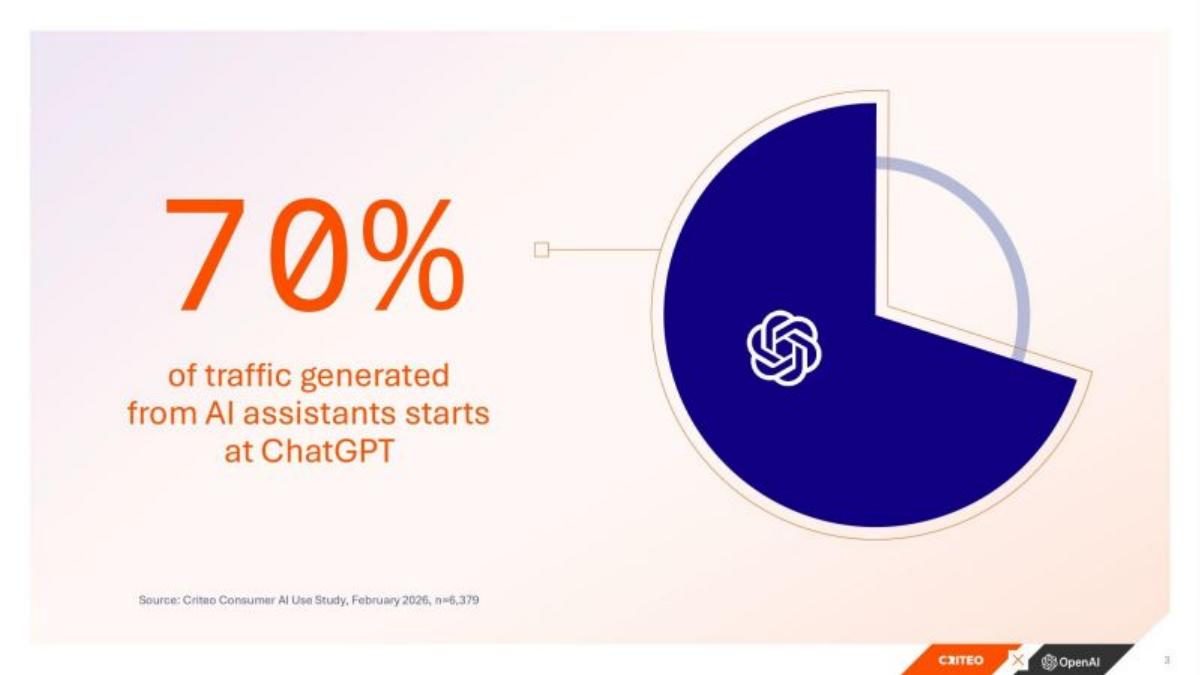
Slide 3 focuses on the dominance of ChatGPT, stating that "70% of traffic generated from AI assistants starts at ChatGPT." This justifies why Criteo has chosen OpenAI as its primary partner for this initiative. The visual is a simple, high-impact pie chart.
Slide 4 introduces the "Compressed Funnel." This is a key strategic insight: AI shopping isn't just a new channel; it's a faster one. The slide notes that 70% of ChatGPT landings go straight to product pages, a 20% increase from the 50% recorded the previous year. This suggests that the "messy middle" of the consumer journey is being bypassed.
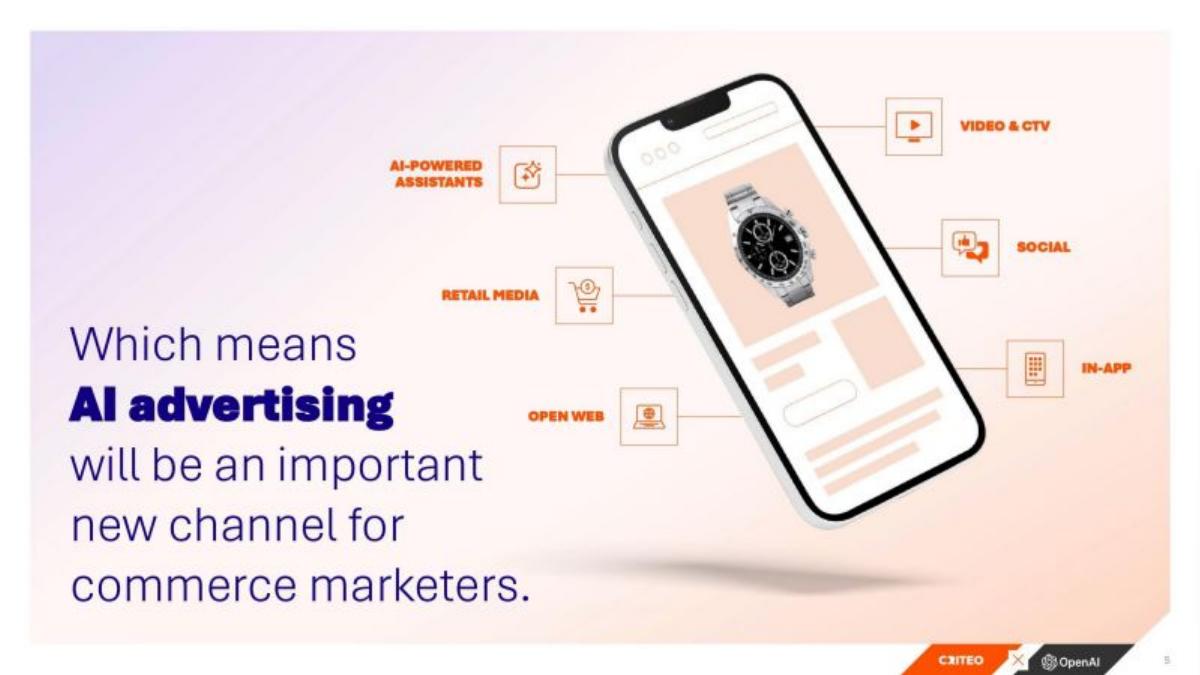
Slide 5 positions AI advertising as a mandatory new channel for commerce marketers, placing it alongside established channels like Retail Media, Social, and CTV. This slide attempts to create a sense of urgency for marketers to diversify their spend.
Slides 6-9: The Solution and Pilot Program
Slide 6 defines the mission: "Turn ChatGPT discovery into shoppable moments." It contrasts Criteo's identity as "The Commerce Intelligence Platform" with OpenAI's mission of "Building AI that benefits all of humanity." This framing suggests that Criteo provides the commercial engine for OpenAI's general-purpose intelligence.
Slide 7 is the call to action: "Join the Pilot." It promises three benefits: going live in days without new contracts, gaining early insight into marketing numbers, and influencing the product roadmap as a design partner. This is a classic "early adopter" pitch designed to lower the barrier to entry.
Slide 8 outlines the roadmap. "Today," Criteo is testing integration health and operational success. "Tomorrow," it plans to optimize ChatGPT ads alongside display, video, and social within a single campaign using their commerce data set. This indicates that the long-term goal is full integration into the Criteo ecosystem rather than a standalone product.
Slide 9 acts as a transition, posing the question: "Hey ChatGPT, what will Criteo ads look like?" It uses the familiar ChatGPT interface to prepare the viewer for the technical breakdown.
Slides 10-12: Technical Execution and Measurement
Slide 10 is the most information-dense slide in the deck, titled "How It Works." It details a six-step process: 1. OpenAI supply is added to a Criteo campaign (with a $60 CPM standard); 2. Criteo sends campaign and product metadata; 3. The user enters a shopping query; 4. OpenAI selects the product based on query language and context; 5. The ad is returned alongside organic results; 6. Measurement (impressions and clicks) is returned to the advertiser. This slide is crucial for media buyers who need to understand the mechanics of the buy.
Slide 11 emphasizes ease of setup. It requires only branding (favicon and name), an updated product feed, and a "OneTag Health Check" to track referrals. This reinforces the "Go live in days" promise from Slide 7.
Slide 12 , titled "Learning Vision," explains what the pilot aims to discover. It focuses on consumer interaction with LLM ads, the performance of paid vs. organic LLM traffic, and how these ads compare to other paid channels. This transparency about the experimental nature of the program helps manage expectations.
Slides 13-18: Appendix and Data Privacy
Slide 13 and 14 are standard "Thank You" and "Appendix" dividers. The inclusion of an appendix suggests that the preceding slides were intended for a high-level presentation, while the following slides provide the "fine print."
Slide 15 is a critical "Data Security" slide. It explicitly lists what is sent to OpenAI (Campaign Name, Description, Budget, $60 Bid Price, Product Metadata) and what is not sent (Product Catalog access, On-Site activity like sales/returns, Shopper identifiers like cookies/device IDs, and Custom Audience data). In an era of heightened privacy concerns, this slide is essential for securing legal and IT approval from enterprise clients.
Slide 16 provides additional research on consumer motivation. "Better Deals & Price Comparator" leads at 28%, followed by "Personalized recommendations" at 12%. This data helps marketers understand what kind of ad copy or product offers might perform best in a conversational context.
Slide 17 and 18 are closing visuals, with Slide 17 showing a blank ChatGPT prompt and Slide 18 being a promotional slide for the source of the deck, bestpitchdeck.com.
What Criteo Does Well
The deck excels at identifying a specific, timely problem: the migration of search and discovery to LLMs. By using the "Compressed Funnel" as a central theme, Criteo makes a compelling case that traditional SEO and SEM strategies are no longer sufficient. The use of specific, dated research (February 2026) gives the presentation an air of authority and current relevance. Furthermore, the technical breakdown on Slide 10 is exceptionally clear, removing the "black box" mystery that often surrounds AI products.
What is Missing
As a partnership and sales deck, it lacks several elements that an investor would require. There is no mention of the revenue-sharing agreement between Criteo and OpenAI. It is unclear if the $60 CPM is entirely passed through to OpenAI or if Criteo takes a margin. There is also no "Team" slide, which is standard in fundraising decks, though less necessary for an established public company like Criteo. Most importantly, there is no data on the effectiveness of these ads yet—the deck is entirely focused on the potential and the process of the pilot.
What Founders Should Copy
Founders should emulate the way Criteo handles the "How It Works" section. Many AI startups struggle to explain their technical integration without becoming overly jargon-heavy; Criteo uses a simple linear flow with clear icons. Additionally, the "What We Don't Send" section on Slide 15 is a masterclass in proactive objection handling. By addressing data privacy head-on with a clear list of exclusions, they likely shorten the sales cycle significantly. Finally, the use of a "Pilot Program" framework is an excellent way for early-stage companies to gather data while charging for a product that is still in development.
Frequently asked questions
- What is the primary value proposition of the Criteo-OpenAI partnership?
- The partnership aims to capture high-intent shoppers within the ChatGPT environment. Criteo argues that AI assistants are now the primary starting point for 70% of AI-generated shopping traffic. By placing ads directly in these conversations, Criteo helps brands reach consumers during the 'Discovery' and 'Consideration' phases, which account for 63% and 53% of AI shopping use cases, respectively.
- How does the pricing model work for this new advertising channel?
- According to Slide 10, the pilot program uses a fixed $60 CPM (Cost Per Mille) standard for all campaigns. This simplified pricing is intended to encourage early adoption and testing within the OpenAI environment, moving away from more complex bidding structures found in traditional display advertising during the initial phase.
- What are the technical limitations for advertisers in this pilot?
- Advertisers are limited to including up to 50 products per campaign, as noted on Slides 10 and 15. These products are typically the 'top 50' as classified by Criteo's OneTag based on sales rate. Additionally, the ad format is restricted to product details including an image and descriptive text that appear alongside organic LLM results.
- How does Criteo handle data privacy between its platform and OpenAI?
- Criteo maintains a strict data silo. Slide 15 specifies that while campaign names and product metadata are sent to OpenAI, sensitive information stays at Criteo. This includes the full product catalog, on-site activity (clicks, sales, add-to-cart), and shopper identifiers like cookies, hashed emails, and device IDs.
- What is the 'Compressed Funnel' mentioned in the deck?
- The 'Compressed Funnel' refers to the trend where AI shopping speeds up the path to purchase. Slide 4 claims that 70% of ChatGPT landings now go straight to product pages, bypassing traditional intermediary steps. This represents a significant jump from 50% in the previous year, suggesting that AI assistants are becoming more efficient at matching users with specific products.