Xyte’s pitch deck focuses on the 'servitization' of hardware—a transition where manufacturers move from one-time sales to recurring, as-a-service models. The deck identifies a critical visibility gap in the traditional supply chain (Slide 3) where manufacturers lose contact with products once they leave the warehouse. Xyte positions itself as the missing infrastructure layer, combining IoT fleet management, monitoring, and subscription billing (Slide 7). By showcasing blue-chip validation from CEOs at Dell and Cisco (Slide 2) and providing a clear roadmap for usage-based pricing and premium f…
Key takeaways
- The deck uses high-level social proof from Dell and Cisco CEOs to validate the 'as-a-service' market transition (Slide 2).
- A simple supply chain diagram illustrates the 'visibility gap' between manufacturers and end users caused by distributors and resellers (Slide 3).
- The solution is presented as a three-tier stack: Infrastructure, Services, and Applications, including a 'Financing' module (Slide 4).
- Traction is shown via an ARR and customer growth curve from September 2022 to June 2023, though specific dollar values are blurred (Slide 5).
- The platform enables specific business transformations like usage-based pricing (e.g., $370.00/km for excavators) and premium software toggling (Slide 6).
- Xyte defines its competitive landscape as the intersection of IoT/Fleet Management, Monitoring/MSP, and Subscription Management (Slide 7).
- Financial projections through 2025 show a diversified revenue mix including core platform, seats, monitoring licenses, and digital products (Slide 9).
- The deck omits a dedicated team slide and a specific 'Ask' slide in the provided 9-slide sample, though the source indicates a $30M round.
Slide-by-Slide Analysis
Slide 1: Title Slide
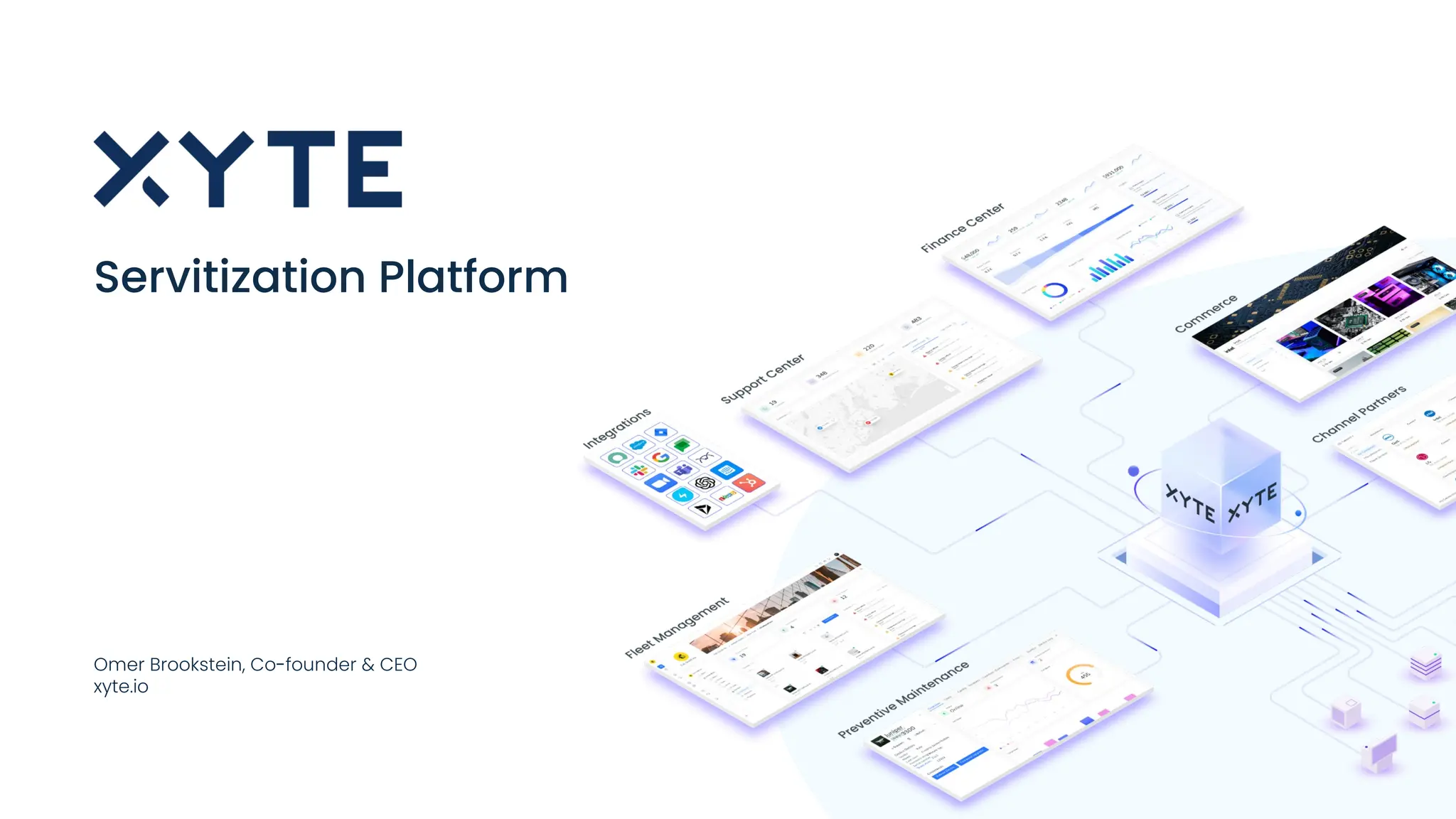
The title slide introduces Xyte as a 'Servitization Platform.' The imagery is a clean, isometric visualization of a modular dashboard ecosystem. It highlights key functional areas: Integrations, Support Center, Finance Center, Fleet Management, Preventive Maintenance, Commerce, and Channel Partners. This immediately signals that the platform is broad in scope, touching both technical (maintenance) and business (finance/commerce) operations. The slide identifies Omer Brookstein as Co-founder & CEO.
Slide 2: The Opportunity
Xyte uses this slide to establish market urgency. Rather than using generic stats, they use direct quotes from industry titans. Michael Dell (CEO, Dell Technologies) and Chuck Robbins (CEO, Cisco) are quoted stating their intentions to move the majority of their portfolios to 'as-a-service' models. The slide also includes visual examples of this transition: a Volvo excavator priced at '$370.00 / km' and a car priced at '$6,245.00 / year.' This anchors the 'servitization' concept in high-value, tangible assets.
Slide 3: The Problem
This slide identifies the structural barrier to servitization. It uses a linear diagram showing a Manufacturer (labeled 'A') selling through Distributors and Resellers to reach End Users. A red line cuts through the middle, indicating where visibility is lost. The text notes that manufacturers 'Lose visibility as devices leave warehouse' and have 'No sustainable customer relationship,' making it 'Impossible to introduce new recurring revenue models.' This is a classic 'gap' slide that sets up the need for a bridge.
Slide 4: Our Solution
Xyte presents its 'Full-Stack Servitization Platform' as a three-layered architecture. The bottom layer is Infrastructure (Security, Data Warehouse, APIs, Xyte Anywhere). The middle layer is Services (Business Ops Hub, Data Lab, Connectivity Hub). The top layer is Applications (Support Center, eCommerce, Analytics, Insights, Fleet Management, and a highlighted 'Financing' module). This structure suggests a 'plug-and-play' ecosystem where manufacturers can choose which modules to activate.
Slide 5: Traction
The traction slide shows a growth curve for ARR and Customers from September 2022 to June 2023. While the Y-axis values are blurred in this version of the deck, the curve shows a clear upward trajectory with specific customer logos pinned to the timeline. The use of a dashed line for the final segment suggests a projection or a very recent acceleration. The slide title 'Early Adopters Are Embracing the Change' reinforces the idea that the market transition mentioned in Slide 2 is already happening.
Slide 6: Business Transformation
This slide details exactly how the platform changes a manufacturer's business. It lists three primary levers: Complementary Services (warranties and bundles), Premium Feature Toggling (enabling features via software), and Usage-Based Pricing (lowering the barrier to entry). The UI mockups show a 'Gen Robotics' store and a payment selection screen for an excavator, demonstrating the 'Endless Options' mentioned in the headline. It emphasizes 'one powerful infrastructure' for 'wide variety of use cases.'
Slide 7: Pioneering a New Product Category
Xyte uses a three-way Venn diagram to position itself. The three circles are 'IoT/Fleet Management' (e.g., Particle, Microsoft Azure IoT Hub), 'Monitoring/MSP' (e.g., Atera, Domotz), and 'Subscription Management & Billing' (e.g., Stripe, Zuora). Xyte places its logo ('X') at the intersection of all three, claiming to be the only 'complete solution' that reduces complexity and accelerates time to market. This is a strong competitive positioning slide that justifies why a manufacturer wouldn't just use Stripe or Azure alone.
Slide 8: Business Section Divider
A simple blue transition slide titled 'Business' with the subtitle 'Business Model, GTM & Projection.' This signals to the investor that the deck is moving from the 'What' and 'Why' to the 'How' of the financial engine.
Slide 9: Forecast and Drivers
The final slide in this set provides a multi-chart financial outlook through 2025. The main chart shows 'Revenue & ARR' growing significantly year-over-year. Two smaller charts break this down: Customers Analysis (categorized by Tier 1, Tier 2, and Tier 3 customers) and Revenue Analysis: Source . The revenue source chart is particularly useful, showing that while 'Core platform revenue' is the base, 'Seats revenue' and 'Monitoring license revenue' become significant drivers as the company scales. This suggests a 'land and expand' strategy where they grow as their customers' fleets grow.
What Works Well
1. Clear Category Definition: The term 'Servitization' is not common parlance, but Xyte defines it immediately through the use of high-profile quotes and specific pricing examples (Slide 2 and Slide 6). By the third slide, the investor understands exactly what problem they are solving.
2. The 'Visibility Gap' Visualization: Slide 3 is a masterclass in explaining a complex B2B supply chain problem. By showing exactly where the relationship breaks (the red line between distributors and resellers), they make the need for their 'Connectivity Hub' feel inevitable.
3. Multi-Dimensional Revenue Strategy: Slide 9 shows a sophisticated understanding of their own business model. They aren't just charging a flat SaaS fee; they are capturing value from seats, licenses, and digital products. This diversity reduces risk and shows multiple paths to hitting their 2025 targets.
What Is Missing
1. Team Slide: In the 9 slides provided, there is no mention of the founding team's background. For a Series A, investors need to know why this specific team has the expertise to navigate both hardware manufacturing and cloud commerce.
2. The 'Ask' and Use of Funds: The deck ends (in this sample) without a clear statement of how much capital is being raised or how it will be deployed (e.g., R&D vs. Sales). While the source listing mentions $30M, the slides themselves should articulate the milestones that capital will unlock.
3. Unit Economics: While the revenue growth is shown, there is no mention of Customer Acquisition Cost (CAC), Lifetime Value (LTV), or churn rates. For a platform that relies on 'Early Adopters,' these metrics are crucial to prove the model is sustainable.
What a Founder Should Copy
1. The Competitive Intersection: If you are building a platform that touches multiple categories, use the Venn diagram approach from Slide 7. It’s much more effective than a standard 'Checklist' grid because it explains why you are different (you are the bridge) rather than just claiming you have more features.
2. Tangible Pricing Examples: Don't just say you enable 'usage-based pricing.' Show a picture of an excavator and a price per kilometer. It makes the abstract concept of 'servitization' feel real and achievable.
3. Strategic Social Proof: Using quotes from the CEOs of Dell and Cisco (Slide 2) is a powerful way to validate a market shift. If you are operating in a new category, find the leaders of the old category who are publicly admitting they need to change, and use their words to build your case.
Frequently asked questions
- What is 'servitization' according to Xyte?
- Xyte defines servitization as the process of hardware manufacturers moving their offerings to consumption-based and as-a-service models. This involves shifting from one-time hardware sales to recurring revenue streams through usage-based pricing, professional service bundles, and premium software features enabled on physical devices.
- How does Xyte solve the 'visibility' problem in hardware sales?
- Traditional manufacturers lose visibility once a device moves to distributors and resellers. Xyte provides a 'Connectivity Hub' and 'Business Ops Hub' that links the manufacturer directly to the end user's device. This allows the manufacturer to monitor usage, provide support, and manage billing regardless of the distribution channel.
- What are the primary revenue drivers for Xyte's business model?
- Based on Slide 9, Xyte generates revenue from four main sources: Core platform revenue, Seats revenue (likely per user), Monitoring license revenue (likely per device), and Digital products revenue. The projections show 'Core platform revenue' as the largest contributor to their growth through 2025.
- Who are Xyte's main competitors?
- Xyte positions itself at the center of three established categories. It competes with or displaces IoT platforms like Particle and ThingWorx, monitoring tools like Datadog or Atera, and subscription billing engines like Stripe, Zuora, and Recurly. Their value prop is being the only 'complete solution' that bridges all three.
- What specific hardware use cases does the deck highlight?
- The deck illustrates several diverse use cases: heavy machinery (an EC380-E excavator at $370/km), automotive (an EX90 at $6,245/year), and enterprise hardware (Digital Audio Platforms at $140/month). This demonstrates the platform's flexibility across different industrial and consumer hardware sectors.