SendGrid's 2009 pitch deck, presented at TechStars Demo Day, focuses on the technical friction of transactional email delivery. The deck identifies four core pain points: deliverability, scalability, lack of insight, and time consumption. By positioning themselves as an 'expert system,' SendGrid claimed to increase deliverability by 20% on average. The presentation highlights a significant market opportunity, noting that transactional emails (600 million/day) vastly outnumber marketing emails (100 million/day). The deck concludes with a clear $300k funding ask to reach 400 customers and $60k…
Key takeaways
- The deck identifies a massive market discrepancy, stating transactional emails total 600 million per day compared to 100 million for marketing emails (Slide 7).
- SendGrid positions itself as an 'expert system' that increases deliverability by 20% on average (Slide 4).
- The revenue model is strictly tiered, ranging from a $9.95 'Basic' plan to a $799.95 'Platinum' plan (Slide 8).
- Technical features like SPF, DKIM, and Feedback Loops are highlighted as the core solution to deliverability (Slide 4).
- The 'Before SendGrid' slide uses a real-world example from SurveyGizmo to illustrate the lack of branding and insight in standard transactional emails (Slide 6).
- The funding ask is specific: $300k to achieve $60k in monthly recurring revenue and 400 customers (Slide 9).
- The deck explicitly seeks investors with 'email experience' and 'contacts with hosting providers' rather than just capital (Slide 9).
Executive Summary: The Infrastructure of Communication
The 2009 SendGrid pitch deck is a foundational example of a 'developer-first' infrastructure pitch. At a time when most email innovation was focused on marketing newsletters, SendGrid identified that the most important emails—password resets, friend requests, and receipts—were the most likely to fail. By focusing on the plumbing of the internet, they built a case for a high-volume, low-friction utility. The deck is notable for its lack of fluff; it identifies a technical pain point, offers a technical solution, and presents a clear path to monetization.
Slide 1: Title and Team
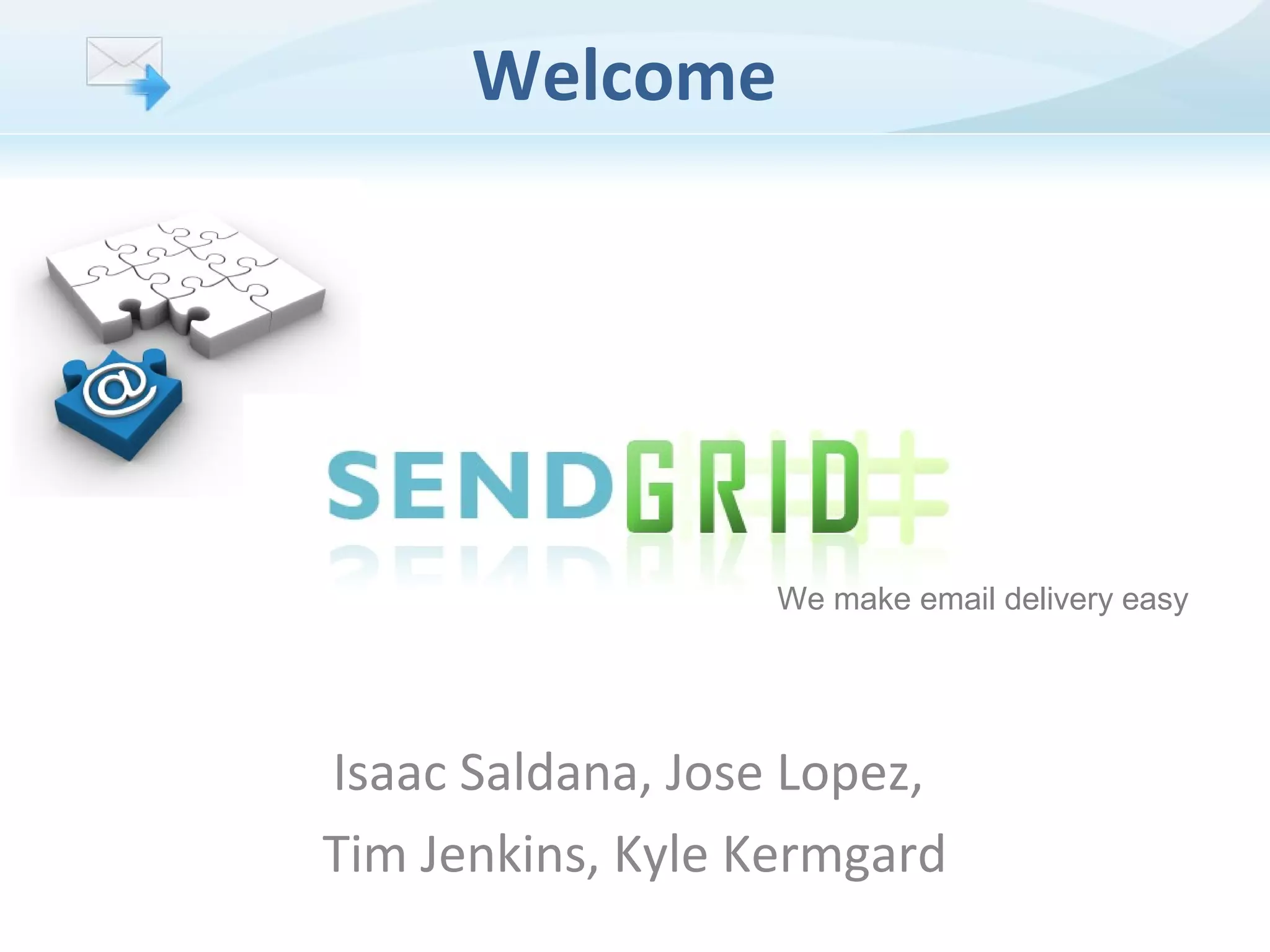
The cover slide introduces SendGrid with the tagline, "We make email delivery easy." It lists the four founders: Isaac Saldana, Jose Lopez, Tim Jenkins, and Kyle Kermgard. The imagery of a puzzle piece with an '@' symbol suggests that SendGrid is the 'missing piece' in the email ecosystem. While the design reflects the aesthetic of the late 2000s, the value proposition is immediate and clear.
Slide 2: The Use Case - Friend Requests
Slide 2 uses a concrete example of a Facebook friend request from 'Matt Van Horn' to 'Isaac.' This serves two purposes: it defines what a 'transactional' email is (an email triggered by a user action) and hints at the scale of the potential market by using Facebook—then a rapidly growing giant—as the primary example. It grounds the technical problem in a relatable user experience.
Slide 3: Transactional Email Problems
This slide outlines the core pain points for developers. It lists four bullet points: Deliverability , Scalability , Lack of insight , and Time consuming . The inclusion of a stock photo of a frustrated businessman is a classic pitch deck trope, but the list itself is highly specific to the frustrations of backend engineers who had to manage their own SMTP servers in 2009.
Slide 4: Deliverability (Solved)
SendGrid positions itself as an "Expert system in transactional email." This slide is dense with technical jargon that would appeal to their target buyer: SPF, DKIM, DomainKeys, RDNS, and CAN-SPAM. By listing these, SendGrid demonstrates they are handling the 'boring but difficult' work. The most important metric on this slide is the claim that "On average users increase 20% deliverability by using SendGrid." This provides a clear ROI for the service.
Slide 5: Lack of Insight after delivery
This slide features a large yellow button with a question mark. It addresses the 'black hole' of email: once a server sends an email, the developer traditionally has no idea if it was received, opened, or marked as spam. This sets up the 'Insight' features (tracking) that appear later in the revenue model.
Slide 6: Before SendGrid
Using a screenshot from SurveyGizmo, SendGrid shows the 'before' state. The email is plain text, lacks branding, and provides no data back to the sender. This slide reinforces the idea that companies are currently using sub-optimal, home-grown solutions that SendGrid can easily replace.
Slide 7: Market Size
This is the most impactful slide in the deck. It compares the daily volume of "Marketing" emails (100 million/day) against "Transactional" emails (600 million/day). By listing competitors like MailChimp, Experian, and Constant Contact under the smaller marketing pillar, SendGrid frames itself as the leader of a much larger, untapped category. The use of the Facebook logo on the larger pillar suggests that as the web becomes more social and transactional, SendGrid’s market will grow proportionally.
Slide 8: Revenue Model
The revenue model is a transparent 4-tier pricing table. Monthly prices range from $9.95 to $799.95. The slide clearly shows how features like Click Tracking, Open Tracking, and White Labeling are gated behind higher tiers. This demonstrates a sophisticated understanding of SaaS packaging, where the 'Basic' tier gets users in the door, but 'Insight' features drive expansion revenue.
Slide 9: Goals and The Ask
The final slide is a direct call to action. SendGrid seeks to Raise $300k . They tie this capital to three specific outcomes: 400 customers, $60k MRR, and a solid sales/marketing engine. Interestingly, they also specify what they want from investors beyond cash: "Email experience," "Contacts with hosting providers," and "Mentorship." This shows the founders were looking for strategic partners to help navigate the complex ISP landscape.
What Works in This Deck
The Volume Comparison: Comparing 100M marketing emails to 600M transactional emails is a brilliant way to show market potential without using questionable 'trillions of dollars' TAM figures. It speaks the language of the internet: traffic and scale.
The Technical Authority: By listing specific protocols like SPF and DKIM, the founders prove they understand the 'nitty-gritty' of the problem. For an infrastructure company, proving technical competence is more important than flashy design.
Clear ROI: The 20% deliverability increase is a 'hard' metric. If a company sends 1 million emails and 200,000 more of them arrive because of SendGrid, the service pays for itself immediately.
What Is Missing
The Team Background: While the names are listed on the first slide, there is no 'Team' slide detailing their previous experience. In a seed round, the 'why these people' is usually as important as the 'what.'
Competition: The deck mentions marketing email competitors but doesn't address other transactional players or the 'build vs. buy' argument in depth. They assume the audience agrees that building a custom solution is a bad idea.
Unit Economics: While the pricing is clear, the deck doesn't mention the cost of goods sold (COGS). Sending 600 million emails has significant server and bandwidth costs; investors would likely want to know the margins on those $0.00045 emails.
Founder's Playbook: What to Copy
The 'Before and After' Visual: Use real screenshots of the current, broken way of doing things. It makes the problem visceral and immediate.
Specific Ask/Milestones: Don't just ask for money. Tell the investors exactly what that money buys in terms of customer count and revenue. SendGrid’s goal of $60k MRR from a $300k raise is a very specific, measurable target that builds trust.
Strategic Investor Requests: If you need more than money (like introductions to hosting providers), say so. It helps you filter for the right investors and shows you know where your blind spots are.
Focus on the 'Plumbing': If you are building a B2B tool, don't be afraid to be technical. SendGrid won by being the best at a boring, difficult task that everyone else wanted to outsource. Identify the 'boring' part of your industry and own it.
Frequently asked questions
- What specific problem was SendGrid trying to solve in 2009?
- SendGrid targeted the 'Transactional Email Problem,' which they defined through four pillars: Deliverability (emails hitting spam), Scalability (handling high volumes), Lack of Insight (not knowing if an email was opened), and the time-consuming nature of managing mail servers. They specifically noted that while marketing email had solutions like MailChimp, transactional email—like Facebook friend requests—was largely ignored by existing infrastructure providers.
- How did SendGrid quantify their value proposition?
- On Slide 4, the company claimed that users increase their deliverability by 20% on average by switching to SendGrid. They achieved this by managing technical hurdles such as SPF, DKIM, DomainKeys, ISP rate limits, and feedback loops, which are difficult for individual developers to manage at scale.
- What was the early pricing strategy for SendGrid?
- SendGrid utilized a four-tier SaaS model: Basic ($9.95/mo), Silver ($79.95/mo), Gold ($199.95/mo), and Platinum ($799.95/mo). Pricing was tied to volume, with the cost per email dropping from $0.001 on the Basic plan to $0.00045 on the Platinum plan. Higher tiers unlocked features like click tracking, open tracking, and white labeling.
- How did SendGrid define their market size?
- Rather than using traditional TAM/SAM/SOM dollar figures, SendGrid used volume as a proxy for market size. Slide 7 shows that marketing email (served by companies like MailChimp and Constant Contact) accounted for 100 million emails per day, while transactional email (exemplified by Facebook) accounted for 600 million per day, suggesting the 'unsolved' market was 6x larger than the 'solved' one.
- What were the company's immediate goals for the $300k raise?
- The $300k ask was tied to three specific milestones: building a solid sales and marketing engine, acquiring 400 customers, and reaching $60,000 in monthly recurring revenue (MRR). This transparency shows a clear understanding of their unit economics and growth trajectory at the seed stage.