Consumer Product Go-to-Market Slides: 7 Real Examples
How consumer product brands show their route to the shelf: distributors, direct-to-retailer warehouses, wholesale boutiques and marketing channels.
Consumer Product Go-to-Market Slide: How the Product Reaches the Shelf
For a physical consumer product, go-to-market is mostly a distribution question: which distributors, retailers or wholesale buyers carry the product, and which shoppers each one reaches. Marketing matters too, but a product nobody stocks can't be bought. This guide compares seven real go-to-market slides from beverage, wine, apparel, food and beauty decks, from a national distributor map to a four-line list of marketing tactics.
TL;DR
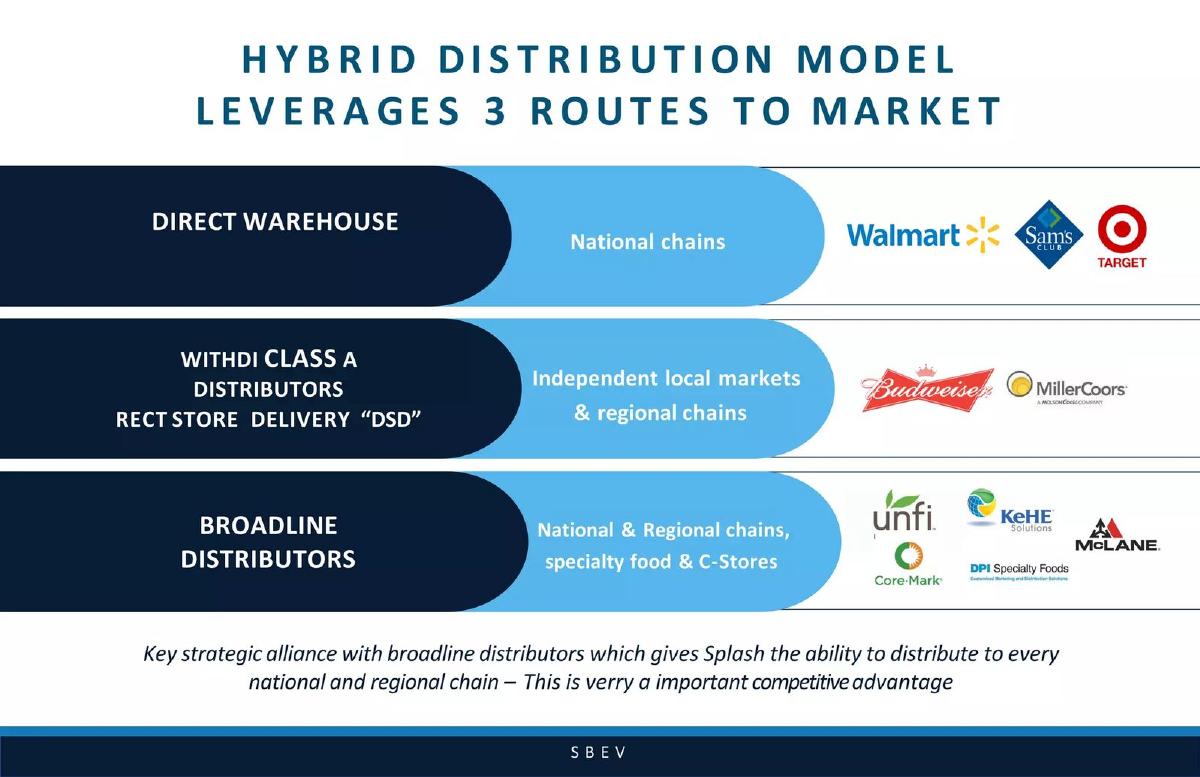
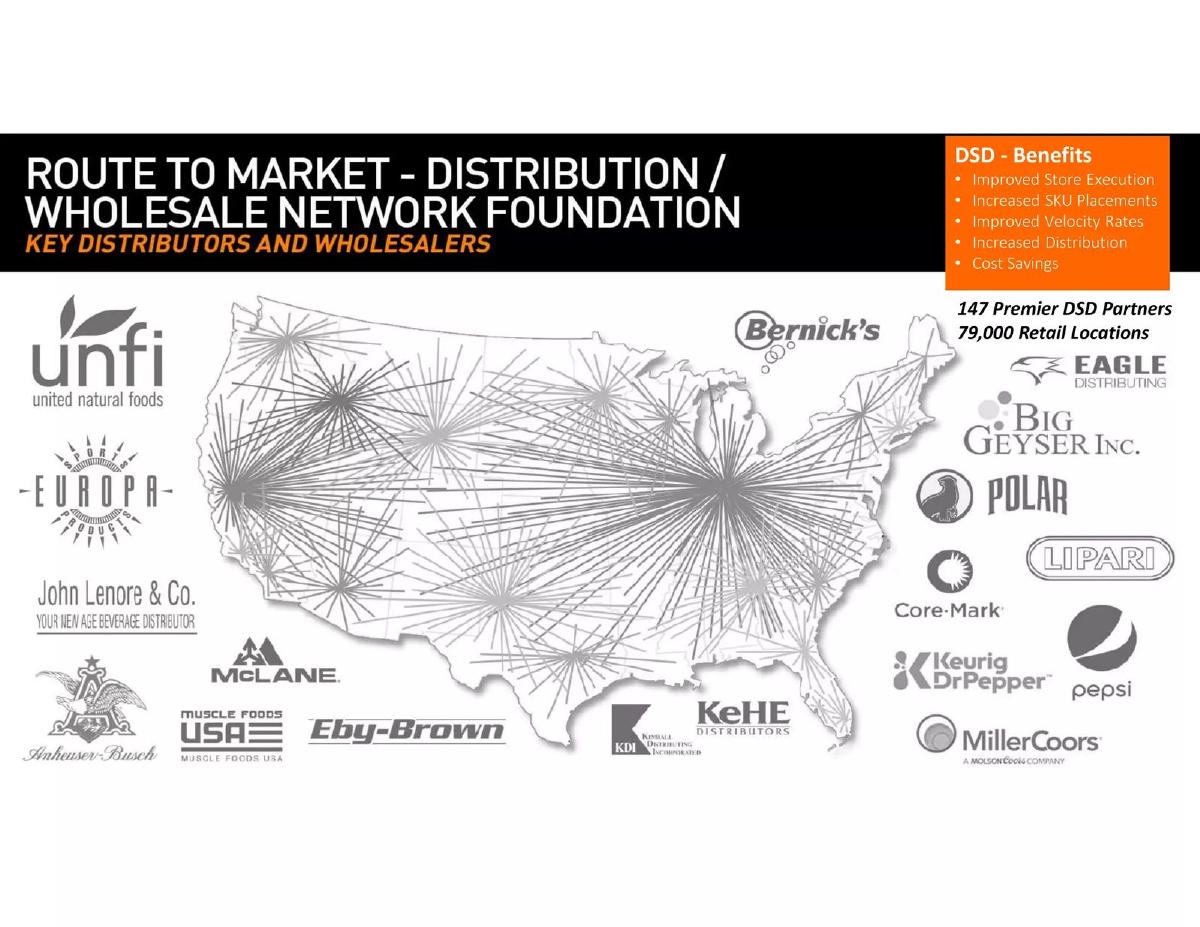
Show the route from your warehouse to the shopper, by channel. Splash Beverage splits three routes: direct warehouse to national chains, direct-store-delivery distributors to local markets, and broadline distributors to specialty and convenience stores. Celsius names its distributors and states 147 DSD partners and 79,000 retail locations. A list of marketing tactics alone doesn't say where the product can be bought.
Consumer product go-to-market slides from real pitch decks
Each example shows the slide above its analysis and links to the full teardown. Slides that map routes to the shelf come first. Claims are as shown on the slides; comments are ours.
Splash Beverage go to market slide — slide 10
Beverage portfolio company (tequila, sports drinks, wine).
Splash Beverage deck, slide 10. Exact stored slide matched to this analysis.
Our analysis: Three routes, each tied to a store type.
Evidence and limitation: Each route is matched to a store type and named partners. It doesn't say which retailers are already stocking the product or how many stores.
What a founder can adapt: "[Route] → [store type]: [partners], [N] doors live."
Supporting analysis
What the deck claims: "Hybrid Distribution Model Leverages 3 Routes to Market." "Direct Warehouse" to "National chains" (Walmart, Sam's Club, Target logos). Class A distributors, direct store delivery "DSD", to "Independent local markets & regional chains" (Budweiser, MillerCoors logos). "Broadline Distributors" to "National & Regional chains, specialty food & C-Stores" (UNFI, KeHE, Core-Mark, McLane, DPI logos).
Presentation choice: Investors see how the product reaches different kinds of stores.
When it does not fit: Logos with no signed-versus-target distinction.
Fitness energy drink brand, investor presentation.
Celsius deck, slide 13. Exact stored slide matched to this analysis.
Our analysis: Named network with reach numbers.
Evidence and limitation: It names distributors and gives a partner count and a store count. It doesn't break stores down by channel or say which distributors carry the most volume.
What a founder can adapt: "[N] distributors, [M] stores; top channel [X]% of volume."
Supporting analysis
What the deck claims: "Route to Market – Distribution / Wholesale Network Foundation. Key Distributors and Wholesalers." "147 Premier DSD Partners. 79,000 Retail Locations." "DSD – Benefits: Improved Store Execution, Increased SKU Placements, Improved Velocity Rates, Increased Distribution, Cost Savings." A US map with distributor logos including UNFI, KeHE, McLane, Core-Mark, Keurig Dr Pepper and Pepsi.
Presentation choice: A store count makes distribution concrete.
Napa Valley wine brand selling in China and the US, 2015 deck.
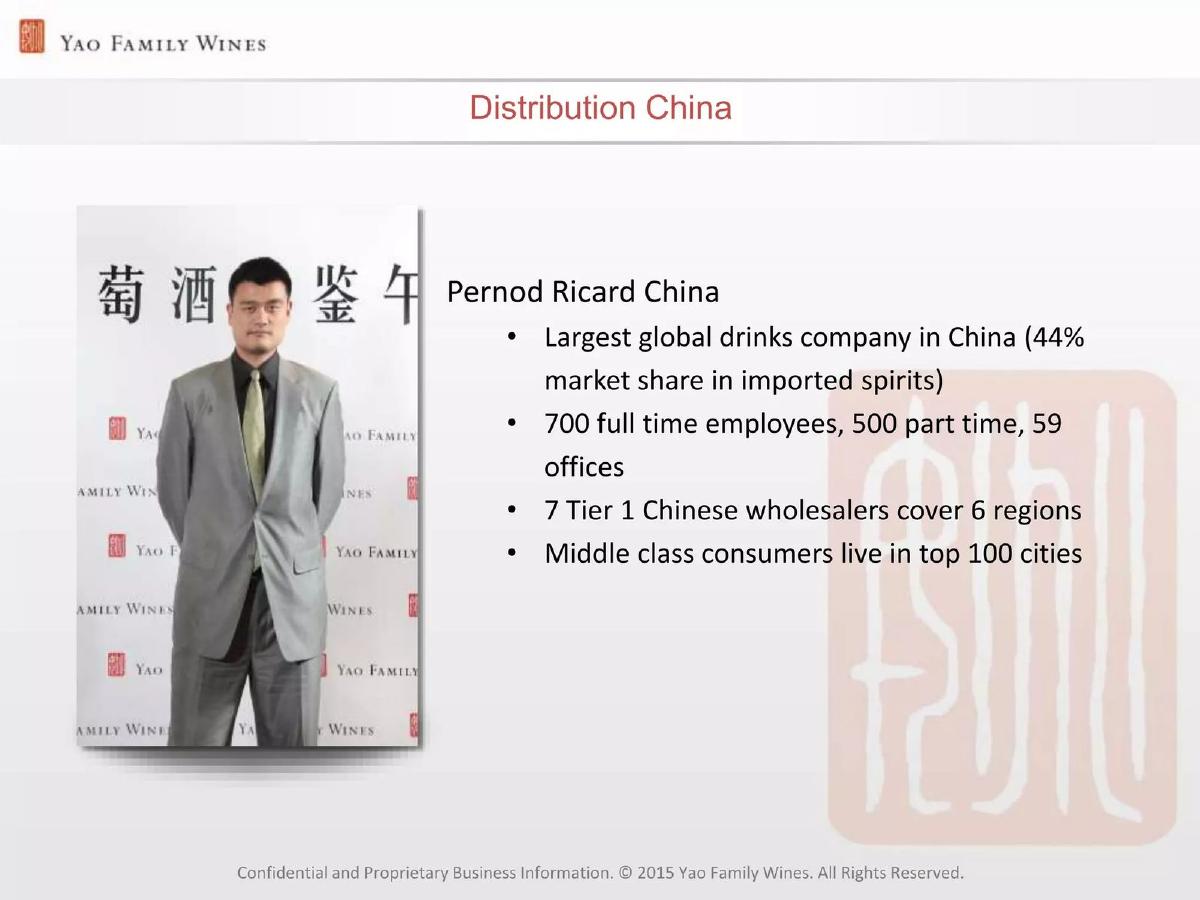
Yao Family Wines deck, slide 11. Exact stored slide matched to this analysis.
Our analysis: One large partner per market.
Evidence and limitation: One named distribution partner, its scale and how it reaches shoppers. The deck covers US distribution on the next page. It doesn't give the brand's own store count or volume through the partner.
What a founder can adapt: "[Market]: [partner], [N] wholesalers, [M] outlets; [X] cases shipped."
Supporting analysis
What the deck claims: "Distribution China." "Pernod Ricard China: Largest global drinks company in China (44% market share in imported spirits). 700 full time employees, 500 part time, 59 offices. 7 Tier 1 Chinese wholesalers cover 6 regions. Middle class consumers live in top 100 cities."
Presentation choice: Investors see who carries the product and how far they reach.
When it does not fit: The partner's size standing in for your sales.
T&J Designs deck, slide 10. Exact stored slide matched to this analysis.
Our analysis: Three channels, one with a count.
Evidence and limitation: It names an off-price retailer, a resale marketplace and a wholesale count. It doesn't say what share of sales each brings or whether Nordstrom Rack is a current account.
What a founder can adapt: "[Retailer]: [N] stores, [X]% of sales. Wholesale: [M] boutiques."
Supporting analysis
What the deck claims: "Partnerships." Three shopping bags labelled "Nordstrom Rack", "Poshmark" and "Wholesale 300 Boutiques".
Presentation choice: A boutique count shows wholesale reach.
When it does not fit: Channel names with no share of sales.
JustBeth Table Water go to market slide — slide 10
Packaged table water brand in Nigeria.
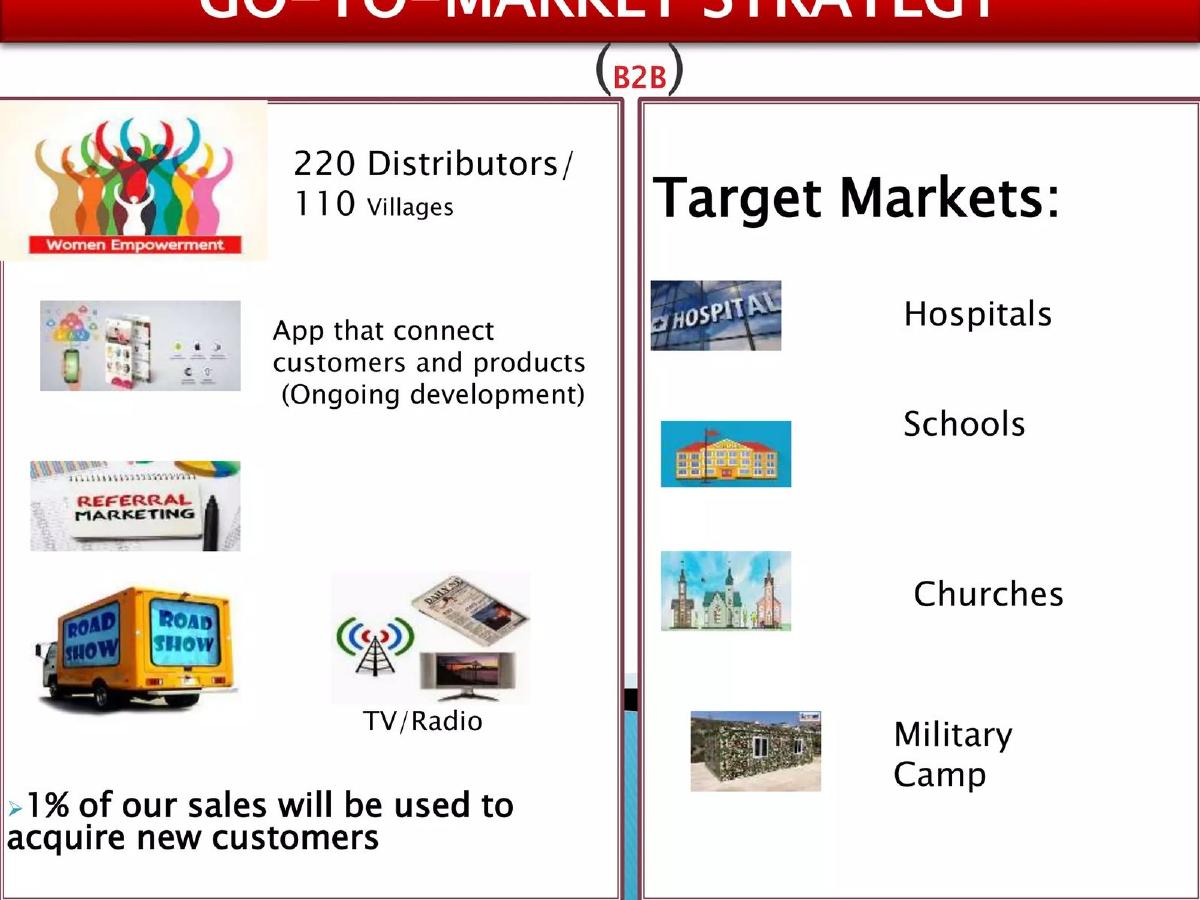
JustBeth Table Water deck, slide 10. Exact stored slide matched to this analysis.
Our analysis: Local distributor network plus institutions.
Evidence and limitation: It gives a distributor count and names institutional buyers. It doesn't say which target markets already buy, and the app is still in development.
What a founder can adapt: "[N] distributors in [area]; [M] institutional accounts signed."
Supporting analysis
What the deck claims: "Go-to-Market Strategy (B2B)." "220 Distributors / 110 Villages" (Women Empowerment). "App that connect customers and products (Ongoing development)." Referral marketing, road shows, TV/Radio. "1% of our sales will be used to acquire new customers." "Target Markets: Hospitals, Schools, Churches, Military Camp."
Presentation choice: Investors see who sells and who buys in bulk.
When it does not fit: Target markets with no signed accounts.
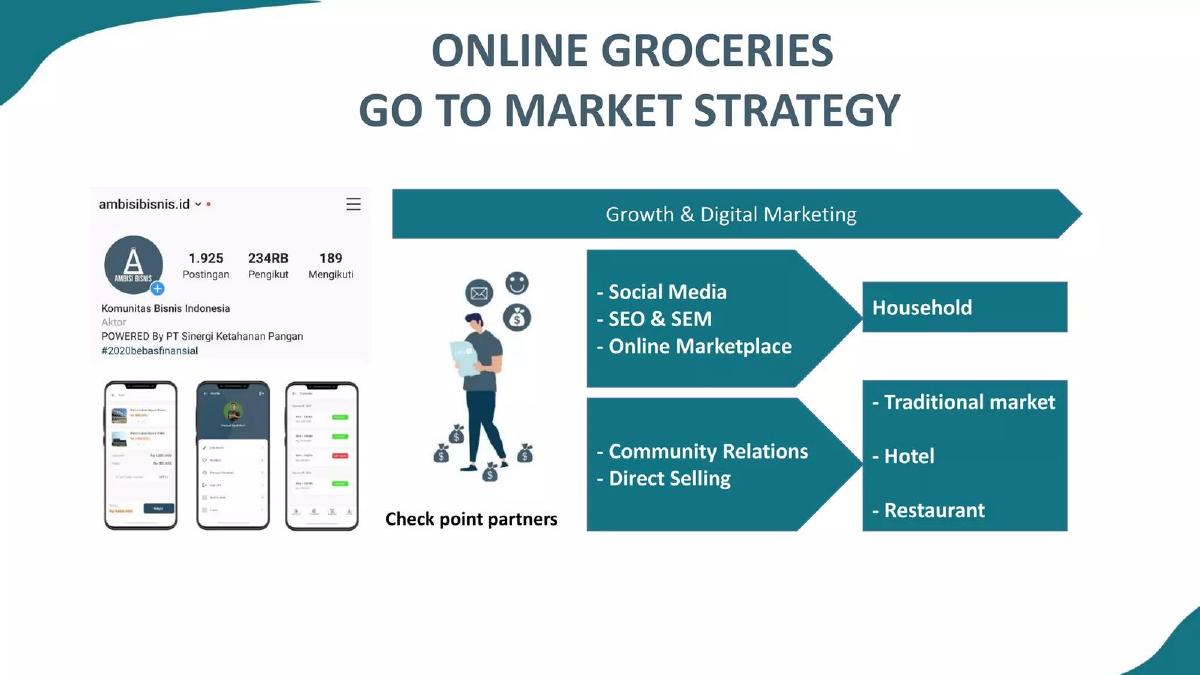
Indonesian poultry-farming company launching online groceries.
Chick-in deck, slide 13. Exact stored slide matched to this analysis.
Our analysis: Channels matched to buyers.
Evidence and limitation: It matches channels to customer groups. It has no numbers, and "check point partners" isn't explained.
What a founder can adapt: "Households: [channel], [N] orders. Restaurants: direct, [M] accounts."
Supporting analysis
What the deck claims: "Online Groceries Go To Market Strategy." "Growth & Digital Marketing." "Social Media, SEO & SEM, Online Marketplace" to "Household". "Community Relations, Direct Selling" to "Traditional market, Hotel, Restaurant". "Check point partners."
Presentation choice: Pairing households with online and restaurants with direct selling is a clear split.
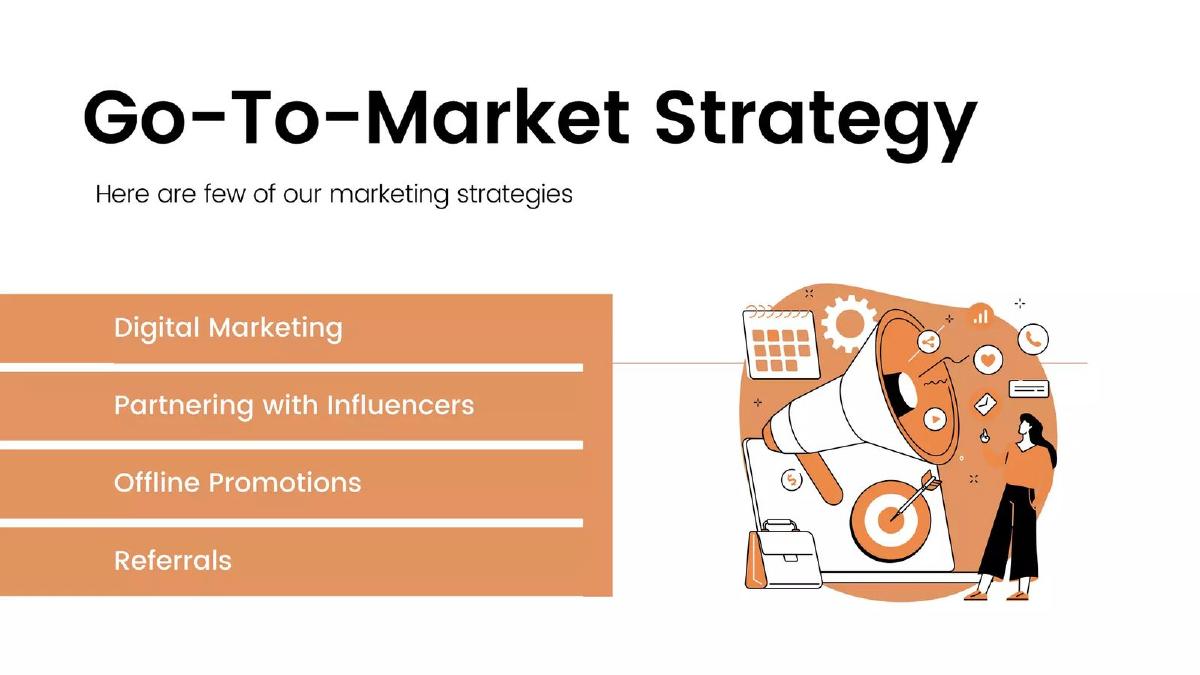
Beautyfyn deck, slide 9. Exact stored slide matched to this analysis.
Our analysis: Marketing list, no route to shelf.
Evidence and limitation: Weaker example. It lists marketing tactics but not where the product is sold, and gives no numbers.
What a founder can adapt: "Sold via [site/marketplace/stores]; [N] influencers drove [M] orders."
Supporting analysis
What the deck claims: "Go-To-Market Strategy. Here are few of our marketing strategies." "Digital Marketing. Partnering with Influencers. Offline Promotions. Referrals."
Presentation choice: Investors can't tell where shoppers would buy the product.
When it does not fit: Tactics without a sales channel.
Before: "Digital Marketing. Partnering with Influencers. Offline Promotions. Referrals."
After: "Sold on [site] and [marketplace]; [N] stores via [distributor]. Influencers drove [M] orders at $[X] each."
What improved: Our illustrative rewrite of Beautyfyn's slide; bracketed text is a placeholder, not company fact.
What's different about consumer product go-to-market
Most consumer goods reach shoppers through intermediaries: distributors, wholesalers and retail chains, alongside the brand's own website or marketplace listings. Each route carries different margins, minimum volumes and store types. The slide should show which routes the company uses, which accounts are already in place and how many stores that adds up to.
What investors check
Which routes carry the product today. Which distributors and retailers are signed versus targeted. How many doors or buyers the product reaches. Whether the channel mix fits the price and margin. How marketing drives sell-through once the product is on the shelf.
How we read each slide
We quote the text on the slide images. We have not checked any distributor, retailer or store count. Page numbers are pages in the original deck file. All seven pages were rendered from those files.
Common mistakes
Marketing instead of distribution. Say where the product can be bought.
Logos without status. Mark signed accounts and targets differently.
No reach number. Give doors, stores or buyers.
Partner's size as your traction. A big distributor isn't the same as your volume.
Diagnostic checklist
Routes to the shelf named.
Each route tied to a store type.
Signed vs target accounts marked.
Store or door count given.
Frequently asked questions
What should a consumer product go-to-market slide show?
The routes from your warehouse to shoppers, the accounts in each and how many stores that reaches. Splash Beverage maps three routes to store types; Celsius gives distributor and store counts.
Is a list of marketing tactics enough?
Not for a physical product. Beautyfyn's slide lists four tactics but not where the product is sold. Add the sales channels first.
How we chose these examples
Corpus: published pitch deck teardowns on StartupFundraising.com. Founder-uploaded private decks are excluded.
Selection (2026-09-26): we searched consumer product teardowns (food, beverage, apparel, beauty) for go-to-market, distribution, channel and route-to-market headings, scanned the full decks of ten candidates to find the matching pages, and kept seven.
Excluded: Uncaged Innovations (sells material to brands, not to consumers), Belgian Boys (pages too small to read), HomeRoots (its retailer page is a traction slide, not a route-to-market plan). Teardown text numbering differed from deck-file pages for Celsius, Splash Beverage, Yao Family Wines, Chick-in and Beautyfyn; pages were matched by eye.
Page numbers are pages in the original deck files. All seven were rendered from the deck PDFs and stored with the existing slide-image workflow. All seven decks were confirmed as published teardowns on 2026-09-26.
Distributor, retailer and store counts are quoted from the slides and not independently verified.
Review: slide images were checked on 2026-09-26 and matched to company, deck and page (editorial model review). No person has yet completed an editorial review of this page. We make no claim that any slide caused a fundraising outcome.