How marketplace startups plan to win both sides: separate channels for sellers and buyers, supply incentives, phased campus launches and conference circuits.
Marketplace Go-to-Market Slide: How to Reach Both Sides
A marketplace has to attract two groups at once, and each usually needs a different channel. The go-to-market slide should say how the company gets its first sellers, how it gets its first buyers, and which side comes first. This guide compares six real marketplace go-to-market slides, from a slide with separate channel lists for merchants and users to a slide that only says the team will travel the country.
TL;DR
Give each side its own channels and say which side you start with. G-Gate lists five merchant channels and three user channels, including using merchants' customer lists to reach users. ReloBuddy explains what supply-side helpers earn (€160 of a €200 fee). Slides that name one channel mix for everyone, or only a timeline, don't show how the marketplace starts.
Marketplace go-to-market slides from real pitch decks
Each example shows the slide above its analysis and links to the full teardown. Slides that separate the two sides come first. Claims are as shown on the slides; comments are ours.
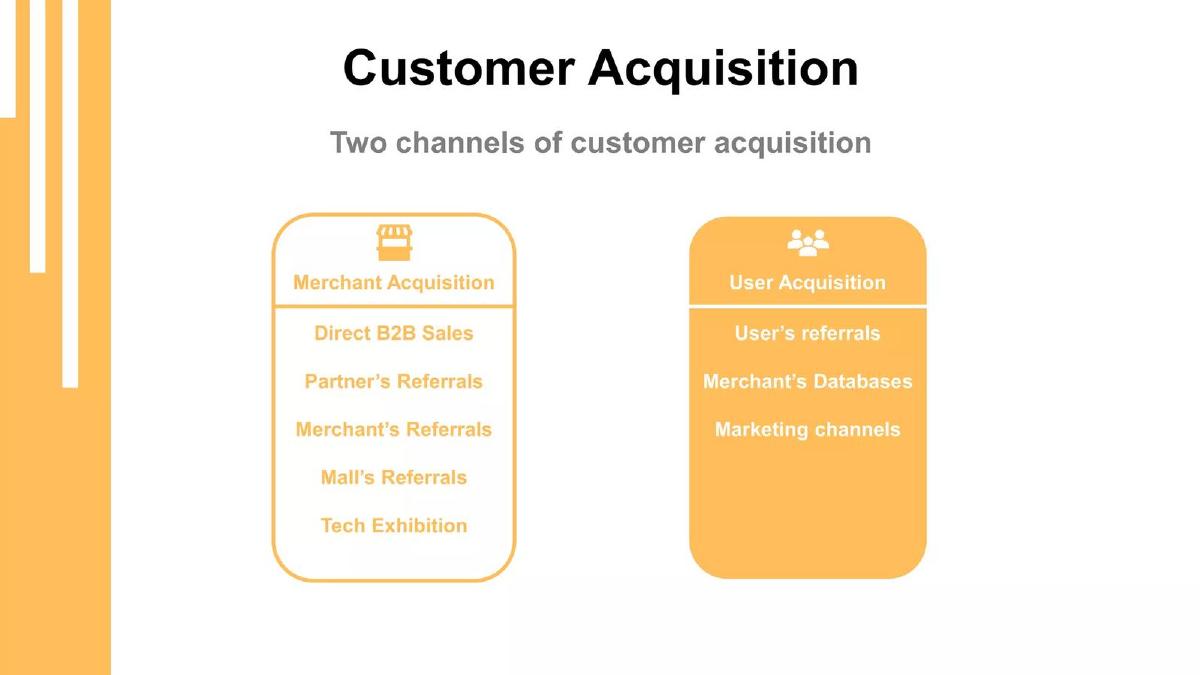
G-Gate go to market slide — slide 9
Marketplace linking local merchants and consumers in Singapore.
G-Gate deck, slide 9. Exact stored slide matched to this analysis.
Our analysis: Two sides, two channel lists.
Evidence and limitation: It gives each side its own list, and "Merchant's Databases" shows one side being used to reach the other. There are no costs, targets or results per channel.
What a founder can adapt: "Merchants: [channel], [N] signed. Users: via merchants' lists, [M] joined, $[X] each."
Supporting analysis
What the deck claims: "Customer Acquisition. Two channels of customer acquisition." "Merchant Acquisition: Direct B2B Sales, Partner's Referrals, Merchant's Referrals, Mall's Referrals, Tech Exhibition." "User Acquisition: User's referrals, Merchant's Databases, Marketing channels."
Presentation choice: Investors see that sellers and buyers are recruited differently.
When it does not fit: Channel lists with no numbers.
Relocation help marketplace pairing newcomers with local helpers.
ReloBuddy deck, slide 10. Exact stored slide matched to this analysis.
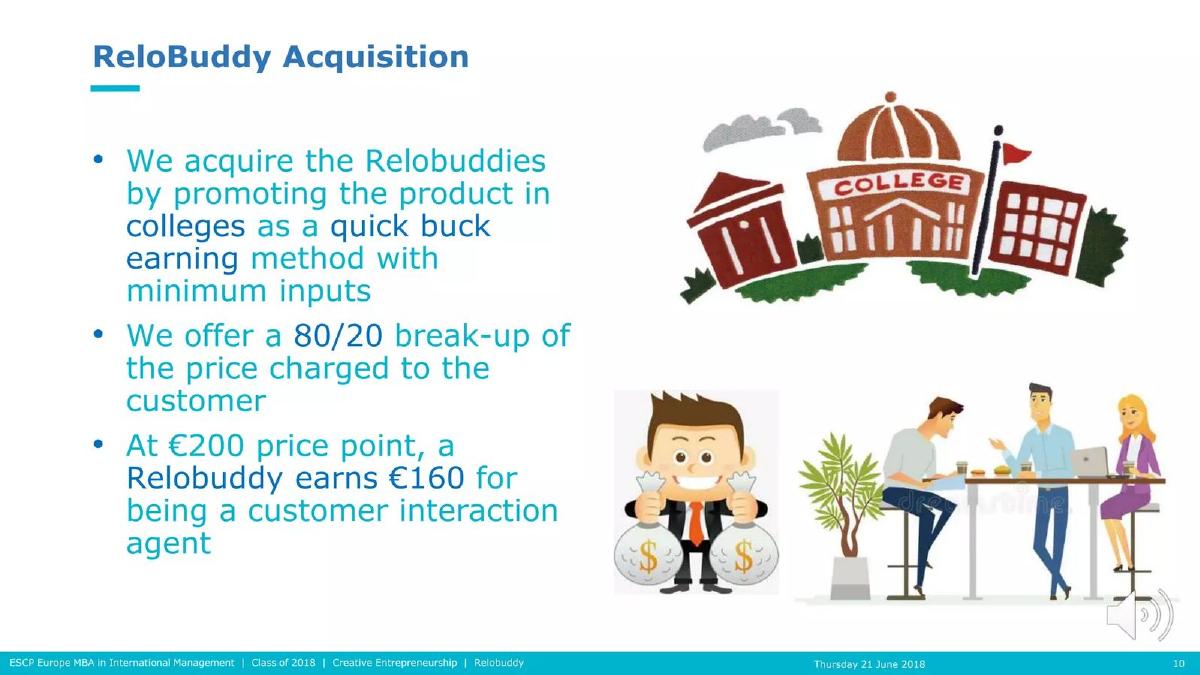
Our analysis: Supply channel with a payout.
Evidence and limitation: It names where supply comes from and what a helper earns. It has no sign-up numbers, and the deck covers the customer side on a separate page.
What a founder can adapt: "Supply from [source]; they earn [X]% ($[Y]/job); [N] signed up in [period]."
Supporting analysis
What the deck claims: "ReloBuddy Acquisition." "We acquire the Relobuddies by promoting the product in colleges as a quick buck earning method with minimum inputs." "We offer a 80/20 break-up of the price charged to the customer." "At €200 price point, a Relobuddy earns €160 for being a customer interaction agent."
Presentation choice: Investors see why helpers would join and what it costs the company.
When it does not fit: A supply incentive with no sign-up data.
Peer-to-peer skills-teaching marketplace for students.
SkillSesh deck, slide 9. Exact stored slide matched to this analysis.
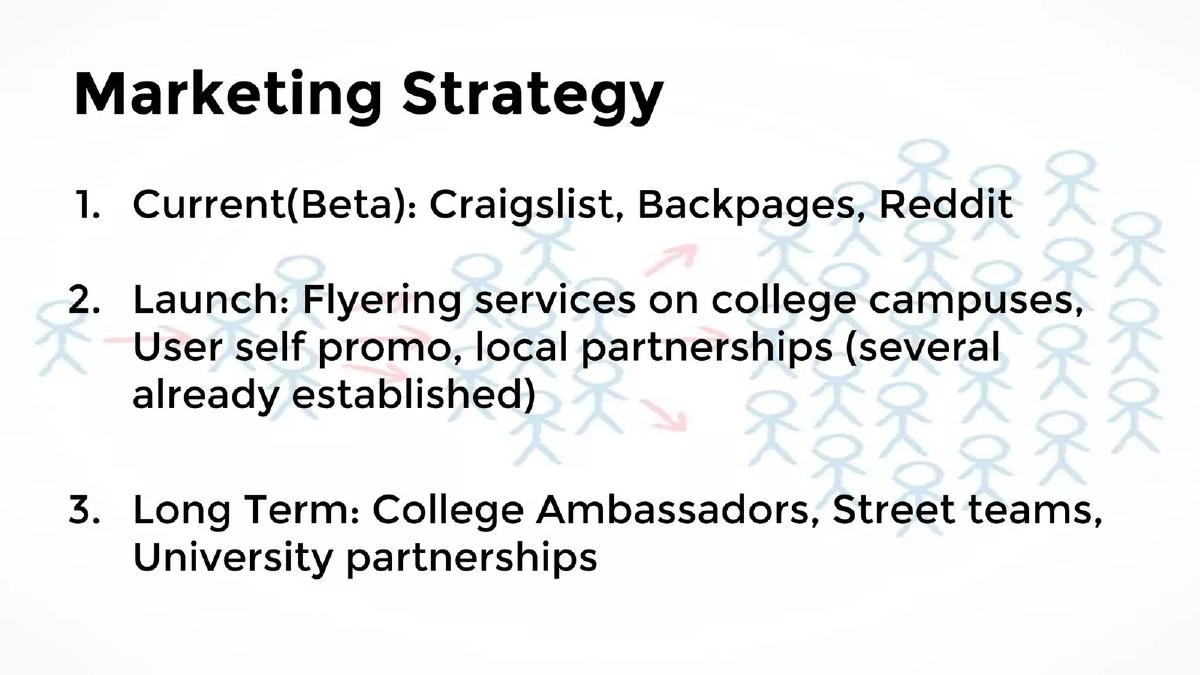
Our analysis: Phased, starting on campus.
Evidence and limitation: It phases the plan and starts on college campuses. It doesn't split channels by side (teachers vs learners) or name the partnerships.
What a founder can adapt: "Beta: [channel], [N] users. Launch: [campus], [partners]. Later: [channels]."
Supporting analysis
What the deck claims: "Marketing Strategy." "1. Current(Beta): Craigslist, Backpages, Reddit." "2. Launch: Flyering services on college campuses, User self promo, local partnerships (several already established)." "3. Long Term: College Ambassadors, Street teams, University partnerships."
Presentation choice: A focused starting point makes the launch believable.
When it does not fit: "Several" partnerships with no names.
Office catering marketplace linking food vendors and companies.
CaterSquad deck, slide 15. Exact stored slide matched to this analysis.
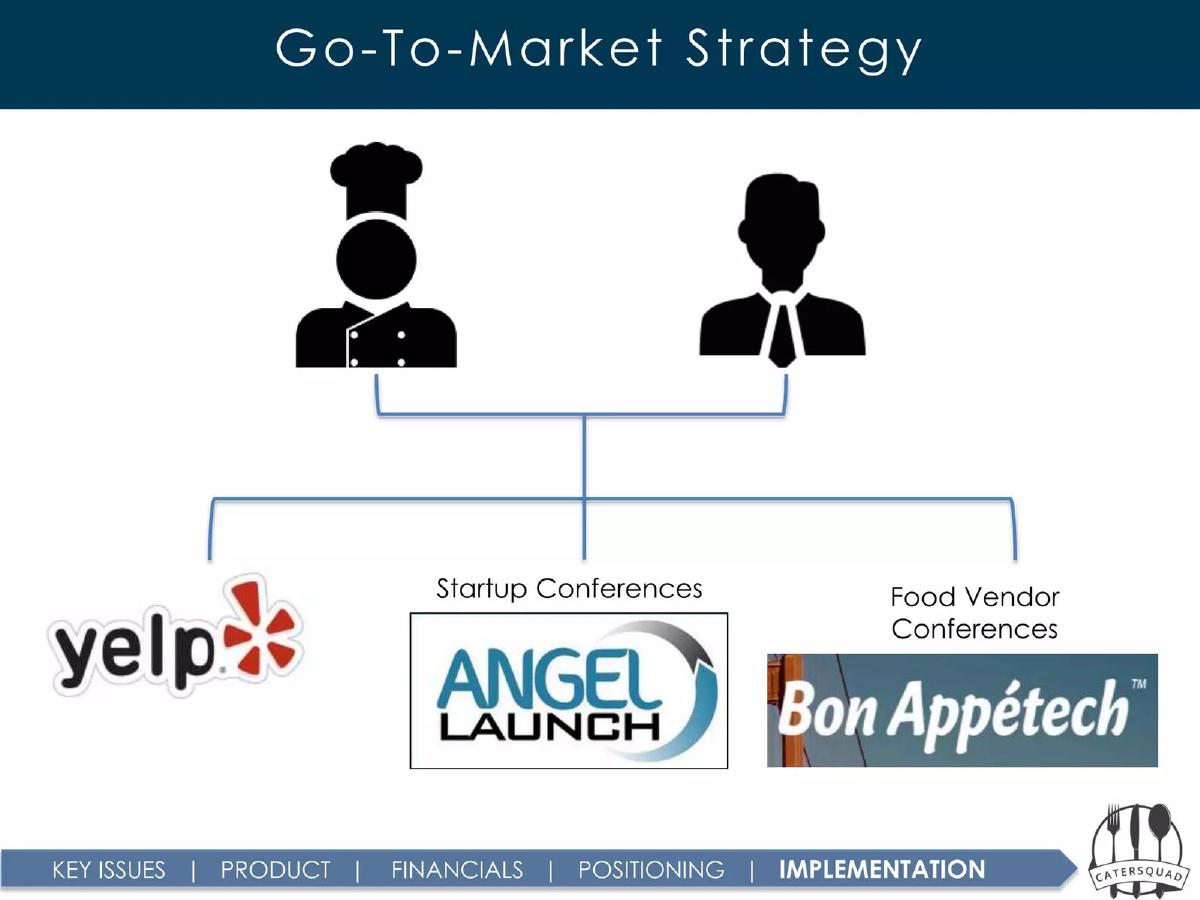
Our analysis: Named venues for both sides.
Evidence and limitation: It shows both sides and names specific places to find them. It doesn't say which channel serves which side, or what any costs.
What a founder can adapt: "Vendors: [event/listing], [N] signed. Companies: [event], [M] trials."
Supporting analysis
What the deck claims: "Go-To-Market Strategy." A chef and a business person both connect to three channels: Yelp, "Startup Conferences" (Angel Launch logo) and "Food Vendor Conferences" (Bon Appétech logo).
Presentation choice: Specific events are more credible than "digital marketing".
When it does not fit: Logos with no link to a side or result.
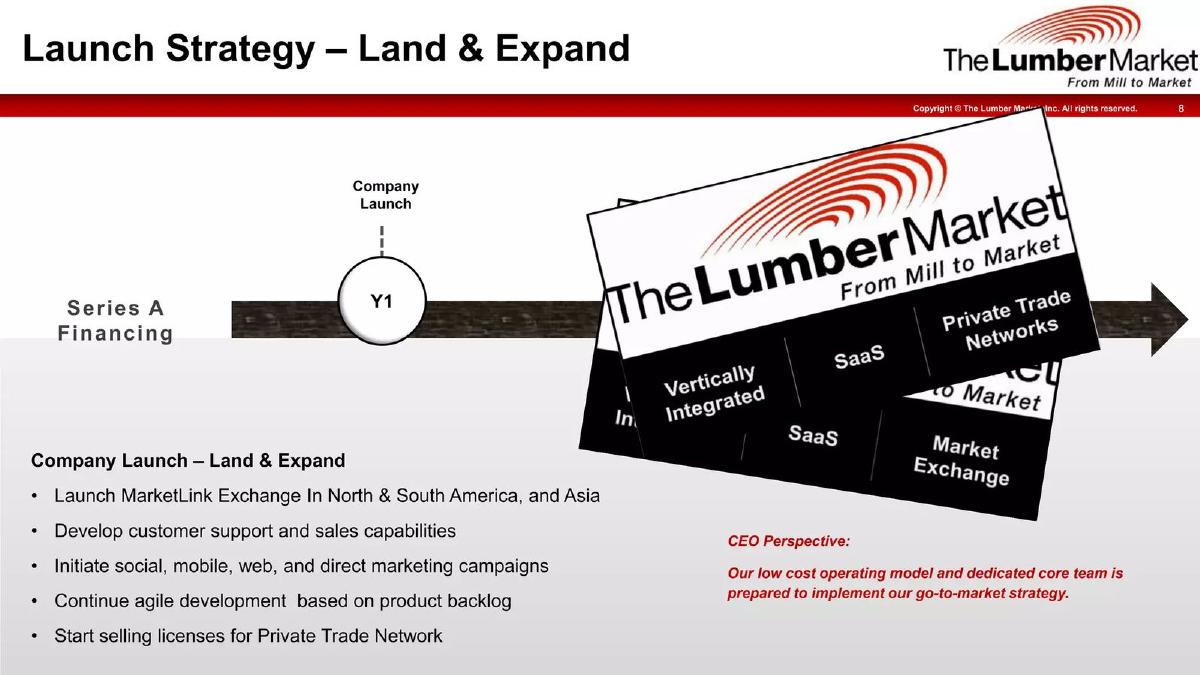
The Lumber Market deck, slide 8. Exact stored slide matched to this analysis.
Our analysis: Broad launch, sides not split.
Evidence and limitation: Weaker example. It launches on three continents at once and doesn't separate mills from buyers.
What a founder can adapt: "Year 1: [region], [N] mills and [M] buyers; then [next region]."
Supporting analysis
What the deck claims: "Launch Strategy – Land & Expand." "Launch MarketLink Exchange In North & South America, and Asia." "Develop customer support and sales capabilities." "Initiate social, mobile, web, and direct marketing campaigns." "Start selling licenses for Private Trade Network." "CEO Perspective: Our low cost operating model and dedicated core team is prepared to implement our go-to-market strategy."
Presentation choice: Starting everywhere makes it hard to build liquidity anywhere.
When it does not fit: Launching in several regions at once.
App connecting small businesses with financial advisors, pre-product.
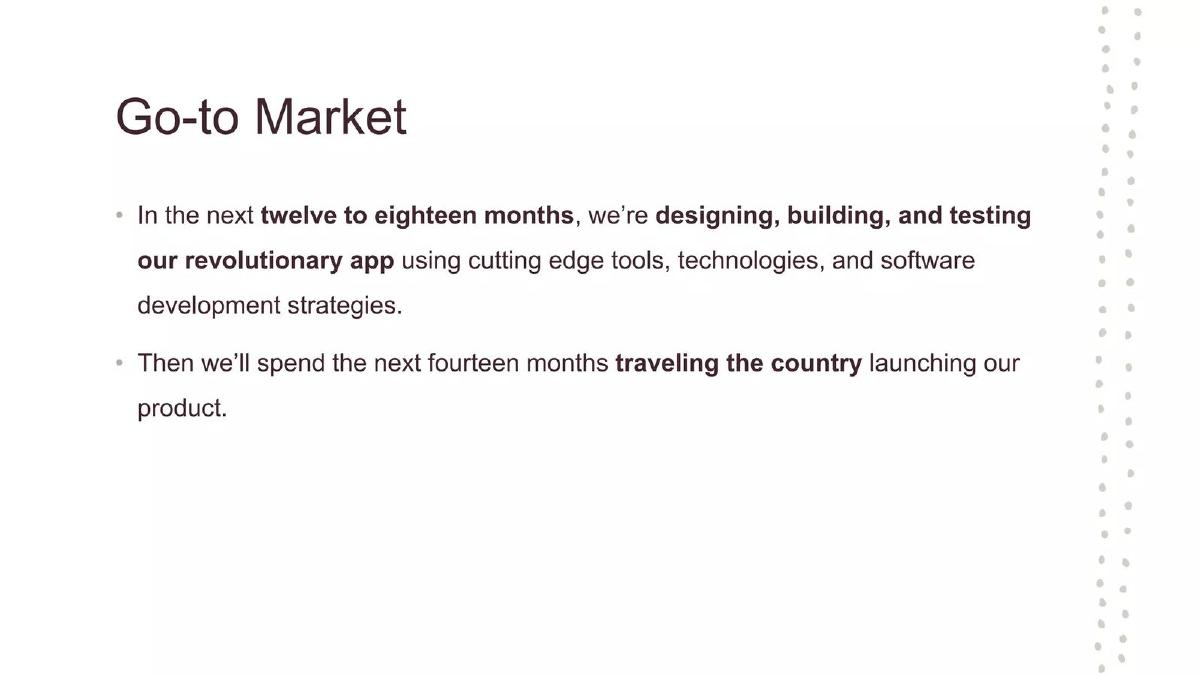
Akmazio deck, slide 9. Exact stored slide matched to this analysis.
Our analysis: Timeline only.
Evidence and limitation: Weaker example. It's a timeline, not a plan: no side, channel or starting market.
What a founder can adapt: "First [N] advisors via [channel] in [city]; businesses via [channel]."
Supporting analysis
What the deck claims: "Go-to Market." "In the next twelve to eighteen months, we're designing, building, and testing our revolutionary app…" "Then we'll spend the next fourteen months traveling the country launching our product."
Presentation choice: Investors can't tell how either side would be found.
When it does not fit: Build-then-travel with no channels.
Before: "Then we'll spend the next fourteen months traveling the country launching our product."
After: "Start in [city]: [N] advisors via [association]; businesses via [partner bank]; then [next city]."
What improved: Our illustrative rewrite of Akmazio's slide; bracketed text is a placeholder, not company fact.
What's different about marketplace go-to-market
Buyers won't come without sellers and sellers won't stay without buyers. A marketplace go-to-market plan usually recruits one side first, often in a single city, campus or niche, and uses it to attract the other. The two sides are often reached in different ways: supply through direct sales, partners or incentives; demand through referrals, listings or marketing.
What investors check
Which side comes first, and why. Where the launch starts. What each side is offered to join. Whether one side's channel also brings in the other. Any early numbers.
How we read each slide
We quote the text on the slide images. We have not checked any price, partner or plan. Page numbers are pages in the original deck file. All six pages were rendered from those files.
Common mistakes
One channel mix for both sides. Sellers and buyers are usually found differently.
No starting point. Name the first city, campus or niche.
Launching everywhere. Liquidity is built one market at a time.
Timeline instead of plan. Dates don't say how either side is found.
Diagnostic checklist
Channels for each side.
First side named.
Starting market named.
Early numbers per side.
Frequently asked questions
How should a marketplace show its go-to-market on a pitch deck?
Give each side its own channels and say where you start. G-Gate lists merchant and user channels separately; SkillSesh starts on college campuses.
Should the supply side get its own slide?
It can. ReloBuddy gives supply acquisition its own page, with what a helper earns per job, and covers customers separately.
How we chose these examples
Corpus: published pitch deck teardowns on StartupFundraising.com. Founder-uploaded private decks are excluded.
Selection (2026-09-26): we searched marketplace teardowns for go-to-market, customer acquisition, supply, launch and marketing strategy headings, scanned twelve candidate decks around the matching pages, and kept six.
Excluded: Cultinet, eProf and Let's Works (the matching deck-file pages aren't go-to-market slides), Metaprops (page numbering didn't match the teardown), Appartmate (images only). ReloBuddy's customer page was not used because its footer names a different project.
Page numbers are pages in the original deck files. All six were rendered from the deck PDFs and stored with the existing slide-image workflow. All six decks were confirmed as published teardowns on 2026-09-26.
Prices, partners and plans are quoted from the slides and not independently verified.
Review: slide images were checked on 2026-09-26 and matched to company, deck and page (editorial model review). No person has yet completed an editorial review of this page. We make no claim that any slide caused a fundraising outcome.