How healthcare startups plan to reach buyers: employers and insurers, health plans, licensing partners, pharmacies and hospital networks.
Healthcare Go-to-Market Slide: Who Pays, Who Buys and Who Distributes
In healthcare, the patient who uses a product is often not the one who pays for it or picks it. The go-to-market slide has to say who buys, why they would, and which channel reaches them. This guide compares six real healthcare go-to-market slides, from a slide that puts a cost figure next to each paying buyer to a slide that names four channels and nothing else.
TL;DR
Name the buyer, the channel and the reason the buyer pays. HealthCaters puts a cost-of-illness figure beside employers and insurers. Hello Heart names self-insured employers and says it now sells through health plans and pharmacy benefit managers. Channel lists with no buyer, price or proof leave investors guessing.
Healthcare go-to-market slides from real pitch decks
Each example shows the slide above its analysis and links to the full teardown. Slides that name the buyer and the proof come first. Claims are as shown on the slides; comments are ours.
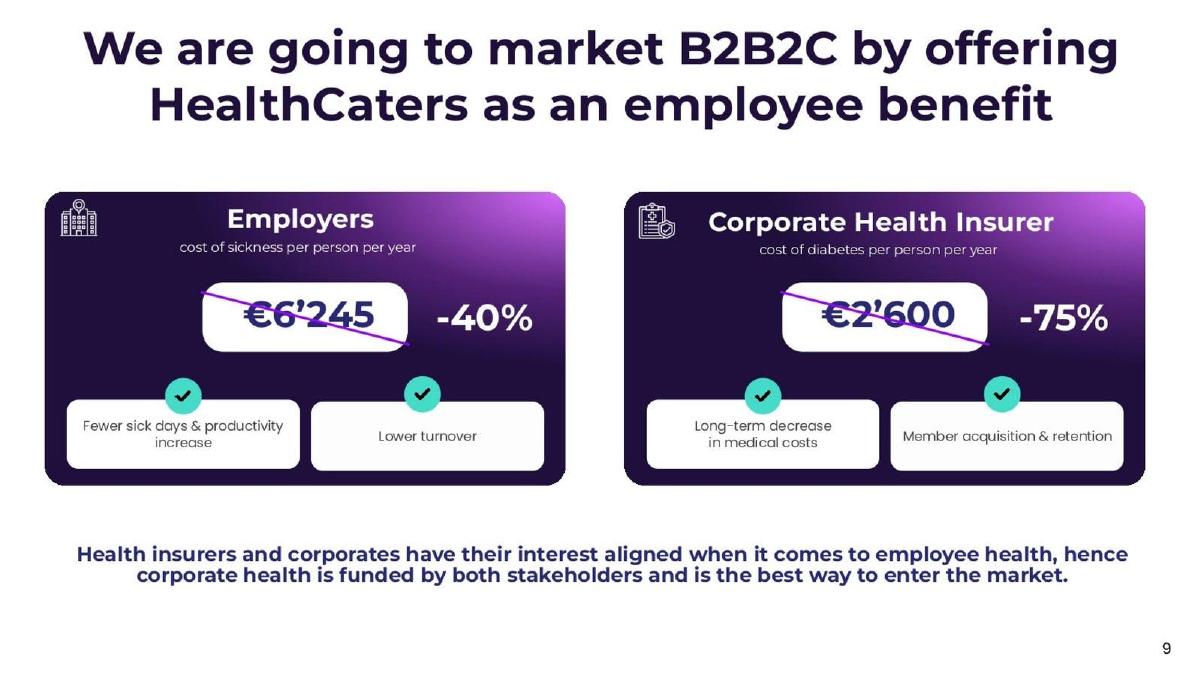
HealthCaters go to market slide — slide 9
Digital health app offered to employees as a benefit.
HealthCaters deck, slide 9. Exact stored slide matched to this analysis.
Our analysis: Buyers with a reason to pay.
Evidence and limitation: It names two paying buyers and gives each a cost and a reason. The cost figures and the -40%/-75% reductions have no source or study on the slide.
What a founder can adapt: "[Buyer] spends $[X]/person on [condition] ([source]); our pilot cut it [Y]% ([n], [period])."
Supporting analysis
What the deck claims: "We are going to market B2B2C by offering HealthCaters as an employee benefit." "Employers — cost of sickness per person per year €6'245 -40%" ("Fewer sick days & productivity increase", "Lower turnover"). "Corporate Health Insurer — cost of diabetes per person per year €2'600 -75%" ("Long-term decrease in medical costs", "Member acquisition & retention"). "Health insurers and corporates have their interest aligned when it comes to employee health, hence corporate health is funded by both stakeholders and is the best way to enter the market."
Presentation choice: Investors see who funds the product and why.
When it does not fit: Savings percentages without a source.
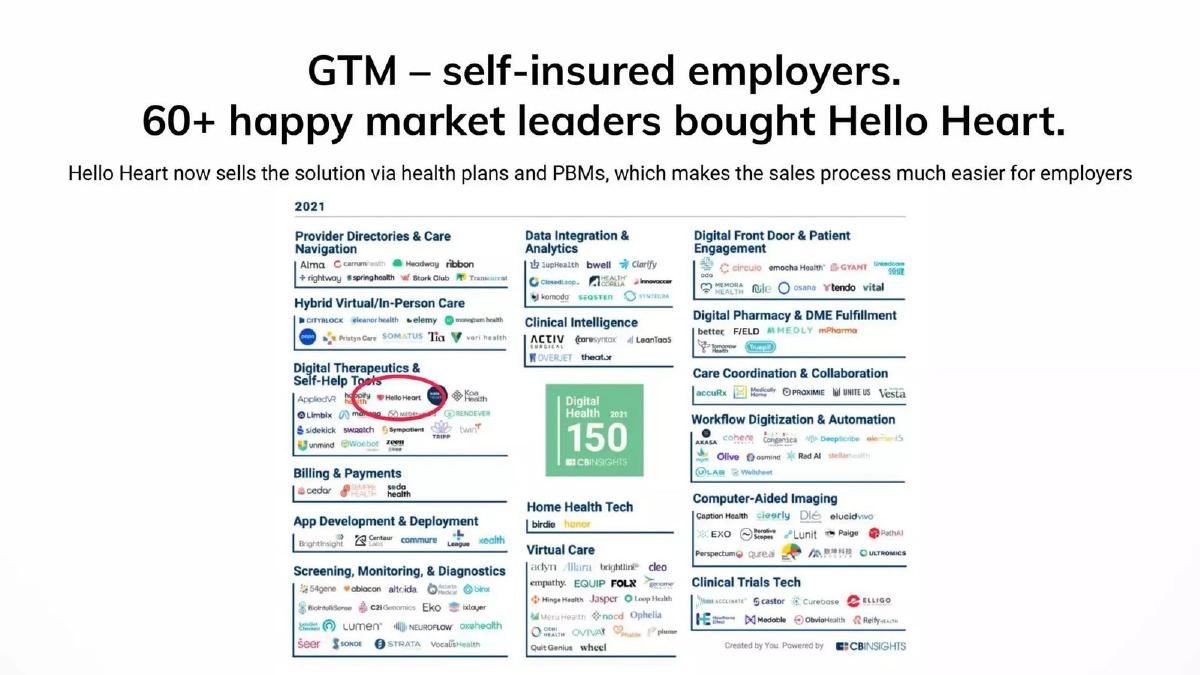
Hello Heart deck, slide 4. Exact stored slide matched to this analysis.
Our analysis: Buyer, count and channel.
Evidence and limitation: It names the buyer, a customer count and the intermediaries it sells through. The customers aren't named, and the market map is recognition rather than go-to-market proof.
What a founder can adapt: "[N] [buyer type] customers; now sold via [channel], cutting sales cycle to [X] months."
Supporting analysis
What the deck claims: "GTM – self-insured employers." "60+ happy market leaders bought Hello Heart." "Hello Heart now sells the solution via health plans and PBMs, which makes the sales process much easier for employers." A 2021 CB Insights "Digital Health 150" map with Hello Heart circled.
Presentation choice: Selling through health plans and PBMs explains how it reaches many employers.
When it does not fit: Using an award graphic in place of channel data.
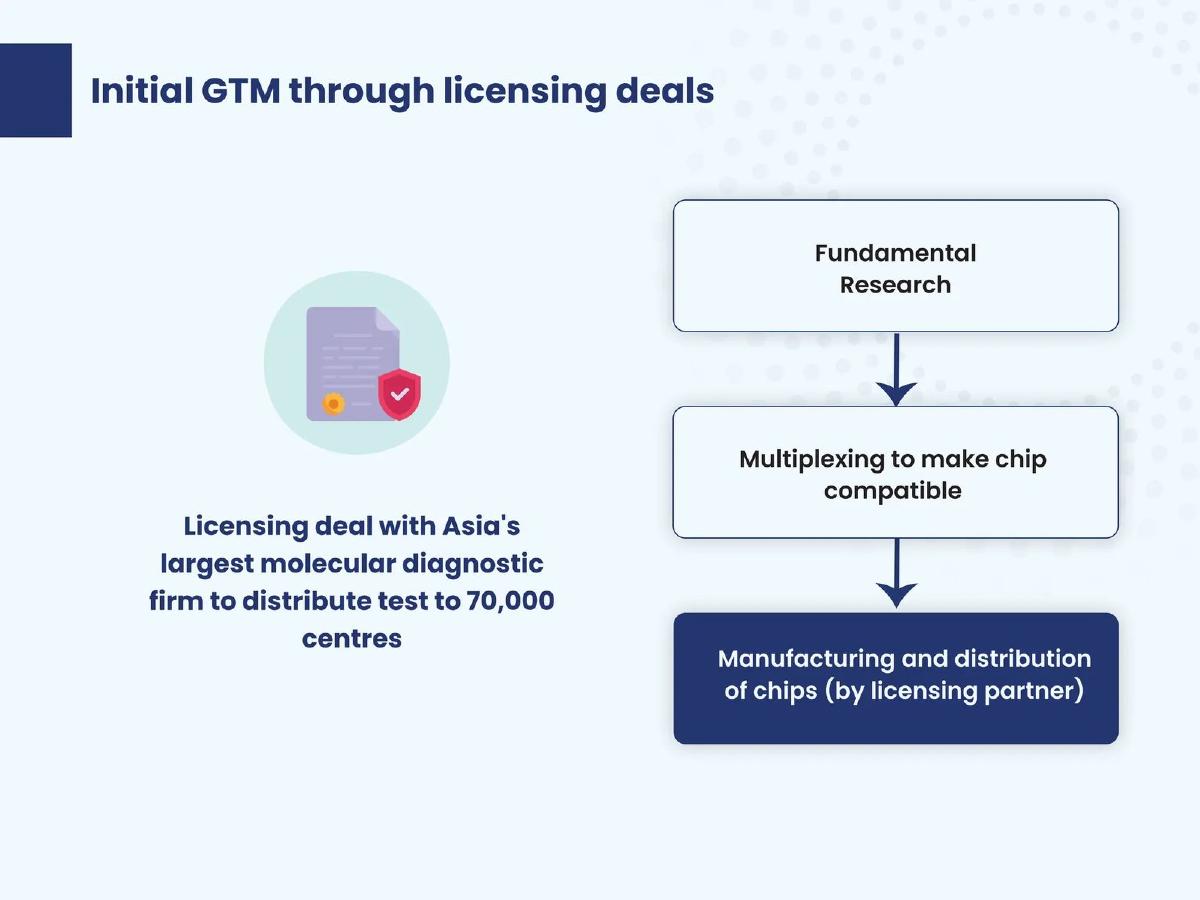
Oncocheck deck, slide 15. Exact stored slide matched to this analysis.
Our analysis: Licensing for distribution.
Evidence and limitation: It shows the company handing manufacturing and distribution to a partner with reach. The partner isn't named, and "70,000 centres" is reach, not tests sold.
What a founder can adapt: "Licensed to [partner]: [N] sites, [royalty]%, first revenue [date]."
Supporting analysis
What the deck claims: "Initial GTM through licensing deals." "Licensing deal with Asia's largest molecular diagnostic firm to distribute test to 70,000 centres." Flow: "Fundamental Research" → "Multiplexing to make chip compatible" → "Manufacturing and distribution of chips (by licensing partner)."
Presentation choice: Shows how a small team can reach many sites without building a sales force.
When it does not fit: Partner reach presented as volume.
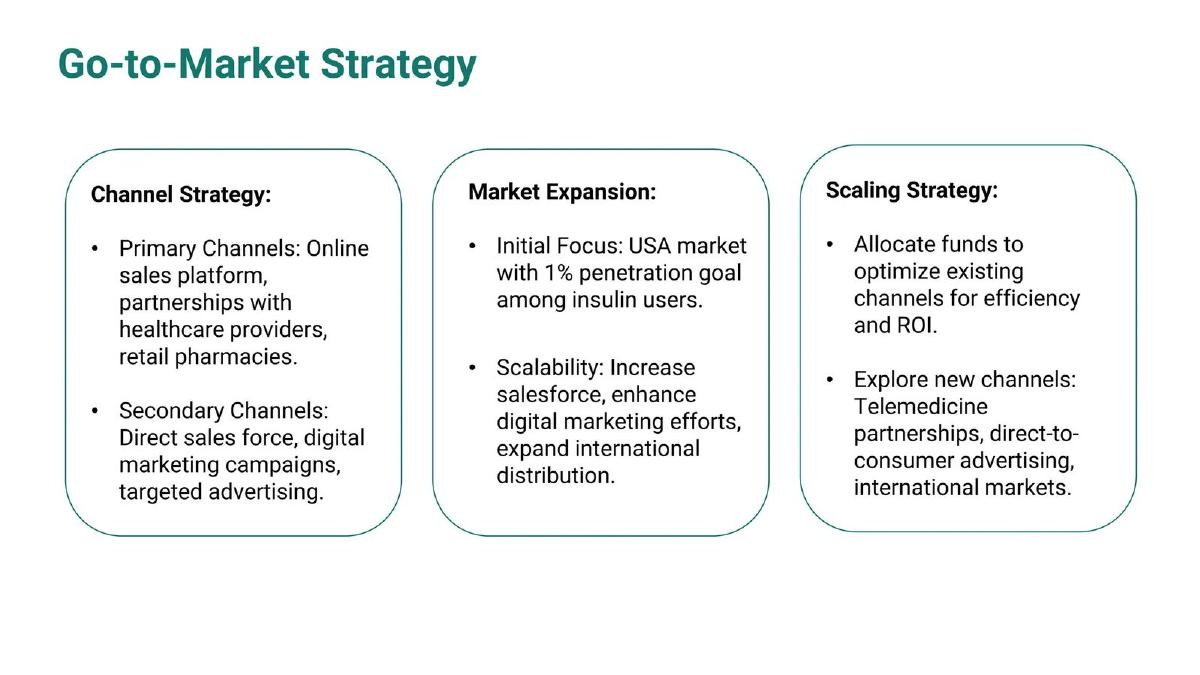
U-Pump deck, slide 8. Exact stored slide matched to this analysis.
Our analysis: Many channels, no payer.
Evidence and limitation: Weaker example. It lists many channels and a penetration target but doesn't mention who pays (insurance coverage) or regulatory timing.
What a founder can adapt: "After [clearance], launch via [channel]; coverage from [payer]; [N] prescribers in pilot."
Supporting analysis
What the deck claims: "Go-to-Market Strategy." "Channel Strategy: Primary Channels: Online sales platform, partnerships with healthcare providers, retail pharmacies. Secondary Channels: Direct sales force, digital marketing campaigns, targeted advertising." "Market Expansion: Initial Focus: USA market with 1% penetration goal among insulin users." "Scaling Strategy: … Explore new channels: Telemedicine partnerships, direct-to-consumer advertising, international markets."
Presentation choice: For a device, insurance coverage often decides adoption; the slide leaves it out.
When it does not fit: Listing channels before saying who pays.
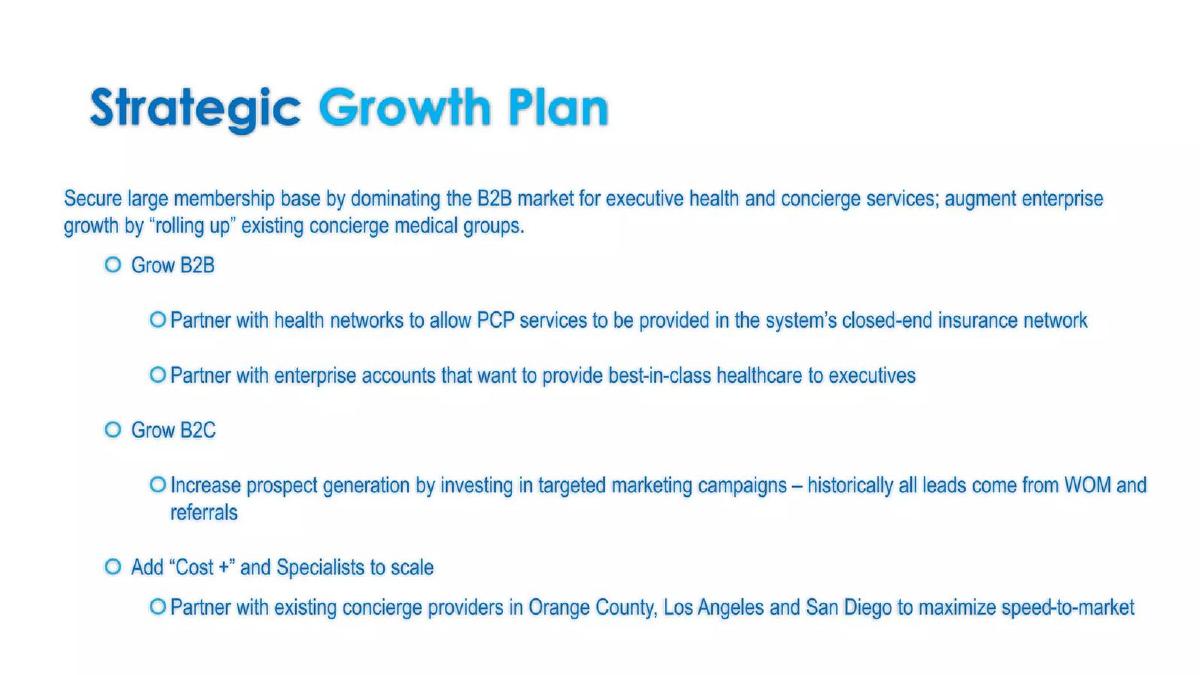
PersonalCare deck, slide 10. Exact stored slide matched to this analysis.
Our analysis: Honest about lead sources.
Evidence and limitation: It separates business and consumer growth and admits leads so far came from word of mouth and referrals. It names no partners or targets.
What a founder can adapt: "[X]% of members from referrals; [N] enterprise accounts; [M] networks in talks."
Supporting analysis
What the deck claims: "Strategic Growth Plan." "Secure large membership base by dominating the B2B market for executive health and concierge services; augment enterprise growth by 'rolling up' existing concierge medical groups." "Grow B2B — Partner with health networks … Partner with enterprise accounts." "Grow B2C — Increase prospect generation by investing in targeted marketing campaigns – historically all leads come from WOM and referrals." "Partner with existing concierge providers in Orange County, Los Angeles and San Diego."
Presentation choice: Saying where leads come from today helps investors judge the plan.
When it does not fit: Growth plans with no targets.
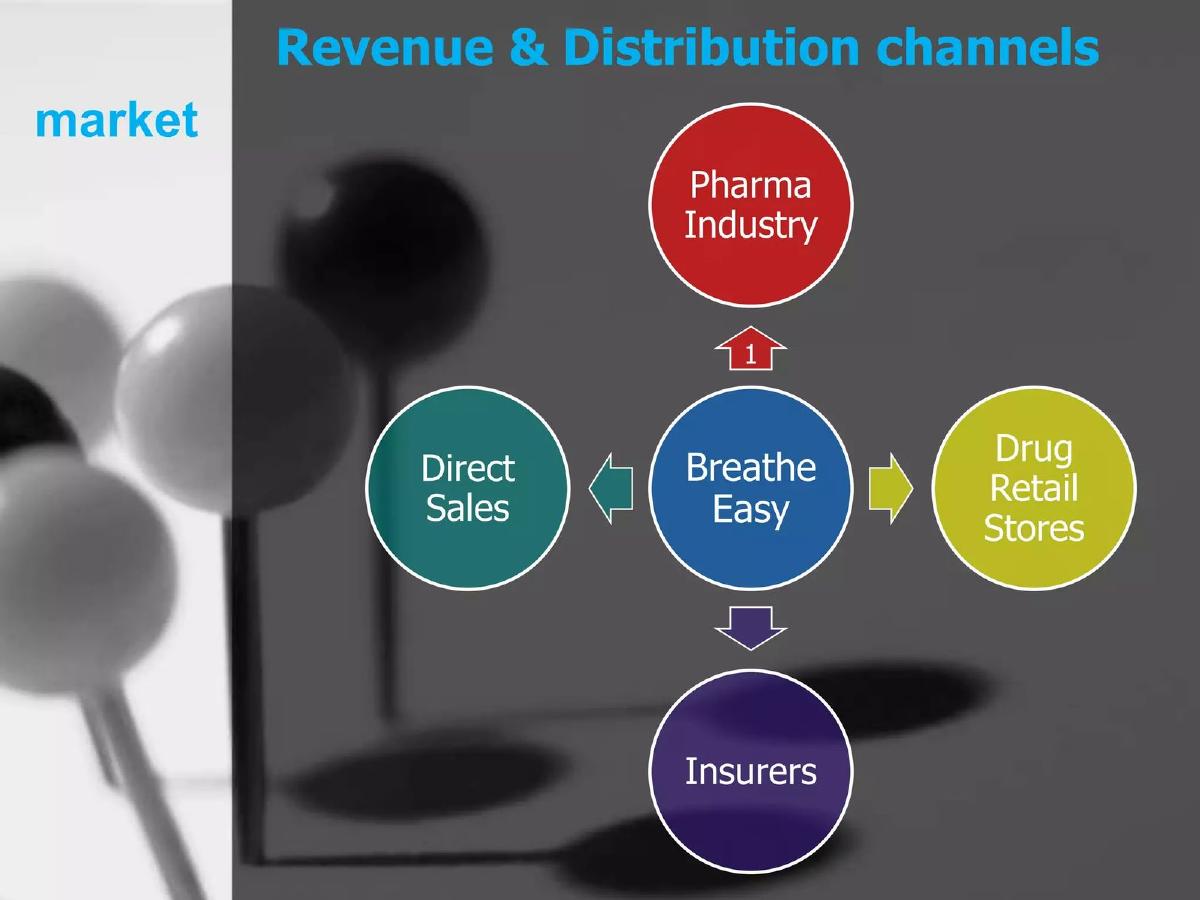
Breathe Easy deck, slide 9. Exact stored slide matched to this analysis.
Our analysis: Channel names only.
Evidence and limitation: Weaker example. It names four channels and a first priority but gives no reason, price, partner or status.
What a founder can adapt: "First: [pharma partner] bundles device with [drug]; $[X]/unit; LOI signed [date]."
Supporting analysis
What the deck claims: "Revenue & Distribution channels." Four circles around the company: "Pharma Industry" (marked "1"), "Direct Sales", "Drug Retail Stores", "Insurers".
Presentation choice: Investors can't tell how any channel would work.
When it does not fit: A channel diagram with no detail.
Which kind of healthcare go-to-market slide answers which question.
Approach
Example
Answers
Leaves open
Paying buyers with costs
HealthCaters
Who pays and why
Sources
Buyer, count and intermediaries
Hello Heart
How it reaches employers
Named customers
Licensing partner
Oncocheck
Distribution without a sales force
Partner name, volume
Channel list and target
U-Pump
Where it might sell
Who pays
Business and consumer growth plan
PersonalCare
Current lead sources
Targets, partners
Channel diagram
Breathe Easy
Channel names
Everything else
Key Takeaways
Say who pays, not just who uses.
Give the buyer's reason to pay.
Name the channel that reaches the buyer.
Show proof the channel works.
Channel names alone aren't a plan.
Write your healthcare go-to-market slide
Answer these before you design the slide.
Payer. Who pays: employer, insurer, health system, patient?
Reason. What cost or outcome makes them pay, and what's the source?
Channel. Who reaches that buyer: brokers, health plans, a licensing partner, your own sales team?
Proof. Which buyers or partners have signed, and how long did the sale take?
Copyable framework: [Payer] pays because [cost/outcome] ([source]). We reach them through [channel]. Signed: [names/count]; sales cycle [X] months.
Illustrative example 1 — written by us
Before: "Revenue & Distribution channels." [Pharma Industry, Direct Sales, Drug Retail Stores, Insurers]
After: "First channel: [pharma partner] bundles device with [drug]; [terms]; later [insurer] coverage."
What improved: Our illustrative rewrite of Breathe Easy's slide; bracketed text is a placeholder, not company fact.
What's different about healthcare go-to-market
The user, the buyer and the payer are often different: an employee uses the app, the employer buys it, an insurer may fund it. Sales can run through intermediaries such as health plans, benefits brokers, pharmacy benefit managers, hospital networks or diagnostics firms. Investors look for a named buyer with a reason to pay and a channel that already has access to them.
What investors check
Who pays and why. Which channel reaches that buyer. Whether any buyer or partner has signed. How long a sale takes, and what it costs.
How we read each slide
We quote the text on the slide images. We have not checked any cost, customer or partner claim. Page numbers are pages in the original deck file. Five pages were rendered from those files; Hello Heart's page was already in our stored image set and was reused.
Common mistakes
No payer. Say who pays, not just who uses.
Unsourced savings. Cite the study or pilot behind cost claims.
Partner reach as volume. Sites or members reached aren't sales.
Channel names only. Add terms, status or a number.
Diagnostic checklist
Payer named.
Reason to pay, with source.
Channel to the buyer named.
Signed buyers or partners shown.
Frequently asked questions
How should a healthcare startup show its go-to-market on a pitch deck?
Name who pays, why, and the channel that reaches them. HealthCaters shows employers and insurers with a cost for each; Hello Heart names self-insured employers and says it sells through health plans and PBMs.
Is a list of distribution channels enough?
No. Breathe Easy lists pharma, direct sales, drug stores and insurers without terms or status. Add who pays, a price and which partners have signed.
How we chose these examples
Corpus: published pitch deck teardowns on StartupFundraising.com. Founder-uploaded private decks are excluded.
Selection (2026-09-26): we searched healthcare teardowns for go-to-market, distribution, sales and commercialisation headings, scanned nine candidate decks page by page, and kept six. Heidi Health is excluded because it appears in the AI go-to-market guide.
Excluded: Medeloop (no go-to-market page in the deck file), Medifies (the matching page is a funding summary), DiabetesProject (the business flow page doesn't describe a channel plan).
Page numbers are pages in the original deck files; for Oncocheck, Breathe Easy and PersonalCare they differ from the numbering in the teardown text. Hello Heart's page was already stored and was reused; the other five were rendered from the deck PDFs and stored with the existing slide-image workflow. All six decks were confirmed as published teardowns on 2026-09-26.
Costs, customers, partners and reach are quoted from the slides and not independently verified.
Review: slide images were checked on 2026-09-26 and matched to company, deck and page (editorial model review). No person has yet completed an editorial review of this page. We make no claim that any slide caused a fundraising outcome.