Oncocheck presents a compelling case for the necessity of multi-cancer early detection (MCED), citing that a one-month delay in treatment increases death risk by ~10%. The company leverages a multi-omics approach—combining metabolites, proteomics, and transcriptomics—processed through proprietary deep learning models to achieve high sensitivity and specificity. Their go-to-market strategy is notably capital-light, focusing on licensing deals with major molecular diagnostic firms to reach 70,000 centers. While the deck provides strong technical validation through AUC metrics for various biomar…
Key takeaways
- Early detection of prostate and breast cancer results in a ~98% survival rate compared to <30% for late-stage detection (Slide 2).
- The company targets a cumulative test cost of <$1000 with a <5% chance of false detection (Slide 3).
- Oncocheck positions itself in the high-sensitivity, high-specificity quadrant against competitors like Galleri, Natera, and Freenome (Slide 4).
- The technical moat is built on a multi-omics pipeline including structural embeddings and pathway enrichment (Slide 5).
- Strategic partnerships with hospitals like AIIMS, BHU, and HCG provide the 'System of Record' for high-quality data (Slide 6).
- Biomarker validation includes MicroRNA with an AUC of 0.95 and Proteomics with AUCs of 0.96 and 0.90 (Slide 7).
- The initial GTM strategy relies on a licensing deal with Asia's largest molecular diagnostic firm for distribution to 70,000 centers (Slide 8).
- The $2M funding request is split: $1.25M for processing 5k samples, $500k for ML, and $250k for operations (Slide 10).
Oncocheck Pitch Deck Analysis
Oncocheck is entering the highly competitive but high-stakes field of Multi-Cancer Early Detection (MCED). The deck focuses heavily on the clinical necessity of early detection and the technical superiority of a multi-omics approach. By combining multiple biological signals with machine learning, they aim to provide a test that is 'Most Accurate, Least Painful, and Most Affordable.'
Slide 1: Title Slide
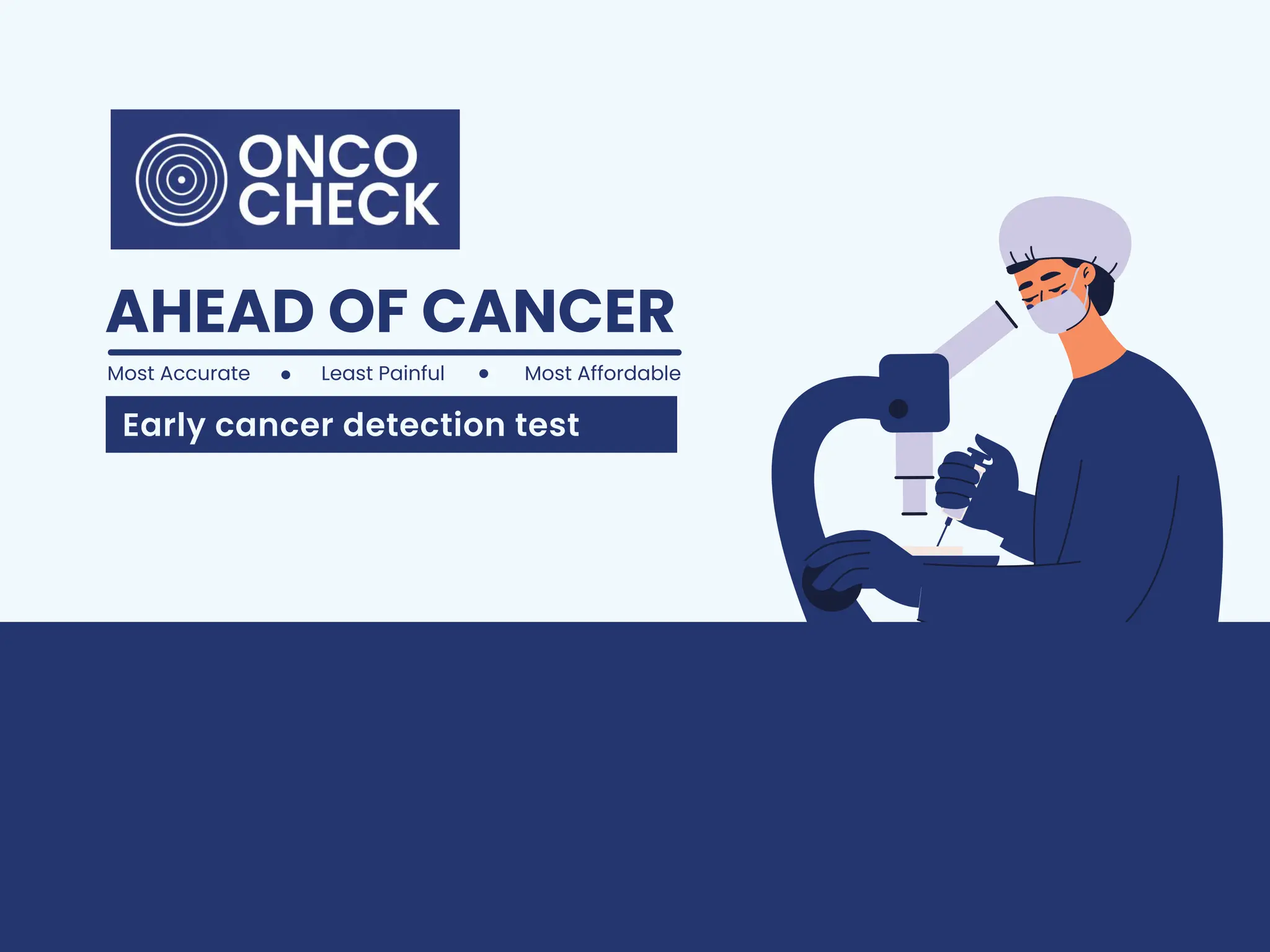
The cover slide establishes the brand identity and core value proposition. The tagline 'Ahead of Cancer' is supported by three pillars: Most Accurate, Least Painful, and Most Affordable. It clearly identifies the product as an 'Early cancer detection test.' The visual of a researcher at a microscope reinforces the scientific nature of the venture.
Slide 2: The Clinical Problem
This slide uses a stark bar chart to compare survival rates between early and delayed detection across five cancer types: Prostate, Breast, Colon & Rectum, Lung and Bronchus, and Pancreas. The headline metric is powerful: 'Every month delay in cancer treatment raises risk of death by ~10%.' It notes that survival for prostate and breast cancer is ~98% with early detection but drops to <30% in late-stage cases. This sets a high-stakes emotional and clinical stage for the solution.
Slide 3: The MCED Solution
Oncocheck introduces Multi-cancer early detection (MCED) tests as 'the way of the future.' The slide lists three key performance indicators for their ideal test: a <5% chance of false detection, the potential to screen for cancers causing 80% of deaths, and a cumulative cost of <$1000. The graphic implies that more screening can be achieved at 'zero additional cost' compared to the current fragmented screening landscape.
Slide 4: Competitive Landscape
The company uses a standard 2x2 matrix, plotting Sensitivity against Specificity. Oncocheck places itself in the top-right corner, indicating superior performance in both metrics. They position themselves above established players and well-funded startups including Mirxes, Freenome, Exai, Galleri (Grail), Natera, Syantra, and Datar Cancer Genetics. Traditional methods like CT scans and mammograms are clustered in the high-sensitivity but lower-specificity area.
Slide 5: The Multi-Omics Approach
This technical slide explains the 'how.' The process starts with a single blood test, which is then analyzed for Metabolites, Proteomics, and Transcriptomics. These inputs are converted into Structural Embeddings, Pathway Enrichment, and Expression Values. This data feeds into a 'Proprietary Deep ML Model' to produce a Cancer Prediction. The mention of 'Saliency Maps' suggests a level of interpretability in their AI models, which is crucial for clinical adoption.
Slide 6: IP and Moat
Oncocheck identifies three pillars for their competitive moat: System of Record: High-quality data from partnerships with major Indian hospitals like AIIMS, BHU, and HCG. Foundational Biological ML Models: Models that understand biomarkers across varied fields. New Cheaper ways to detect biomarkers: Research into 'quantum dots' to lower the cost of biomarker detection for price-sensitive markets.
Slide 7: Biomarker Validation
This slide provides the 'receipts' for their technical claims. It shows three categories of biomarkers with their respective Area Under the Curve (AUC) scores. MicroRNA shows an AUC of 0.95. Metabolomics shows an AUC of 0.8. Proteomics shows the highest results with AUCs of 0.96 and 0.90, specifically noting a fusion gene product found in all PCa (Prostate Cancer) samples. This level of data is essential for biotech investors.
Slide 8: Go-To-Market (GTM) Strategy
The GTM strategy is focused on licensing rather than direct-to-consumer or building a proprietary lab network. They highlight a 'Licensing deal with Asia's largest molecular diagnostic firm' to distribute the test to 70,000 centres. The workflow shows Oncocheck handling Fundamental Research and Multiplexing, while the partner handles manufacturing and distribution of the chips. This is a highly scalable, asset-light approach.
Slide 9: Market Opportunity
The slide argues for a '$10 B dollar revenue company' potential. It cites three supporting facts: the US spent $80B on cancer screening last year, over 100 million people are covered for healthcare-enabled screening tests, and over $2 billion is spent annually on 'unnecessary biopsies.' By reducing unnecessary biopsies and capturing a portion of the screening market, the revenue target is framed as attainable.
Slide 10: Funding and Roadmap
The final slide attached details a $2M raise. The allocation is specific: $1.25M for processing 5k samples, $500k for ML computation, and $250k for operations. The timeline is split into two phases: Preclinical Phase (June 2024 - Dec 2024): Focusing on centre establishment, sampling, and ML modelling. Approvals and Market Entry (Sept 2024 - Dec 2025): Covering clinical trials and seeking regulatory nods from NABL, CDSCO, and the FDA.
What Works in the Oncocheck Deck
The deck excels at communicating a complex scientific process simply. The multi-omics pipeline on Slide 5 is easy to follow, and the biomarker validation on Slide 7 provides the necessary technical evidence to back up the claims. The licensing GTM strategy on Slide 8 is a standout; it shows the founders understand the massive capital requirements of building a diagnostic lab and have chosen a more efficient path to scale through partnerships. The clear breakdown of the $2M ask on Slide 10 demonstrates fiscal responsibility and a clear plan for the next 18 months.
What is Missing from the Oncocheck Deck
The most glaring omission in the provided slides is a Team Slide . In early-stage biotech, the pedigree of the scientists and the experience of the founders in navigating regulatory pathways are often more important than the initial data. There is also no mention of Unit Economics beyond a target cost of <$1000. Investors would want to know the expected margin on the licensing deals. Furthermore, while they mention partnerships with hospitals like AIIMS, there are no Letters of Intent (LOIs) or specific details on the status of the 'licensing deal with Asia's largest molecular diagnostic firm'—is it signed, or in negotiation? Finally, a Risk Factors slide is missing, which is standard for med-tech to address regulatory hurdles and clinical trial failure risks.
Founder Takeaways
Lead with the 'Why': Slide 2 effectively uses mortality statistics to create urgency. Founders in health-tech should always anchor their pitch in the human cost of the status quo. · Validate with Data: Using AUC scores (Slide 7) is the correct way to present diagnostic accuracy to sophisticated investors. Avoid vague terms like 'very accurate' and use industry-standard metrics. · Asset-Light GTM: If you are a research-heavy startup, consider the licensing model shown on Slide 8. It can be much more attractive to investors than a plan that requires $50M+ to build out physical infrastructure. · Specific Use of Funds: The breakdown on Slide 10 is a model for how to present an 'Ask.' It ties the dollar amounts directly to tangible milestones like 'process 5k samples.'
Frequently asked questions
- What is the primary problem Oncocheck is solving?
- Oncocheck addresses the high mortality rate associated with late-stage cancer detection. According to Slide 2, every month of delay in treatment increases the risk of death by approximately 10%. They aim to replace invasive or single-organ screenings with a non-invasive, multi-cancer early detection (MCED) blood test that is more affordable and accurate.
- How does Oncocheck differentiate its technology from existing screenings?
- Unlike traditional methods like CT scans, mammograms, or PSA tests, Oncocheck uses a multi-omics approach. Slide 5 and 7 show they analyze metabolites, proteomics, and transcriptomics simultaneously. By using proprietary deep learning models to process these diverse data points, they claim higher sensitivity and specificity than both traditional screenings and several liquid biopsy competitors.
- What is the company's business model and go-to-market strategy?
- Oncocheck is pursuing a licensing-first model rather than building its own laboratory infrastructure. Slide 8 details an initial GTM through licensing deals, specifically mentioning a deal with Asia's largest molecular diagnostic firm to distribute the test to 70,000 centers. This allows them to focus on research and multiplexing while the partner handles manufacturing and distribution.
- What are the specific technical metrics provided for their test's accuracy?
- The deck provides Area Under the Curve (AUC) values for different biomarkers on Slide 7. They report three specific miRNA biomarkers with an AUC of 0.95, metabolomic biomarkers with an AUC of 0.8, and 20 proteins with AUCs of 0.96 and 0.90. These figures are intended to validate the predictive power of their multi-omics approach.
- What is the funding ask and how will the capital be used?
- Oncocheck is raising $2M. Slide 10 breaks this down into $1.25M for processing 5,000 samples to collect multi-omic data, $500k for machine learning computation and model refining, and $250k for operational expenses. This capital is intended to carry them through the preclinical phase ending in December 2024.