Omen AI’s 10-slide deck is a concise, high-signal presentation that successfully raised $31 million in Series A funding. The company addresses the increasing risk of liquid cooling failures in high-density data centers. By combining custom spectroscopy hardware with machine learning, Omen moves maintenance from reactive quarterly lab tests to real-time, actionable insights. The deck excels by anchoring its value proposition in the massive shift toward liquid cooling—projected to grow from 30% to 80% by 2030. While it lacks traditional slides like a full team bio or detailed financial projecti…
Key takeaways
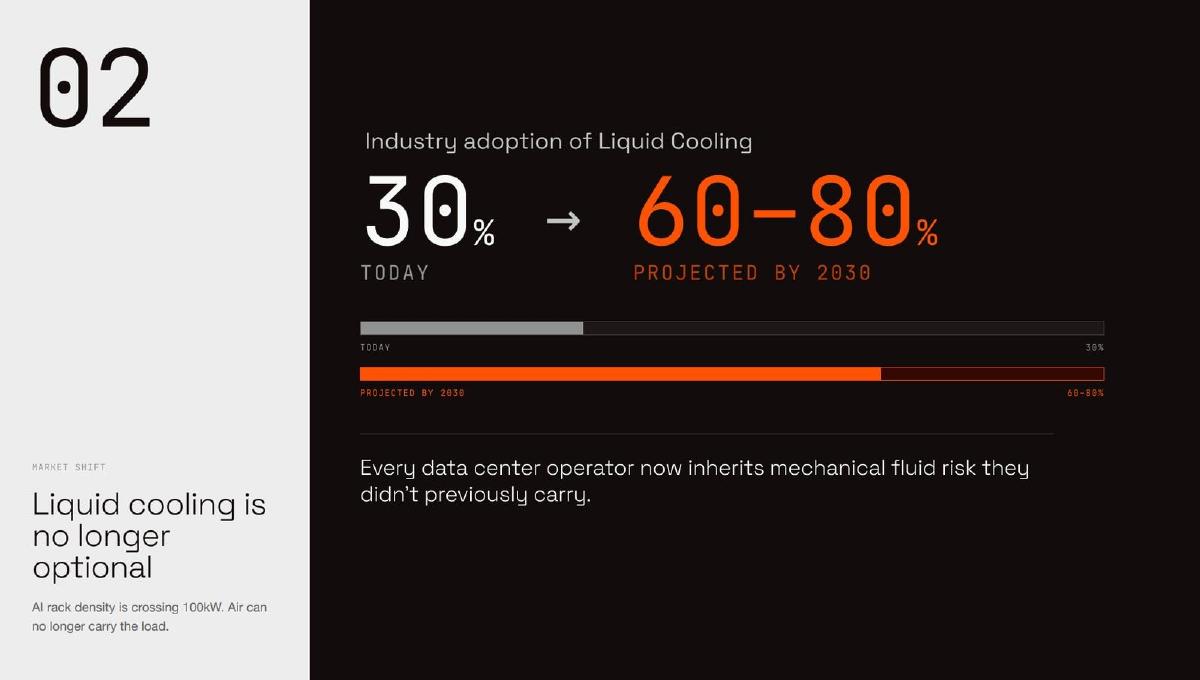
- The deck identifies a massive market shift: liquid cooling adoption is projected to rise from 30% today to 60-80% by 2030 (Slide 3).
- Omen highlights a critical gap in legacy maintenance, noting that quarterly lab tests cannot detect failures that develop in mere days (Slide 4).
- The product combines custom spectroscopy hardware with AI to provide 'clinical-grade data' from noisy industrial environments (Slide 6).
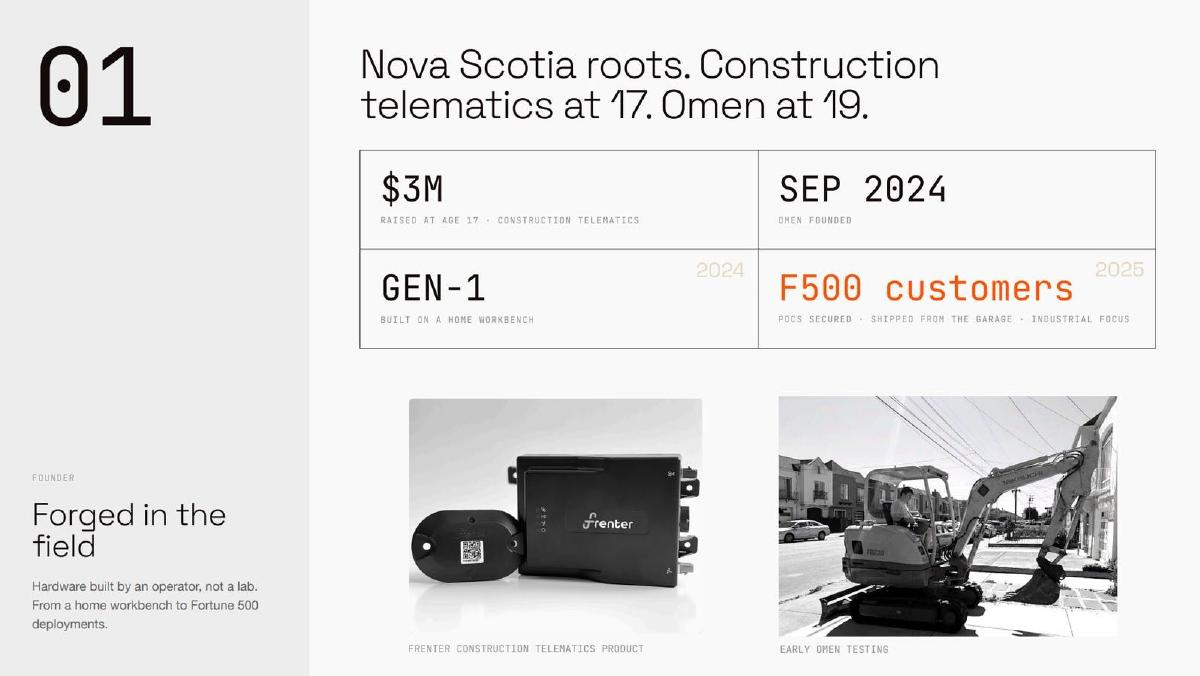
- The founder, Zach Laberge, emphasizes his 'forged in the field' background, having raised $3M for a previous startup at age 17 (Slide 2).
- The solution integrates directly into Data Center Infrastructure Management (DCIM) software to automate work orders (Slide 7).
- Omen claims its fluid optimization can unlock 5-10% in thermal headroom for GPUs (Slide 8).
- The capitalization slide reveals a high-profile investor list including Nava Ventures, CRV, and Sheryl Sandberg (Slide 9).
- The deck omits a traditional 'Ask' slide, focusing instead on the recent $31M Series A milestone as a signal of momentum (Slide 9).
The Strategic Context of Omen AI
Omen AI entered the market at a pivotal moment in the infrastructure cycle. As reported by Business Insider, the company raised a $31 million Series A in 2024. This funding was predicated on a single, undeniable truth: the AI boom is a heat problem. As Nvidia and its competitors push chip densities higher, the data center industry is being forced to abandon air cooling for liquid cooling. Omen positions itself as the essential 'immune system' for these new, liquid-cooled environments.
Slide 1: The Hook
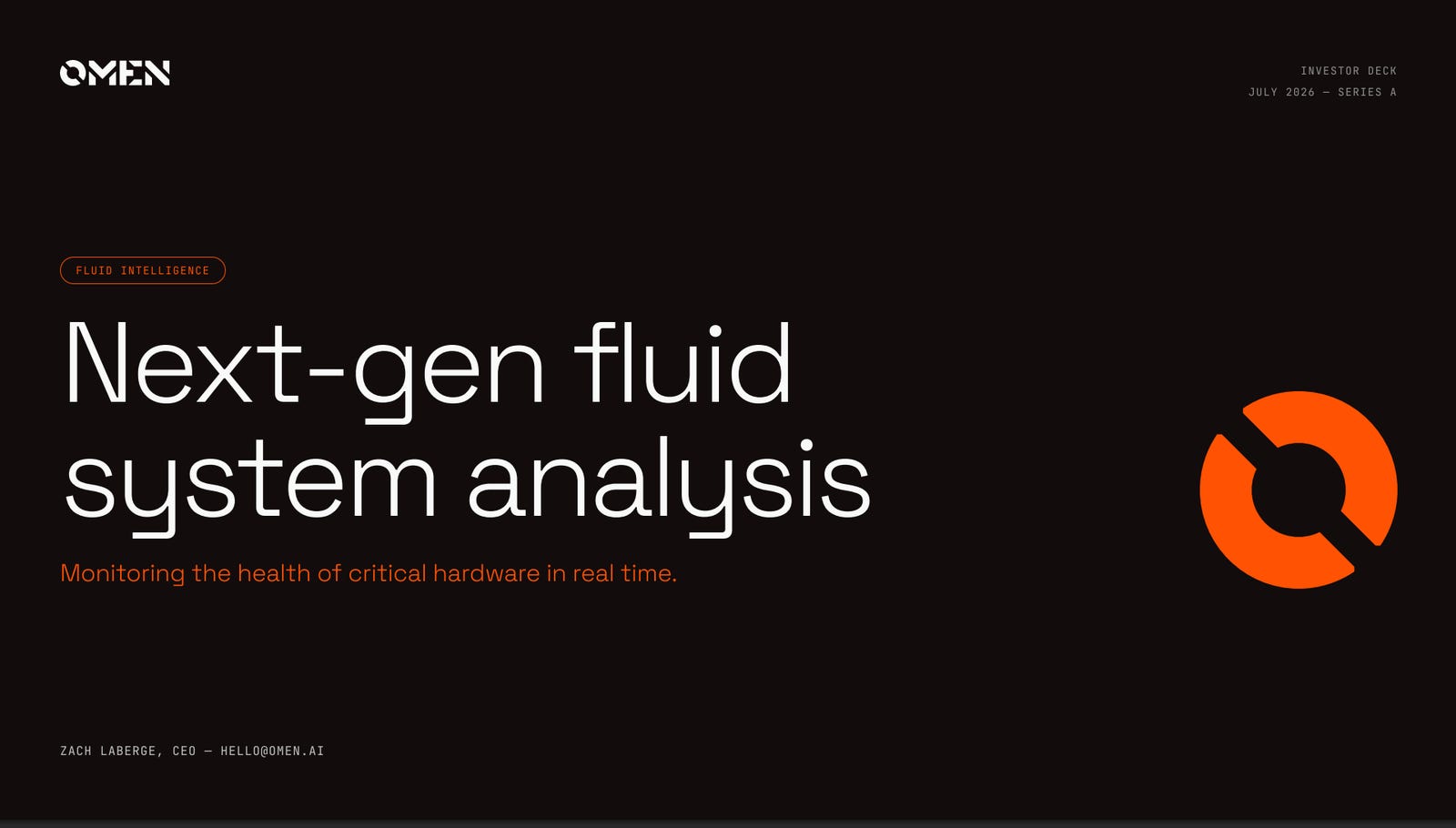
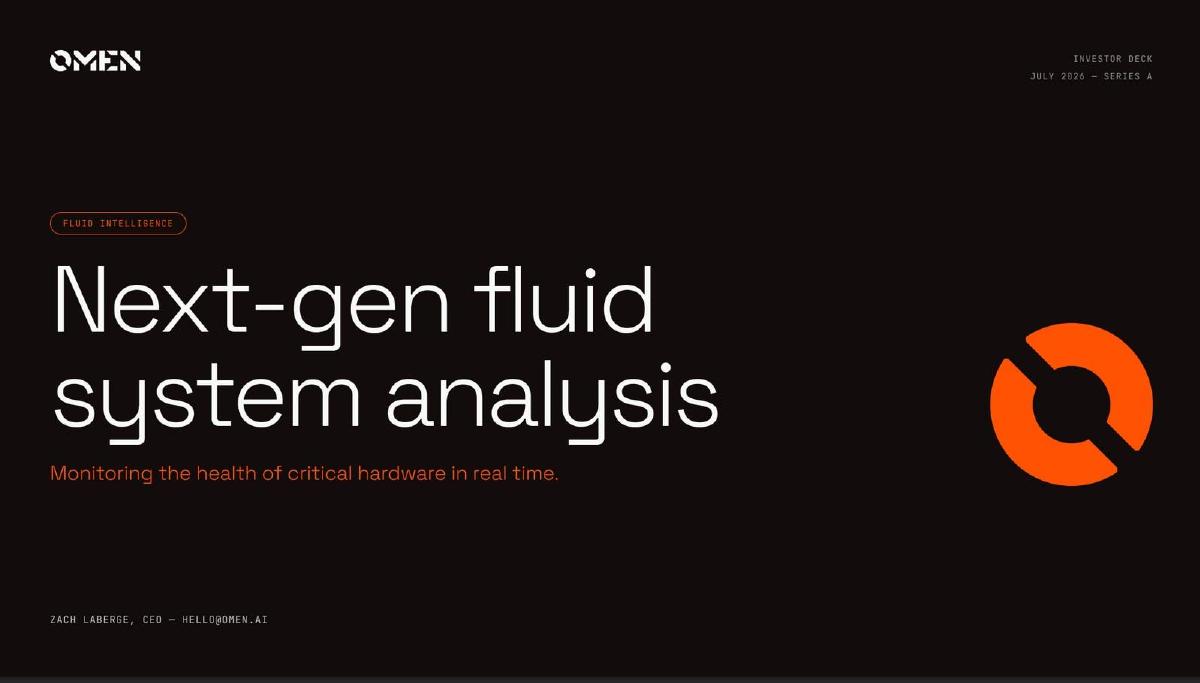
The title slide is minimalist, using the phrase Next-gen fluid system analysis . It immediately establishes the niche: Fluid Intelligence. By sub-titling the slide 'Monitoring the health of critical hardware in real time,' Omen signals that this is not just a software play, but a hardware-enabled reliability platform. The branding is dark and industrial, fitting for a company selling into the 'gray space' of data centers.
Slide 2: The Founder Pedigree
Slide 2, titled Forged in the field , is a masterclass in establishing founder-market fit without a long resume. Zach Laberge highlights his 'Nova Scotia roots' and his history as a teenage founder. The slide notes he raised $3M for a construction telematics startup at age 17 and founded Omen at 19. This narrative counters potential age bias by showing a track record of building rugged hardware ('built on a home workbench') that successfully reached 'Fortune 500 deployments' by 2025. It establishes him as an operator, not an academic.
Slide 3: The Market Shift
This is the 'Why Now?' slide. It presents a stark statistic: Industry adoption of Liquid Cooling is moving from 30% today to 60-80% by 2030 . The slide explicitly states that 'Air can no longer carry the load' as rack density crosses 100kW. This creates a massive, newly addressable market of data center operators who are 'inheriting mechanical fluid risk' they never had to manage before. It transforms Omen from a 'nice-to-have' into a mandatory insurance policy for AI infrastructure.
Slide 4: The Problem Gap
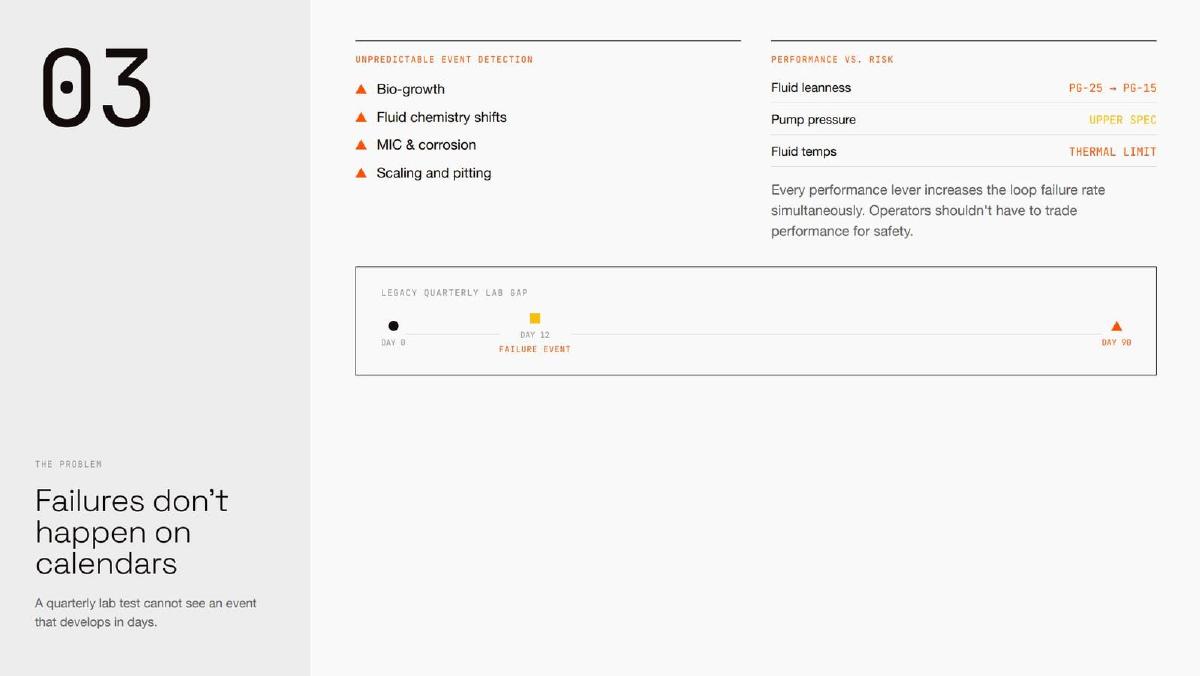
Slide 4 identifies the specific failure of the status quo. Titled Failures don't happen on calendars , it visualizes the 'Legacy Quarterly Lab Gap.' A timeline shows a lab test at Day 0 and another at Day 90. However, a 'Failure Event' is shown occurring at Day 12. The slide lists unpredictable threats like bio-growth, MIC (microbiologically influenced corrosion), and pitting. The core argument is that manual sampling is too slow for the speed of modern hardware degradation.
Slide 5: The Vision
This is a transition slide that asks a rhetorical question: What if machines could monitor and maintain themselves? It serves to elevate the company's mission from 'selling sensors' to 'enabling autonomous infrastructure.' It bridges the gap between the gritty reality of corrosion and the high-level promise of AI-driven maintenance.
Slide 6: The Product (Hardware)
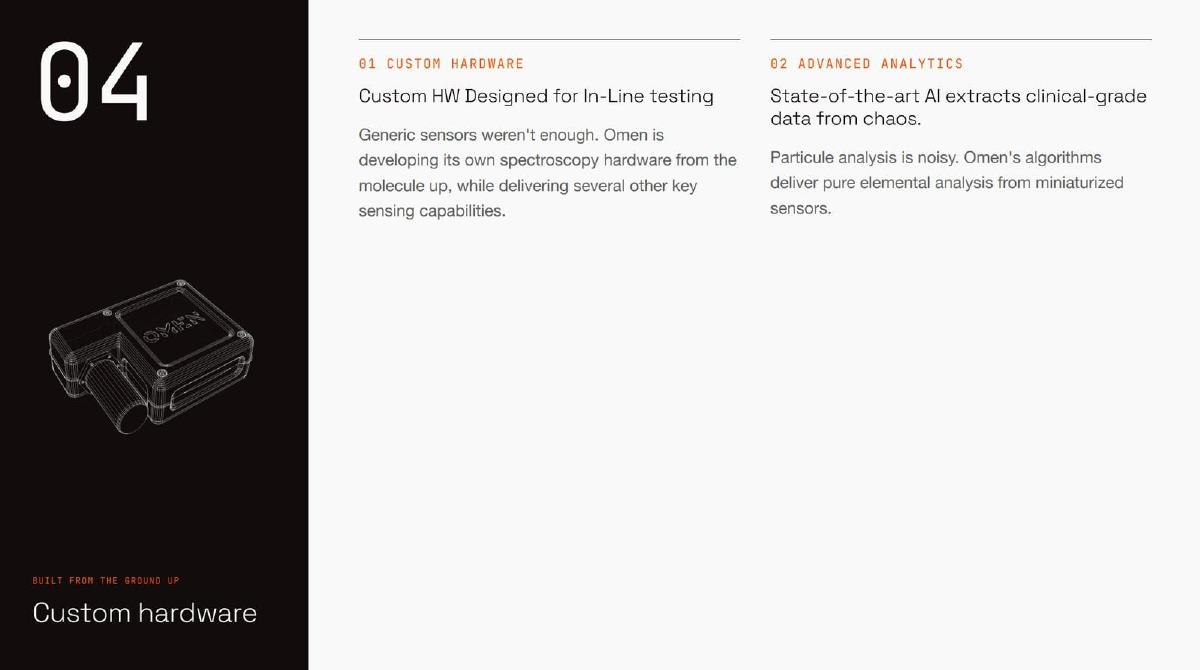
Omen addresses the 'hardware is hard' skepticism by showing a wireframe of their Custom hardware . They claim that 'generic sensors weren't enough' and that they are developing proprietary spectroscopy hardware. The slide emphasizes 'clinical-grade data' and 'pure elemental analysis.' By miniaturizing what used to require a full lab, Omen justifies its technical moat.
Slide 7: The Product (Software & Integration)
Slide 7, Omen's engine , explains the workflow: Sense, Interpret, Act. It highlights that the system provides 'PPM (parts-per-million) resolution' and, crucially, integrates directly into the customer's DCIM (Data Center Infrastructure Management) . This integration is vital because it means Omen doesn't just provide an alert; it triggers a specific work order, reducing the cognitive load on data center staff.
Slide 8: The Value Proposition
The Three buckets of value slide quantifies the ROI. 1) Reduce Downtime by catching bio-growth before failure. 2) Run GPUs Harder by unlocking 5-10% thermal headroom through fluid optimization. 3) Increase Lifetime by maintaining chemistry. The mention of 'protecting billions in fixed GPU capex' speaks directly to the CFOs of major cloud providers.
Slide 9: The Capitalization
Instead of a traditional 'Ask' slide, Omen uses Slide 9 to show strength. It declares $41.5M total capitalization following the recent $31M Series A. The list of investors is top-tier: Nava Ventures (Lead), CRV, and Caffeinated Capital. The 'Strategic Angels' section is particularly impressive, featuring Sheryl Sandberg and executives from Lambda and CoreWeave . This slide proves that the industry's biggest players are already betting on Omen's solution.
Slide 10: The Closing
The deck ends with a simple, bold statement: Protecting the world's most important hardware. It reinforces the high stakes of the problem they are solving.
What Omen AI Does Exceptionally Well
The deck is remarkably focused. It doesn't waste time on generic 'AI is big' slides. Instead, it focuses on the physical reality of AI: heat and fluid. By identifying the 'Quarterly Lab Gap,' they create a sense of urgency that makes their real-time solution feel inevitable. The use of a 'Founder' slide that emphasizes field experience over academic credentials is also a smart move for a hardware startup, where execution risk is often higher than research risk.
What is Missing from the Deck
While the deck was clearly successful, it omits several standard components. There is no Competitor Matrix , which is surprising given that industrial sensor companies (like Emerson or Honeywell) have existed for decades. There is also no Unit Economics or Financial Projections slide. While these were likely in a data room, their absence in the main deck suggests Omen relied heavily on the 'Market Shift' and 'Investor Signal' to carry the narrative. Finally, there is no Team Slide beyond the founder; for a $31M raise, investors usually want to see the engineering and chemistry talent behind the 'custom spectroscopy.'
Founder Takeaways: What to Copy
The 'Why Now' Slide: Copy the way Omen uses a specific industry transition (Air to Liquid cooling) to justify their existence. If your market is undergoing a fundamental shift, make that the centerpiece of your deck. · Visualizing the Gap: Slide 4's timeline of a failure happening between scheduled tests is a perfect way to visualize a 'hidden' problem. Use simple diagrams to show why the current way of doing things is broken. · Strategic Angels: Omen didn't just get money; they got money from the COO of CoreWeave (a major GPU cloud). Founders should prioritize 'Strategic Angels' who represent their target customers or partners, as this provides massive validation to lead VCs. · Actionable Output: Don't just say you provide 'data.' Show that you provide 'work orders' (Slide 7). Investors love solutions that integrate into existing workflows rather than creating new ones.
Frequently asked questions
- What specific problem does Omen AI solve for data centers?
- Omen AI solves the 'Legacy Quarterly Lab Gap.' Traditional data centers rely on manual fluid samples sent to labs every 90 days. However, cooling system failures—such as bio-growth, corrosion, or chemistry shifts—can occur in as little as 12 days. Omen provides continuous, real-time monitoring to prevent these catastrophic 'thermal events' before they cause downtime.
- How does Omen AI differentiate its hardware from generic sensors?
- According to Slide 6, generic sensors are insufficient for the complexity of modern coolants. Omen developed proprietary spectroscopy hardware 'from the molecule up.' This hardware is paired with ML algorithms that filter out operational noise to deliver 'pure elemental analysis' at parts-per-million (PPM) resolution, which is significantly more precise than standard industrial sensors.
- Why is liquid cooling becoming a mandatory requirement?
- Slide 3 notes that AI rack density is now crossing the 100kW threshold. At this level of power consumption and heat generation, traditional air cooling is physically unable to 'carry the load.' As data centers transition to liquid cooling to support AI chips, they inherit new mechanical risks that Omen is designed to mitigate.
- Who are the key investors mentioned in the Omen AI deck?
- The deck lists Nava Ventures as the lead investor. Other institutional backers include CRV, Caffeinated Capital, Vanderbilt University, and Starhill Holdings. Notable strategic angels include former Meta COO Sheryl Sandberg, Mike Mattacola (formerly of Lambda and CoreWeave), and Piotr Tomasik (COO of Tensorwave).
- What are the primary business benefits for an operator using Omen?
- Omen categorizes its value into three buckets: reducing downtime by catching wear early, running GPUs harder by unlocking 5-10% thermal headroom, and increasing the operational lifespan of hardware by maintaining optimal fluid chemistry. This effectively allows operators to recover 'stranded compute' and protect billions in GPU capital expenditures.