Blue White Robotics presents a compelling case for the automation of permanent crops, targeting a $15B TAM. The deck, used for their 2021 Series B, successfully articulates a transition from a 'Robot-as-a-Service' (RaaS) model to a pure 'Software-as-a-Service' (SaaS) model. By retrofitting existing tractor fleets rather than building new hardware from scratch, the company lowers the barrier to entry for growers facing severe labor shortages. The narrative is built on efficiency, claiming up to 70% cost savings for growers in the final phase of adoption. While the deck is light on specific his…
Key takeaways
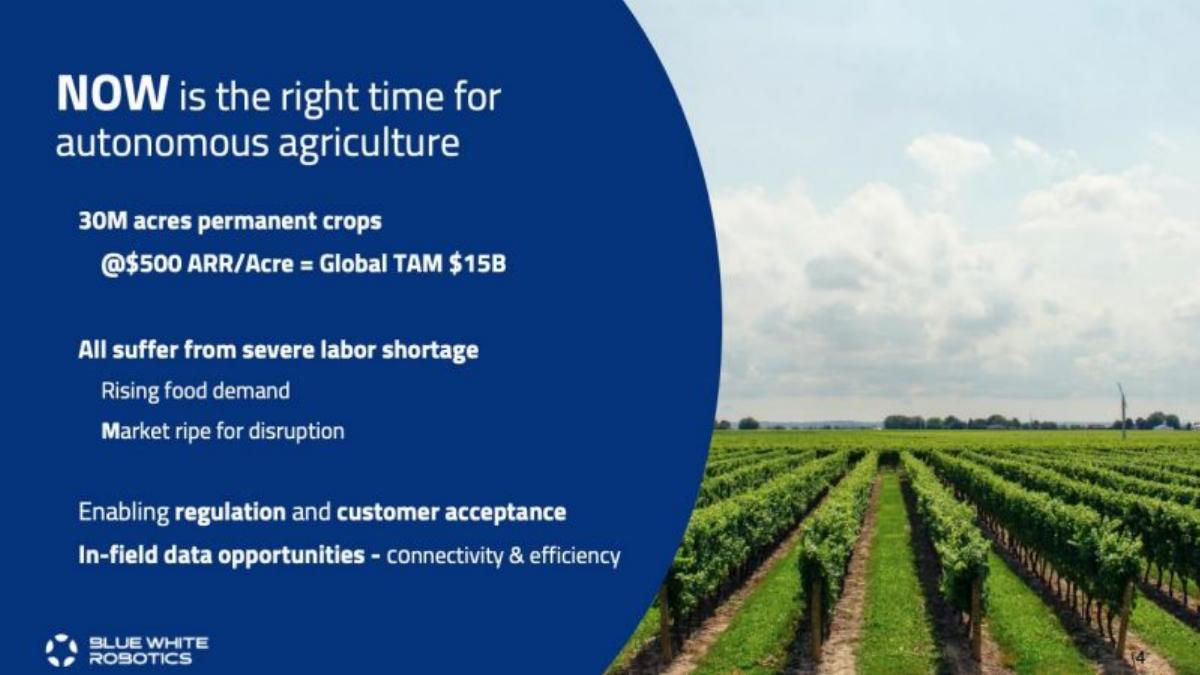
- The company targets a $15B Global TAM based on 30M acres of permanent crops at a $500 ARR/Acre price point (Slide 4).
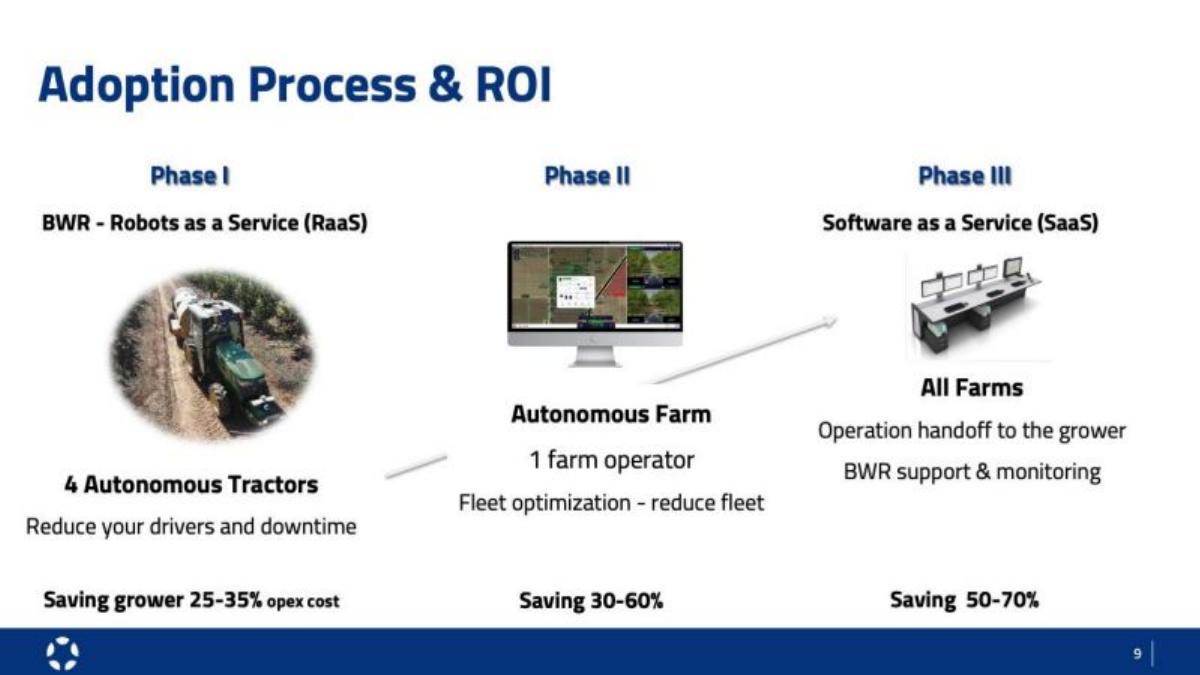
- The business model follows a three-phase adoption process: starting with RaaS (25-35% savings), moving to Autonomous Farm (30-60% savings), and ending with SaaS (50-70% savings) (Slide 6).
- Blue White Robotics focuses on retrofitting existing tractor fleets rather than selling new hardware, which they describe as 'no HW dependency' (Slide 7).
- The Series B round raised $37M and was led by Insight Partners and Entrée Capital, bringing total funding to $50M (Slide 3).
- The company was founded in 2017 in Tel-Aviv and has grown to 100 full-time employees across Israel and the US (Slide 3).
- A key value proposition is providing 'ROI from Day 1' for both growers and vendors (Slide 3).
- The management team claims over 20 years of experience in autonomous technology, with backgrounds from companies like Intel, Mobileye, and PayPal (Slide 9).
- The two-year plan focuses on geographic expansion into California, Washington, Florida/New York, and Australia (Slide 8).
The Series B Narrative: From Service to Software
Blue White Robotics’ 11-slide deck is a masterclass in positioning a complex hardware-software hybrid for a Series B audience. At this stage, investors are looking for proof of scale and a path to high-margin revenue. The deck addresses this by framing their 'Robot-as-a-Service' (RaaS) not as the final destination, but as a strategic 'on-ramp' to a pure SaaS model. By focusing on permanent crops—a high-value segment of agriculture—and emphasizing the retrofitting of existing equipment, the company removes the capital expenditure hurdles that often sink ag-tech startups.
Slide 1: Title Slide
The deck opens with the tagline "Autonomy Now" and the date September 2021. The background image of an orchard at dusk immediately establishes the company’s focus on the agricultural sector, specifically permanent crops like fruit and nut trees.
Slide 2: Mission Statement
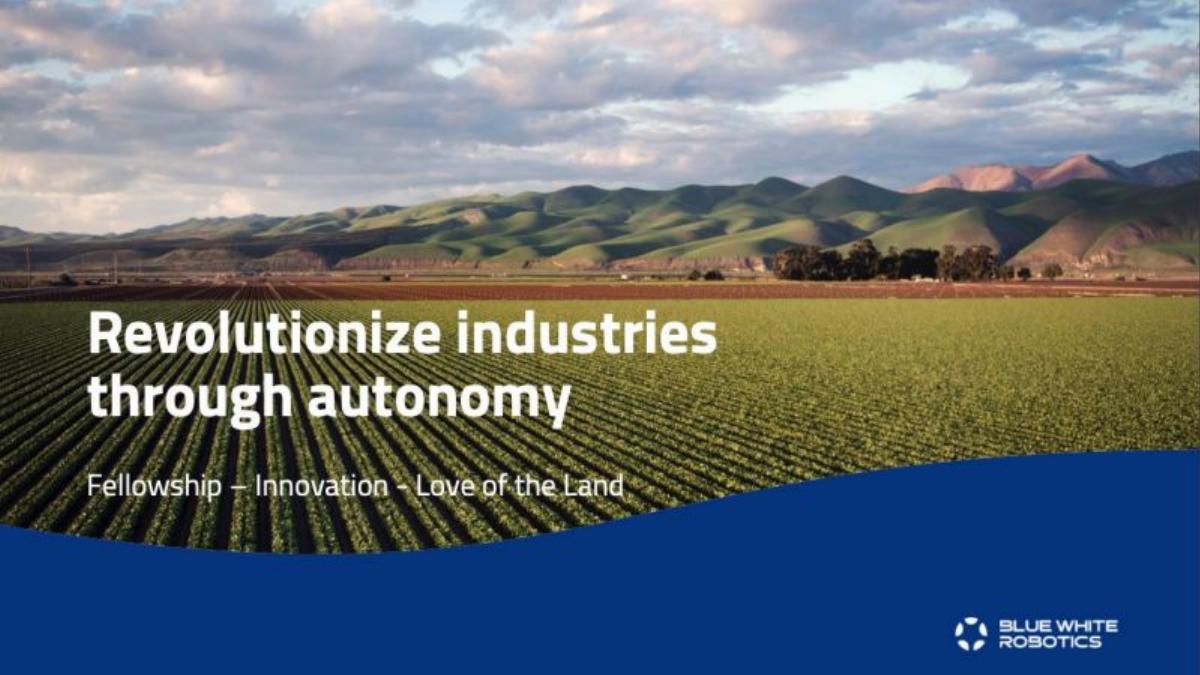
The second slide presents the vision: "Revolutionize industries through autonomy." It lists three core values: Fellowship, Innovation, and Love of the Land. This slide serves to humanize the technology, connecting high-tech robotics to the traditional values of the farming community.
Slide 3: Company Snapshot
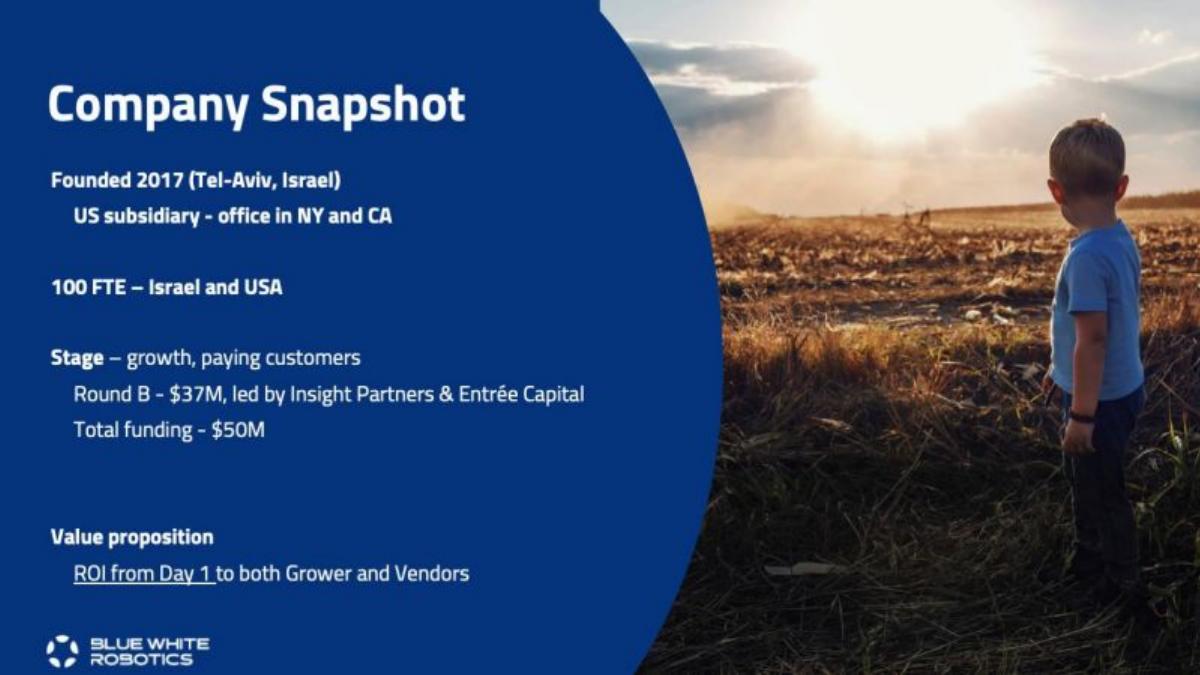
This is a high-density data slide that establishes immediate credibility. It notes the company was founded in 2017 in Tel-Aviv and has a US subsidiary with offices in New York and California. Key metrics include 100 FTEs and the announcement of their $37M Series B led by Insight Partners and Entrée Capital. The total funding is listed at $50M . Crucially, it mentions they are in the 'growth' stage with 'paying customers' and promises "ROI from Day 1" for both growers and vendors.
Slide 4: Market Opportunity and Timing
The 'Why Now' slide focuses on the $15B Global TAM . This figure is derived from 30M acres of permanent crops valued at $500 ARR/Acre . The slide identifies a "severe labor shortage" and "rising food demand" as the primary market drivers. It also notes that enabling regulation and customer acceptance are reaching a tipping point, creating a market ripe for disruption.
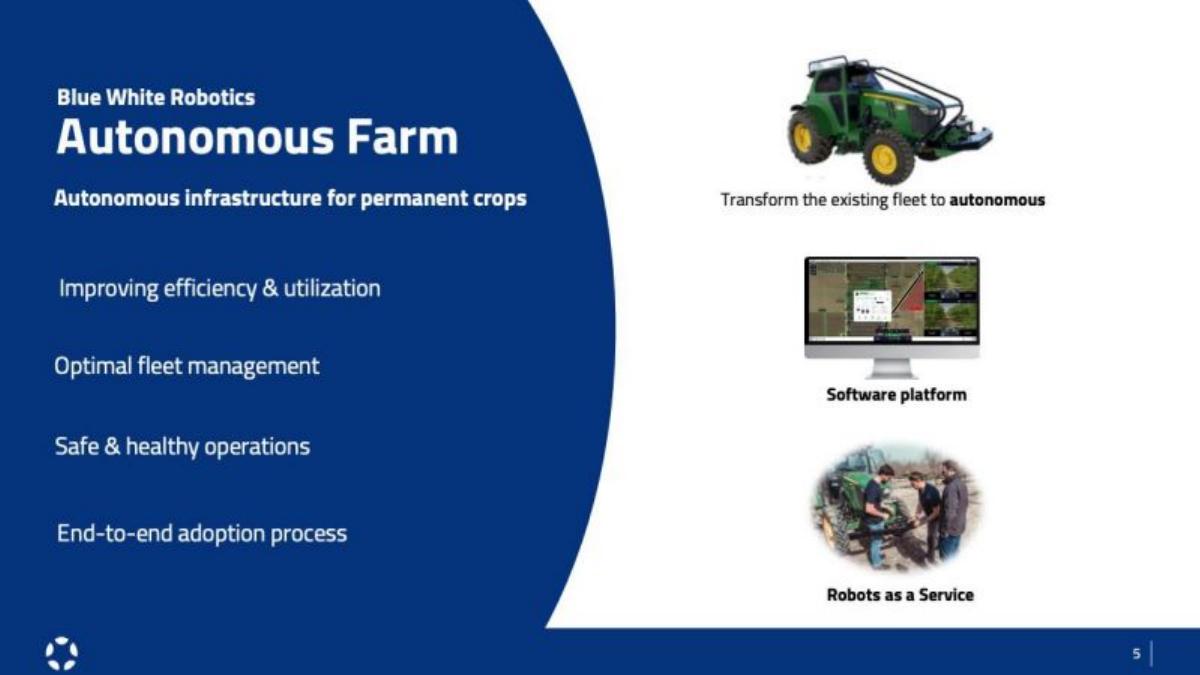
Slide 5: The Autonomous Farm Solution
This slide defines the product offering. Blue White Robotics provides "Autonomous infrastructure for permanent crops." The solution is three-pronged: 1) Transforming the existing fleet to autonomous (retrofitting), 2) A software platform for fleet management, and 3) A Robots-as-a-Service model to manage the end-to-end adoption process. This highlights their hardware-agnostic approach, which is a significant differentiator from competitors building proprietary tractors.
Slide 6: Adoption Process & ROI
This is arguably the most important slide in the deck for a Series B investor. It maps out the transition from service to software in three phases:
Phase I (RaaS): 4 autonomous tractors managed by BWR, saving the grower 25-35% in opex. · Phase II (Autonomous Farm): 1 farm operator managing the fleet, saving 30-60%. · Phase III (SaaS): Operation handoff to the grower with BWR providing support and monitoring, saving 50-70%.
This slide clearly illustrates how the company intends to improve its own margins while increasing the value proposition for the customer over time.
Slide 7: Our Unfair Advantage
The company lists four pillars of its competitive edge. First is "Autonomous Technologies Expertise" based on decades of experience in defense and mobility. Second is a "Holistic Solution" that supports various tasks and crops. Third is the "Focus on Adoption" via the RaaS model. Finally, they highlight "Robust System Design" with no hardware dependency, allowing them to operate in diverse real-world environments.
Slide 8: 2 Year Plan & KPIs
The forward-looking slide sets targets for becoming the market leader in autonomy and data for permanent crops. The expansion focus is geographic: California, Washington, Florida/New York, and Australia . The primary KPI mentioned is reaching "Hundreds of vehicles" and establishing a "Vast vendors program."
Slide 9: Our Management Team
The team slide features the three co-founders: Ben Alfi (CEO), Yair Shahar (COO), and Aviram Shmueli (CTO). It also lists seven VPs across BD, R&D, Operations, Finance, Product, and HR. The bottom of the slide displays logos of former employers, including Intel, Mobileye, PayPal, Wix, and Mellanox , reinforcing the claim of 20+ years of autonomous technology experience.
Slide 10: Closing Slide
The deck concludes with a repeat of the "Autonomy Now" slogan over an image of a retrofitted tractor in a field, reinforcing the practical, ready-to-deploy nature of their technology.
What Works in This Deck
The RaaS-to-SaaS Bridge: The most effective part of this deck is Slide 6. It acknowledges that farmers may be hesitant to jump straight into managing a fleet of robots. By starting with a service model (RaaS), Blue White Robotics de-risks the technology for the grower. By showing the path to SaaS, they de-risk the business model for the investor.
Hardware Agnosticism: By stating they have "no HW dependency" (Slide 7), the company avoids the massive capital requirements and manufacturing risks associated with building tractors. This makes the business much more scalable and attractive to venture capital, which typically prefers software margins.
Clear Market Segmentation: Rather than claiming to automate all of agriculture, they focus specifically on "permanent crops." This allows them to build a specialized solution for a high-value niche, making their TAM calculations (Slide 4) feel more grounded and attainable.
What is Missing
Historical Financials: While the deck mentions "paying customers" on Slide 3, it provides no data on current ARR, growth rates, or churn. For a Series B round, investors usually expect to see a more detailed breakdown of the existing revenue base.
Unit Economics: The deck claims significant opex savings for growers, but it does not detail the unit economics for Blue White Robotics itself. There is no mention of the cost to retrofit a tractor or the payback period for the RaaS equipment.
Competitive Landscape: There is no slide addressing competitors. In the autonomous ag space, there are both established incumbents (like John Deere) and numerous startups. Failing to address how they win against these players is a notable omission.
What a Founder Should Copy
The 'Company Snapshot' Slide: Slide 3 is an excellent way to start a deck. It answers the 'who, where, and how much' questions immediately, allowing the rest of the presentation to focus on the 'how' and 'why.'
Visualizing the Customer Journey: The three-phase adoption chart on Slide 6 is a perfect example of how to explain a complex go-to-market strategy. It links product evolution directly to customer value (ROI) and business model maturity.
The Pedigree Bar: Using logos of top-tier former employers at the bottom of the team slide (Slide 9) is a standard but highly effective way to signal talent density without cluttering the slide with long biographies.
Frequently asked questions
- What is the core problem Blue White Robotics is solving?
- According to Slide 4, the primary problem is a severe labor shortage in the agriculture sector, specifically within permanent crops. This is compounded by rising food demand and the need for greater efficiency. The company positions its autonomous infrastructure as the solution to these labor constraints and operational inefficiencies.
- How does the company generate revenue?
- The company utilizes a tiered service model. It begins with 'Robot-as-a-Service' (RaaS), where they manage autonomous tractors for the grower. As the grower becomes more comfortable with the technology, they transition to a 'Software-as-a-Service' (SaaS) model where the grower operates the fleet using Blue White’s platform, as detailed on Slide 6.
- What is the 'Unfair Advantage' claimed by the company?
- Slide 7 outlines four key advantages: deep expertise in autonomous technologies from the defense and mobility industries, a holistic solution that supports multiple tasks and vehicle types, a focus on the adoption process via RaaS, and a robust system design that is hardware-agnostic.
- Who are the lead investors in the Series B round?
- Slide 3 explicitly states that the $37M Series B round was led by Insight Partners and Entrée Capital. This round brought the company's total funding to $50M at the time of the September 2021 presentation.
- Does the deck include detailed financial projections?
- No. The deck is notably missing detailed financial statements, historical revenue charts, or granular burn rate information. It focuses instead on the '2 Year Plan & KPIs' (Slide 8), which mentions high-level goals like reaching 'hundreds of vehicles' and expanding into new geographic markets.