Blume’s 2022 pitch deck is a concise, visually-driven presentation that successfully secured a $1.8M Seed round. The deck excels by focusing on tangible retail success rather than theoretical projections. By highlighting that the company was 'bootstrapped' to 1,500 doors and achieved 200% year-over-year growth within those stores, Blume proved product-market fit in the difficult Consumer Packaged Goods (CPG) sector. The narrative centers on 'flavour-first' functional wellness, positioning the brand as an accessible alternative to clinical supplements. While the deck lacks a detailed financial…
Key takeaways
- Blume emphasizes a 'flavour-first' approach to differentiate from clinical-style supplement brands (Slide 2).
- The company successfully bootstrapped to 1,500 retail doors before seeking this $1.8M Seed round (Slide 5).
- Traction is anchored by a 200% Q1 YOY growth rate within existing stores, proving velocity, not just distribution (Slide 5).
- A 30%+ returning customer rate in 2021 demonstrates strong brand loyalty and repeat purchase behavior (Slide 5).
- The deck positions the product in the tea/coffee aisle, which claims 4-10x the traffic of the supplement aisle (Slide 4).
- Blume utilizes a massive 'Press' slide with 10 distinct media features to establish cultural relevance (Slide 6).
- 85% of sales were concentrated in Canada at the time of the deck, indicating a clear path for US expansion (Slide 5).
- The deck lacks a formal 'Team' slide beyond the Founder/CEO, omitting key advisors or department heads (Slide 7).
The Blume Pitch Deck: Scaling Functional Wellness Through Retail Velocity
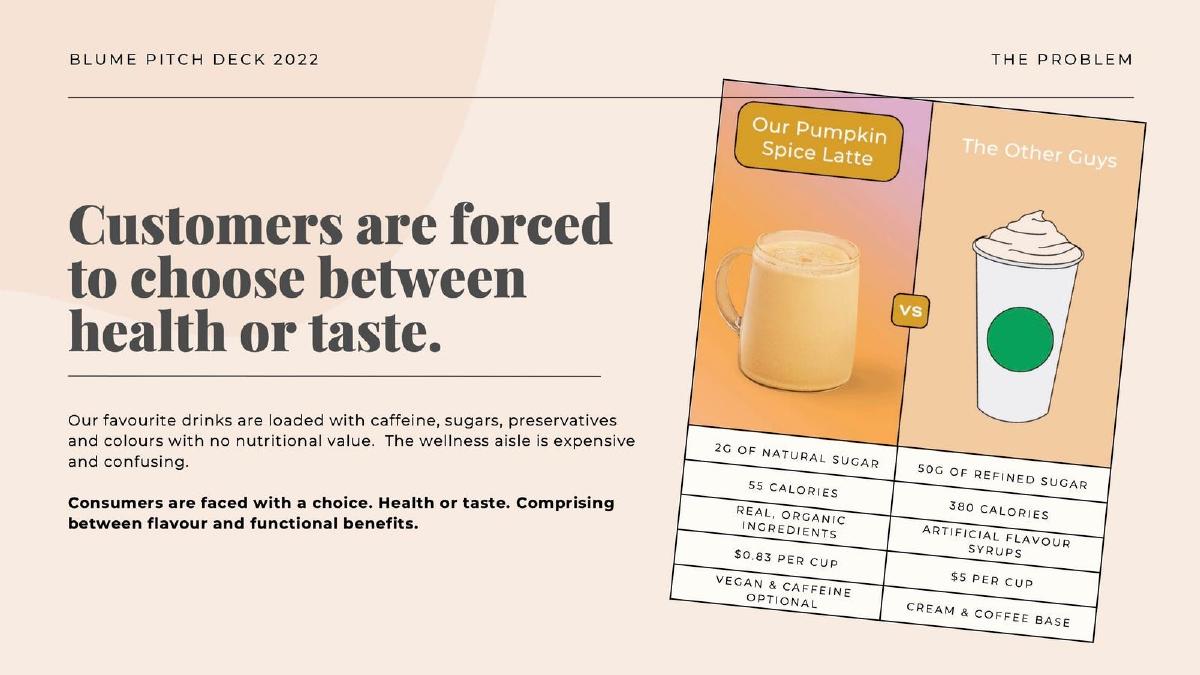
Blume’s 2022 pitch deck serves as a blueprint for Consumer Packaged Goods (CPG) founders who have moved past the 'idea' phase and into the 'scaling' phase. Raising $1.8M in a Seed round is no small feat in a crowded wellness market, but Blume’s deck succeeds by prioritizing hard retail data over marketing fluff. The deck is visually cohesive, using a soft, pastel aesthetic that mirrors their product packaging, which reinforces the brand identity to potential investors.
Slide 1: Title and Branding
The cover slide is minimalist, featuring the 'blume' logo in a serif typeface against a gradient background of pink, yellow, and blue. It includes the date 'June 2022' and the company website. This sets a professional, brand-forward tone immediately. It doesn't use a tagline here, allowing the visual identity to speak for itself.
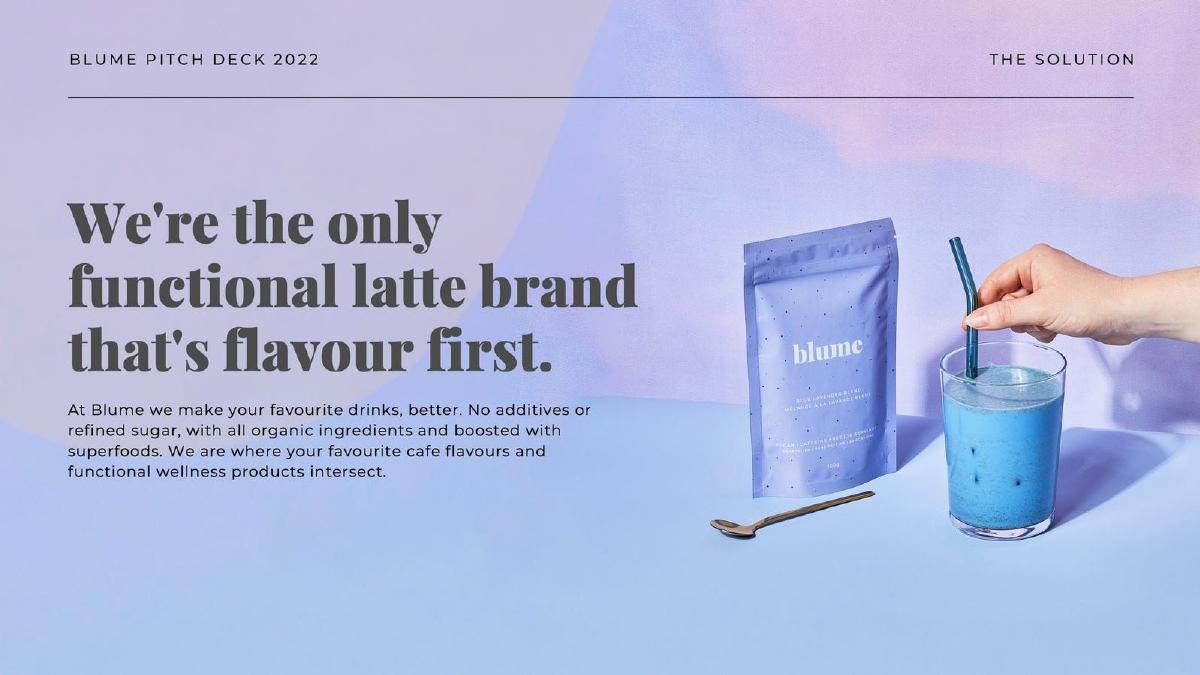
Slide 2: The Solution - Flavour First
Slide 2 introduces the core value proposition: 'We’re the only functional latte brand that’s flavour first.' This is a critical strategic choice. By emphasizing flavor, Blume distances itself from the 'medicinal' or 'earthy' taste often associated with superfood supplements. The text specifies that the products have no additives or refined sugar and use all organic ingredients. The imagery shows the 'Blue Lavender Blend,' providing a concrete example of the product in a lifestyle setting.
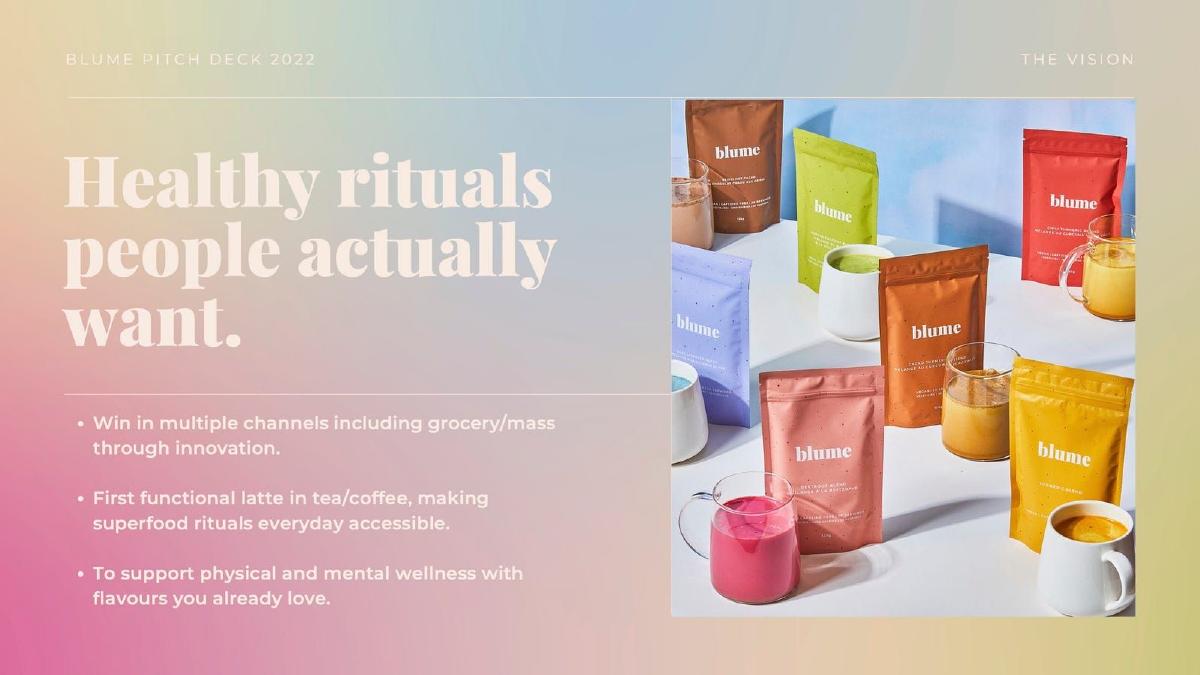
Slide 3: The Vision - Healthy Rituals
The vision slide focuses on the consumer experience: 'Healthy rituals people actually want.' Blume outlines three strategic goals: winning in multiple channels (grocery/mass) through innovation, making superfood rituals everyday accessible by placing them in the tea/coffee category, and supporting physical and mental wellness. The right side of the slide displays the full product lineup in their colorful, distinct packaging, showcasing the breadth of the SKU count.
Slide 4: The Gap - Strategic Positioning
Slide 4 is perhaps the most important for an investor looking at market fit. It features a 2x2 matrix comparing 'Everyday vs. Premium' and 'Supplement vs. Food Product.' Blume positions itself in the 'Premium Food Product' quadrant. The slide notes that by re-creating familiar flavors, they widen their addressable market. Crucially, it mentions that the tea/coffee aisle has '4-10x the traffic of the supplement aisle,' explaining why their retail placement strategy is a competitive advantage over brands like Moon Juice or Four Sigmatic, which are placed in the supplement section.
Slide 5: Traction - The 1,500 Door Milestone
This slide provides the 'proof of work.' The headline '1500 doors bootstrapped' is a powerful statement for a Seed round, showing capital efficiency. Key metrics include: 85% of sales in Canada, being a 'Canadian market leader,' and 200% Q1 YOY growth within stores. The mention of 'growing velocity not just door count' is vital; investors want to see that the product moves off the shelf once it gets there. A 30%+ returning customer rate from 2021 further proves brand stickiness. Logos for Whole Foods, Indigo, and Anthropologie provide high-tier social proof.
Slide 6: Press - Cultural Validation
Slide 6 is a collage of media coverage. It features 10 different publications, including Rolling Stone, Forbes, Buzzfeed, and Insider. The snippets highlight specific products, like the 'Beetroot Blend' and 'Pumpkin Spice Blend.' This slide serves to prove that Blume is not just a retail product but a brand with 'buzz' and cultural relevance, which is essential for maintaining a premium price point in CPG.
Slide 7: The Founder
The final slide in the provided set features Karen Danudjaja, Founder and CEO. It includes social media icons for the brand. While it identifies the leader, it is notably thin on professional background or the rest of the management team. In a full pitch, investors would typically expect to see the 'Why You' represented through past exits, industry experience, or specific expertise in supply chain or retail distribution.
What Blume Does Exceptionally Well
The Blume deck is a masterclass in positioning . Many wellness brands struggle to define whether they are a 'health' company or a 'food' company. Blume explicitly chooses 'Food Product' and 'Tea/Coffee Aisle.' This isn't just a marketing choice; it's a distribution strategy that targets higher foot traffic and lower consumer hesitancy. By framing their products as 'familiar flavours,' they lower the barrier to entry for the average consumer who might be intimidated by 'adaptogens' or 'functional mushrooms.'
Furthermore, the traction metrics are perfectly selected for a Seed stage CPG company. Highlighting 'velocity' (how fast the product sells) over just 'distribution' (how many stores carry it) addresses the number one fear of retail investors: that a product will be delisted due to poor performance. The 200% YOY growth within existing stores is a 'hair-on-fire' metric that suggests strong organic demand.
What is Missing from the Blume Deck
Despite its strengths, the deck has several notable omissions based on the 13-slide sequence provided:
The Ask: There is no slide detailing how much money is being raised or the terms of the round. While we know from external reports it was $1.8M, a pitch deck should typically conclude with a clear funding goal. · Use of Funds: Investors need to know if the capital is going toward inventory, marketing, new hires, or R&D. Without this, the deck feels like a brand presentation rather than a formal investment proposal. · Unit Economics: In CPG, margins are everything. The deck does not mention Gross Margins, Customer Acquisition Cost (CAC), or Lifetime Value (LTV). While the 'returning customer rate' is a proxy for LTV, hard dollar figures are missing. · Team Depth: Only the CEO is listed. A company with 1,500 doors likely has a head of sales, a head of operations, or at least a board of advisors with retail experience. Omitting them leaves a gap in the 'execution' part of the story. · Competitive Analysis: While Slide 4 shows a positioning map, it doesn't detail how Blume wins against specific incumbents on price, ingredients, or supply chain.
Founder Takeaways: How to Copy the Blume Formula
If you are building a CPG brand, there are three elements of this deck you should emulate immediately:
1. The 'Aisle' Strategy: Don't just say you are better than competitors. Explain why your physical location in a store (or your digital category) gives you a mathematical advantage. Blume’s '4-10x traffic' stat is a compelling reason for an investor to believe in their scale potential.
2. Velocity Over Doors: Many founders brag about being in 500 stores, but if the product isn't moving, those stores will drop you in six months. Always include a 'Same Store Sales' or 'Velocity' metric to prove that consumers are actually buying the product repeatedly.
3. Visual Cohesion: The Blume deck looks like a Blume package. The fonts, colors, and photography are identical to the product. This level of brand consistency suggests to an investor that the founder understands the importance of brand equity in the consumer space.
In summary, Blume used this deck to transition from a successful bootstrapped Canadian business to a venture-backed North American player. By focusing on the 'ritual' of the product and the 'reality' of their retail numbers, they presented a de-risked investment opportunity in a high-risk sector.
Frequently asked questions
- How much did Blume raise with this deck?
- As reported by Business Insider, Blume raised $1.8 million in a Seed round in 2023. The deck itself, dated June 2022, focuses on the traction built leading up to that capital injection.
- What is Blume's primary competitive advantage according to the deck?
- Blume identifies its advantage as being 'flavour first' (Slide 2) and positioning itself in the high-traffic tea and coffee aisles rather than the supplement aisle. They claim these aisles have 4-10x more traffic than supplement sections (Slide 4).
- What retail partners does Blume highlight?
- The deck showcases several major North American retailers on Slide 5, including Whole Foods Market, Indigo, Anthropologie, Thrifty Foods, and Well.ca.
- Does the deck include financial projections?
- No, the provided 13 slides do not include forward-looking financial projections or a P&L statement. It relies entirely on historical traction metrics like YOY growth and returning customer rates.
- What is the geographic focus of the business in this deck?
- Slide 5 states that 85% of sales are currently in Canada. The deck uses a map of Canada to visualize their 1,500-door footprint, suggesting the Seed round was likely intended to fuel further expansion into the US.