Honeycomb’s Series A deck is a masterclass in identifying a stagnant, high-value niche and applying modern technology to solve specific operational friction. By targeting the $26B multi-family property insurance market, Honeycomb highlights a 'worst of all worlds' scenario where policies are too small for manual underwriting but too complex for legacy systems. The deck emphasizes their proprietary AI that translates visual cues—like mold risk from vegetation or fire hazards from wooden escapes—into actionable underwriting insights. While the deck is light on financial traction and specific 'a…
Key takeaways
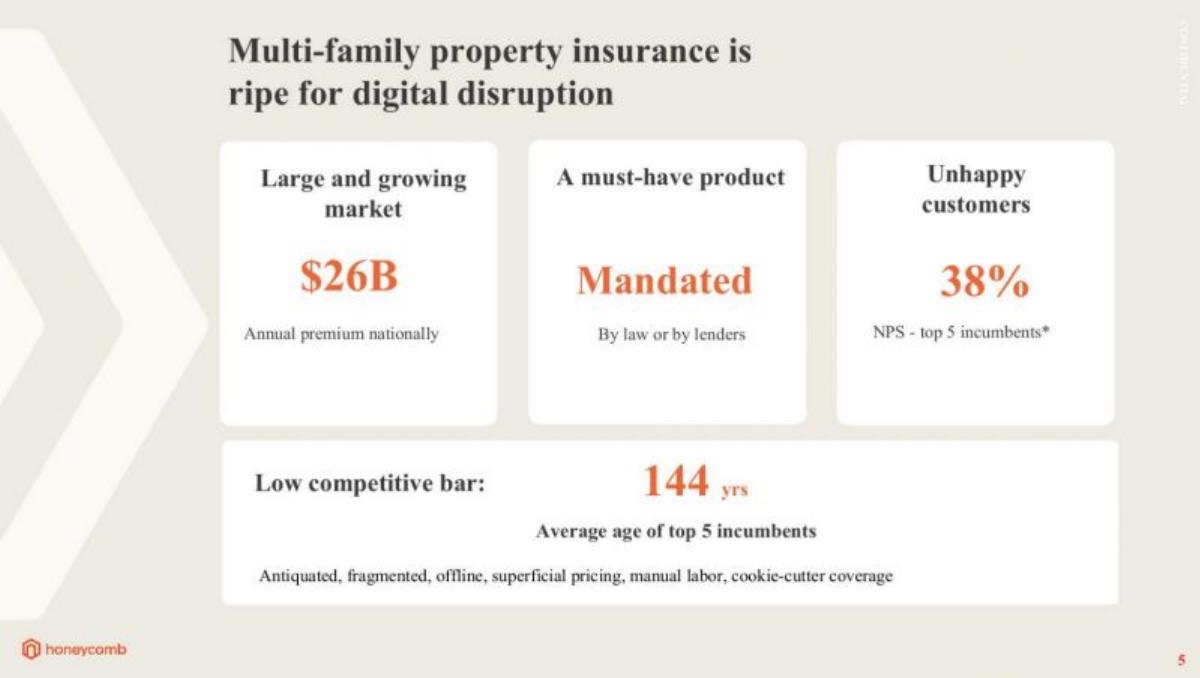
- The multi-family property insurance market is valued at $26B in annual premiums nationally (Slide 5).
- Top 5 incumbents in the space have an average age of 144 years, creating a low competitive bar for digital disruption (Slide 5).
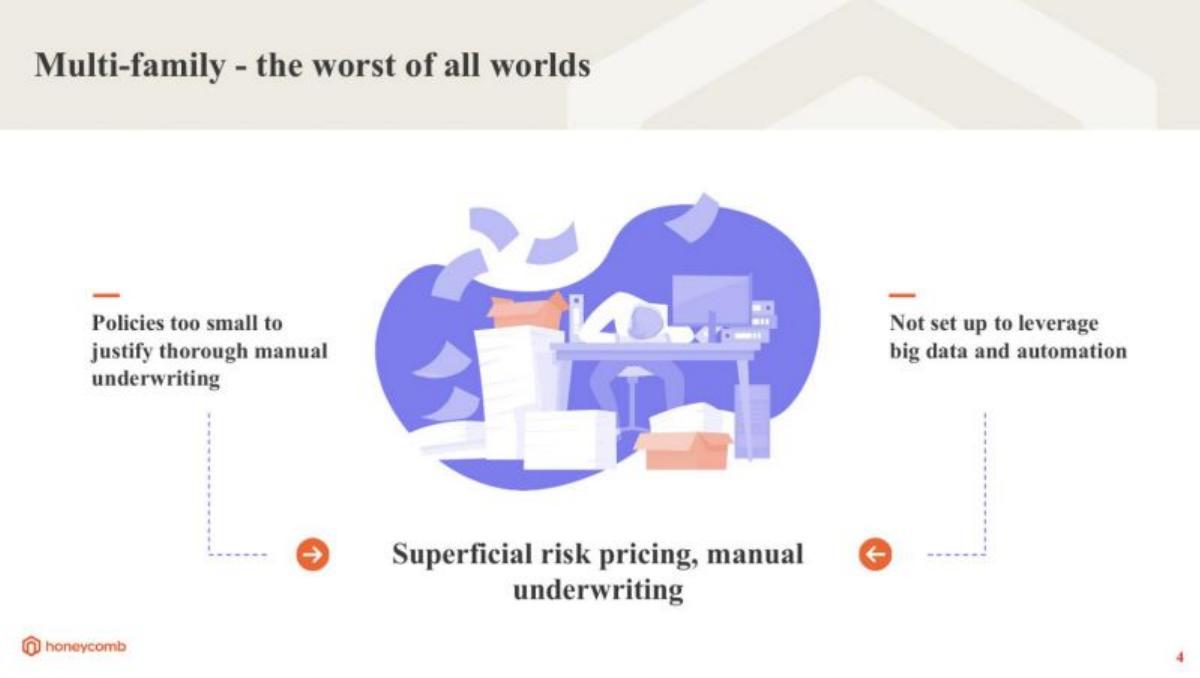
- The 'worst of all worlds' problem describes policies too small for thorough manual underwriting but not yet automated (Slide 4).
- Honeycomb’s AI identifies specific risks such as mold from vegetation, fire hazards from wooden escapes, and trip hazards from uneven surfaces (Slide 9).
- The platform claims to offer deeper, unbiased risk evaluation at $0 variable cost in real time (Slide 8).
- The leadership team includes a CEO who headed a $100M online insurance business and a CRO with 30 years of industry experience (Slide 2).
- The product provides a 'Triple Win' for customers (right-priced insurance), brokers (time savings), and Honeycomb (improved profitability) (Slide 10).
- Honeycomb launched the first 100% digital insurance platform for this sector in June 2021 (Slide 7).
The Vision: Reinventing Real-Estate Insurance
Honeycomb’s pitch deck for their $15.4M Series A round is a concise, 11-slide presentation that focuses on a very specific niche: multi-family property insurance. The deck positions the company as a 'NeoInsurer'—a digital-first entity that uses proprietary technology to outperform legacy incumbents. The narrative is built on the premise that the current market is antiquated, relying on manual processes for a segment that is too large to ignore but too small for traditional firms to underwrite efficiently.
Slide 1: Title Slide
The deck opens with a high-angle shot of a multi-family residential building, immediately grounding the viewer in the company's target asset class. The tagline, "Real-estate insurance reinvented," is simple and direct. It also includes the website URL, which is standard practice for establishing brand presence from the first second.
Slide 2: Highly Experienced Leadership Team
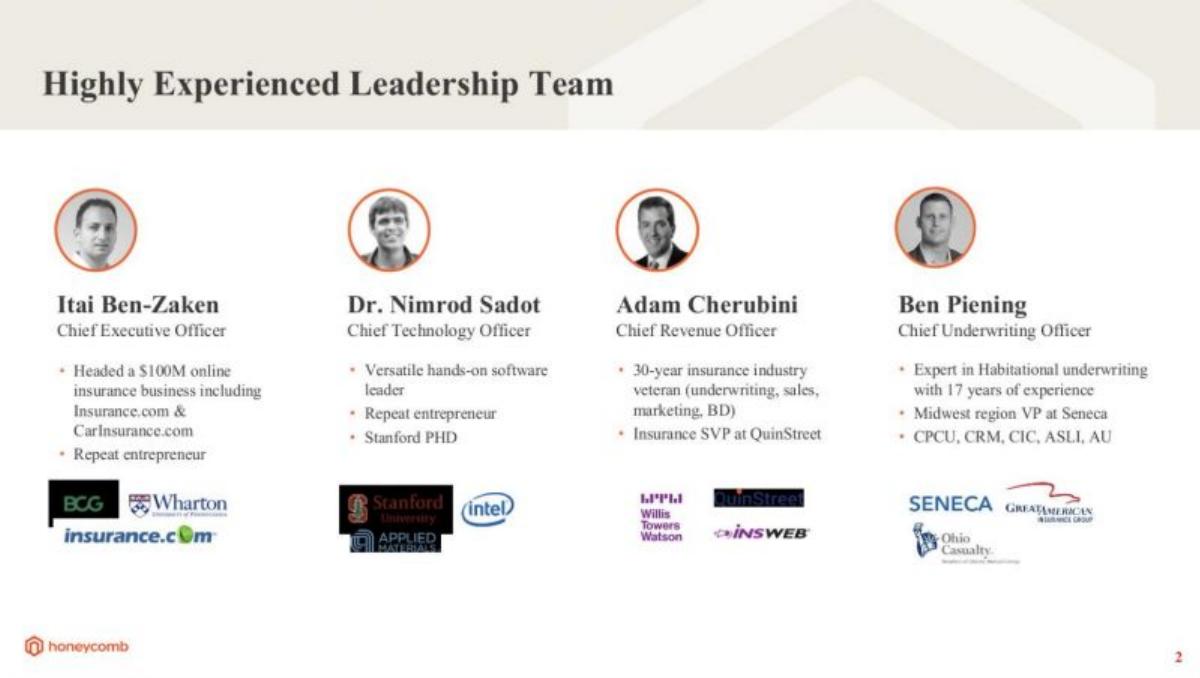
Honeycomb places its team slide second, a common move for Series A companies where the 'founder-market fit' is a primary selling point. The team is balanced between tech and insurance veterans:
Itai Ben-Zaken (CEO): Highlighted for heading a $100M online insurance business including Insurance.com and CarInsurance.com. · Dr. Nimrod Sadot (CTO): A Stanford PhD and repeat entrepreneur with experience at Intel and Applied Materials. · Adam Cherubini (CRO): A 30-year insurance industry veteran with a background at Willis Towers Watson and QuinStreet. · Ben Piening (CUO): An expert in habitational underwriting with 17 years of experience, specifically noting his time as a VP at Seneca.
The inclusion of logos like BCG, Wharton, and Stanford adds institutional credibility to the individual profiles.
Slide 3: Market Size and Scope
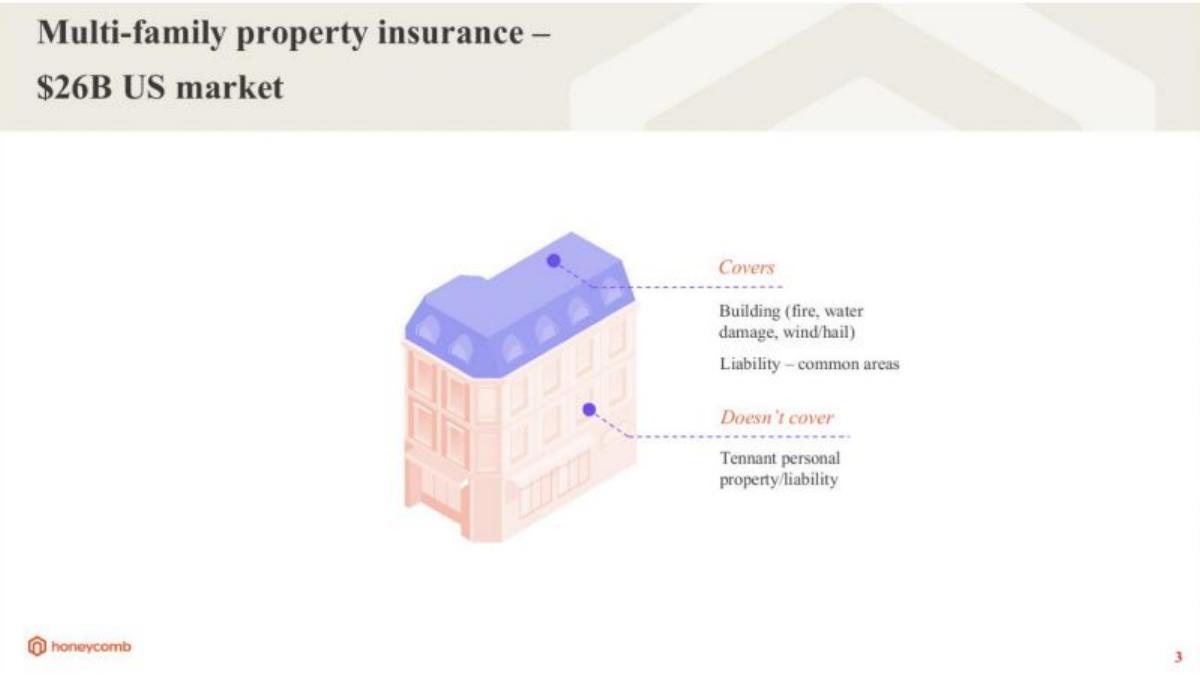
This slide defines the boundaries of the product. It identifies a "$26B US market" for multi-family property insurance. A simple 3D diagram of a building clarifies what the insurance covers: the building itself (fire, water damage, wind/hail) and liability for common areas. Crucially, it notes what it doesn't cover: tenant personal property and liability. This specificity helps investors understand exactly where Honeycomb sits in the insurance stack.
Slide 4: The Problem - "The Worst of All Worlds"
Slide 4 articulates the market gap. It argues that multi-family property insurance is currently in a state of 'superficial risk pricing' and 'manual underwriting.' The core friction is that these policies are "too small to justify thorough manual underwriting" but the industry is "not set up to leverage big data and automation." This creates an opportunity for a tech-enabled player to step in and capture the middle ground that incumbents are currently mishandling.
Slide 5: Ripe for Digital Disruption
This slide uses four data points to prove the market is ready for a new player:
Market Size: $26B annual premium nationally. · Mandated Product: Insurance is required by law or by lenders, ensuring a constant baseline of demand. · Unhappy Customers: A low Net Promoter Score (NPS) of 38% for the top 5 incumbents. · Low Competitive Bar: The average age of the top 5 incumbents is 144 years .
The slide characterizes the competition as "antiquated, fragmented, offline," and providing "cookie-cutter coverage."
Slide 6: Enter Honeycomb
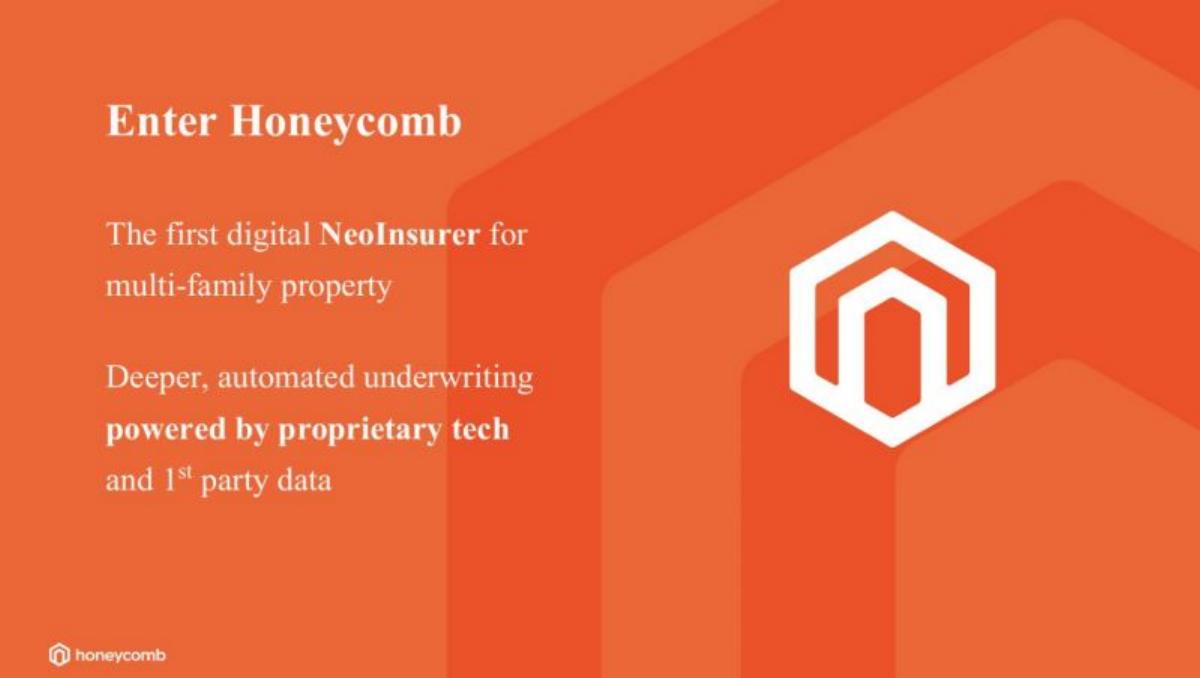
This is the transition slide that introduces the solution. It defines Honeycomb as the "first digital NeoInsurer for multi-family property." The key value proposition is "deeper, automated underwriting powered by proprietary tech and 1st party data." This is the first time the deck mentions their data advantage, which they expand upon in the following slides.
Slide 7: Product Launch and User Interface
Slide 7 marks a milestone: "6/2021 Honeycomb introduced the first, 100% digital insurance platform for multi-family property." It shows two mobile mockups. One displays multiple proposals (e.g., "Most Affordable" at $2,627/year vs. "Best Value" at $2,879/year). The second shows a customization screen where users can adjust deductibles and coverage limits. This emphasizes the speed and transparency of the user experience compared to traditional offline brokers.
Slide 8: Proprietary Underwriting Platform
01: Deeper, unbiased risk evaluation. · 02: At $0 variable cost. · 03: Real time.
To the right, a mobile screen shows a checklist of "Property Photos" that the user must provide, including the building front, rear, common staircase, common basement, and water heater. This suggests a self-service inspection model that feeds their AI engine.
Slide 9: AI and Visual Cues
This is arguably the most important slide in the deck. It shows a photograph of a building with various areas highlighted by AI. It demonstrates how the software translates visual data into underwriting insights:
Vegetation on building: Identified as a mold risk. · Wooden fire escape: Identified as a fire hazard. · Clutter blocking egress route: Identified as a safety risk. · Uneven surfaces: Identified as a trip hazard. · Sidewalk: Noted as being in smooth and even condition.
This slide proves the "proprietary tech" claim by showing exactly how they automate the inspection process that would normally require a human to visit the site.
Slide 10: The Triple Win
The final content slide explains the benefits for all stakeholders in the ecosystem:
Customer: Receives right-priced insurance, deeper discounts for "working harder" (likely referring to property improvements), and a quick/easy process. · Broker: Gains time savings, optionality in a constrained market, and additional income sources. · Honeycomb: Achieves improved profitability, scalability, and a claims handling advantage through proprietary data.
By including the broker in this "Triple Win," Honeycomb signals that they are not trying to eliminate the middleman, but rather empower them with better tools.
Slide 11: Closing Slide
The deck ends with a generic promotional slide for the platform where the deck was hosted. There is no specific "Ask" slide or contact information for the founders included in this version of the deck.
What Honeycomb Does Well
The Honeycomb deck excels at niche identification . By focusing strictly on multi-family properties, they avoid the broader, more competitive general insurance market and speak directly to a specific pain point. The visual demonstration of their AI (Slide 9) is a powerful way to show, rather than just tell, how their technology creates a competitive advantage. Furthermore, the team slide is exceptionally strong, providing a mix of high-level academic credentials and decades of relevant industry experience.
What is Missing from the Deck
Despite the successful fundraise, the deck has several notable omissions:
Traction Metrics: There are no slides showing Year-over-Year growth, Gross Written Premium (GWP), or the number of policies currently underwritten. For a Series A, investors usually expect to see early evidence of product-market fit through revenue or volume. · Unit Economics: The deck mentions "$0 variable cost" for underwriting, but it does not discuss Customer Acquisition Cost (CAC) or Lifetime Value (LTV), which are critical for evaluating the scalability of an insurance business. · Loss Ratios: In insurance, the most important metric is the loss ratio (claims paid vs. premiums collected). The deck claims their AI leads to "improved profitability," but provides no data to back this up. · The Ask: There is no slide detailing how much capital is being raised (though we know from catalogue facts it was $15.4M) or how that capital will be deployed (e.g., geographic expansion, hiring, or marketing).
What Other Founders Should Copy
Founders in traditional industries should emulate Honeycomb's "Worst of All Worlds" framework (Slide 4). Identifying a segment of the market that is too small for manual labor but too complex for basic software is a classic recipe for a successful startup. Additionally, the Visual Proof slide (Slide 9) is a great example of how to make abstract AI claims tangible. If your product uses machine learning or computer vision, showing a 'behind-the-scenes' look at how the algorithm 'sees' the world is much more convincing than a list of bullet points.
Frequently asked questions
- What is the primary problem Honeycomb is solving?
- Honeycomb targets the inefficiency in multi-family property insurance. According to Slide 4, these policies are often too small to justify the cost of thorough manual underwriting by traditional firms, leading to superficial risk pricing. By using AI and big data, Honeycomb automates this process, allowing for more accurate pricing and faster quotes than the 144-year-old incumbents currently dominating the $26B market.
- How does Honeycomb's technology actually work?
- The deck highlights a proprietary AI platform that uses computer vision to analyze property photos. As shown on Slide 9, the AI identifies specific 'visual cues' such as vegetation on buildings (mold risk), wooden fire escapes (fire hazard), and uneven sidewalks (trip hazard). This data is then translated into underwriting insights in real time, which the company claims results in deeper, unbiased risk evaluation at zero variable cost.
- Who is on the Honeycomb leadership team?
- The team consists of four key executives with deep roots in insurance and tech. CEO Itai Ben-Zaken previously led a $100M insurance business; CTO Dr. Nimrod Sadot is a Stanford PhD and repeat entrepreneur; CRO Adam Cherubini is a 30-year insurance veteran; and CUO Ben Piening has 17 years of experience in habitational underwriting. This mix of 'insur' and 'tech' is a core part of their credibility (Slide 2).
- What are the benefits for insurance brokers?
- While many digital platforms try to disintermediate brokers, Honeycomb positions them as partners. Slide 10 outlines a 'Triple Win' where brokers benefit from time savings, additional income sources, and 'optionality in a capacity constrained market.' This suggests Honeycomb uses a B2B2C or partner-led distribution model rather than relying solely on direct-to-consumer sales.
- What financial information is included in the deck?
- The deck is notably sparse on internal financial metrics. While it mentions the $26B total addressable market and a $100M business previously led by the CEO, it does not disclose Honeycomb's current Revenue, Loss Ratios, or Customer Acquisition Cost (CAC). It also lacks a specific 'Ask' slide detailing how the $15.4M Series A funds will be allocated.