Homigo’s 2016 seed deck is a lean, 10-slide presentation that successfully raised $200,000 by leading with traction rather than narrative. Instead of the traditional 'problem-solution' arc, the deck immediately presents a $780K GMV run rate and impressive unit economics, including a $2,900 24-month LTV against a $255 CAC. The product section is purely visual, using mobile screenshots to demonstrate home inspections, preventative maintenance plans, and instant quoting. While it lacks a formal 'Ask' slide or a detailed competitive landscape, the deck relies heavily on the founders' pedigree—com…
Key takeaways
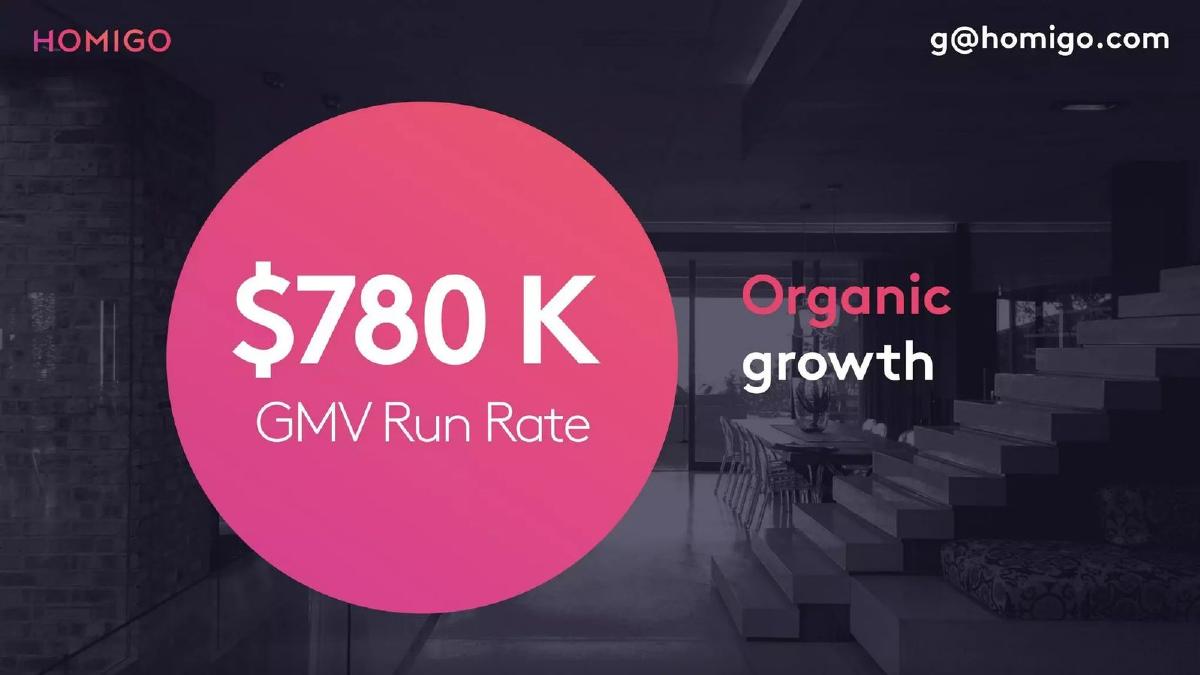
- The deck leads with a high-impact traction slide showing a $780K GMV run rate achieved through organic growth (Slide 2).
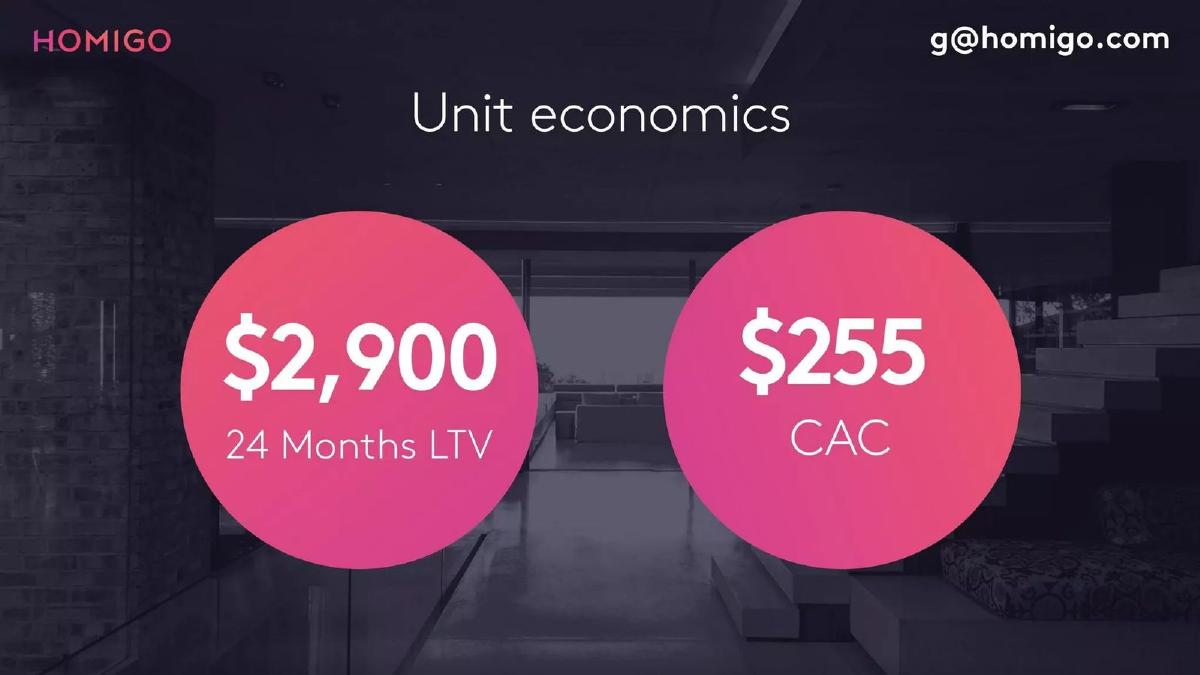
- Unit economics are presented with extreme clarity, highlighting a 24-month LTV of $2,900 against a $255 CAC (Slide 3).
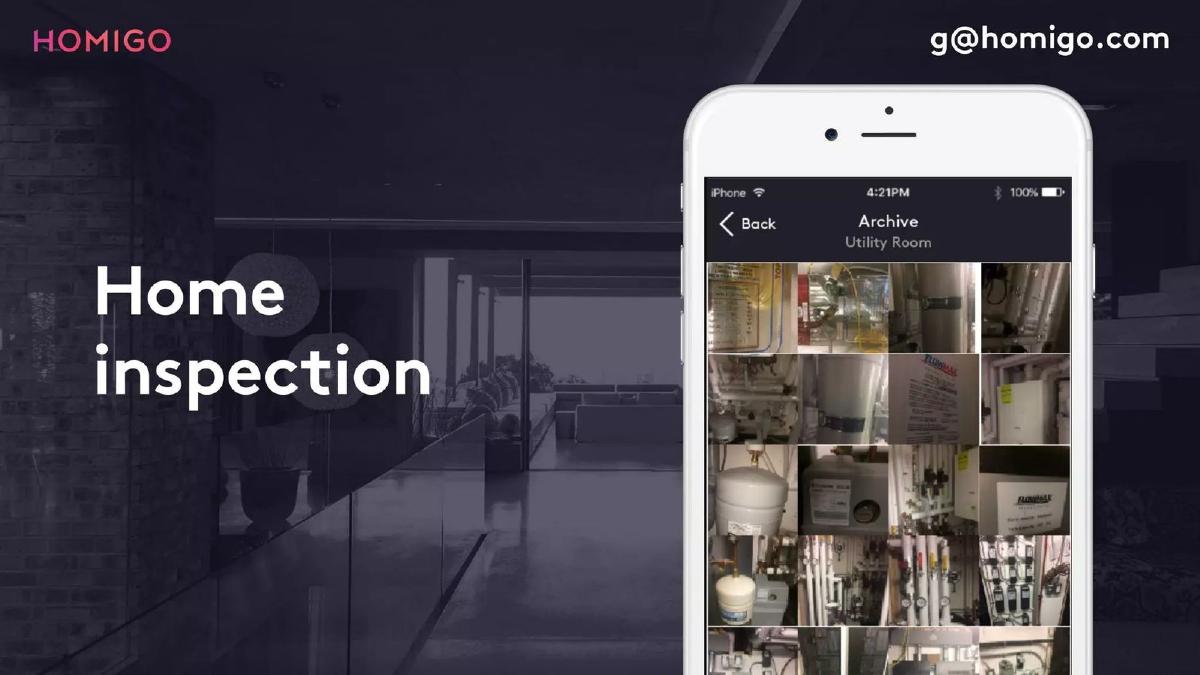
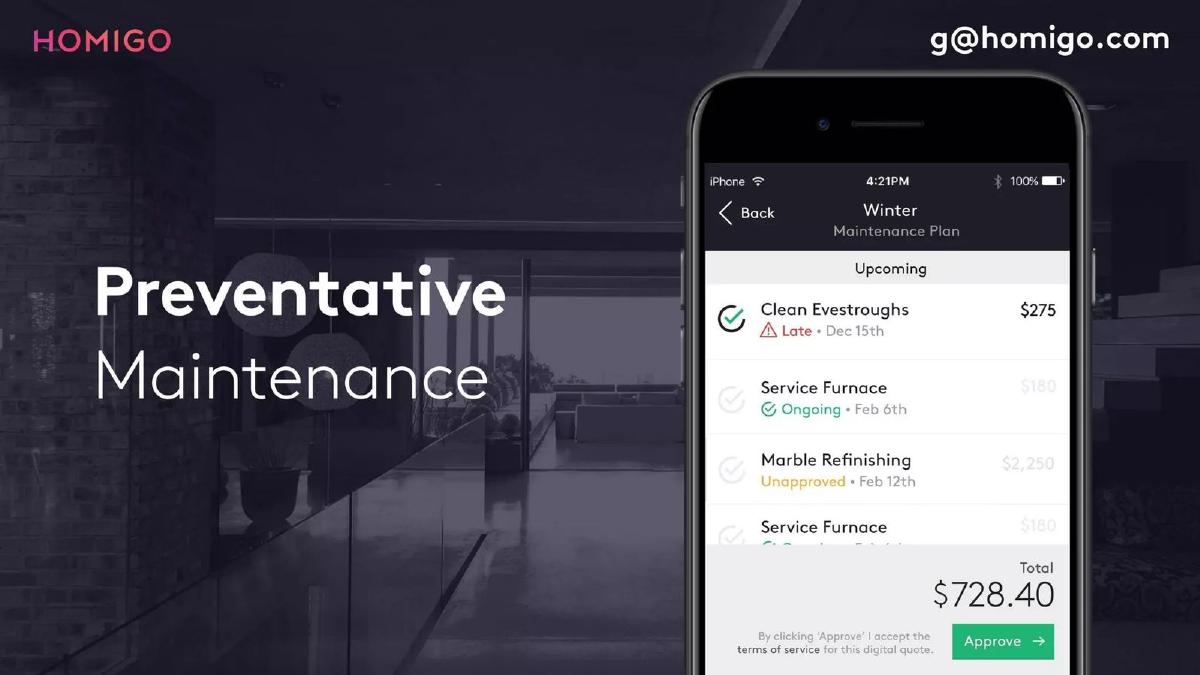
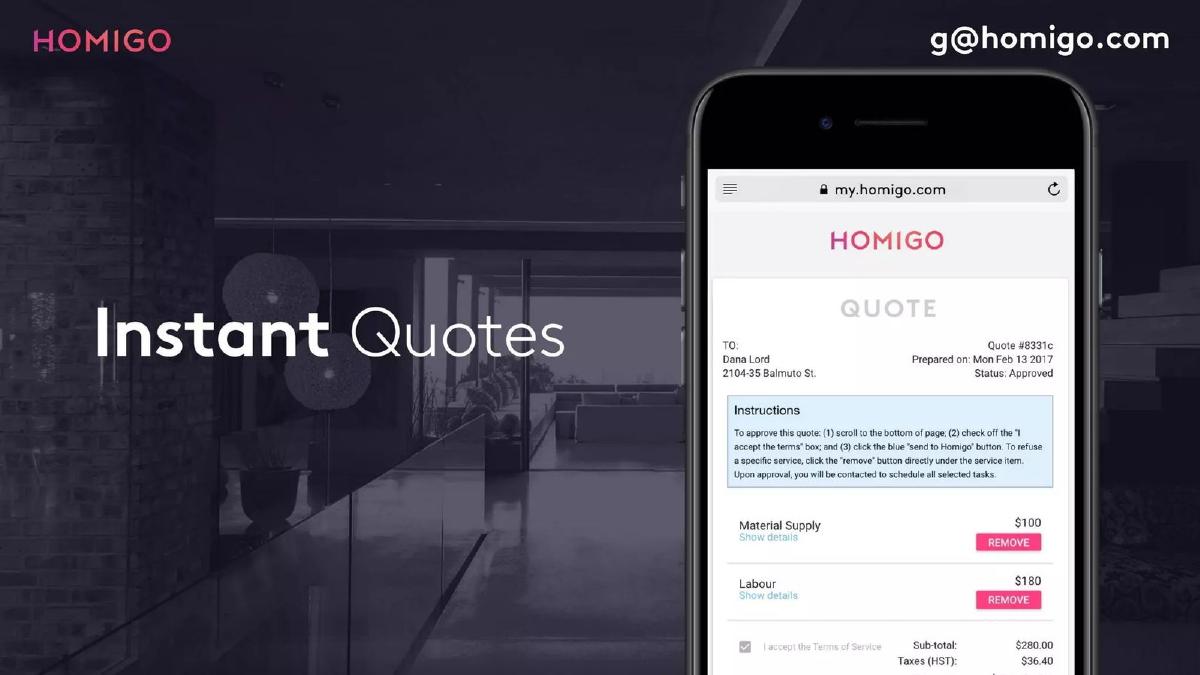
- Product functionality is shown through three distinct mobile interface screenshots: inspection, maintenance, and quotes (Slides 4-6).
- Market size is stated as a single, massive figure of $200 Billion without further segmentation or sourcing (Slide 7).
- Growth velocity is visualized with a graph showing 30% Month-over-Month (MoM) growth from September 2016 to January 2017 (Slide 8).
- The team slide emphasizes founder-market fit, citing 6 years in tech for the CEO and 9 years in home contracting for the President (Slide 9).
- The deck omits a specific funding ask, use of funds, or roadmap, focusing instead on a summary of existing performance metrics (Slide 10).
- Visual consistency is maintained throughout using a dark overlay and pink accent color, prioritizing readability of large-font metrics.
Executive Summary: The Data-First Seed Deck
Homigo’s pitch deck is a notable example of the 'Traction-First' school of fundraising. In an era where many Seed decks spend five slides defining a problem, Homigo spends exactly zero. Instead, they assume the investor understands that home maintenance is a fragmented, difficult industry and move immediately to proving they have solved the execution layer. With only 10 slides, the deck is designed for a quick read, relying on large typography and high-contrast visuals to hammer home three points: they are growing fast, their customers are valuable, and the founders have the right background.
Slides 1-3: The Hook and the Math
Slide 1: Title The cover slide introduces the brand with the tagline: "The best possible home maintenance experience." It includes a contact email and an AngelList link, signaling that the company is actively engaged in the startup ecosystem. The visual language—a hand interacting with a mobile device—immediately frames this as a tech-enabled service rather than a traditional contracting business.
Slide 2: Traction This is the most important slide in the deck. It features a massive pink circle containing the figure $780 K GMV Run Rate . By leading with Gross Merchandise Volume (GMV), Homigo establishes that they are already processing significant transactions. The subtext "Organic growth" is a powerful signal to investors that they haven't had to 'buy' their revenue through heavy ad spend yet, suggesting a strong product-market fit.
Slide 3: Unit Economics Following the 'what' (revenue) is the 'how' (profitability). Homigo presents two key figures: $2,900 24 Months LTV (Lifetime Value) and $255 CAC (Customer Acquisition Cost). This represents an LTV/CAC ratio of roughly 11:1. In the venture world, a 3:1 ratio is considered good; 11:1 is exceptional. This slide tells the investor that for every dollar spent on marketing, the company expects to generate eleven dollars in value over two years, making the business highly scalable.
Slides 4-6: The Product Experience
Slide 4: Home Inspection The deck transitions into the product. Instead of a list of features, Slide 4 shows a mobile screen titled "Archive - Utility Room." It displays a grid of photos showing furnaces, water heaters, and electrical panels. This demonstrates that the app acts as a digital record for the home, providing value through organization and documentation.
Slide 5: Preventative Maintenance This slide shows a "Winter Maintenance Plan" with specific line items: "Clean Evestroughs" for $275 and "Service Furnace" for $180 . This is a crucial slide because it explains the business model. Homigo isn't just a directory; they are a managed marketplace that facilitates specific, priced services. The "Approve" button at the bottom highlights the frictionless nature of the transaction.
Slide 6: Instant Quotes The final product slide shows a digital quote for a user named Dana Lord. It breaks down costs into "Material Supply" ( $100 ) and "Labour" ( $180 ), with a total of $280.00 plus taxes. This reinforces the transparency of the platform, addressing a common pain point in home maintenance where pricing is often opaque and negotiated manually.
Slides 7-8: Market and Velocity
Slide 7: Market Size Slide 7 is the simplest in the deck, consisting only of the text $200 Billion . While it successfully conveys that the home maintenance market is enormous, it lacks the nuance of a typical TAM/SAM/SOM analysis. It doesn't specify if this is the global market, the North American market, or the specific segment Homigo targets. However, in a deck this brief, it serves as a placeholder for 'The Opportunity is Huge.'
Slide 8: GMV Growth To prove the $780K run rate wasn't a fluke, Slide 8 provides a growth chart from Sep. 2016 to Jan. 2017 . The chart shows a steady upward trajectory, starting around $23K and ending near $90K in monthly GMV. The headline metric here is 30% MoM Growth . Consistent double-digit monthly growth is the gold standard for early-stage startups, and this slide provides the visual proof of that momentum.
Slides 9-10: The Team and The Close
Slide 9: Team The team slide focuses on two founders: Guillaume Laliberte (CEO) and David Steckel (President). The slide is split between "tech" and "industry." Laliberte is credited with 6 years in tech + CS degree , with logos for Harvard, Next Canada, and 500 Startups. Steckel is credited with 9 years in home contracting , featuring logos for Alair Homes and Black General Contracting. This 'hacker and the expert' pairing is a classic venture capital preference, as it suggests the team can both build the software and understand the operational nuances of the trades.
Slide 10: Summary/Contact The final slide repeats the core metrics: $2,900 LTV , $780 K Run Rate , and 30% MoM Growth . It provides a clear call to action: "Talk to us" followed by the CEO's email. Interestingly, there is no mention of the $200,000 raise mentioned in the catalogue facts. This suggests the deck was used as a teaser to secure meetings rather than a final document to close the round.
What Works
Metric Density: By Slide 3, an investor knows the revenue, the growth rate, and the unit profitability. This efficiency is rare and highly valued. · Visual Clarity: The use of a consistent dark theme with high-contrast pink accents makes the numbers pop. It looks professional and modern. · Founder-Market Fit: The team slide perfectly balances technical skill with deep domain expertise. The 9 years in contracting specifically mitigates the fear that this is just 'tech people' trying to disrupt an industry they don't understand. · Product Screenshots: Using actual UI instead of conceptual icons makes the platform feel real and ready to scale.
What is Missing
The Ask: There is no slide detailing how much capital is being raised, the valuation, or the milestones the team intends to hit with the new funding. · Competition: The deck ignores the competitive landscape. In 2016, companies like Thumbtack, TaskRabbit, and Angie's List were well-established. Investors would naturally want to know how Homigo differentiates itself from these giants. · Business Model Depth: While we see quotes and maintenance plans, the deck doesn't explicitly state the take rate. Does Homigo take a percentage of the $280 quote, or is there a subscription fee for the maintenance plan? · Geographic Focus: The deck doesn't specify where they are operating. Given the nature of home services, geographic density is a major factor in operational efficiency.
What a Founder Should Copy
The 'Traction First' Slide: If you have revenue or GMV that looks like a hockey stick, put it on Slide 2. Don't make the investor wait until the end of the deck to find out the business is actually working. · Clean Unit Economics: Presenting LTV and CAC as standalone, bold figures shows a level of financial maturity that many Seed-stage founders lack. · Minimalist Product Slides: Use one large, clear screenshot per slide to explain a single feature. It is much more effective than a 'features' list with 10 bullet points. · The 'Expert + Builder' Team Layout: If your team has a clear split between industry experience and technical ability, highlight the years of experience in large font as Homigo did. It creates an immediate sense of authority.
Frequently asked questions
- What is the primary strength of the Homigo pitch deck?
- The primary strength is its focus on 'hard' traction. By placing the $780K GMV run rate on Slide 2, the founders immediately validate the business model before explaining how it works. This approach is highly effective for Seed-stage companies that already have significant revenue or volume, as it removes the 'will people pay for this?' doubt from the investor's mind.
- Why does the deck use so little text on the product slides?
- Homigo uses a 'show, don't tell' strategy. Slides 4, 5, and 6 feature large mobile mockups that clearly display an archive of utility room photos, a winter maintenance plan with pricing, and a digital quote. This allows investors to visualize the user experience and the professional nature of the service without getting bogged down in technical descriptions.
- Is the $200 Billion market size slide effective?
- Slide 7 is perhaps the weakest in the deck. While a $200 Billion figure indicates a massive opportunity, the lack of a source or a breakdown into TAM, SAM, and SOM (Total, Serviceable, and Obtainable market) makes it feel like a 'vanity metric.' Founders should generally provide context on how they arrived at such a large number to maintain credibility.
- What is missing from the Homigo deck that most investors expect?
- The deck is missing a 'Competitors' slide, a 'Roadmap' slide, and an 'Ask' slide. There is no mention of how much money they are raising or what they plan to do with the capital. While the catalogue listing confirms they raised $200,000, the deck itself functions more as a performance report than a complete investment proposal.
- How does the team slide establish founder-market fit?
- Slide 9 uses logos and specific years of experience to build trust. By highlighting Guillaume Laliberte's CS degree and David Steckel's 9 years in home contracting, they prove they have both the technical capability to build the platform and the industry knowledge to navigate the complexities of home maintenance and contractor management.