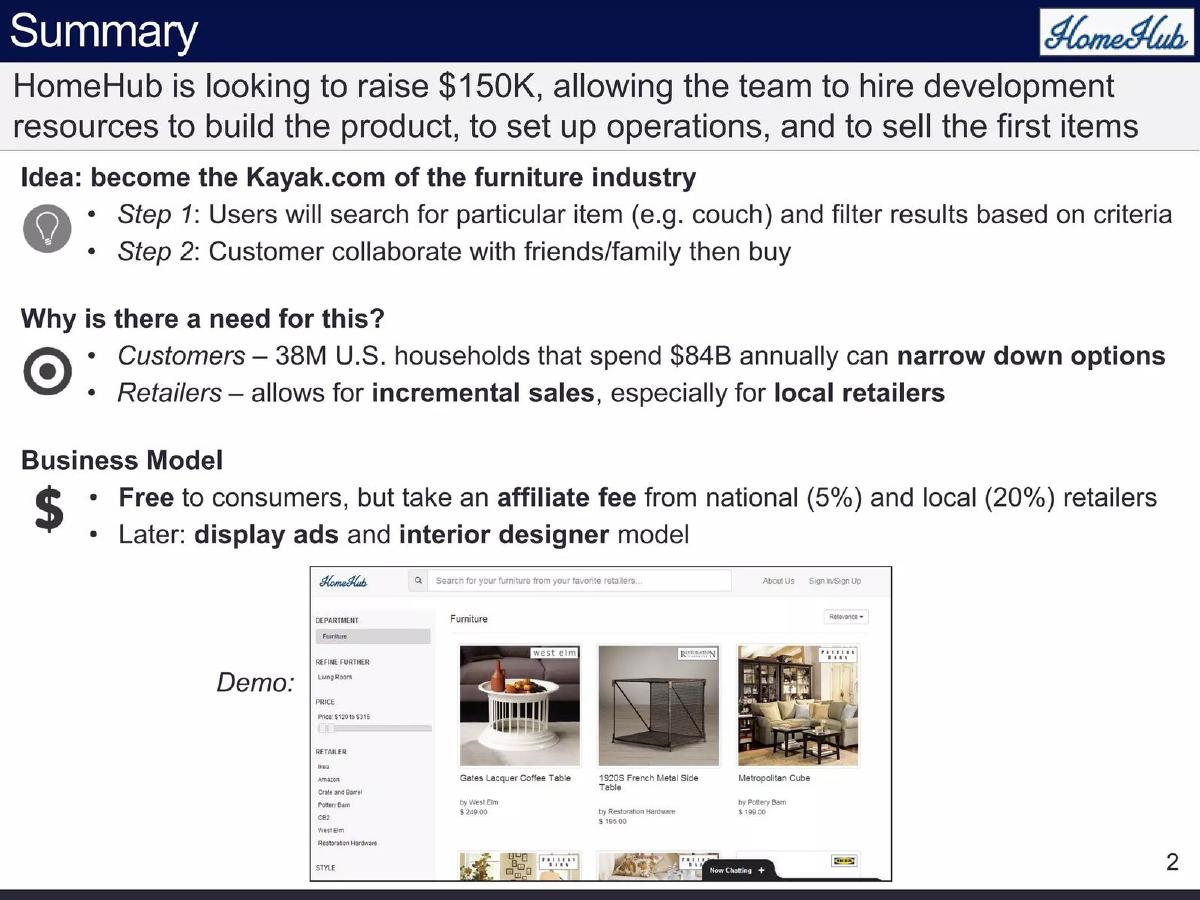
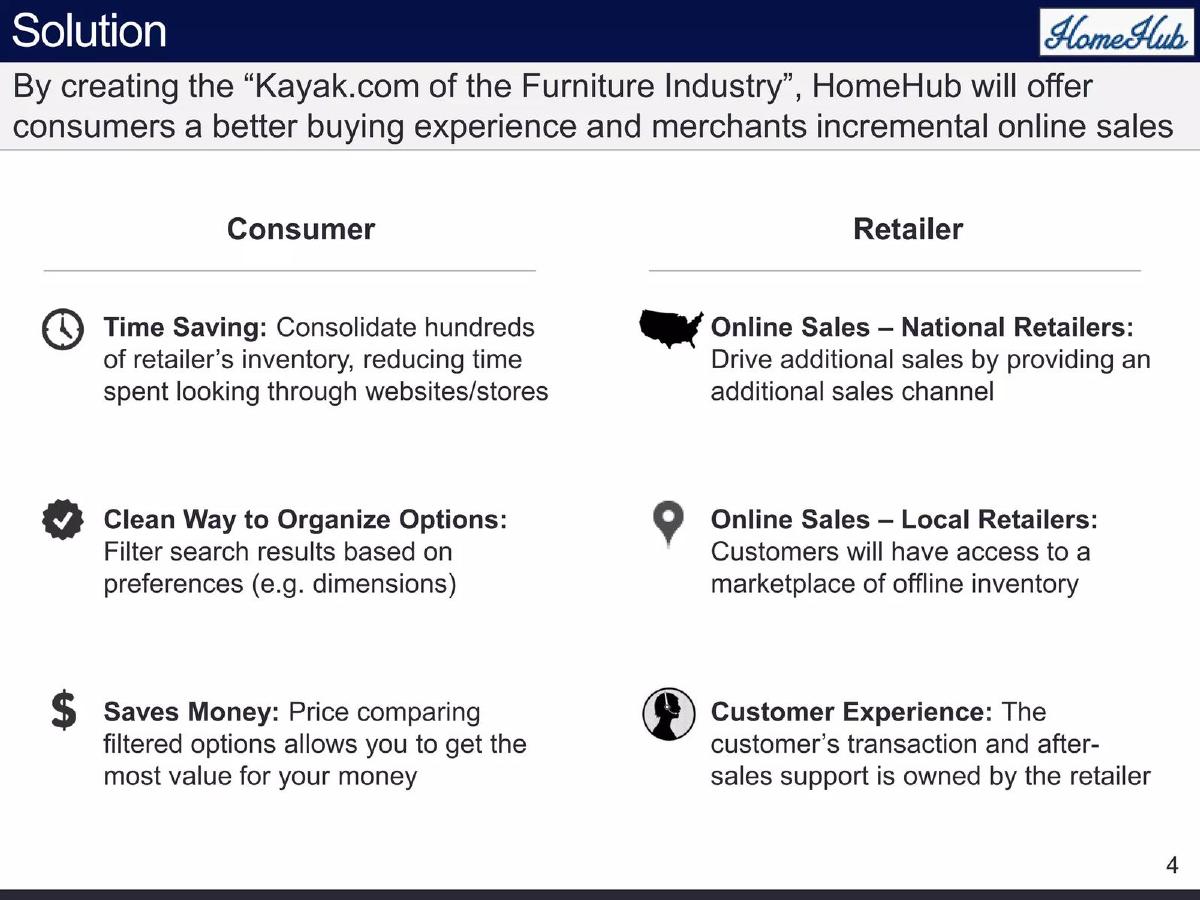
HomeHub's 15-slide presentation (8 slides provided) from early 2014 targets the fragmented furniture retail market. The company identifies a significant consumer pain point: the 60 hours per year households spend shopping for furniture across an overwhelming number of options. Their solution is a centralized search and comparison engine, similar to ShopStyle but for home goods. The business model relies heavily on affiliate fees from both mass and local retailers, supplemented by display ads and low-touch interior design services. Seeking a $150K pre-seed round, the deck provides a granular b…
Key takeaways
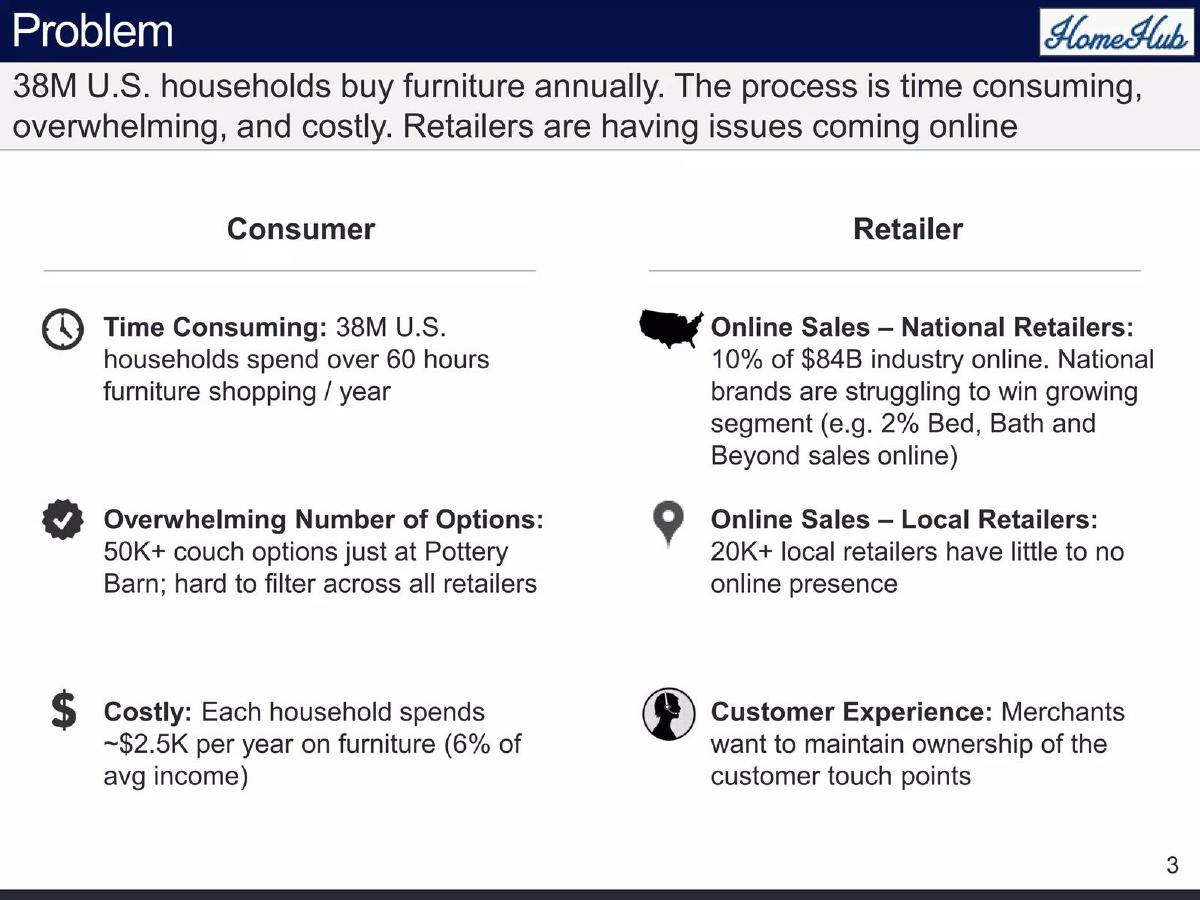
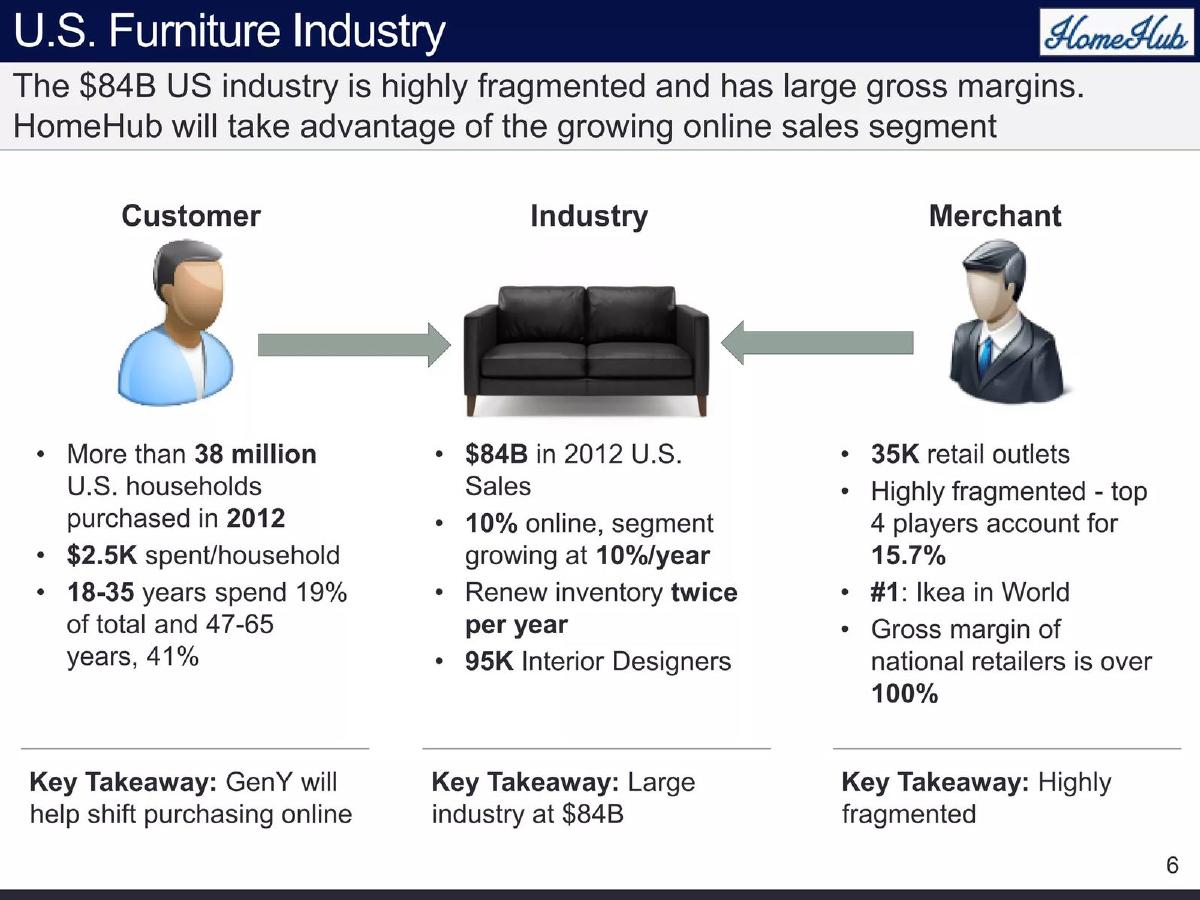
- The problem slide identifies that 38M U.S. households spend over 60 hours furniture shopping annually, representing a $2.5K spend per household (Slide 3).
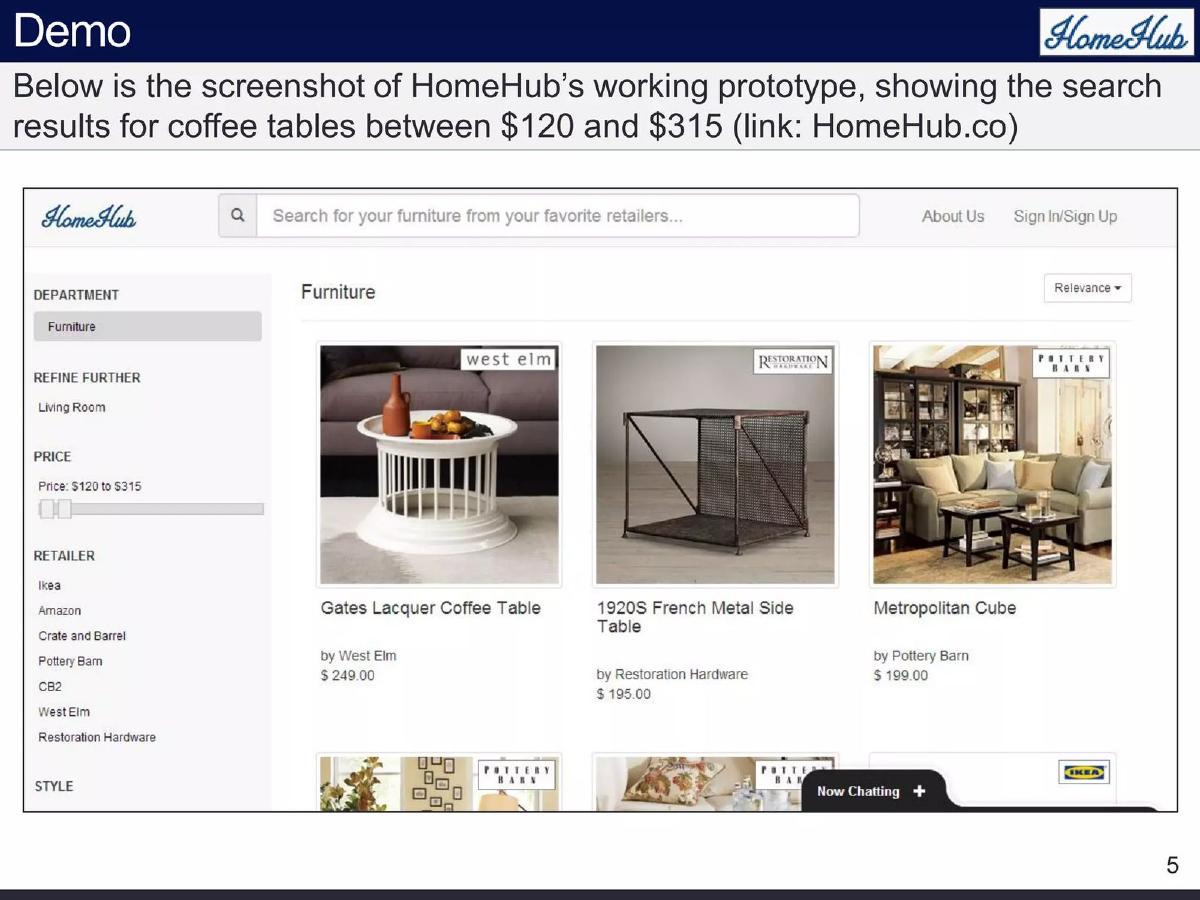
- HomeHub's prototype features a cross-retailer search interface including brands like West Elm, Restoration Hardware, and Pottery Barn (Slide 5).
- The business model is diversified across four streams: mass affiliate fees (5%), local affiliate fees (20%), display ads ($15 CPM), and interior design services (Slide 7).
- The deck uses 'Proof-of-Concept' comparables like Wayfair ($1B revenue) and ShopStyle ($28M revenue) to validate the aggregator model (Slide 9).
- Revenue projections are highly optimistic, targeting a 204% average growth rate to reach $78.9M in total revenue by Year 5 (Slide 11).
- The $150K pre-seed ask is detailed down to specific monthly salaries, including $5,000/month for co-founder David Albert (Slide 13).
- The 9-month roadmap sets clear technical milestones, including 'Crawler Complete' by Month 3 and 'MVP Released' by Month 4 (Slide 13).
- The advisor list includes high-level former Groupon executives and the owner of a major upholstery supplier to West Elm (Slide 15).
Executive Summary and Vision
HomeHub presents itself as a solution to the fragmented and time-consuming process of furniture shopping. The cover slide (Slide 1) establishes the brand identity with the tagline "No Headache Furniture Shopping." It clearly defines the platform's utility: search, discover, filter, compare, organize, and buy. The inclusion of contact information for co-founders David Albert and Eli Gill directly on the cover suggests a transparent, founder-led approach typical of pre-seed stage companies.
Slide 3: The Problem Statement
The problem slide is data-heavy, splitting the market pain points between the consumer and the retailer. For consumers, the deck highlights that 38 million U.S. households spend over 60 hours per year furniture shopping, which is described as "overwhelming" due to the volume of options (e.g., 50,000+ couch options at Pottery Barn alone). Financially, it notes that the average household spends $2,500 annually on furniture, representing 6% of average income.
On the retailer side, the deck points out a digital lag. National retailers are struggling to capture the online segment (citing Bed Bath & Beyond's 2% online sales rate), while 20,000+ local retailers have almost no online presence. This dual-sided problem sets the stage for a marketplace or aggregator solution that bridges the gap between high consumer intent and poor digital discovery.
Slide 5: Product Demo
The Demo slide provides a screenshot of a "working prototype." The interface mimics a standard e-commerce aggregator, featuring a sidebar for refining searches by department, price (shown as a range of $120 to $315), retailer, and style. The search results display products from West Elm, Restoration Hardware, and Pottery Barn side-by-side. This visual confirms that the core value proposition is price and style comparison across competing brands, a feature often missing from individual retailer sites.
Slide 7: The Four-Pillar Business Model
HomeHub outlines a diversified revenue strategy. The model is not reliant on a single stream, which is both an opportunity and a complexity risk for a pre-seed startup. The four pillars are: (1) Affiliate Fees from Mass Retailers: Tapping into existing programs like Amazon or West Elm. (2) Affiliate Fees from Local Retailers: A higher-margin play (20% fee) targeting the 20,000+ independent retailers lacking digital infrastructure. (3) Display Ads: Targeting home buyers with ads from telecom and insurance companies. (4) Interior Design Services: A "low-touch" service where customers pay for professional help to build rooms, leveraging designer discounts at retail.
Slide 9: Proof-of-Concept and Comparables
To validate the aggregator model, HomeHub compares itself to established players in adjacent verticals. They cite Wantering (clothing aggregator), Wayfair (home retailer), 1stDibs (luxury marketplace), and ShopStyle (fashion aggregator). By showing Wayfair's $1B revenue and ShopStyle's $28M revenue, the deck attempts to prove that the "aggregator" model is a proven winner in high-ticket consumer categories. Notably, they highlight ShopStyle's acquisition by Sugar Inc. as a potential exit path.
Slide 11: Revenue Projections
The financial projections are granular but highly ambitious. HomeHub projects growing from $983,772 in Year 1 to $78,954,013 by Year 5. The model assumes a 100% year-over-year growth in unique visitors for the first four years, reaching 17.2 million uniques by Year 5. The conversion rate is projected to start at 2% and climb to 3%. A significant portion of the Year 5 revenue ($46.6M) is expected to come from local retailer affiliate fees, suggesting that the company views the local market as its primary long-term profit driver rather than mass-market brands.
Slide 13: The Ask and Roadmap
HomeHub is seeking $150,000 in pre-seed funding. The deck provides a rare level of transparency regarding the use of proceeds, listing monthly costs for a 9-month runway. The budget includes $5,000/month for one full-time co-founder and $4,700/month for outsourced development. The milestones are clearly mapped: the homepage is due in Month 1, the web crawler in Month 3, and a full MVP release in Month 4. The plan culminates in the start of a Seed round by Month 7, giving the company only a two-month buffer after the MVP launch to prove enough traction for the next round.
Slide 15: The Advisory Board
The final slide presented lists five advisors. This is a high-pedigree group for a $150K raise. The presence of two former Groupon executives (Chris Muhr and Tobias Tschotsch) suggests the founders have strong ties to the Chicago/European tech ecosystem. Josh Silver’s role as a major supplier to West Elm and Macy’s is particularly relevant, as it provides the startup with "insider" knowledge of the furniture supply chain and potential retailer partnerships.
What HomeHub Does Well
The deck excels at identifying a specific, relatable consumer frustration. By quantifying the time spent shopping (60 hours) and the number of choices (50,000 couches), they make the need for an aggregator feel urgent. The business model slide is also well-constructed, showing how the product interface directly generates different types of revenue (e.g., pointing to where an ad would sit versus an affiliate link).
Furthermore, the transparency of the "Use of Proceeds" table is a best practice for pre-seed decks. It shows investors exactly how their capital will be deployed and demonstrates that the founders have a realistic grasp of their burn rate and technical requirements.
What is Missing from the Deck
The most glaring omission in the provided slides is a dedicated Team Slide . While co-founders are named on the cover and an advisor slide is included, there is no biographical information for the founders themselves. Investors at the pre-seed stage primarily bet on the team, so the lack of founder backgrounds (previous startups, education, or specific industry experience) is a significant gap.
Additionally, there is no Competition Slide beyond the "Proof-of-Concept" table. While they mention Wayfair as a comparable, they do not explain how they will compete against Wayfair's massive marketing budget or how they differ from other emerging home decor aggregators of that era. The deck also lacks Unit Economics ; while they project total revenue, they don't detail the Customer Acquisition Cost (CAC) vs. Lifetime Value (LTV), which is critical for an affiliate-heavy model.
Founder Takeaways
Be Granular with Your Ask: HomeHub’s breakdown of the $150K raise is excellent. Instead of asking for a lump sum for "product development," they broke it down into monthly salaries and infrastructure costs. This builds trust with early-stage investors.
Leverage High-Value Advisors: If you are a first-time founder, your advisory board can act as a proxy for your own experience. HomeHub successfully used their advisors to signal that they have the operational and industry connections necessary to scale.
Show, Don't Just Tell: Including a screenshot of a working prototype (Slide 5) is far more effective than just describing a vision. It proves that the technical work has already begun and that the founders are capable of execution.
Diversify Revenue Early: The four-pillar revenue model shows strategic thinking. By not relying solely on Amazon affiliate fees (which are notoriously thin), HomeHub demonstrated they were thinking about higher-margin opportunities like local retail partnerships and professional services from day one.
Frequently asked questions
- What is the primary value proposition for consumers?
- HomeHub aims to eliminate the 'headache' of furniture shopping by allowing users to search, filter, compare, and organize items from multiple top brands in one place. According to Slide 3, the average household spends 60 hours a year on this process, and HomeHub intends to reduce this time by aggregating over 50,000 options into a single searchable interface.
- How does HomeHub plan to monetize local retailers?
- Unlike mass retailers where HomeHub expects a 5% affiliate fee, the company targets a much higher 20% affiliate fee from local retailers. Slide 3 notes that over 20,000 local retailers have little to no online presence, and HomeHub intends to act as their primary digital storefront and customer acquisition channel.
- What are the specific uses for the $150K pre-seed funding?
- The funding is allocated over a 9-month period. The largest expenses are $45,000 for co-founder David Albert's salary and $42,300 for outsourced development work. Other costs include part-time salaries for VP Engineering and VP Product ($13,500 each), $18,000 for overhead, and $9,000 each for marketing and infrastructure (Slide 13).
- Who are the key advisors mentioned in the deck?
- The advisory board is a significant strength of the deck. It includes Josh Silver (owner of a top West Elm supplier), Chris Muhr (former SVP at Groupon), Tobias Tschotsch (former COO at Groupon EMEA), Jeremy Zuker (founder of WagJag), and Stacey Cohen (interior design firm founder). This provides both domain expertise and operational scaling experience (Slide 15).
- What are the technical milestones for the first nine months?
- The roadmap on Slide 13 outlines a rapid development cycle: Month 1 focuses on the homepage, Month 3 on completing the web crawler, and Month 4 on releasing the MVP with shareability features. Marketing and customer feedback loops begin in Month 5, leading into the start of Seed round fundraising by Month 7.