Hospitality Rising is not a traditional tech startup but a collective industry initiative designed to combat the UK's severe hospitality labor shortage. The deck, dated November 2021, seeks to raise £5M from hospitality operators to fund a massive, multi-channel advertising campaign. By positioning hospitality as a 'fun and exciting community' rather than a stop-gap job, the organization aims to attract young, experience-led job seekers who might otherwise choose retail or office work. The value proposition for investors (operators) includes early access to a 'locked' job board and a marketin…
Key takeaways
- The initiative identifies 188,000 hospitality vacancies in the UK as a primary driver for the campaign (Slide 5).
- The core strategy is to launch a 'government-sized' advertising campaign to double the hospitality talent pool (Slide 9).
- The campaign explicitly targets young job seekers who view hospitality as a less viable option than retail or warehouse work (Slide 13).
- The organization seeks a total of £5M in funding to be raised between November 2021 and January 2022 (Slide 33).
- Investors receive tangible benefits including access to a locked job board and an 'HRUK kitemark' for their venues (Slide 29).
- The creative strategy relies on two distinct routes: 'Live Fast. Work Young.' and 'Become a Local Legend' (Slides 17, 21).
- The deck lacks a traditional management team slide, though it includes a quote from the CEO of the British Beer & Pub Association (Slide 9).
- The timeline projected a 12-month advertising campaign to go live in May/June 2022 (Slide 33).
The Problem: A Sector-Wide Labor Shortage
Slide 1: Title Slide
The deck opens with a bold, high-contrast title: "Solving the Recruitment Crisis Forever." It is labeled as a "Hospitality Operator Return on Investment Document" dated November 2021. The branding is minimalist, using a sun-like logo and a yellow-on-white color scheme that suggests energy and optimism.
Slide 5: The Scale of the Problem
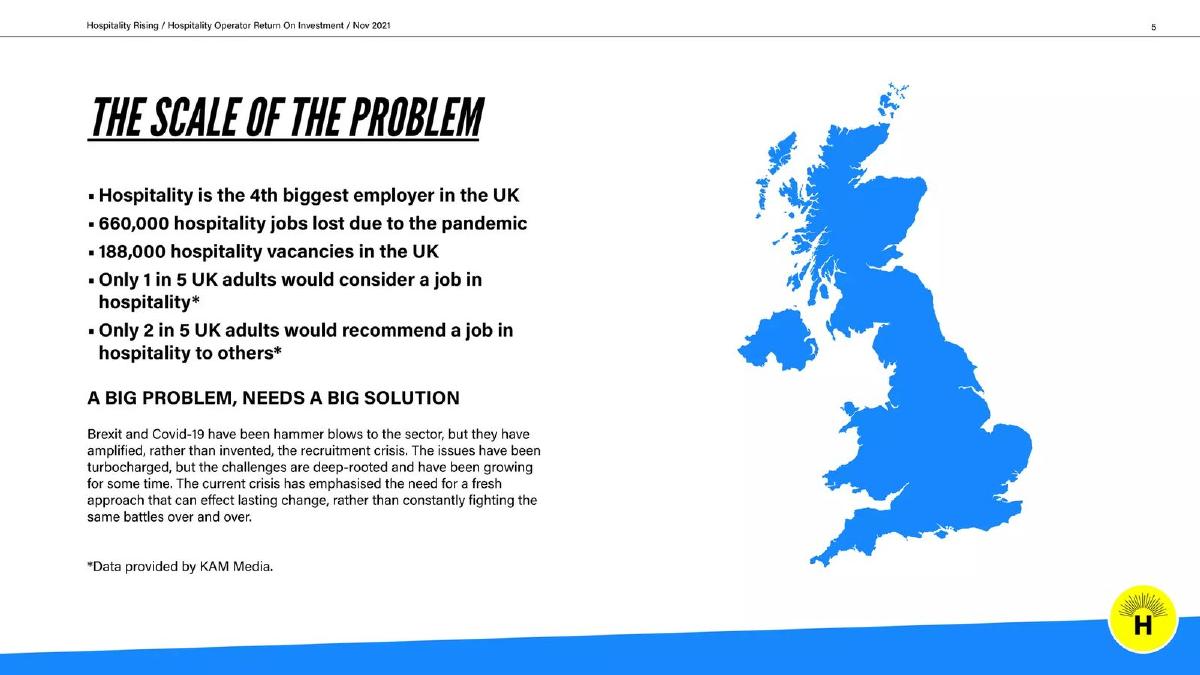
This slide establishes the urgency of the mission with five critical data points provided by KAM Media. It notes that hospitality is the 4th biggest employer in the UK, yet 660,000 jobs were lost due to the pandemic, leaving 188,000 vacancies. Most concerning for the industry is the perception gap: only 1 in 5 UK adults would consider a job in hospitality, and only 2 in 5 would recommend it. The text argues that Brexit and Covid-19 "turbocharged" deep-rooted issues, necessitating a "fresh approach."
The Solution: A "Government-Sized" Campaign
Slide 9: How Do We Do This?
The proposed solution is a "world-class brand and advertising campaign." The vision is to launch the biggest hospitality recruitment campaign in history, aiming to double the talent pool. The deck uses a high-profile comparison, telling investors to "Think (the hugely successful) Army 'Be The Best' campaign, but for Hospitality." This slide also includes a testimonial from Emma McClarkin, Chief Executive of the British Beer & Pub Association, providing industry-level social proof.
Slide 13: The Brief
This slide defines the target audience and the psychological shift required. It uses a "Get/Who/To/By" framework common in advertising agencies. The goal is to get young job seekers who want entry-level positions but fear "boring" jobs to consider hospitality as a viable alternative to retail or warehouse work. The "By" clause is the strategy: showing that hospitality is a "fun and exciting community, filled with interesting people like them."
Creative Strategy and Brand Identity
Slide 17: Creative Route 1 - Live Fast. Work Young.
The first creative concept is positioned as a "calling." It frames hospitality as an "act of rebellion against the 9-5." The copy emphasizes belonging and community, suggesting that the fast-paced nature of the industry is a way to "stay young" at heart and body. This is a direct play for Gen Z and younger Millennial workers who prioritize experience and social connection over traditional corporate structures.
Slide 21 & 25: Creative Route 2 - Become a Local Legend
The second route focuses on social status within a community. Slide 21 introduces the "Local Legend" tagline with retro, 3D-style typography. Slide 25 explores the "Tone of Voice," using aggressive comparisons to other entry-level sectors. Example copy includes: "Cogs stack shelves, legends bring the party" and "You won't find many customers buying a cold caller a beer." This positioning seeks to elevate the social capital of the bartender or server above that of a retail worker or telemarketer.
The Investment Proposition
Slide 29: What's In It For You?
This slide outlines the ROI for the operators funding the campaign. The benefits are tiered: 1) Access to a "locked" job board where all campaign traffic is directed; 2) Early access to the new talent pool; 3) The "HRUK kitemark" to signal a quality workplace; 4) Feature as an official partner in marketing materials; and 5) A venue marketing pack. This effectively turns the investment into a subscription for a premium recruitment channel.
Slide 33: Timeline and Next Steps
The execution plan is straightforward. The fundraising goal is £5M, to be collected between November 2021 and January 2022. The creative production phase is slated for February through April 2022, with the full 12-month advertising campaign going live in May/June 2022. The "Next Steps" section provides a direct call to action, asking investors to email a commitment form.
Slide 37: Closing Quote
The deck concludes with a quote by Ryunosuke Satoro: "Individually we are one drop, together we are ocean." This reinforces the theme of collective action, emphasizing that no single restaurant group can solve the labor crisis alone, but a unified £5M fund can shift national perception.
What Hospitality Rising Does Well
Clear Value Proposition for a Niche: The deck doesn't try to be everything to everyone. It identifies a specific pain point (labor shortage) and offers a specific, albeit non-traditional, solution (collective marketing). By focusing on the "locked job board" and the "kitemark," it gives operators a tangible reason to contribute to a common fund.
Strong Emotional Branding: The creative routes are well-defined and culturally relevant. Instead of promising higher wages (which the organization can't control), they promise a better lifestyle and higher social status. This is a sophisticated way to compete for talent without engaging in a wage war.
Industry Alignment: Including a quote from the British Beer & Pub Association (Slide 9) is a masterstroke. It signals to potential investors that this isn't a rogue startup, but an initiative backed by the industry's heavyweights.
What Is Missing from the Deck
Detailed Budget Breakdown: While the £5M figure is clear, there is no slide explaining how that money is split between creative production, agency fees, and actual media spend (TV, Social, OOH). Investors usually want to see that the majority of their capital is going toward "working media" rather than overhead.
The Internal Team: Slide 9 mentions a vision, but the deck (at least the 10 slides provided) lacks a dedicated team slide. Who is managing the £5M? Is it a group of seasoned marketers, or a committee of pub owners? In a campaign-led business, the pedigree of the creative and media directors is as important as the product in a tech startup.
Success Metrics: Beyond "doubling the talent pool," there are no specific KPIs. How many applicants do they expect to deliver per £1,000 invested? What is the target Cost Per Applicant? Without these benchmarks, the "Return on Investment" mentioned on the cover remains theoretical.
Lessons for Other Founders
The Power of the "Get/Who/To/By" Framework: Slide 13 is a perfect example of how to communicate a marketing strategy to non-marketers. Founders should use this simple structure to explain their go-to-market strategy to investors.
Leverage Collective Pain: If your industry is suffering from a systemic issue, consider if a collective model is more viable than a competitive one. Hospitality Rising shows that you can raise significant capital by positioning yourself as the "rising tide that lifts all boats."
Frequently asked questions
- Is Hospitality Rising a software platform or a service?
- It is primarily a marketing and recruitment initiative. While it mentions a 'locked job board' for partners, the core product is the advertising campaign itself, designed to shift public perception of the industry to increase the overall supply of labor for all participating operators.
- How does the company plan to spend the £5M investment?
- Slide 33 indicates the funds are for the creation and execution of a massive advertising campaign. The deck does not provide a granular budget breakdown, but it compares the scale to the 'Army: Be The Best' campaign, suggesting heavy spend on media buying and creative production.
- What is the specific target demographic for this recruitment drive?
- According to Slide 13, the target is 'young, experience-led, job seekers' who are looking for entry-level positions. The goal is to convince them that hospitality is more 'fun and exciting' than alternatives like retail, office jobs, or warehouse work.
- What are the 'Creative Routes' mentioned in the deck?
- The deck proposes two brand identities. Route 1, 'Live Fast. Work Young,' focuses on hospitality as an act of rebellion against 9-5 jobs (Slide 17). Route 2, 'Become a Local Legend,' focuses on the social status and community impact of hospitality workers compared to 'shelf stackers' (Slide 25).
- What is the 'HRUK kitemark' mentioned in the investor benefits?
- The kitemark is a branding tool for operators. By investing, companies can display this mark to show they are 'working to make Hospitality a good place to work,' effectively acting as an employer branding certification to attract talent (Slide 29).