Envizion Medical’s 10-slide deck is a masterclass in clinical validation and market specificity. Founded in 2014 and based in Tel Aviv, the company targets the $1.6 billion enteral feeding market with its ENvue system, an electromagnetic navigation tool designed to prevent the 4-5% of feeding tubes that are mistakenly placed in the lungs. The deck highlights a significant milestone: FDA 510(k) clearance achieved in February 2019, followed by a rapid U.S. commercial rollout in early 2020. By emphasizing a recurring revenue model and a nationwide agreement with a major 150-hospital healthcare s…
Key takeaways
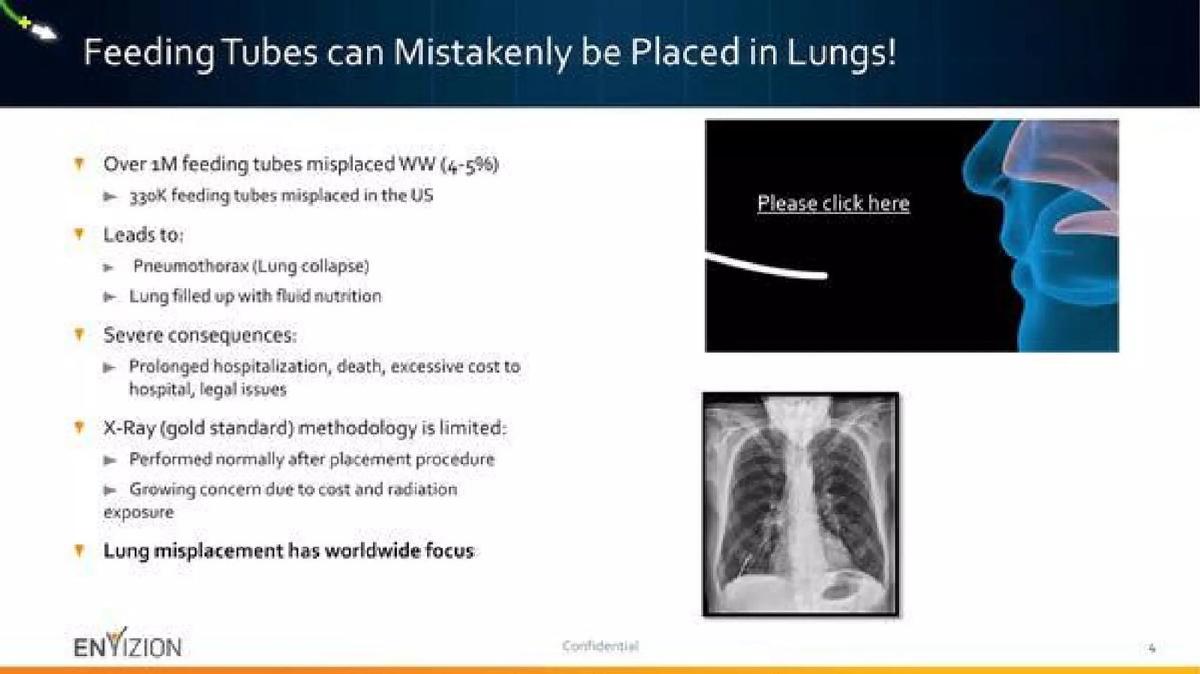
- The company identifies a massive clinical failure rate, noting that over 1 million feeding tubes are misplaced worldwide annually (Slide 4).
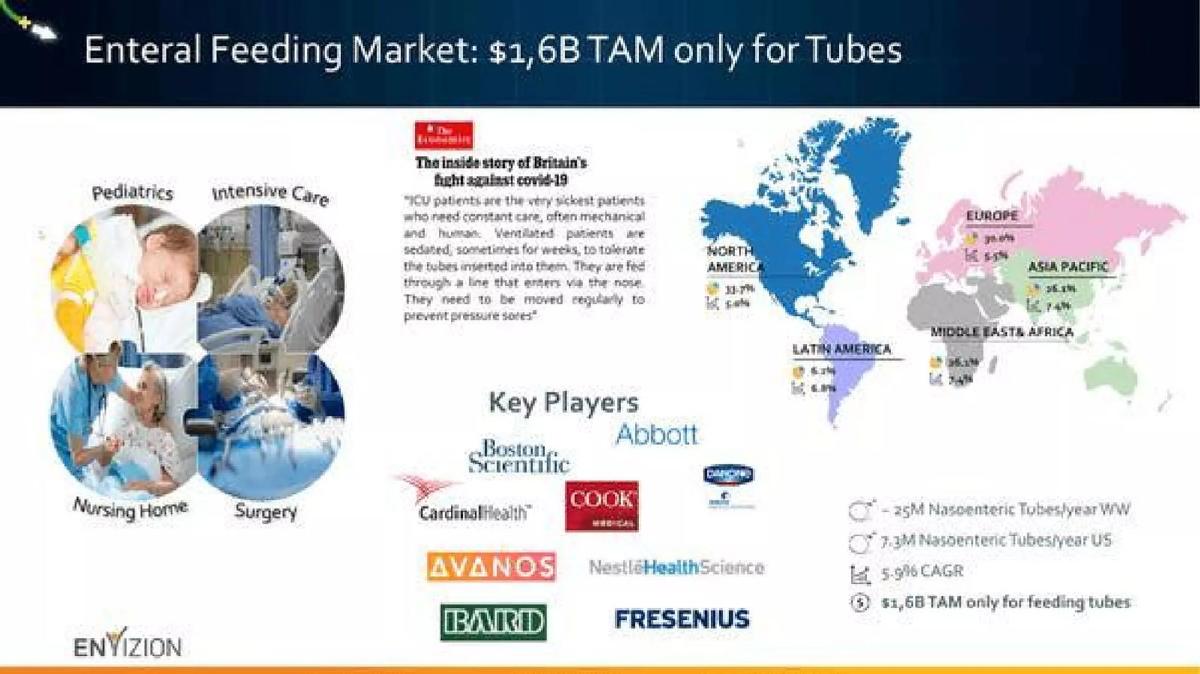
- Envizion defines its Total Addressable Market (TAM) as $1.6 billion specifically for feeding tubes, growing at a 5.9% CAGR (Slide 6).
- The ENvue system achieved FDA 510(k) clearance in February 2019 after successful trials at Cleveland Clinic and St. Vincent's (Slide 8).
- Commercial traction is evidenced by a nationwide agreement with the second-largest private U.S. healthcare system, covering 150 hospitals (Slide 9).
- The business model relies on monthly recurring revenue from tube orders rather than just one-time hardware sales (Slide 3).
- The management team features deep exit experience, including leaders from companies acquired by Covidien and Avanos (Slide 10).
- Clinical trials demonstrated zero lung placements and zero lung damage across 58 successful placements (Slide 8).
- The deck notes that $16.7 million had been raised prior to this specific presentation, with Swing Medical cited as a key investor (Slide 3).
Introduction: The Precision of Medical Device Fundraising
Envizion Medical’s pitch deck is a focused, 10-slide presentation that prioritizes clinical efficacy and market validation over stylistic flair. Founded in 2014 in Tel Aviv, the company addresses a visceral and expensive problem in healthcare: the accidental insertion of feeding tubes into a patient's lungs. By the time this deck was circulated, the company had already secured FDA clearance and begun a significant U.S. rollout, eventually resulting in $18 million in total funding. This teardown explores how they balanced technical innovation with a clear path to commercial profitability.
Slides 1-2: The Mission and Visual Identity
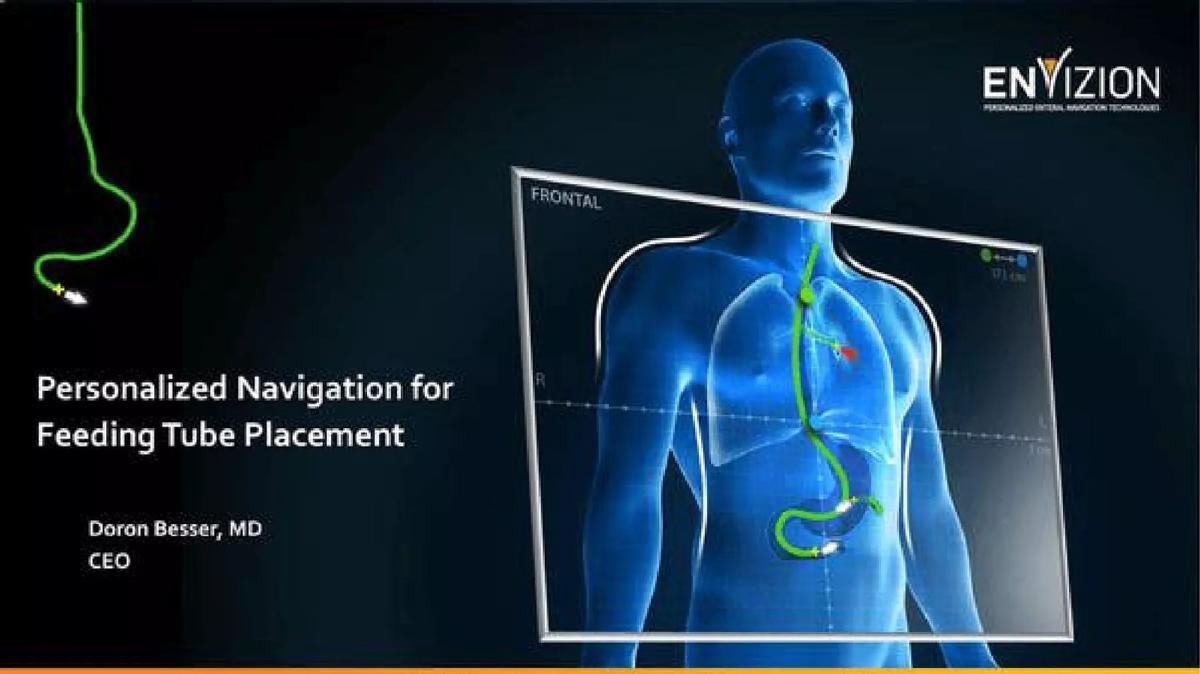
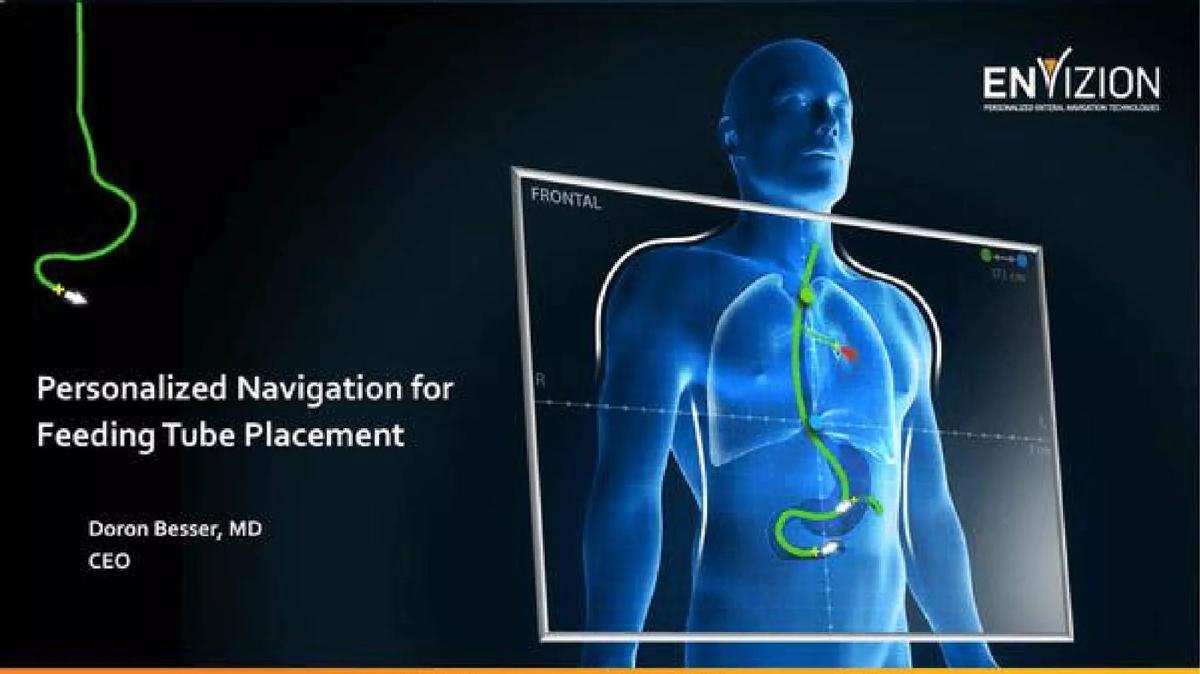
The Title Slide (Slide 1) sets a professional tone, featuring a high-quality 3D anatomical render of the ENvue system in action. It clearly states the value proposition: "Personalized Navigation for Feeding Tube Placement." The inclusion of "Doron Besser, MD" as CEO immediately establishes clinical authority, which is vital for medical device startups.
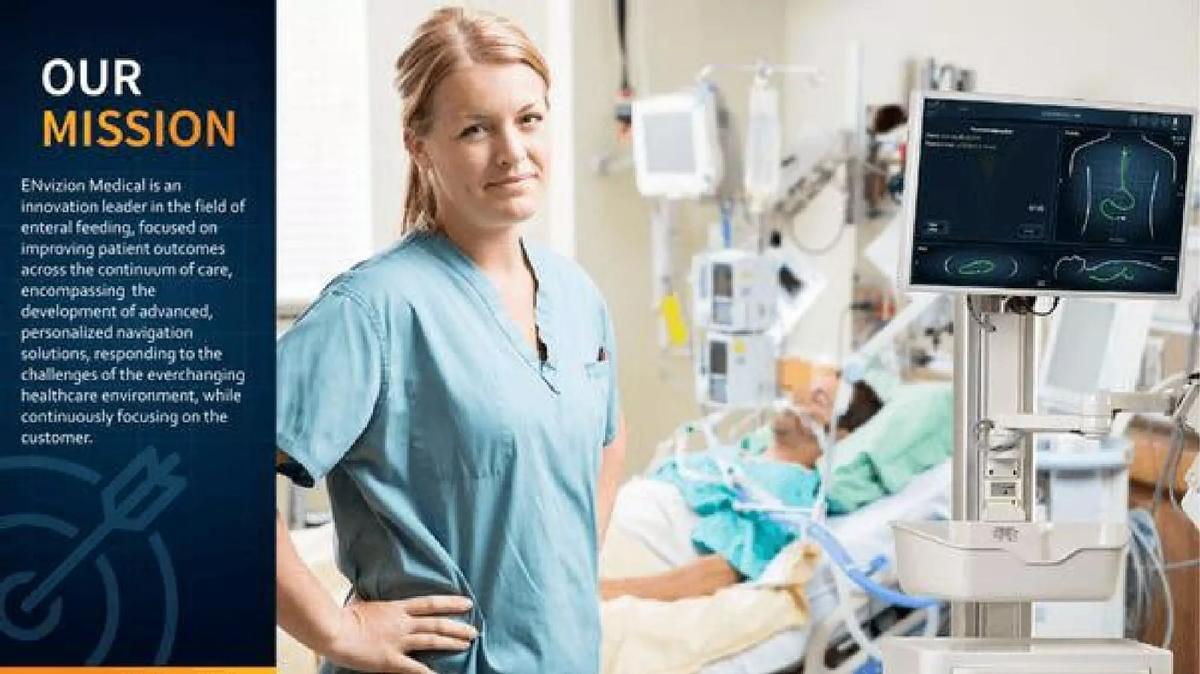
Slide 2 (Our Mission) uses a standard healthcare aesthetic—a nurse in a clinical setting—to humanize the technology. The text describes Envizion as an "innovation leader" focused on improving patient outcomes. While the mission statement is somewhat generic, the visual of the ENvue monitor at a patient's bedside reinforces that this is a finished, tangible product, not a theoretical concept.
Slide 3: The Executive Summary
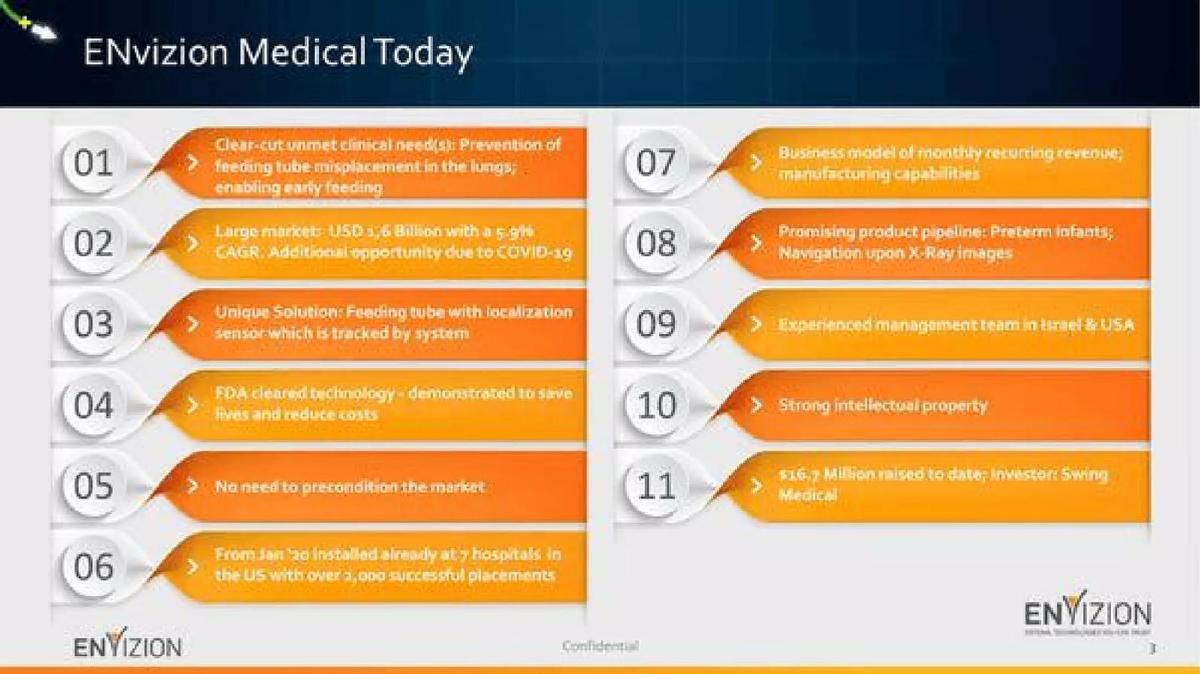
Slide 3 (Envizion Medical Today) acts as a comprehensive summary of the entire business case. It lists 11 key points that cover every major investor concern: unmet clinical need, market size ($1.6B), FDA clearance, and commercial traction. Notably, point 06 highlights that as of January 2020, the system was already installed in 7 U.S. hospitals with over 2,000 successful placements. Point 11 discloses that $16.7 million had been raised to date, providing a floor for the current valuation and showing existing investor confidence from firms like Swing Medical.
Slides 4-5: The Problem and Clinical Consequences
Slide 4 (Feeding Tubes can Mistakenly be Placed in Lungs!) defines the pain point with startling statistics. It notes that 4-5% of the 1 million feeding tubes placed worldwide annually are misplaced, including 330,000 in the U.S. alone. The slide lists severe consequences: lung collapse, death, and legal issues. It also critiques the current "gold standard" (X-ray) for being reactive rather than proactive.
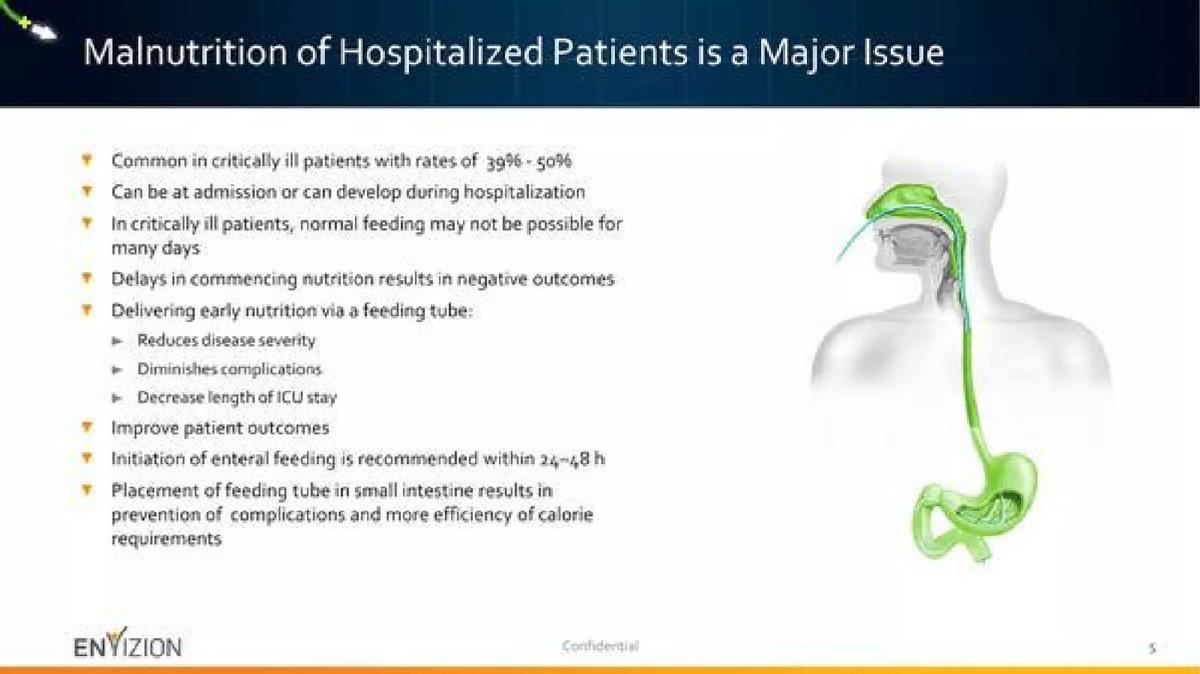
Slide 5 (Malnutrition of Hospitalized Patients) expands the problem scope. It argues that delays in feeding—often caused by placement difficulties—lead to negative outcomes in 39-50% of critically ill patients. By framing the device as a tool to enable "early nutrition," Envizion moves from being a safety tool to an essential component of ICU recovery efficiency.
Slide 6: Market Opportunity and Competition
Slide 6 (Enteral Feeding Market) quantifies the opportunity. The company claims a $1.6 billion TAM specifically for tubes, with a 5.9% CAGR. The slide includes a global map showing growth rates across North America, Europe, and Asia Pacific. Crucially, it lists "Key Players" like Boston Scientific, Abbott, and Cardinal Health. This serves two purposes: it shows the market is validated by giants, and it identifies potential future acquirers.
Slides 7-8: The Solution and FDA Validation
Slide 7 (ENvue Personalized Real-time Navigation System) introduces the hardware. The slide is minimalist, featuring a photo of the mobile cart and a placeholder for a video demonstration. This emphasizes the ease of integrating the system into existing hospital workflows.
Slide 8 (ENvue Clinical Trial Led to FDA 510(k) Clearance) is perhaps the most important slide for a medical startup. It cites trials at prestigious institutions like the Cleveland Clinic. The results are perfect: 58 successful placements, zero lung placements, and zero lung damage. The mention of a "short learning curve" and "no change in clinical practice" addresses the biggest barrier to hospital adoption: staff training and workflow disruption.
Slide 9: Commercial Traction
Slide 9 (Current Status) proves that the company has moved past the R&D phase. It highlights a nationwide agreement with the second-largest private healthcare system in the U.S., encompassing 150 hospitals. The slide also includes video testimonials from a Registered Nurse and a Doctor, providing social proof that the device works in high-pressure clinical environments. This slide justifies the "Later Stage" designation of the deck.
Slide 10: The Team
Slide 10 (Envizion Medical - Overview) provides a detailed table of the leadership team. The pedigree is exceptional. CEO Doron Besser and CTO Ran Cohen were part of SuperDimension, a company acquired by Covidien for $330 million. Other members have experience at Alcon, Novartis, and Abbott. For an investor, this team represents a "safe pair of hands" with a proven track record of exits in the medical device space.
What Works in This Deck
Clinical Credibility: By leading with an MD as CEO and citing trials at the Cleveland Clinic, the deck bypasses the skepticism often faced by med-tech startups. The data on slide 8 (zero lung placements) is the ultimate "mic drop" for a safety-focused device.
Clear Business Model: The deck doesn't just sell a machine; it sells a recurring revenue stream. By mentioning the "monthly recurring orders" on slide 9 and the "localization sensor" in the tubes on slide 3, they make it clear that this is a high-margin, scalable business.
Market Urgency: Slide 4 does an excellent job of making the problem feel urgent. The use of terms like "death" and "legal issues" highlights the high stakes for hospital administrators, making the ENvue system feel like a necessary insurance policy rather than a luxury.
What Is Missing
Unit Economics: While the deck mentions a recurring revenue model, it does not provide specific figures for the cost of the hardware versus the margin on the disposable tubes. Investors would want to see the LTV (Lifetime Value) of a hospital contract.
The Ask: The deck ends abruptly with the team slide. There is no specific "Ask" slide detailing how much capital is being raised in this round, the valuation, or the specific milestones the new funding will achieve (e.g., expanding to Europe or developing the preterm infant pipeline mentioned on slide 3).
Competitive Matrix: While slide 6 lists key players, it doesn't show a direct feature-by-feature comparison. How does ENvue specifically outperform a standard X-ray or other emerging navigation technologies in terms of cost or time-to-feed?
What a Founder Should Copy
The 'Today' Slide: Every founder should include a slide like Slide 3. It acts as a cheat sheet for the entire deck, allowing an investor to grasp the core value proposition in 30 seconds. If they like what they see there, they will pay much closer attention to the rest of the slides.
Testimonials with Context: Instead of just using quotes, slide 9 uses video thumbnails of actual practitioners at named hospitals. This makes the validation feel much more authentic and harder to fake than a text-only quote.
Exit-Oriented Team Slide: The team slide on slide 10 doesn't just list titles; it lists the acquisition values of the founders' previous companies. This is a powerful signal to VCs that these founders know how to build a company that is attractive to big-cap buyers.
Conclusion
Envizion Medical’s deck is a highly effective tool for a later-stage medical device company. It successfully navigates the transition from "we have an idea" to "we have a cleared, proven product with a massive U.S. distribution deal." By focusing on clinical safety and the recurring revenue potential of the $1.6 billion enteral feeding market, the company made a compelling case for the $18 million it eventually secured.
Frequently asked questions
- What specific problem does Envizion Medical solve?
- Envizion addresses the high risk of feeding tube misplacement. According to slide 4, 4-5% of the 1 million tubes placed annually end up in the lungs rather than the stomach. This leads to severe complications like pneumothorax (lung collapse) or lungs filling with fluid nutrition, which increases hospital costs, legal risks, and patient mortality.
- How does the ENvue technology work compared to the 'gold standard'?
- The current 'gold standard' is X-ray, but slide 4 notes this is limited because it happens after the procedure and involves radiation. The ENvue system (Slide 7) provides real-time, personalized electromagnetic navigation. It allows clinicians to see the tube's path during insertion, ensuring it reaches the small intestine without needing post-procedure X-ray confirmation.
- What is the company's revenue model?
- Envizion utilizes a 'razor and blade' strategy. Slide 3 explicitly mentions a 'Business model of monthly recurring revenue.' While they provide the ENvue navigation hardware, the recurring income is generated through the specialized feeding tubes equipped with localization sensors that are tracked by the system.
- What evidence of market fit is presented in the deck?
- The deck shows significant commercial momentum on slide 9. As of early 2020, they had signed a nationwide agreement with the second-largest private U.S. healthcare system (150 hospitals). They also highlight that 'thousands of procedures' have been successfully performed with zero lung placements since their U.S. launch.
- Is the company's leadership experienced in the medical device sector?
- Yes, the team slide (Slide 10) lists a heavy-hitting roster. CEO Doron Besser and CTO Ran Cohen both come from SuperDimension, which was acquired by Covidien for $330M. Other members have backgrounds at Novartis, Boston Scientific, and Abbott, showing a team capable of navigating both R&D and large-scale medical sales.