Enlightened is a B2B2C platform designed to bridge the gap between e-commerce and corporate social responsibility. By embedding donation goals and social sharing triggers into the checkout process, the company claims to increase sales conversions by 0.25% to 1%. The deck outlines a two-phase strategy: an initial managed service (Phase 1) evolving into a scalable SaaS platform (Phase 2). With early traction of $75,000 in revenue from three contracts, the company projects reaching $20-$30 million in revenue within five years. The pitch relies heavily on the 'conscious consumerism' trend, positi…
Key takeaways
- The platform aims to increase sales conversion rates by 0.25% to 1% by integrating giving into the brand site (Slide 4).
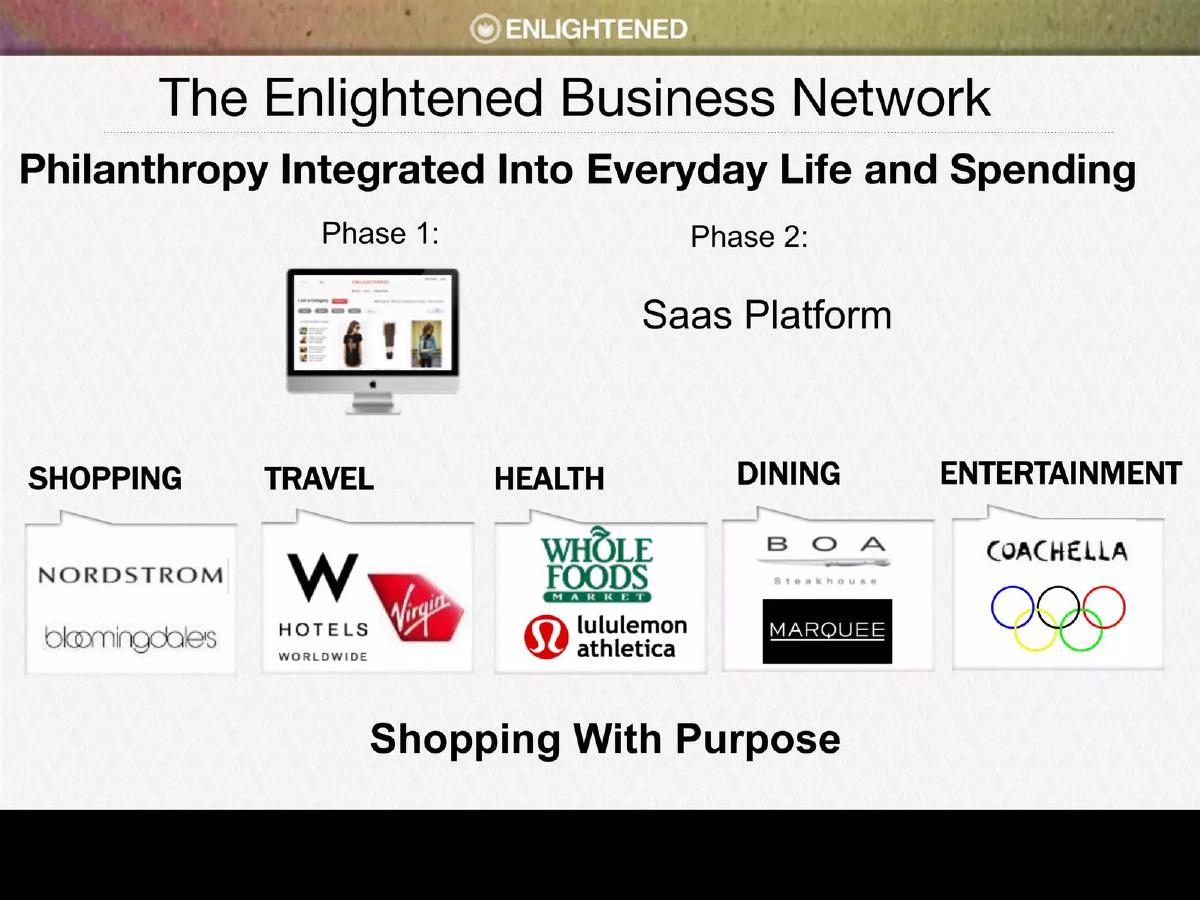
- The business model transitions from a service-heavy Phase 1 to a scalable SaaS platform in Phase 2 (Slide 2).
- Revenue is generated through monthly contracts ($2K-$5K), a 3.5%-7% cut of donation campaigns, and SaaS subscription fees (Slide 8).
- Early traction is reported as 3 contracts and $75,000 in revenue (Slide 9).
- The company identifies a 'Sales Pipeline' including major brands like Zappos.com, Virgin Group, and CBS.com (Slide 9).
- Competitive positioning claims a unique combination of payment tracking, loyalty through philanthropy, and social media gamification (Slide 7).
- Financial projections target $20-$30 million in revenue by years 4-5 with an exit valuation goal of $300 million (Slide 8).
- The deck lacks a team slide, specific use of funds, or a detailed breakdown of the underlying technology (Omitted).
Executive Summary
Enlightened is a B2B software company targeting the intersection of e-commerce and philanthropy. The deck presents a solution for brands that want to leverage social impact to drive traditional retail metrics like conversion rates and customer loyalty. By providing a suite of plugins that handle the tracking, gamification, and social sharing of corporate donations, Enlightened seeks to turn 'being good' into a measurable profit center for online retailers.
Slide 1: Title and Vision
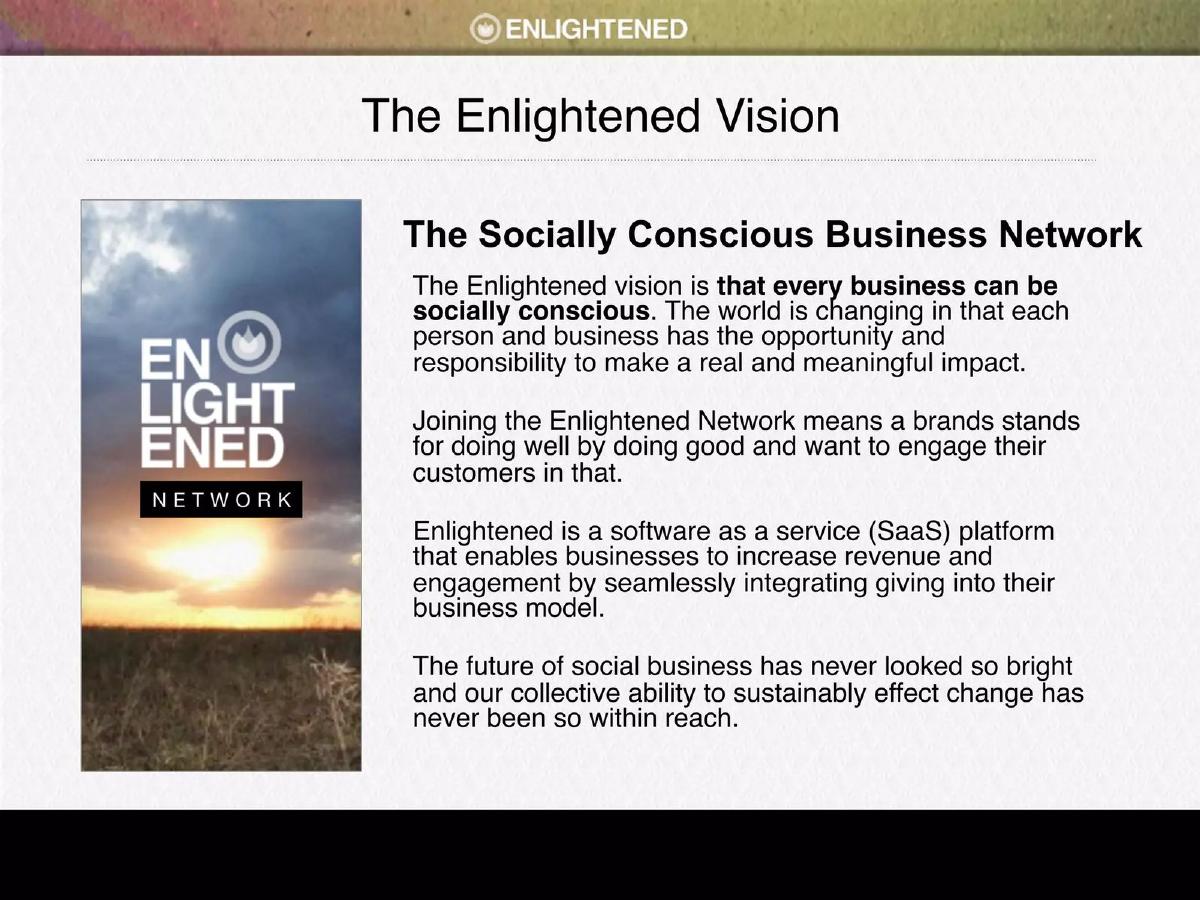
The cover slide establishes the brand identity with high-contrast imagery juxtaposing Western fashion with global philanthropic themes. The sub-headline defines the product as a "platform that enables brands to increase revenue and engagement by integrating philanthropic giving." This immediately frames the company as a performance-marketing tool rather than just a non-profit utility.
Slide 2: The Enlightened Business Network
This slide outlines the strategic roadmap. It splits the business into two phases: Phase 1 (a managed service/network) and Phase 2 (a SaaS platform). It lists target verticals including Shopping, Travel, Health, Dining, and Entertainment, featuring logos of major brands like Nordstrom, Virgin, Whole Foods, and Coachella. It is unclear if these are current partners or merely target examples, though later slides clarify the actual pipeline.
Slide 3: Value Proposition
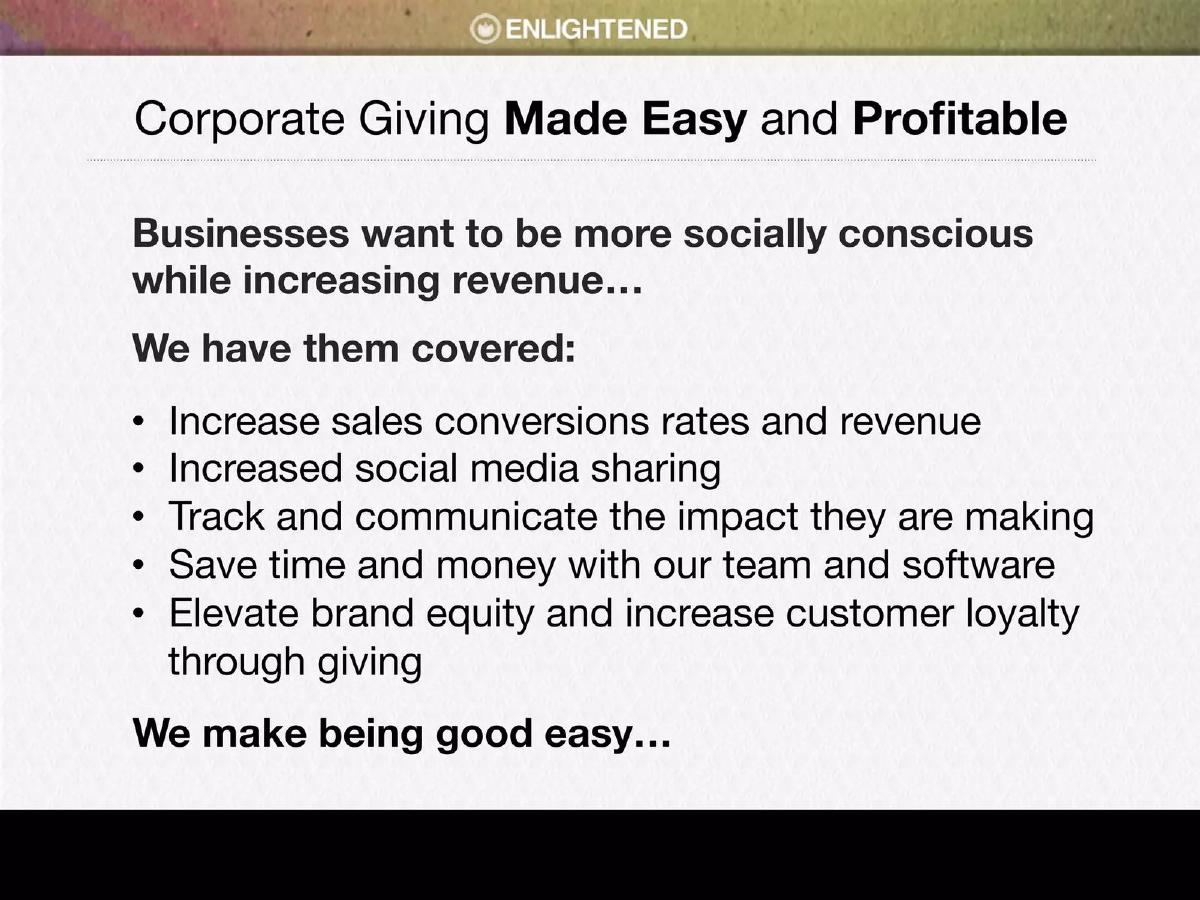
Titled "Corporate Giving Made Easy and Profitable," this slide lists the benefits for business clients. Key points include increasing sales conversion rates, social media sharing, and brand equity. The phrase "We make being good easy" summarizes the pitch to busy e-commerce executives who may be deterred by the logistical hurdles of managing charitable campaigns.
Slide 4: Socially Conscious Integration
This slide provides a visual walkthrough of the user experience. It shows a brand site (Net-A-Porter) integrated with Enlightened's UI. The process is mapped from "Engage Shoppers" (viewing a story about clean water) to "Increase Sales Conversions" (a call to action stating every purchase gives back) to "Increase post-purchase social media sharing." Crucially, it quantifies the expected lift in sales conversions at .25%-1%.
Slide 5: Enlightened Plugin Software
fundingPlugin: Displays the donation goal and current progress (e.g., "$13,432 raised"). · sharePlugin: A post-purchase pop-up that encourages sharing the impact on Facebook, Twitter, or Pinterest in exchange for a discount on the next purchase. · leaderPlugin: A leaderboard that ranks customers by the impact of their purchases, introducing a gamification element to the shopping experience.
Slide 6: Market Opportunity
Using data from Forrester Research, this slide highlights the growth of the US online retail market. The chart shows a forecast growing from $177 billion in 2010 to $327 billion in 2016. While the data is dated, the intent is to show that Enlightened is building in a massive, expanding sector where even a 1% conversion lift represents billions of dollars in value.
Slide 7: Competitive Landscape
The "This Space Is Very Hot" slide compares Enlightened to Rally.org, Socialvest, Upromise, and Kickstarter. Enlightened claims 6,000 monthly visitors and $700k in funding (though the source of this funding is not specified). The matrix suggests that while competitors have higher valuations or traffic, Enlightened is the only one offering a complete feature set including payment tracking and social gamification.
Slide 8: Financial Projections
This slide details the revenue model and growth targets. Revenue comes from $2K-$5K monthly contracts, a 3.5%-7% cut of donations, and SaaS fees.
Year 1: $550K revenue from ~35 contracts. · Year 2: $2.1 million revenue from ~130 contracts. · Year 4-5: $20-$30 million revenue.
The slide also explicitly mentions a target ROI for investors of 15-20 times based on a $300 million valuation.
Slide 9: Traction and Pipeline
The final slide in this set provides current status. The company reports 3 contracts and $75,000 in revenue. It reiterates the conversion lift metrics (3%-5% for sign-ups and .25%-1% for buy buttons). The "Current Sales Pipeline" lists high-profile names like CBS.com, Starwood Hotels, Nastygal.com, and Zappos.com. It is important to note these are listed as "pipeline," not signed customers.
What Works in This Deck
The deck is highly focused on the ROI for the customer . By repeatedly citing the .25% to 1% conversion lift, the founders move the conversation away from "charity" and toward "conversion rate optimization" (CRO). This is a much easier sell to a CMO or Head of E-commerce. The product breakdown into three distinct plugins (Slide 5) makes the technical implementation feel tangible and manageable rather than a vague "platform" integration.
What Is Missing
The most glaring omission in this 9-slide set is the Team Slide . In early-stage investing, the pedigree of the founders is often as important as the idea. There is also no Ask Slide ; we know they want a 15-20x return, but we don't know how much capital they are currently seeking or how they plan to spend it. Furthermore, the Unit Economics are thin. While they list revenue sources, they don't account for the cost of customer acquisition (CAC) or the operational costs of managing the "Phase 1" service-heavy model.
Founder Takeaways
Founders should emulate the visual walkthrough of the product seen on Slide 4. Showing exactly where the software lives on a customer's site helps investors visualize the user journey. Additionally, the competitive matrix on Slide 7 is a good example of how to frame a "crowded" market by highlighting specific feature gaps that the startup fills. However, be cautious about listing a "Sales Pipeline" (Slide 9) with massive brand names unless there are active, verifiable pilots in place, as sophisticated investors will often ask for proof of these relationships during due diligence.
Frequently asked questions
- What is the core value proposition of Enlightened?
- Enlightened positions itself as a tool for 'Corporate Giving Made Easy and Profitable.' According to Slide 3, the platform helps businesses increase sales conversion rates, boost social media sharing, and track social impact. The primary hook for retailers is the claim that integrating these philanthropic elements can lead to a conversion lift of 0.25% to 1%.
- How does the software actually integrate with a retailer's website?
- Slide 5 describes the product as 'Enlightened Plugin Software.' It features three specific components: a 'fundingPlugin' to show progress toward a donation goal, a 'sharePlugin' to incentivize post-purchase social sharing, and a 'leaderPlugin' to gamify the experience by displaying top contributors. The deck claims implementation is 'seamless' via simple code integration.
- What are the primary revenue streams for the company?
- Revenue is diversified across three sources as listed on Slide 8: monthly service contracts ranging from $2,000 to $5,000, a transaction fee of 3.5% to 7% on all donation campaigns processed through the platform, and a recurring SaaS subscription fee for the 'plug and play' version of the software.
- How does Enlightened compare itself to competitors like Kickstarter or Upromise?
- On Slide 7, Enlightened uses a feature matrix to differentiate itself. It claims to be the only player that offers the full suite of payment tracking, loyalty through philanthropy, and social media gamification. It notes that while Upromise sold for $300 million, it lacks the social and loyalty features Enlightened provides.
- What is the projected growth trajectory for the business?
- The company aims for significant scaling, moving from $550,000 in revenue (35 contracts) in Year 1 to $2.1 million (130 contracts) in Year 2. By years 4 or 5, they project revenue between $20 million and $30 million, targeting a $300 million valuation for investors (Slide 8).