Endpoint’s deck is remarkably brief at just seven slides, yet it manages to convey a sophisticated understanding of its operational position within the Title and Escrow (T&E) sector. Eschewing the traditional problem-solution narrative, the deck functions more as a progress report and strategic roadmap. It highlights a transition from an 'MVP' phase focused on user experience to a 'Foundation' phase centered on API development and market expansion. The standout feature is a detailed competitive matrix that uses specific metrics like 'Revenue / Sales Rep' and 'Product, Design, & Engineering HC…
Key takeaways
- The company defines itself as a full-service digital title and escrow provider with an enhanced closing experience across web, iOS, and Android (Slide 2).
- Endpoint’s history is rooted in a 2017 'DV Innovation Sprint' followed by a $7M Seed investment in August 2018 (Slide 3).
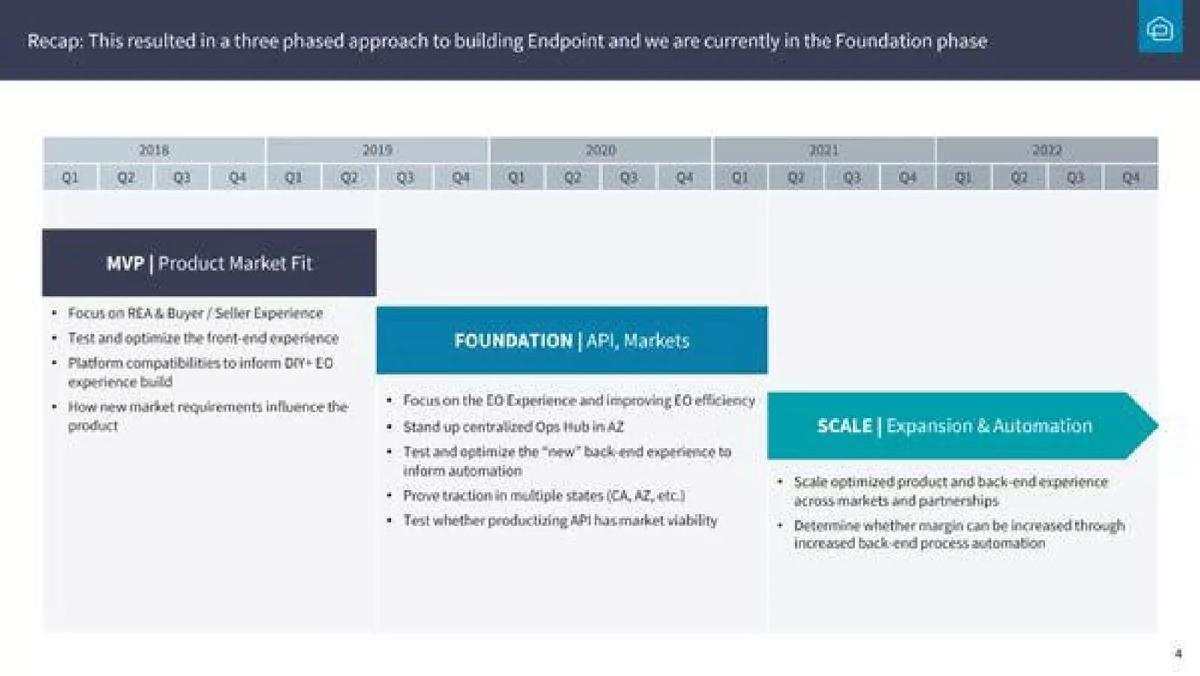
- The roadmap is divided into three distinct phases: MVP | Product Market Fit (2018-2019), Foundation | API, Markets (2020), and Scale | Expansion & Automation (2021-2022) (Slide 4).
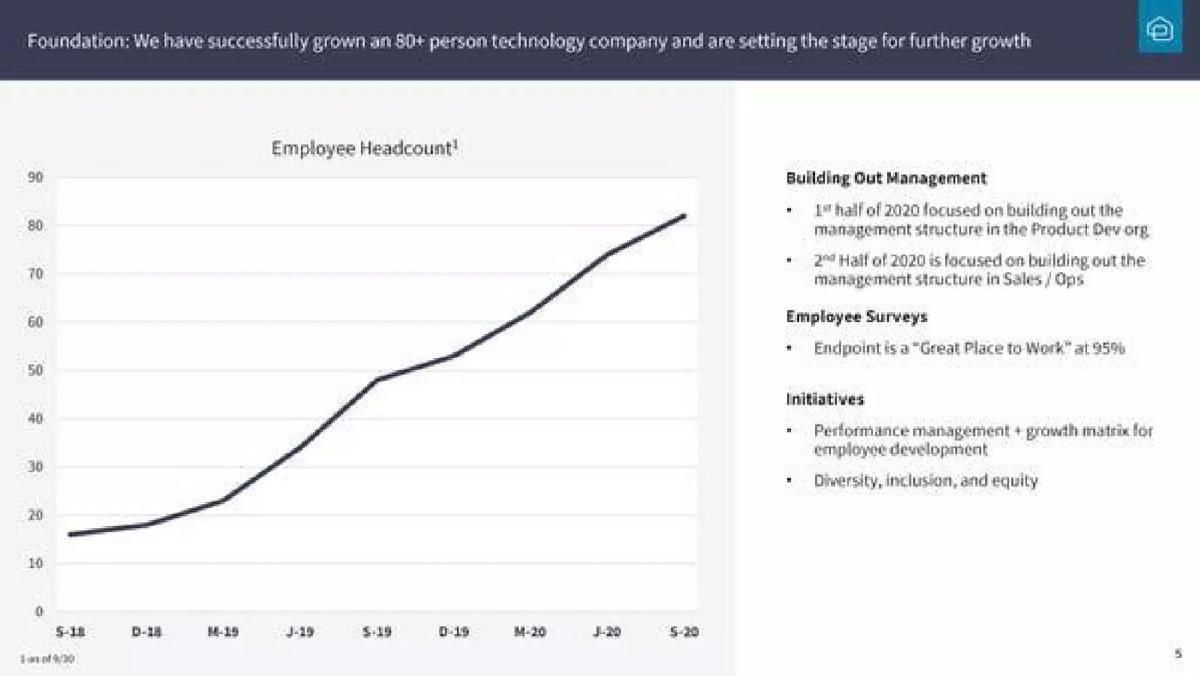
- As of September 2020, the company reached a headcount of 80+ employees, with a 95% 'Great Place to Work' survey rating (Slide 5).
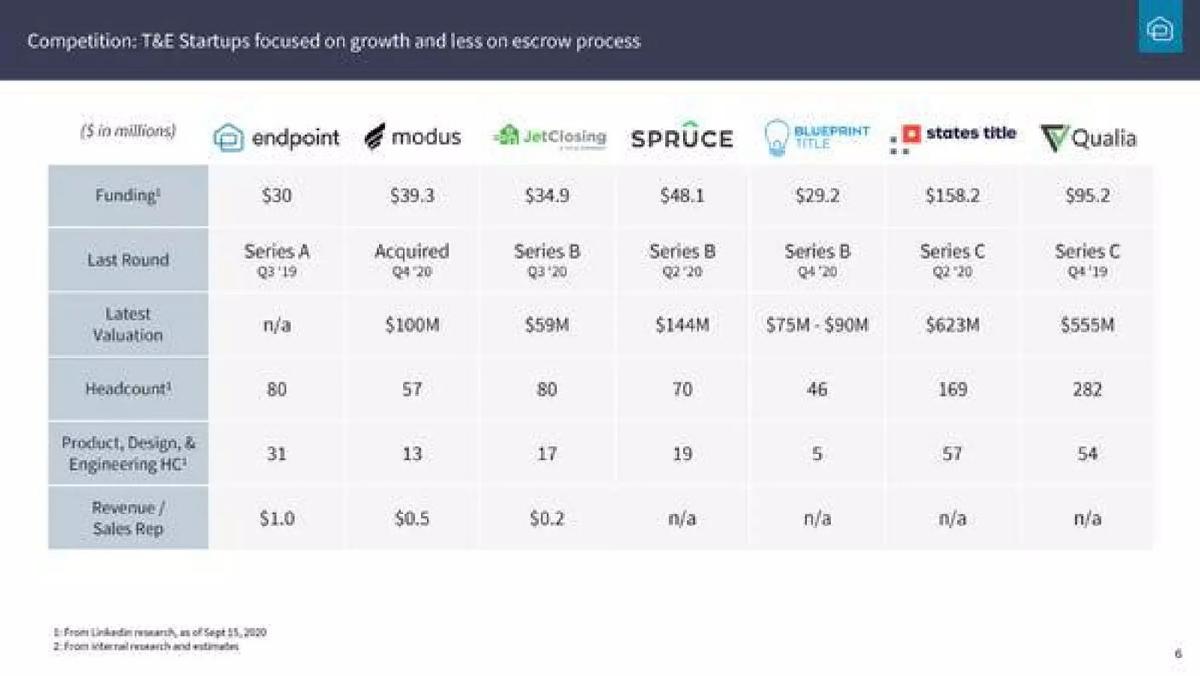
- Endpoint benchmarks itself against six competitors, claiming a higher 'Revenue / Sales Rep' of $1.0M compared to Modus ($0.5M) and JetClosing ($0.2M) (Slide 6).
- The deck highlights a significant Series A round of $12M in October 2019, bringing total funding to $30M by the time of the presentation (Slide 3, Slide 6).
- The future vision focuses on a 'smooth, automated back-end process flow' where data entry and document preparation are fully automated (Slide 7).
- The deck omits a dedicated team slide, detailed financial projections, and a specific funding request for the next round.
The 7-Slide Strategy: Operational Transparency Over Hype
The Endpoint pitch deck from 2020 is a departure from the standard 15-slide narrative arc. It does not spend time convincing the reader that the real estate closing process is broken; it assumes the investor already knows the Title and Escrow (T&E) space is ripe for disruption. Instead, the deck focuses on execution, efficiency, and the roadmap to automation. With only seven slides, it serves as a high-level briefing on how the company has utilized its $30M in total funding to build a foundation for scale.
Slide 1: Title Slide
The deck opens with a minimalist title slide. It features the Endpoint logo—a stylized house icon—and the text Pitch Deck . There are no taglines or mission statements here. It establishes a professional, corporate tone that persists throughout the presentation.
Slide 2: About Us and Product Interface
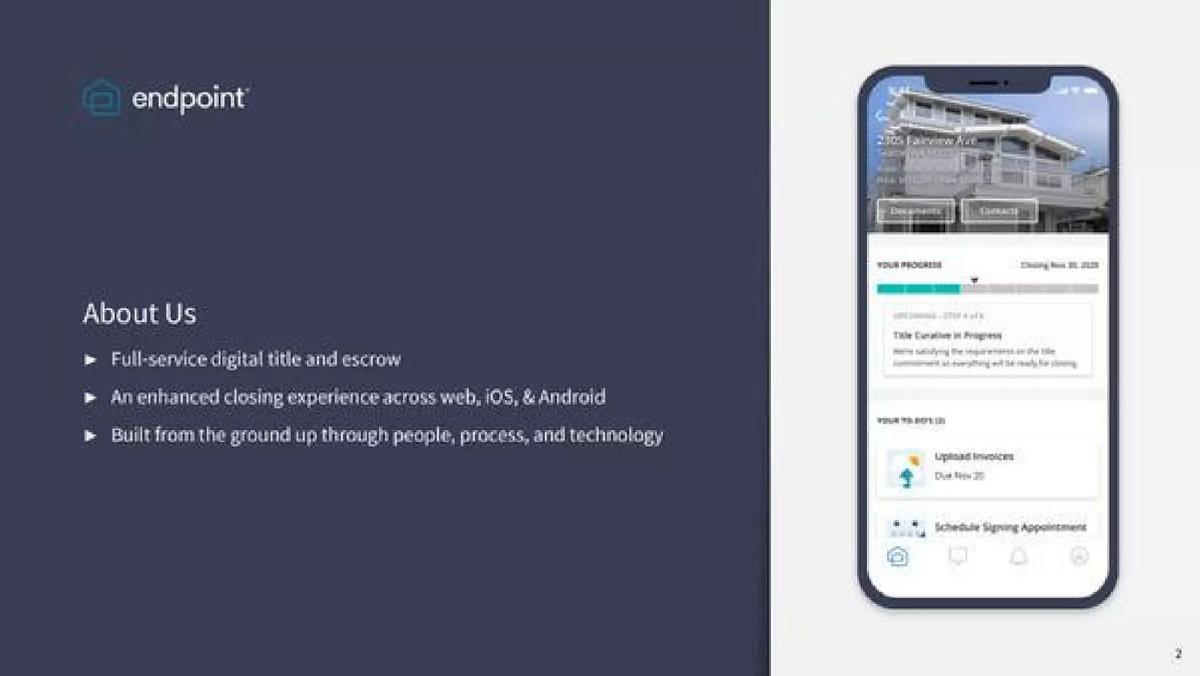
Slide 2 introduces the company's core identity. It defines Endpoint as a Full-service digital title and escrow provider. The slide lists three key value propositions: an enhanced closing experience across web, iOS, and Android; and a system built from the ground up through people, process, and technology . To the right, a mobile handset graphic displays the app interface, showing a property at 2105 Fairview Ave, Seattle, and a progress bar indicating that 'Title Curative' is in progress. This visual confirms that the product is live and functional, providing a transparent view of the user's 'To-Do' list and closing timeline.
Slide 3: The Execution Timeline
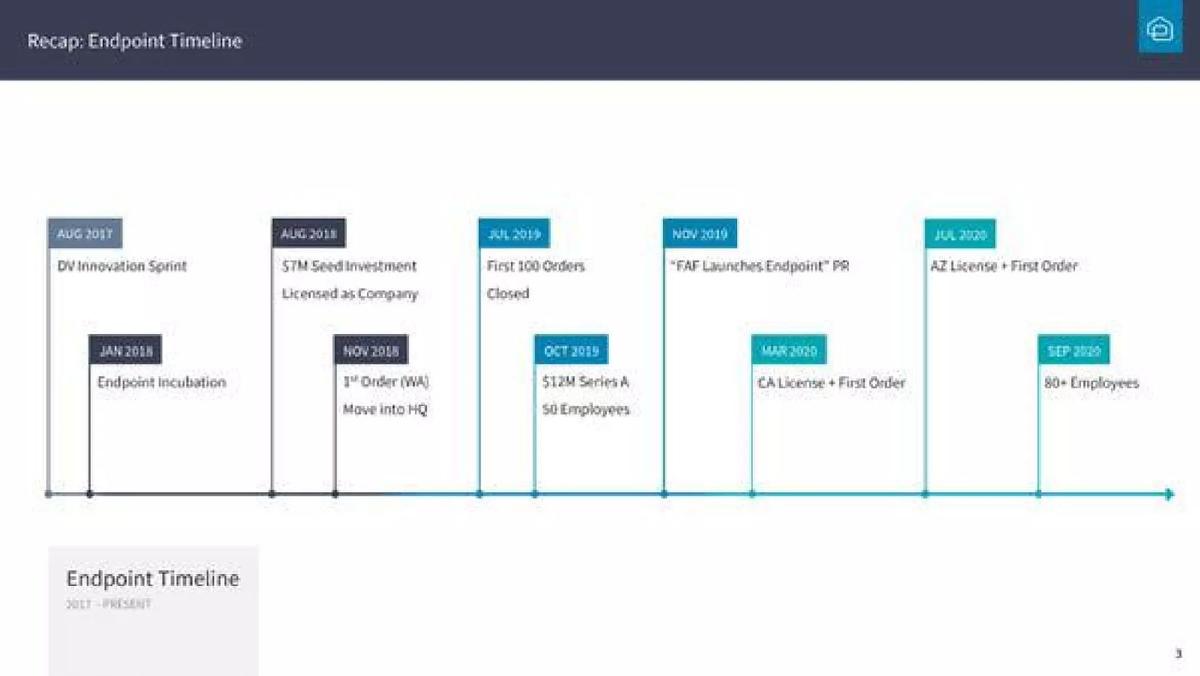
This slide provides a Recap: Endpoint Timeline from 2017 to the 'present' (September 2020). It tracks the company's evolution from a DV Innovation Sprint in August 2017 to an 80+ employee organization. Key financial milestones are noted: a $7M Seed Investment in August 2018 and a $12M Series A in October 2019. The timeline also highlights geographic expansion, noting the first order in Washington (Nov 2018) and subsequent licensing in California (Mar 2020) and Arizona (Jul 2020). This slide is critical for establishing credibility, showing that the company hits its regulatory and financial milestones on a consistent schedule.
Slide 4: The Three-Phased Roadmap
Slide 4 categorizes the company's journey into three distinct phases. The MVP | Product Market Fit phase (2018-2019) focused on the Real Estate Agent (REA) and Buyer/Seller experience. The FOUNDATION | API, Markets phase (2020) is described as the current stage, focusing on the Escrow Officer (EO) experience and proving traction in multiple states. The future SCALE | Expansion & Automation phase (2021-2022) aims to scale the product across markets and partnerships while determining if margin can be increased through increased back-end process automation . This slide tells investors exactly where their money is going: moving from a human-centric service to an automated, high-margin technology platform.
Slide 5: Human Capital and Culture
Titled Foundation: We have successfully grown an 80+ person technology company , slide 5 uses a line graph to show Employee Headcount growth from approximately 15 in May 2018 to over 80 by September 2020. Beyond just numbers, the slide emphasizes organizational health, noting a 95% 'Great Place to Work' survey rating. It also mentions initiatives in performance management, diversity, inclusion, and equity. In a service-heavy industry like escrow, demonstrating the ability to recruit and retain talent is a significant de-risking signal for investors.
Slide 6: Competitive Benchmarking
This is arguably the most important slide in the deck. It features a table comparing Endpoint against six competitors: Modus, JetClosing, Spruce, Blueprint Title, States Title, and Qualia . The metrics are highly specific: Funding, Last Round, Latest Valuation, Headcount, Product/Design/Engineering HC, and Revenue / Sales Rep . Endpoint highlights that while it has less total funding ($30M) than States Title ($158.2M) or Qualia ($95.2M), it maintains a Revenue / Sales Rep of $1.0M . This is significantly higher than Modus ($0.5M) and JetClosing ($0.2M). By including 'Product, Design, & Engineering HC' (31 for Endpoint), the company argues that it is more tech-heavy and operationally efficient than its peers.
Slide 7: The Future Vision
The final slide outlines the Future state vision for Endpoint closing process . It contrasts 'Objectives' with 'What it feels like.' The goals include a smooth, automated back-end process flow , seamless UX for customers, and timely lender engagement . The 'What it feels like' column describes a world where data entry and document preparation are automated, and agents can self-serve for forms. It concludes with a focus on comprehensive integration with real estate data sources to improve efficiencies. This slide serves as the 'North Star' for the company’s technical development.
What Works in This Deck
Operational Benchmarking: Slide 6 is a masterclass in using data to tell a story. By focusing on 'Revenue per Sales Rep,' Endpoint shifts the conversation from 'who has the most money' to 'who is the most efficient.' This suggests a superior business model that can generate more output with less capital.
Phased Clarity: The roadmap on Slide 4 is exceptionally clear. It avoids vague promises of 'growth' and instead identifies specific technical and market milestones (e.g., 'Productizing API,' 'Stand up centralized Ops Hub in AZ'). This gives investors a concrete checklist to measure future performance.
Proof of Product: Including a high-fidelity mobile screenshot on Slide 2 immediately validates that the 'digital title and escrow' claim isn't just a concept—it is a live platform with a tracking interface and document management capabilities.
What Is Missing
The Team Slide: Perhaps the most glaring omission is the lack of a team slide. While Slide 5 mentions headcount and culture, there are no bios for the founders or key executives. In a highly regulated industry like Title and Escrow, the professional background of the leadership team is usually a primary concern for investors.
The Financial Ask: The deck concludes without a specific 'Ask' slide. It does not state how much money the company is looking to raise or the specific valuation they are targeting. While this information is often handled in person, its absence makes the deck feel more like a corporate update than a fundraising tool.
The Problem Statement: The deck assumes the audience is intimately familiar with the friction in traditional real estate closings. While this may be true for sector-specific VCs, a broader audience might benefit from a slide quantifying the 'pain' (e.g., days to close, manual error rates) that Endpoint is solving.
What a Founder Should Copy
The Efficiency Metric: Founders should follow Endpoint’s lead in identifying a 'hero metric' that proves their operational superiority. For Endpoint, it was Revenue per Sales Rep. For a SaaS company, it might be a unique take on LTV/CAC or Magic Number that benchmarks favorably against the industry average.
The Timeline as Traction: Slide 3 is an excellent way to show momentum. By layering funding rounds, licensing milestones, and order volume on a single timeline, the company demonstrates a consistent 'heartbeat' of execution. This is much more effective than a simple list of achievements.
Visualizing the Roadmap: The use of 'MVP,' 'Foundation,' and 'Scale' as headers for the roadmap (Slide 4) is a great way to communicate the maturity of the business. It tells the investor exactly what risks have already been retired (Product-Market Fit) and what challenges lie ahead (Automation and Scale).
Frequently asked questions
- What is Endpoint's core product offering?
- According to slide 2, Endpoint provides a full-service digital title and escrow platform. The product is designed to offer an enhanced closing experience accessible via web, iOS, and Android devices. It emphasizes a 'built from the ground up' approach that integrates people, process, and technology to streamline real estate transactions.
- How does Endpoint compare its efficiency to its competitors?
- On slide 6, Endpoint uses a competitive matrix to highlight its operational efficiency. It reports a 'Revenue / Sales Rep' figure of $1.0M, which is double that of Modus ($0.5M) and five times that of JetClosing ($0.2M). It also notes that 31 of its 80 employees are in Product, Design, and Engineering, suggesting a heavy lean toward technical automation.
- What are the key milestones in Endpoint's timeline?
- Slide 3 outlines a timeline starting with an innovation sprint in August 2017. Key milestones include a $7M Seed investment (Aug 2018), the first order in Washington (Nov 2018), a $12M Series A (Oct 2019), and obtaining licenses in California (Mar 2020) and Arizona (Jul 2020). By September 2020, the company had grown to over 80 employees.
- What is the company's strategy for scaling?
- Slide 4 details a 'Scale' phase set for 2021-2022. This strategy involves scaling the optimized product and back-end experience across new markets and partnerships. A primary goal of this phase is to determine if margins can be increased through further back-end process automation, moving away from manual escrow tasks toward a tech-heavy model.
- What information is missing from this pitch deck?
- The deck is missing several standard components, including a dedicated Team slide featuring founder bios, a clear 'Problem' slide explaining the pain points of traditional escrow, and a specific 'Ask' slide detailing how much capital they are currently seeking and how it will be deployed. It also lacks detailed financial statements or P&L projections.