Encore Alert raised $940,000 in 2016 with an 11-slide deck that prioritized social proof over technical complexity. Operating in the crowded social listening space, the company positioned itself as an AI-driven filter for 'online noise.' The deck is notable for its heavy reliance on high-tier customer logos, including NASA and the Denver Broncos, appearing on five separate slides. While it lacks traditional financial projections, a detailed competitive matrix, or a specific 'ask' slide, it compensates with strong qualitative validation and a clear product interface demonstration. The narrativ…
Key takeaways
- The deck utilizes blue-chip logos on Slide 1 and Slide 2 to immediately establish credibility before the problem is even defined.
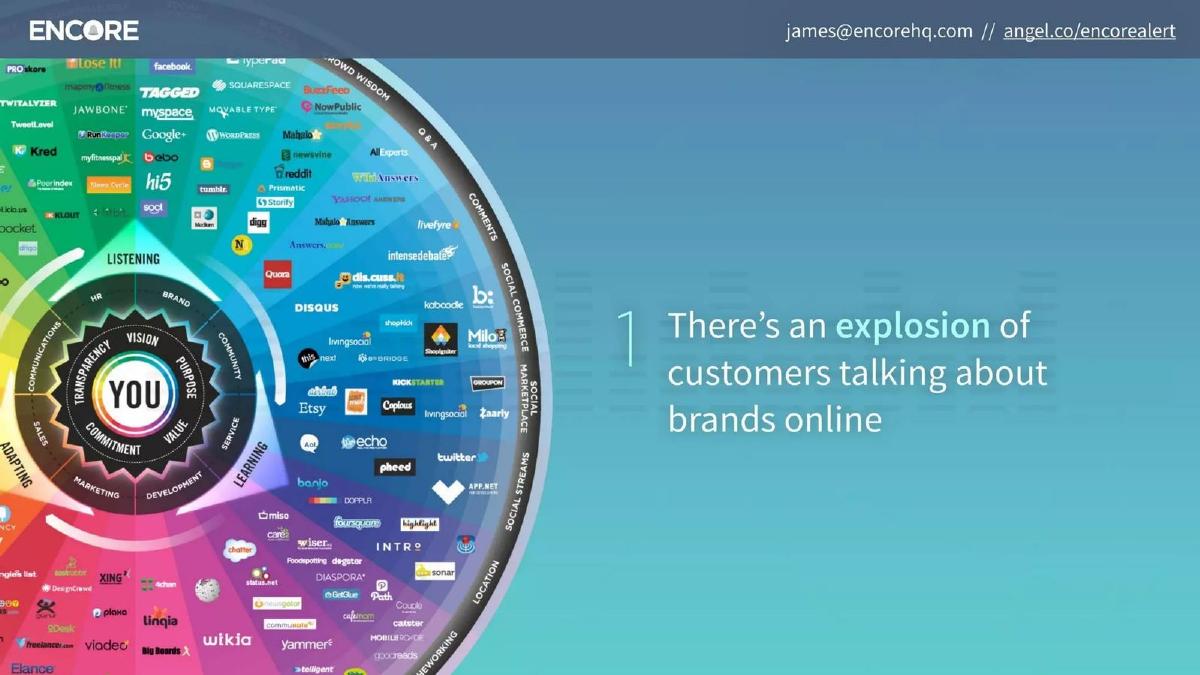
- Slide 4 uses a complex 'Conversation Prism' graphic to visualize the 'explosion of customers talking about brands online.'
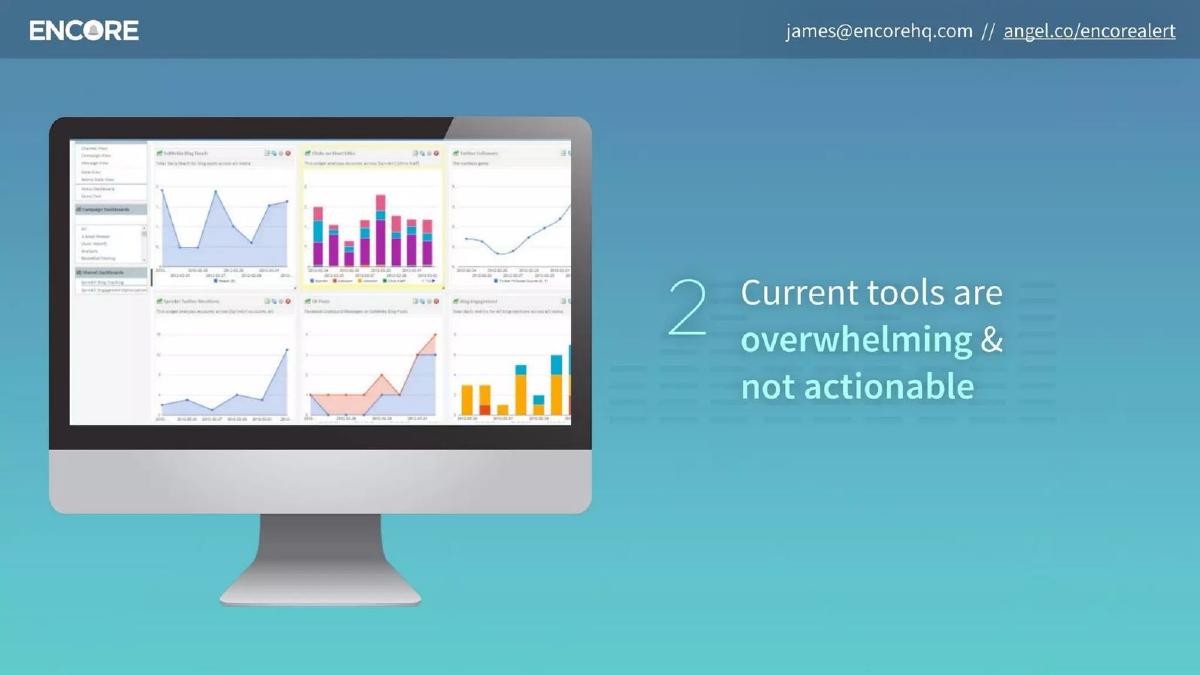
- The problem is framed on Slide 5 as current tools being 'overwhelming & not actionable,' illustrated by a cluttered dashboard.
- Product functionality is shown on Slide 7 via a mobile-style alert featuring a high-engagement tweet (1.5K shares vs. 46 average).
- Slide 8 provides a specific ROI metric, claiming a '3x Social Reach' increase for a Director of Digital Strategy.
- NASA's Head of Communications provides a 'holy grail' testimonial on Slide 9, serving as a powerful anchor for enterprise viability.
- Traction is quantified on Slide 10 with '$21,000 Monthly Recurring Revenue' and a '4x Pipeline Size.'
- The deck completely omits a formal 'Ask' slide, market sizing (TAM/SAM/SOM), and a roadmap for future development.
Introduction: The Power of Social Proof
The Encore Alert pitch deck from 2016 is a concise, 11-slide presentation that leans heavily on the reputation of its early adopters. In a period where 'Big Data' was transitioning into 'Actionable AI,' Encore Alert positioned itself as the signal within the noise. The deck's primary strength is not its data visualization or its market analysis—both of which are largely absent—but its sheer volume of social proof. By the time an investor reaches the traction slide, they have already seen the NASA and Mercedes-Benz logos multiple times, creating an aura of inevitability around the product's utility.
The Hook and Immediate Validation
Slide 1: Title Slide The deck opens with the company name and the tagline: "Turning online noise into actionable marketing & PR insights with AI." Notably, the bottom of the slide features a row of eight high-profile logos, including the Denver Broncos, NASA, and ABC. This is a bold move that signals immediate product-market fit.
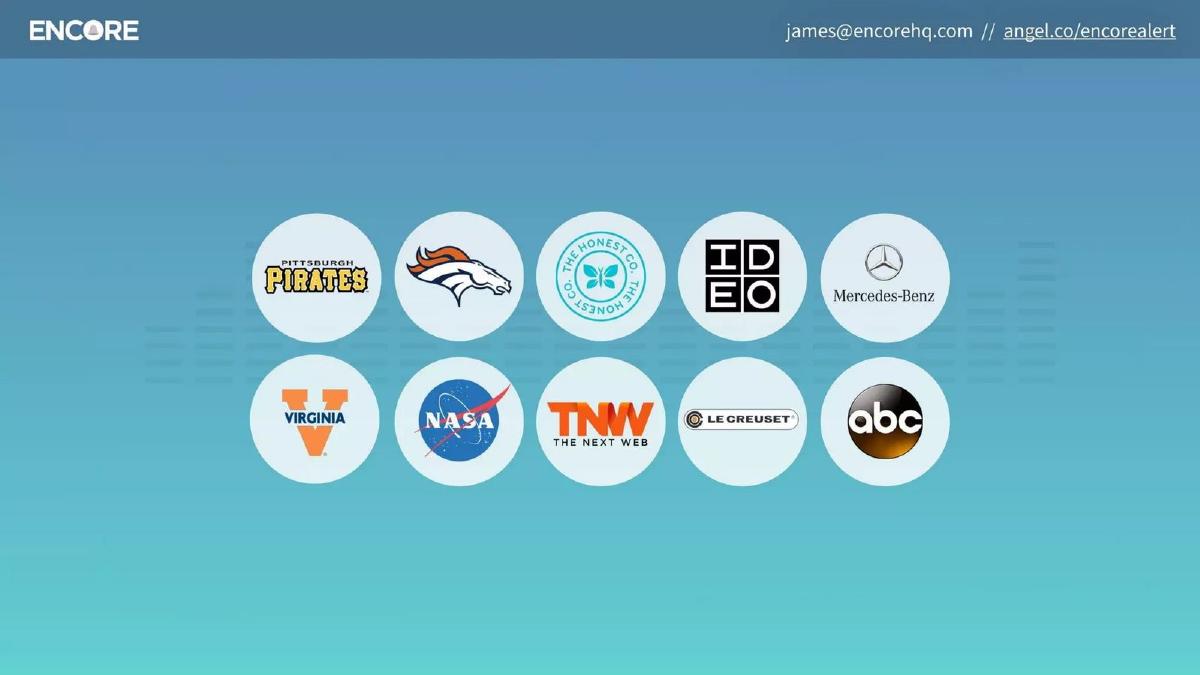
Slide 2: Logo Wall The second slide doubles down on this strategy, presenting ten logos in a clean grid. The list includes the Pittsburgh Pirates, Mercedes-Benz, The Next Web (TNW), and Le Creuset. This slide serves no purpose other than to say, "Important organizations use us." For a seed-stage startup, this is often more persuasive than a theoretical market size slide.
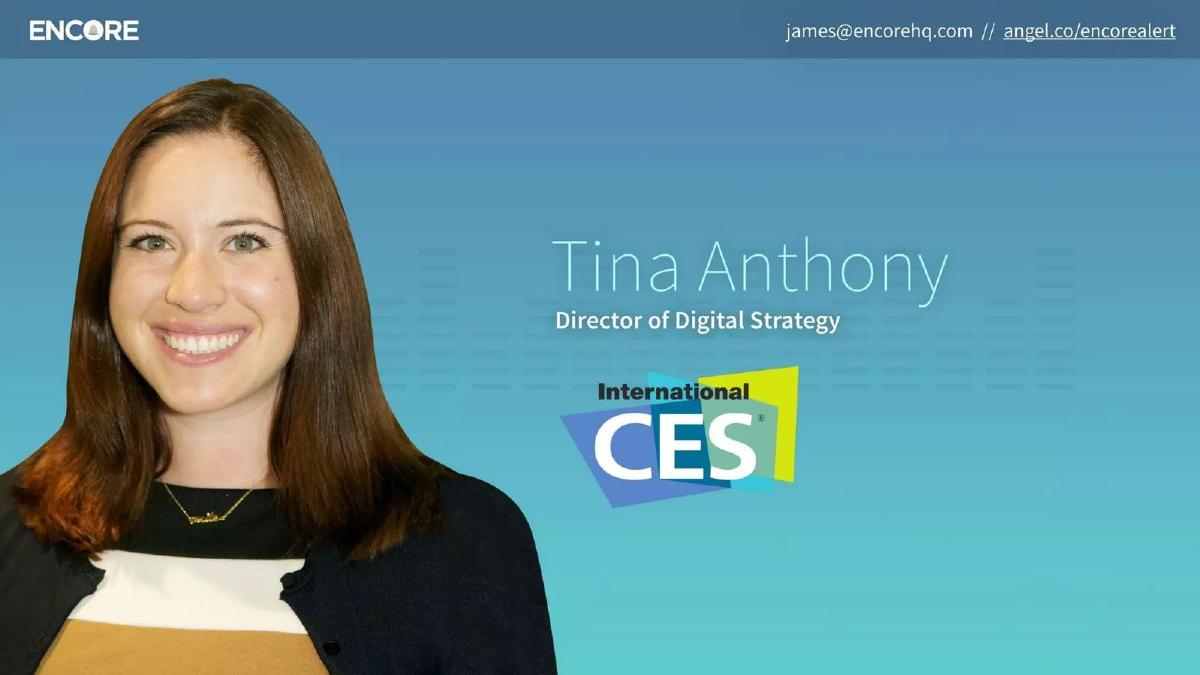
Slide 3: The User Persona Instead of a problem statement, Slide 3 introduces Tina Anthony, Director of Digital Strategy at International CES. This humanizes the customer base and prepares the reader for a testimonial-led narrative. It suggests that the product is built for high-level professionals at major events.
Defining the Problem and the Solution
Slide 4: The Noise (Problem Part 1) The deck uses the famous "Conversation Prism" graphic to illustrate the "explosion of customers talking about brands online." It is a standard industry visual used to represent the chaos of the social media landscape. The text simply states: "1. There’s an explosion of customers talking about brands online."
Slide 5: The Dashboard Fatigue (Problem Part 2) Slide 5 identifies the specific pain point: "2. Current tools are overwhelming & not actionable." The visual is a screenshot of a traditional social media dashboard filled with line graphs and bar charts. This sets up the contrast for Encore Alert’s minimalist approach.
Slide 6: The Re-Introduction This slide repeats the title slide’s branding and tagline. It acts as a transition from the problem space into the solution space, though it feels somewhat redundant in such a short deck.
Product and Performance
Slide 7: The Solution in Action This is the most critical slide for understanding the product. It shows a mock-up of an alert. The text explains that a tweet by @DeMarcusWare is "starting to catch fire," noting that while his average post has 46 shares, this specific post has 1.5K shares. The interface provides two clear calls to action: "Forward to Team" and "Keep a Closer Eye on This." This validates the "Google Now for marketers" description mentioned in the company's listing.
Slide 8: Quantified Success Returning to Tina Anthony from Slide 3, this slide claims a "3x Social Reach" increase. A quote from Anthony states, "I love receiving the insights in real-time. Encore has been a huge help to our team." This connects the product's features directly to a business outcome.
Slide 9: The 'Holy Grail' Testimonial Slide 9 features a quote from Bob Jacobs, Head of Communications at NASA: "I’ve been looking for something like [Encore] for the last 13 years. This is the holy grail." For a seed-stage company, a testimonial of this caliber from a government agency known for technical rigor is an extraordinary asset. The logo wall is repeated on the right side of the slide to reinforce the message.
Traction and Team
Slide 10: The Numbers The traction slide is straightforward. It lists "$21,000 Monthly Recurring Revenue" and a "4x Pipeline Size." By providing a hard dollar figure rather than just percentage growth, the founders demonstrate that they have moved past the pilot phase and into a repeatable sales motion. The logos appear yet again on the right side, linking the revenue to the enterprise clients previously mentioned.
Slide 11: The Team The final slide shows the three founders—Tammy Cho (CPO), James Li (CEO), and Felipe Lopes (CTO)—standing in front of the Golden Gate Bridge. It includes the CEO's email and the company's social handle. Unlike many modern decks, there are no resumes, past company logos, or educational backgrounds listed for the founders. The deck relies entirely on what the team has built and who they have sold it to, rather than where they worked previously.
What Works in the Encore Alert Deck
Relentless Social Proof: The decision to include the logo wall on five out of eleven slides is aggressive but effective. In a crowded SaaS category like social listening, the biggest risk for an investor is that the product is a "nice-to-have" that no one will pay for. By showing that NASA and Mercedes-Benz are active users, Encore Alert effectively de-risks the investment.
Clarity of Problem: Slide 5 perfectly captures the "dashboard fatigue" felt by many digital marketers. By showing a cluttered screen and labeling it "not actionable," the founders create an immediate desire for the simplified solution shown on Slide 7.
Outcome-Oriented Metrics: Instead of focusing on technical specs (like how many tweets they process per second), the deck focuses on "3x Social Reach" and "Actionable Recommendations." This speaks the language of the buyer and the investor simultaneously.
What is Missing from the Encore Alert Deck
The Ask: There is no slide detailing how much money is being raised, the terms of the round, or the intended use of funds. While this information is often removed from public versions of decks, its absence makes it harder to evaluate the company's capital efficiency at the time.
Market Sizing: There is no mention of the Total Addressable Market (TAM). Investors usually want to see that a company can grow into a billion-dollar entity. Encore Alert assumes the investor already knows the marketing technology market is large.
Competitive Landscape: The deck ignores competitors. In 2016, the social listening space was already mature, with players like Brandwatch, Meltwater, and NetBase. Failing to explain why Encore Alert’s "AI-first" approach is a defensible moat against these incumbents is a significant omission.
Business Model: While Slide 10 mentions MRR, there is no detail on pricing tiers, customer acquisition costs (CAC), or churn rates. For a seed round, these unit economics are vital for proving the scalability of the $21,000 MRR.
What a Founder Should Copy
The 'Show, Don't Tell' Product Slide: Slide 7 is a perfect example of how to demonstrate a product without a video. It shows a specific use case, the data behind the alert, and the action the user takes. It is far more effective than a list of bulleted features.
The Anchor Testimonial: If you have a customer like NASA, make them the star of the show. The "holy grail" quote on Slide 9 is likely what closed the round. Founders should identify their most prestigious user and get a high-impact, emotional quote from them.
Minimalist Design: The deck uses a consistent color palette, plenty of white space, and very little text. It is designed to be read in under three minutes, which is the reality of most initial investor reviews.
The Traction-Logo Link: Placing your revenue numbers right next to your best logos (as seen on Slide 10) creates a psychological link between the quality of the product and the quality of the revenue. It suggests that this isn't just $21k from friends and family, but $21k from world-class organizations.
Frequently asked questions
- How much did Encore Alert raise with this deck?
- According to the catalogue facts, Encore Alert raised $940,000 in a Seed round in 2016. The deck itself does not state the amount being raised or the valuation, which is a common omission in decks shared publicly after a round closes.
- Who were the key investors in this round?
- The listing identifies several prominent individual and institutional investors, including DC's NextGen Angels, Max Wessel (VP of SAP), Sean Glass (Founder of HigherOne), Sonny Ganguly (CMO of WeddingWire), Tyler Peterson (Head of Google Social), and Adam Riggs (President of Shutterstock).
- What is the core value proposition of the product?
- The product is positioned as an AI-driven tool that turns 'online noise' into actionable insights. Slide 7 demonstrates this by showing a push alert that identifies a specific high-performing tweet and offers buttons to 'Forward to Team' or 'Keep a Closer Eye on This.'
- Does the deck include a competitive analysis?
- No. The deck lacks a traditional competitive matrix or 'X/Y' axis chart. It implies competition on Slide 5 by stating that 'current tools' are overwhelming, but it does not name specific competitors like Sprout Social or Hootsuite.
- What traction did the company have at the time of the pitch?
- Slide 10 reports $21,000 in Monthly Recurring Revenue (MRR) and a sales pipeline four times that size. This is supported by a list of ten major logos, including NASA, Mercedes-Benz, and the Pittsburgh Pirates.