Epiminds, a Swedish marketing tech startup, raised a $6.6M Seed round in 2025 using a highly condensed 7-slide pitch deck. The presentation eschews traditional sections like competition, business model, and use of funds in favor of a pure 'velocity and pedigree' narrative. The deck highlights a founding team with experience at Google and Spotify and emphasizes that they reached 16 paying agency clients and 200+ brands within just 12 weeks of starting. By positioning their AI agent, 'Lucy,' as a manager of a 20+ person AI workforce, they target a $600B inefficiency in the marketing labor marke…
Key takeaways
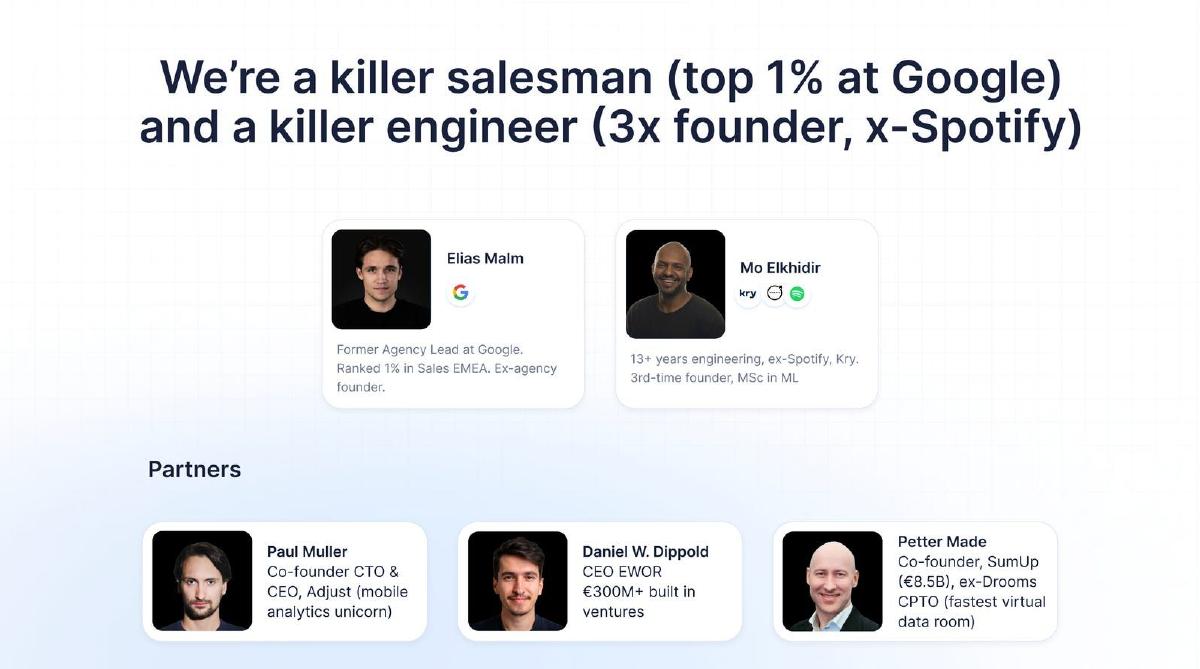
- The deck relies heavily on founder pedigree, citing a 'killer salesman' from Google and a 'killer engineer' from Spotify on slide 2.
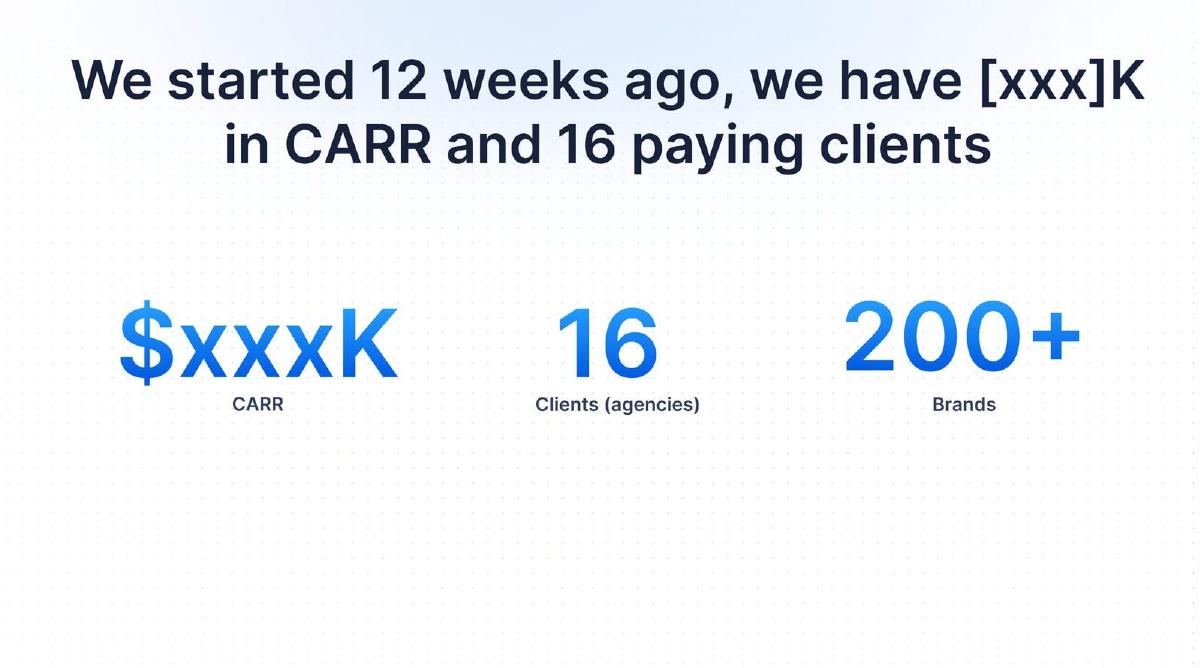
- Velocity is the primary metric, with slide 3 stating the company started only 12 weeks prior to the pitch.
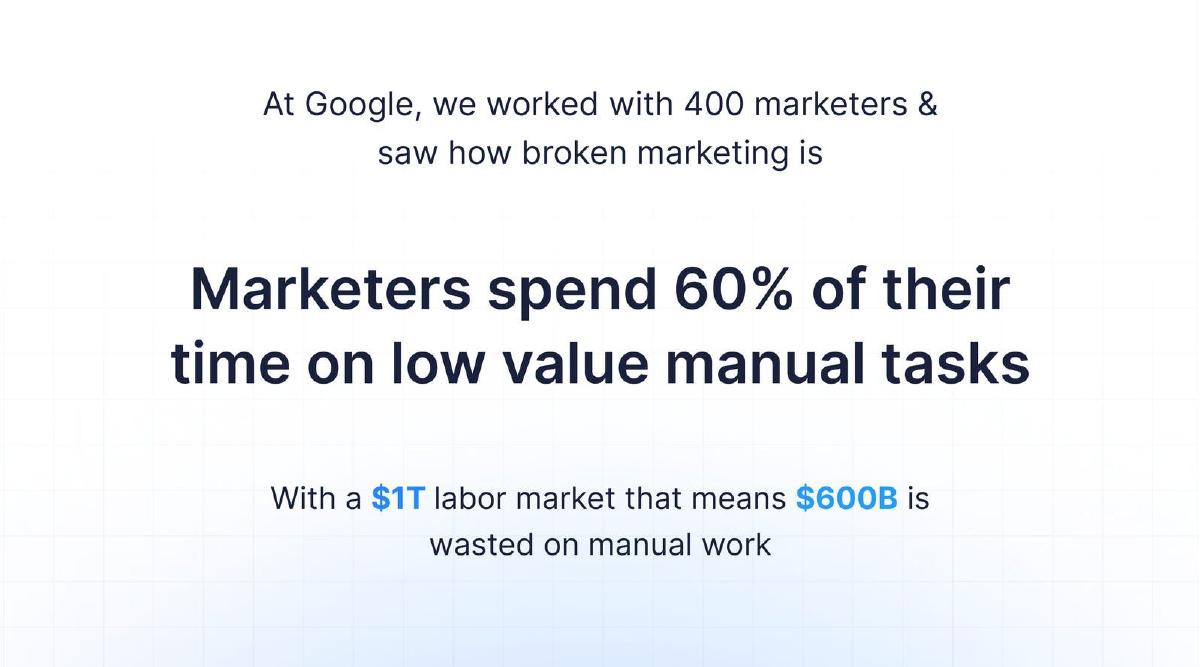
- The problem is quantified as a $600B waste of manual labor within a $1T marketing labor market on slide 4.
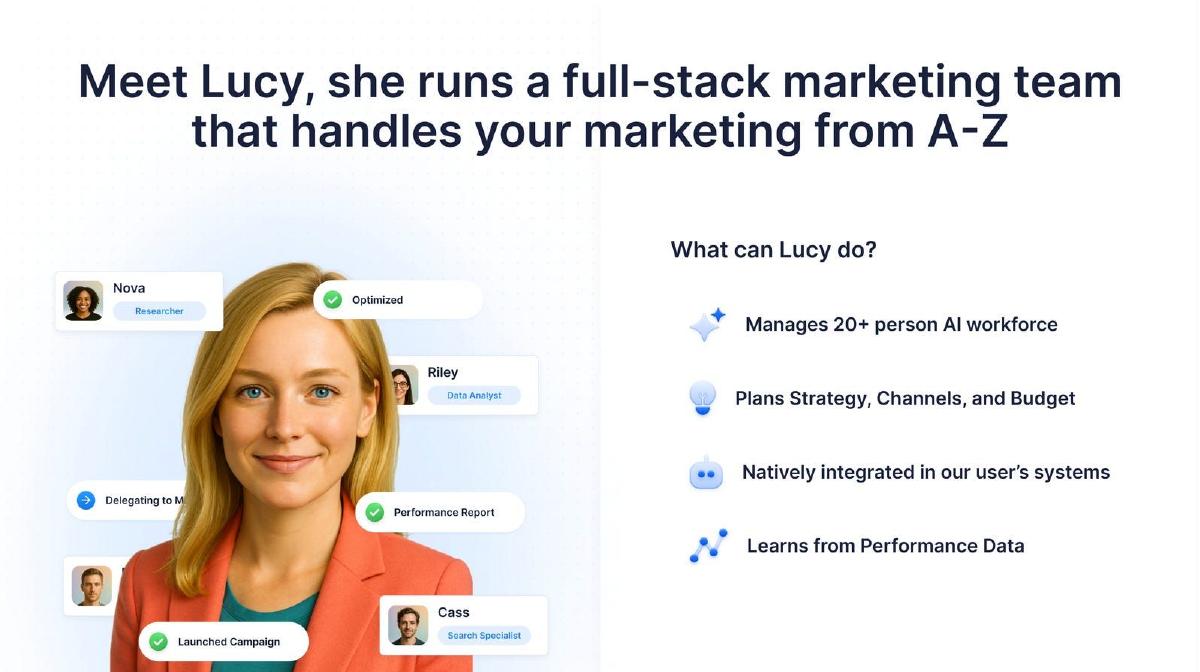
- Product functionality is personified through 'Lucy,' an AI agent that manages a 20+ person AI workforce, according to slide 5.
- Traction is demonstrated by 16 paying agency clients and 200+ brands reached in under three months on slide 3.
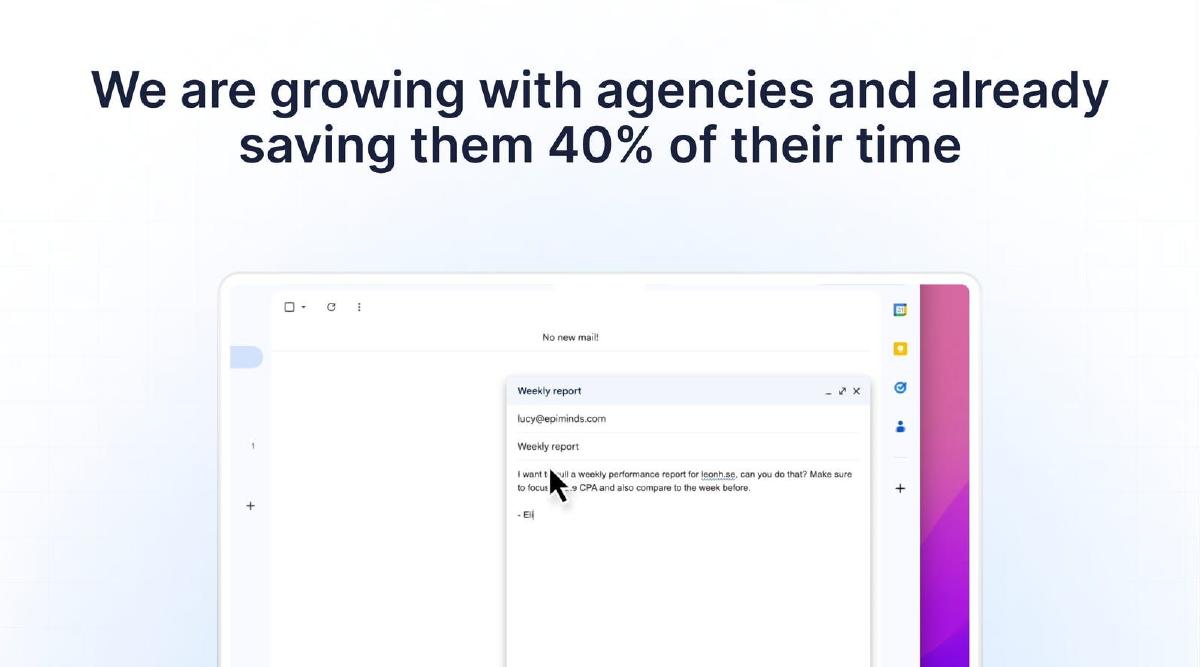
- The deck claims the solution is already saving agencies 40% of their time on slide 6.
- The presentation omits standard slides for competition, go-to-market strategy, and a specific financial 'ask' or use of funds.
- Revenue figures are redacted in the public version, but slide 7 emphasizes the goal to 'take over the market in 10 months.'
The Power of Pedigree and Pace
Epiminds, a Swedish startup, secured $6.6M in Seed funding in 2025 with a deck that defies many traditional fundraising 'rules.' At only seven slides, the presentation is a concentrated burst of information designed to prove one thing: this team moves faster than the market. By focusing on a 12-week window of execution, the founders created a sense of urgency that clearly resonated with investors. The deck doesn't just pitch a product; it pitches a trajectory.
Slide 1: The Vision Statement
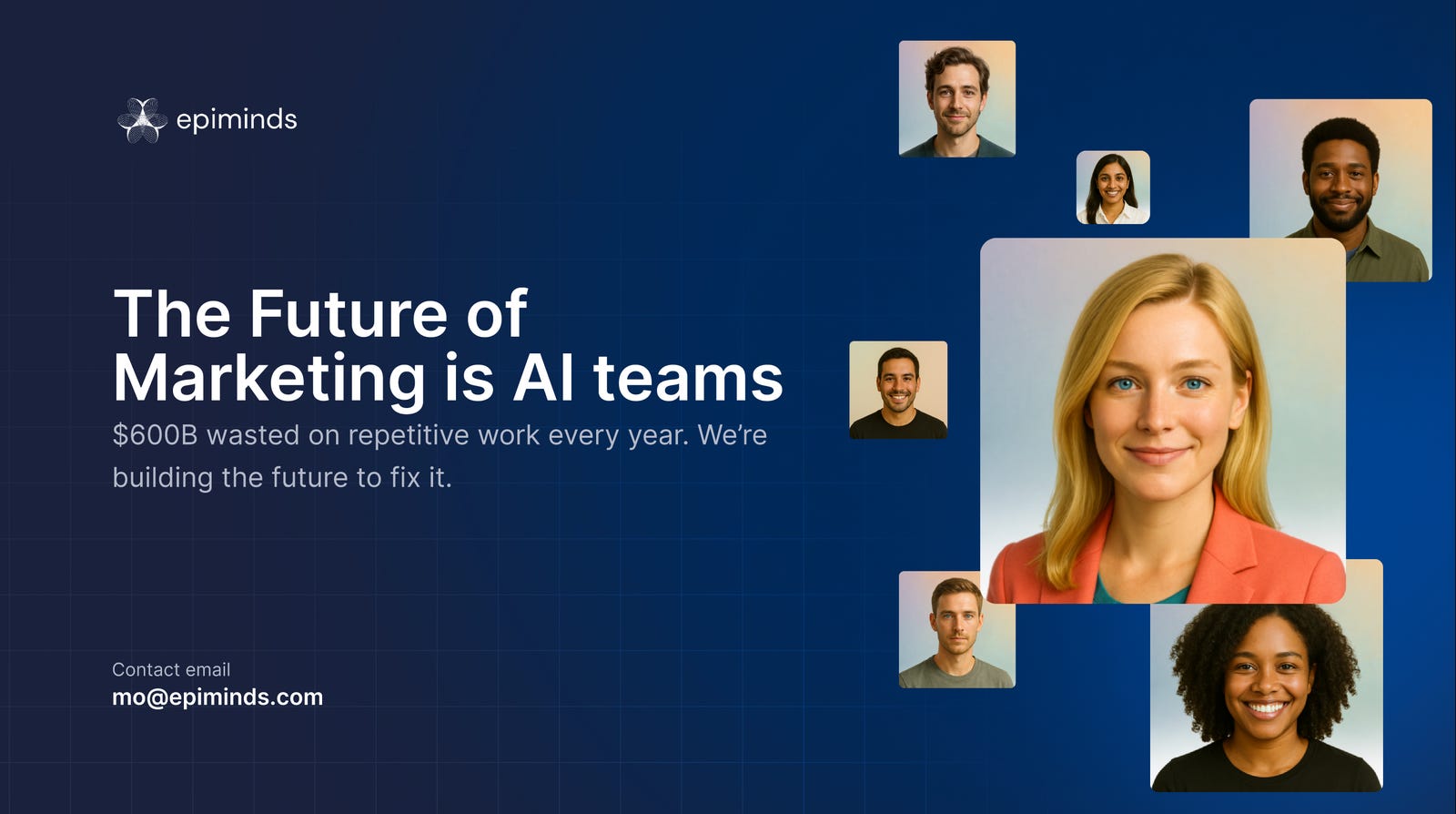
The cover slide sets a bold tone: "The Future of Marketing is AI teams." It immediately identifies a massive inefficiency, stating that "$600B [is] wasted on repetitive work every year." The visual design is clean, featuring a central AI persona surrounded by smaller human-like avatars, visually representing the 'AI team' concept. The inclusion of a direct contact email for a founder (mo@epiminds.com) on the first slide signals accessibility and a desire for immediate engagement.
Slide 2: The 'Killer' Team
Slide 2 is arguably the most important slide in the deck. It uses aggressive, high-confidence language: "We're a killer salesman... and a killer engineer." The pedigree is top-tier: Elias Malm is noted as a "Former Agency Lead at Google" ranked in the "1% in Sales EMEA," while Mo Elkhidir is described as a "3x founder, x-Spotify" with "13+ years engineering" and an "MSc in ML." This combination of elite sales performance at the world's largest advertising platform and deep technical experience at a major European tech success story provides the 'Founder-Market Fit' that Seed investors crave. The bottom of the slide features 'Partners' from unicorn companies like Adjust and SumUp, further insulating the founders with institutional credibility.
Slide 3: The 12-Week Sprint
This slide is the 'Traction' anchor. It states, "We started 12 weeks ago, we have [xxx]K in CARR and 16 paying clients." While the specific dollar amount is redacted in the public version, the raw numbers are impressive for a three-month-old company: "16 Clients (agencies)" and "200+ Brands." By highlighting that they are selling to agencies (who then bring in multiple brands), Epiminds demonstrates a highly scalable B2B2B distribution model. The use of CARR (Committed Annual Recurring Revenue) is a standard way for very early-stage companies to show the value of their pipeline.
Slide 4: The $600B Problem
Epiminds frames the problem through the lens of their own experience. "At Google, we worked with 400 marketers & saw how broken marketing is," the slide claims. This personal anecdote validates the market research. They quantify the problem by stating that marketers spend "60% of their time on low value manual tasks." By applying this percentage to a "$1T labor market," they arrive at a "$600B" waste figure. This is a classic 'Bottom-Up' market sizing approach that feels more grounded than a generic Gartner chart.
Slide 5: Meet Lucy
The product slide introduces "Lucy," an AI persona that "runs a full-stack marketing team." Rather than listing features, the slide lists capabilities that sound like job descriptions: "Manages 20+ person AI workforce," "Plans Strategy, Channels, and Budget," and "Learns from Performance Data." The visual shows Lucy at the center of a workflow, delegating tasks to other AI agents like 'Nova' (Researcher) and 'Cass' (Search Specialist). This positions the product not as a tool, but as a replacement for an entire department or agency tier.
Slide 6: Proof of Efficiency
Slide 6 moves from theory to results. It claims Epiminds is "already saving [agencies] 40% of their time." The slide includes a UI mockup showing an email interface where a user asks 'Lucy' to summarize an email and generate new copy for search ads. This demonstrates the 'Natively integrated' claim from the previous slide, showing that the AI lives where the work already happens (in the inbox) rather than requiring a new dashboard.
Slide 7: The Closing Argument
The final slide uses a pop-culture reference— "Where's the money Lebowski!?" —to maintain a high-energy, informal tone. It reiterates the core metrics: "200 Brands" and "16 Clients." The closing sentence is a definitive statement of intent: "We did this in 10 weeks — we will take over the market in 10 months." This slide serves as the 'Ask,' even though it omits a specific dollar figure. It asks the investor to buy into the speed of the team.
What Works in This Deck
Extreme Velocity: The recurring theme of '12 weeks' and '10 weeks' creates a narrative of unstoppable momentum. · Pedigree: The 'Google Sales' + 'Spotify Engineering' combo is a 'dream team' archetype for a MarTech startup. · Agency Focus: Targeting agencies as the primary customer is a smart 'wedge' strategy, as one agency sale provides access to dozens of brands. · Personification: Giving the AI a name (Lucy) and a management role makes a complex multi-agent system easy to understand.
What Is Missing
Business Model: There is no mention of pricing tiers, seat costs, or how the company actually makes money beyond the existence of 'paying clients.' · Competition: The deck ignores the crowded field of AI marketing tools (Jasper, Copy.ai, etc.), likely relying on the 'AI Agent' distinction to stand apart. · The Ask: There is no slide detailing how much capital is being raised or how it will be spent (hiring, R&D, etc.). · Unit Economics: While they show time savings (40%), they don't show the LTV (Lifetime Value) or CAC (Customer Acquisition Cost) of their agency partners.
Founder's Playbook: What to Copy
The 'Pedigree + Traction' Slide: If you have a strong background, put it on slide 2 and immediately follow it with what you've achieved in the first 90 days. · The Labor Market TAM: Instead of using software spend as your Total Addressable Market, use the cost of the human labor your software replaces. It results in a much larger, more compelling number. · The 'Brevity as Signal' Strategy: If your metrics are exceptional, don't bury them in a 20-slide deck. A short deck signals that you are busy building and that the opportunity is fleeting.
Frequently asked questions
- Why is the Epiminds deck so short at only 7 slides?
- The brevity is a strategic choice to emphasize velocity. When a team can show 16 paying clients and 200 brands in just 12 weeks, the data speaks louder than a 20-slide theoretical projection. High-pedigree founders (Google/Spotify) often use shorter decks to signal that their time is valuable and the momentum is self-evident, forcing investors to move quickly.
- What is 'CARR' mentioned on slide 3?
- CARR stands for Committed Annual Recurring Revenue. It represents the value of signed contracts that are expected to turn into ARR, even if the service hasn't fully launched or the billing cycle hasn't started. For a 12-week-old startup, CARR is a common metric to show future revenue potential based on current sales success.
- How does Epiminds define its market opportunity?
- On slide 4, they define the market through labor inefficiency rather than software spend. They cite a $1T marketing labor market and claim 60% of that time is spent on low-value manual tasks. This allows them to claim a $600B 'waste' as their Addressable Market, positioning their AI agents as a direct replacement for expensive human hours.
- Who are the 'Partners' listed on the team slide?
- Slide 2 lists three key advisors/partners: Paul Muller (Co-founder of Adjust), Daniel W. Dippold (CEO of EWOR), and Petter Made (Co-founder of SumUp). Including these names provides 'borrowed credibility,' signaling to investors that established unicorn founders have already vetted the Epiminds team and technology.
- Is the lack of a 'Competition' slide a mistake?
- In a Seed round for a 'hot' sector like AI agents, founders often omit competition slides to maintain a narrative of category creation. By focusing on their unique 'Lucy' agent and their specific agency traction, Epiminds avoids being compared to generic LLM wrappers and focuses instead on their specific workflow integration.