Falco Resources (TSXV: FPC) uses this 37-slide deck to position itself as a premier Canadian gold developer by revitalizing the historic Horne 5 deposit. The presentation relies heavily on the results of a 2016 Preliminary Economic Assessment (PEA), highlighting an after-tax NPV of C$667M and a 16.0% IRR at a base gold price of $1,250/oz. The deck effectively uses historical context—citing 4,384 underground drill holes inherited from Noranda—to demonstrate high geological confidence. However, the presentation is notably light on specific management bios and a clear 'ask' for new capital, func…
Key takeaways
- The project is centered on the Horne 5 deposit, which historically produced 11 million ounces of gold and 2.5 billion pounds of copper before closing in 1976 (Slide 5).
- Financial viability is anchored by a PEA showing a 3.8-year pre-tax payback period at a $1,250 gold price (Slide 9).
- Falco identifies a significant 'Value Gap,' showing its Enterprise Value per ounce of resources ($12) is far below the Canadian average of $72 (Slide 21).
- The technical foundation rests on 305,788 meters of historical drilling performed by Noranda, providing high confidence in the resource density (Slide 29).
- Operational plans include a highly mechanized underground mining operation with a 58-day stope cycle time (Slide 17, Slide 33).
- The deck includes detailed sensitivity analysis, showing that at $1,400 gold, the after-tax NPV rises to $874M (Slide 9).
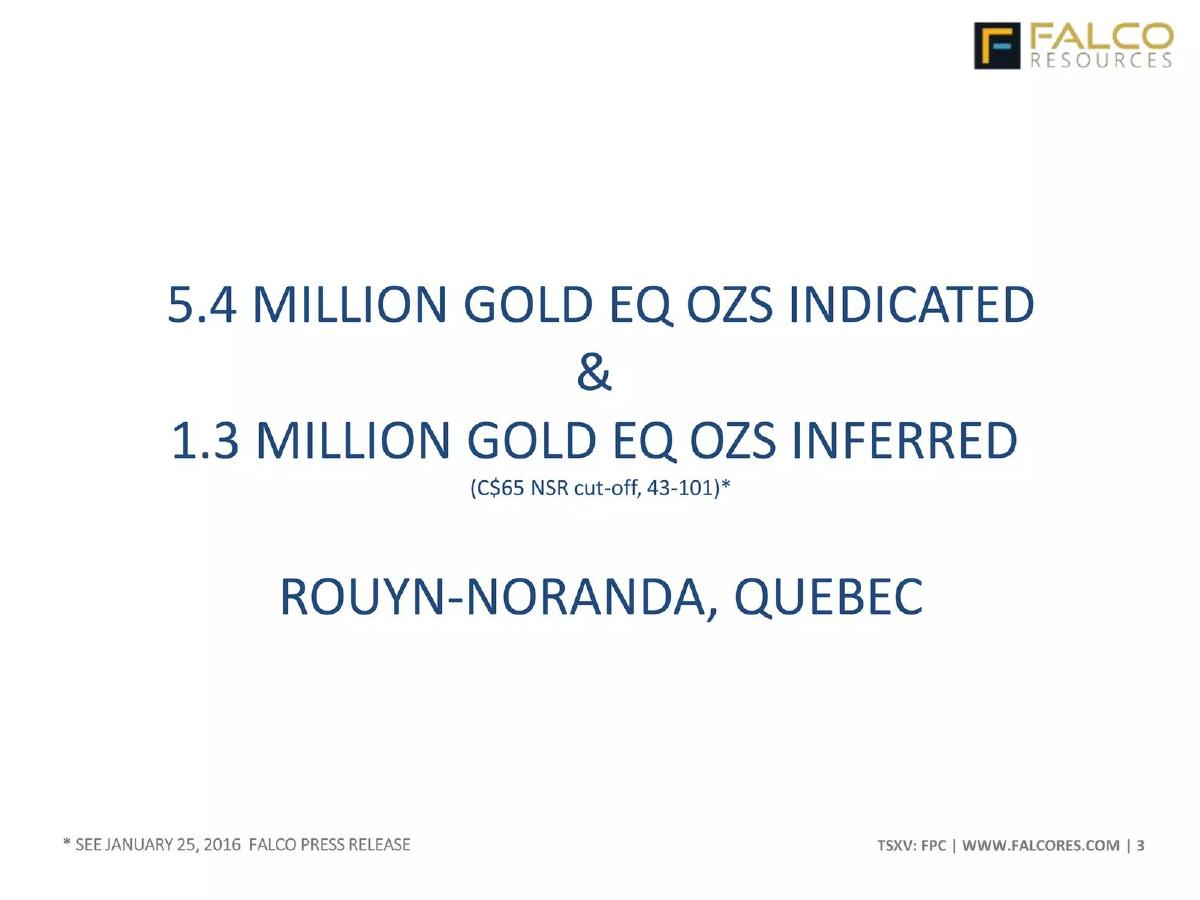
- Resource modeling is based on 4,411 diamond drill holes and uses a base case NSR cut-off of C$65 per tonne (Slide 37).
- The presentation lacks a dedicated team slide or a specific capital request, common in public company 'marketing' decks (Slide 1-37).
Falco Resources: The Horne 5 Project Analysis
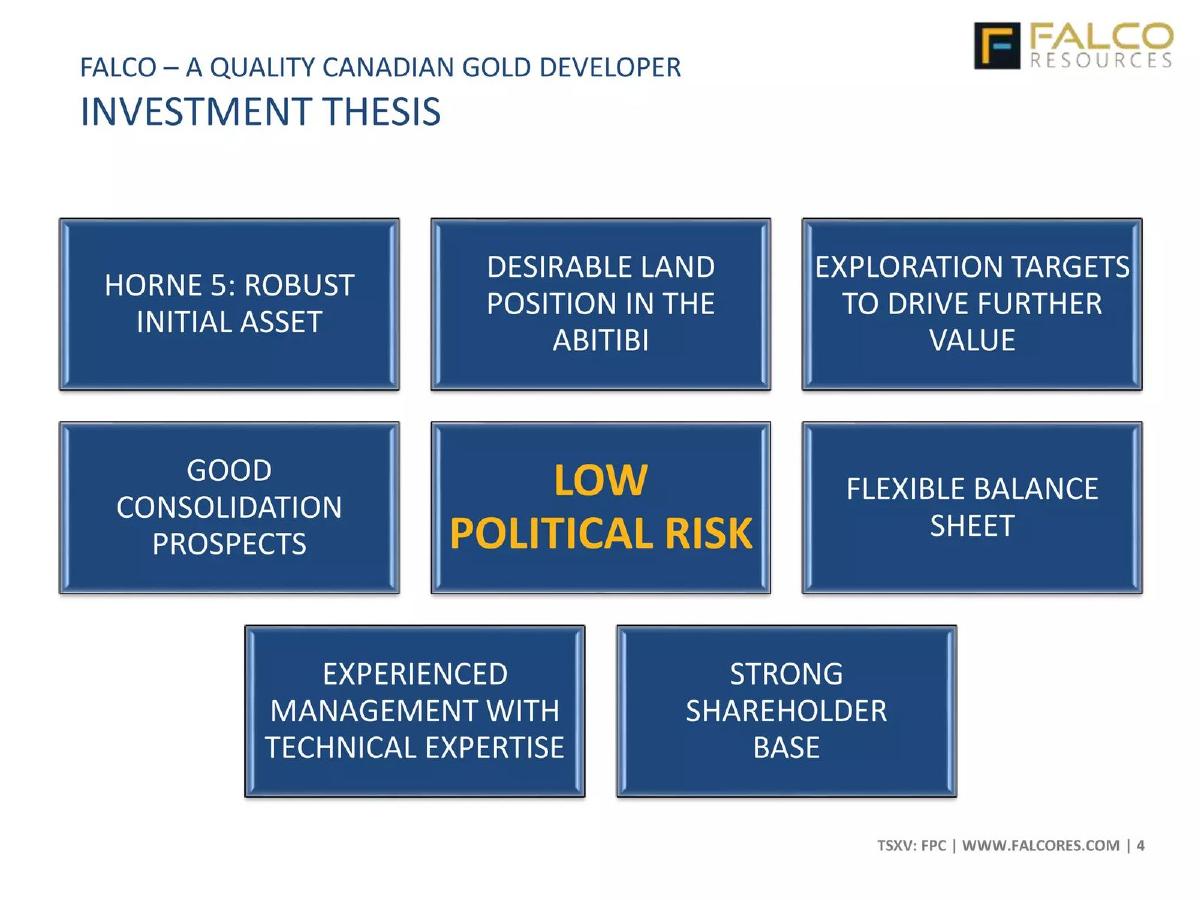
Falco Resources (TSXV: FPC) provides a masterclass in how to present a technical, asset-heavy project to the public markets. The 2016 investor presentation for the Horne 5 project is designed to convince institutional and retail investors that the company is significantly undervalued relative to its peers. By focusing on a 'brownfield' redevelopment of a legendary Canadian mine, Falco sidesteps much of the risk associated with greenfield exploration. The following teardown examines the 37-slide deck, focusing on the 10 key slides provided.
Slide 1: Title and Positioning
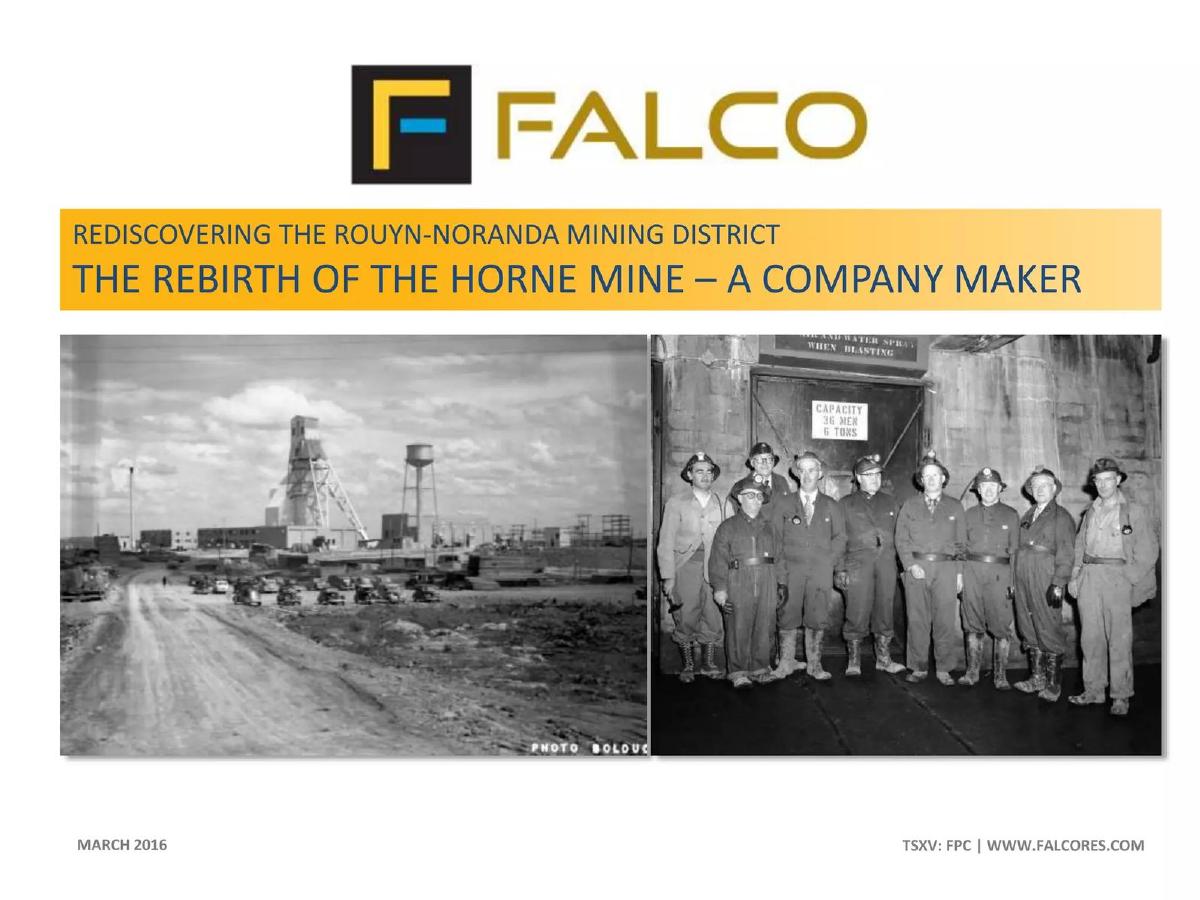
The cover slide establishes the company's primary claim: "The Leading Canadian Gold Developer." The imagery is split between a close-up of a gold bar and heavy underground mining machinery. This immediately signals that the company is focused on production and development rather than early-stage prospecting. The date, August 2016, and the mention of "European Marketing" suggest this deck was used for an international roadshow to attract capital from overseas markets.
Slide 5: Historical Context and Timeline
Mining investors value history because it reduces geological uncertainty. Slide 5, titled "Horne Project – 40 Years Later," provides a timeline that spans nearly a century. Key milestones include:
1923: Discovery of the Horne Mine. · 1927-1976: Initial production period, which yielded 11 million ounces of gold and 2.5 billion pounds of copper. · 2012: Falco acquires the properties. · 2013-2016: The transition from digitizing historical Noranda data to producing a new resource update and a Preliminary Economic Assessment (PEA).
This slide is critical because it frames the project not as a gamble, but as a continuation of a proven, world-class asset. The use of black-and-white historical photos adds a sense of heritage and scale.
Slide 9: PEA Financial Highlights
This is the 'money slide.' It presents a sensitivity table for the Horne 5 Project based on the 2016 PEA. The base case is highlighted at a gold price of $1,250/oz. Key figures include:
After-Tax NPV (5%): C$667 million. · After-Tax IRR: 16.0%. · After-Tax Payback: 4.1 years.
The slide also shows the upside potential: if gold reaches $1,400/oz, the After-Tax NPV jumps to $874 million and the IRR to 18.9%. By providing this range, Falco allows investors to model the project against their own commodity price forecasts. The inclusion of assumptions for silver ($17.00/oz), copper ($2.85/lb), and zinc ($1.00/lb) in the footnotes ensures transparency.
Slide 13: Site Layout and Infrastructure
Slide 13 features a 3D architectural rendering of the proposed site layout. It labels key components such as the Process Plant, Sub Station, Head Frame, Ore Storage, and Mine Building. For a developer, showing a physical plan is essential for demonstrating that the project is 'shovel-ready' or at least deeply considered from an engineering perspective. It moves the conversation from abstract numbers to physical reality.
Slide 17: Operational Strategy
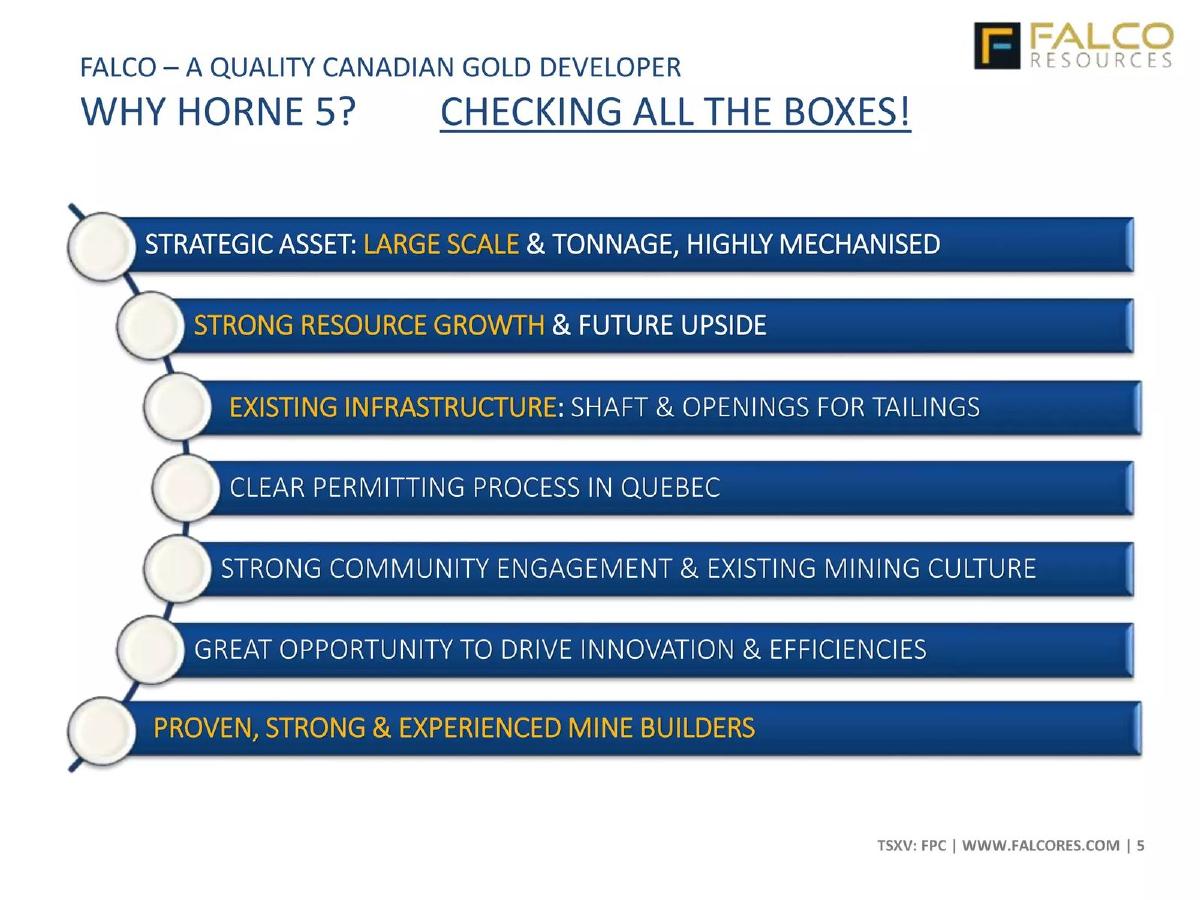
This slide summarizes the project's operational pillars. It emphasizes a "Highly Mechanized Underground Mining Operation" and "Low All-In Sustaining Cash Cost." The mention of "Strong Resource Growth Potential" suggests that the current 6.6 million ounce estimate may only be the beginning. The visual of a large underground haul truck reinforces the scale of the intended operation.
Slide 21: Comparable Analysis and the 'Value Gap'
This is perhaps the most persuasive slide for a value investor. Falco compares itself to 15 other pre-production assets globally. The data is striking:
Canadian Average EV/Resources: $72/oz. · Rest of the World Average EV/Resources: $31/oz. · Falco Resources EV/Resources: $12/oz.
By pointing a large arrow at the $12 figure, Falco is explicitly telling the market that it is trading at a massive discount compared to peers like Pretium ($109/oz) or TMAC ($156/oz). The slide argues that simply by 'bridging the gap' to the Canadian average, the stock could see significant appreciation.
Slide 25: Appendix Overview
The appendix slide lists four sections: Glencore Back-In Agreement, Reserves & Resources, PEA Additional Information, and Resource & Modeling Notes. The mention of Glencore is a subtle but important 'social proof' element, indicating that a major global commodity player has a vested interest or contractual tie to the project.
Slide 29: Geological Confidence
Slide 29, "Historical Drill Density of Horne 5 Deposit," provides a cross-section of the drilling data. It highlights "Exceptional Drill Density" with 4,384 underground drill holes. The visual shows a dense web of drill lines, particularly in the upper areas, and points out "Great upside at Depth" where drilling has been more limited. This slide justifies the resource estimates by showing the sheer volume of physical evidence supporting the gold's presence.
Slide 33: Production Ramp-Up
This slide gets into the granular details of the mining cycle. It includes a "Ramp-Up Schedule" table and a table of "Mining cycle times." Key metrics include:
23,500 tonne stopes. · 20 effective hours per day. · 58-day stope cycle time. · 4 mucking faces.
This level of detail is intended for technical analysts who want to verify if the production targets are realistic based on underground logistics.
Slide 37: Resource Modeling Notes
The final slide provided is a dense list of 22 technical notes regarding the resource estimate. It cites the "Independent and Qualified Persons" (Carl Pelletier and Vincent Jourdain) and the use of Geovia GEMS 6.7 software. It details the NSR cut-offs (C$65/t) and the interpolation methods used (Inverse Distance Squared). While dry, this slide is legally and technically necessary to comply with NI 43-101 standards and to provide the 'fine print' for the claims made earlier in the deck.
What Falco Resources Does Well
The deck is exceptionally strong on data and technical validation. By leveraging the historical Noranda data, Falco presents a project that feels 'discovered' rather than 'guessed.' The use of comparable analysis (Slide 21) is a classic and effective way to create a sense of urgency and value for investors. The financial sensitivity table (Slide 9) is also a best practice, as it acknowledges the volatility of gold prices while showing the project remains viable even at lower price points.
What is Missing
Despite the technical depth, there are several omissions that would be standard in a venture-style pitch deck:
Team Bios: There is no slide introducing the management team or board of directors. In mining, the 'jockey' is often as important as the 'horse,' and investors want to know who has successfully built mines before. · The Ask: The deck does not specify how much capital the company is currently seeking or what the next specific use of funds will be (e.g., a Feasibility Study or permitting costs). · Environmental and Social Governance (ESG): There is very little mention of the environmental impact, water management, or community relations in the provided slides, which are increasingly critical for modern mining projects. · Risk Factors: While the sensitivity analysis covers price risk, it does not address operational, regulatory, or geopolitical risks.
Lessons for Other Founders
Founders in capital-intensive industries can learn several lessons from this deck:
Use Comparables to Tell a Story: Don't just list your valuation; show how it compares to the market. If you are 'cheaper' than the average, explain why that represents an opportunity for the investor. · Leverage Historical Data: If your startup is building on existing research, expired patents, or historical datasets, highlight that. It reduces the perception of 'zero-to-one' risk. · Technical Transparency: Including a detailed appendix with modeling notes (Slide 37) builds trust with sophisticated investors who will eventually perform deep due diligence. · Visualizing the Future: The site layout rendering (Slide 13) helps investors visualize the transition from a 'project on paper' to a functioning business.
In conclusion, the Falco Resources deck is a highly professional, data-driven document that successfully positions the Horne 5 project as a high-value, de-risked opportunity in the Canadian mining sector. Its primary strength lies in its ability to quantify the 'Value Gap' and back it up with decades of geological data.
Frequently asked questions
- What is the primary value proposition of the Horne 5 project?
- The primary value proposition is the redevelopment of a brownfield site with massive historical data. By utilizing over 4,000 historical drill holes from the former Noranda operation, Falco significantly reduces exploration risk. The deck emphasizes that the project is 'well positioned to further de-risk' because the infrastructure and geological understanding are already partially established, leading to a projected low all-in sustaining cash cost.
- How does Falco Resources justify its valuation to investors?
- Falco uses a 'Comparable Analysis' slide to show it is undervalued. It compares its Enterprise Value (EV) per ounce of gold resources ($12/oz) against other Canadian pre-production assets like Pretium ($109/oz) and TMAC ($156/oz). By highlighting that their EV is just $82M despite having 6.6 million ounces of resources, they argue there is a 'Value Gap to be Bridged' for new investors.
- What are the key financial metrics presented in the PEA?
- The 2016 Preliminary Economic Assessment (PEA) highlights include a Pre-Tax NPV (5% discount) of C$1.131 billion and an After-Tax NPV of C$667 million at a gold price of $1,250/oz. The After-Tax Internal Rate of Return (IRR) is stated at 16.0%, with a payback period of 4.1 years after taxes. These figures serve as the baseline for the project's economic feasibility.
- What technical data supports the resource estimates?
- The resource estimate is supported by an 'exceptional drill density' consisting of 4,384 underground drill holes totaling 305,788 meters. This data was originally compiled by Noranda. Falco digitized and compiled these historical results starting in 2013, which allowed them to produce an NI 43-101 compliant resource estimate without the massive expense of a completely new grassroots drilling campaign.
- What is missing from this presentation that a private investor might expect?
- As a public company presentation, it lacks a specific 'Ask' slide detailing how much money is being raised and the exact use of proceeds. It also omits a traditional 'Team' slide featuring headshots and bios of the executive leadership, which is standard in private VC decks. Furthermore, it does not detail the specific environmental permitting status or community relations, which are critical risks for mining projects.