Pino is a vertical hydroponic system startup targeting the urban population of Santiago, Chile. The deck identifies a specific market niche—environmentally aware individuals in the ABC1 and C2 socioeconomic brackets who live in apartments. With a primary product price point of $90,000 (presumably Chilean Pesos) and a recurring revenue model through seeds and nutrients, the company aims to capitalize on the growing interest in home-grown produce. However, the deck is at a very early stage, lacking a functional website, established supplier relationships, or a technical breakdown of the hardwar…
Key takeaways
- The company targets a specific demographic in Santiago, Chile, where 40% of environmentally aware individuals live in apartments (Slide 2).
- The product is positioned as a 'stylish and easy' home growing solution for herbs and vegetables like lettuce, basil, and peppers (Slide 1, Slide 3).
- Revenue is generated through a $90,000 unit price and recurring sales of 'complementary products' including seeds and nutrients (Slide 4).
- Customer acquisition relies heavily on physical presence at sustainability fairs like 'Feria Verde' and 'Diseño de Ambientes' (Slide 5).
- The business model includes a 'presales at cost price' strategy to build initial traction (Slide 4).
- The project is in a pre-operational phase, with 'Get a website' and 'Contact suppliers' listed as upcoming milestones (Slide 6).
- The deck lacks a technical specification slide, competitive analysis, or a formal financial ask for investors.
- The team consists of Viviana Pino and Francisco Reygadas, both associated with the Pontifical Catholic University of Chile (Slide 1).
Slide-by-Slide Analysis
Slide 1: Title and Contact
The cover slide introduces 'Pino' with the tagline 'The most stylish and easy way to grow your own plants at home.' The logo features a stylized house roof over a green plant, reinforcing the indoor/home gardening theme. The slide lists two individuals: Viviana Pino and Francisco Reygadas. The email addresses provided use the 'ing.puc.cl' domain, indicating an association with the Engineering department of the Pontifical Catholic University of Chile (Pontificia Universidad Católica de Chile). This suggests the project may have originated as a university capstone or research project.
Slide 2: Market Opportunity
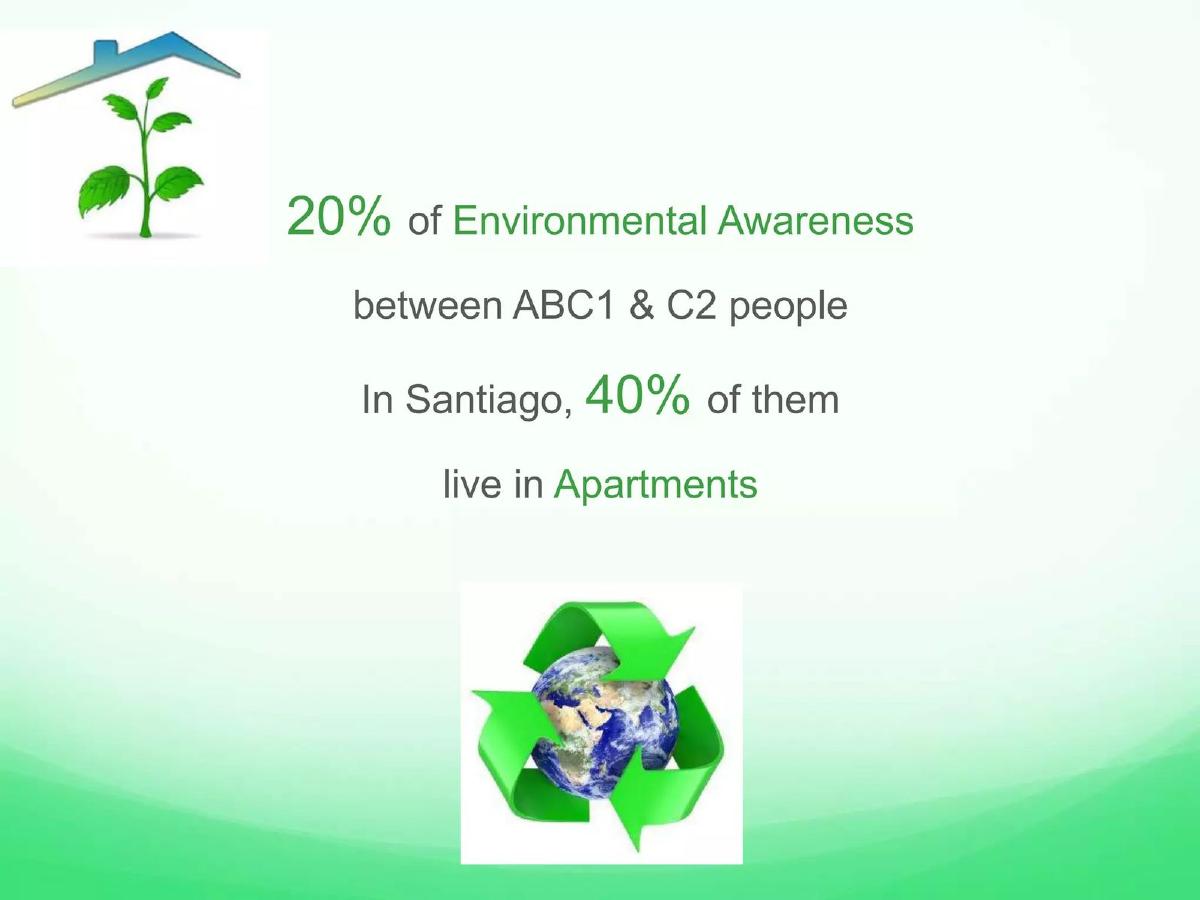
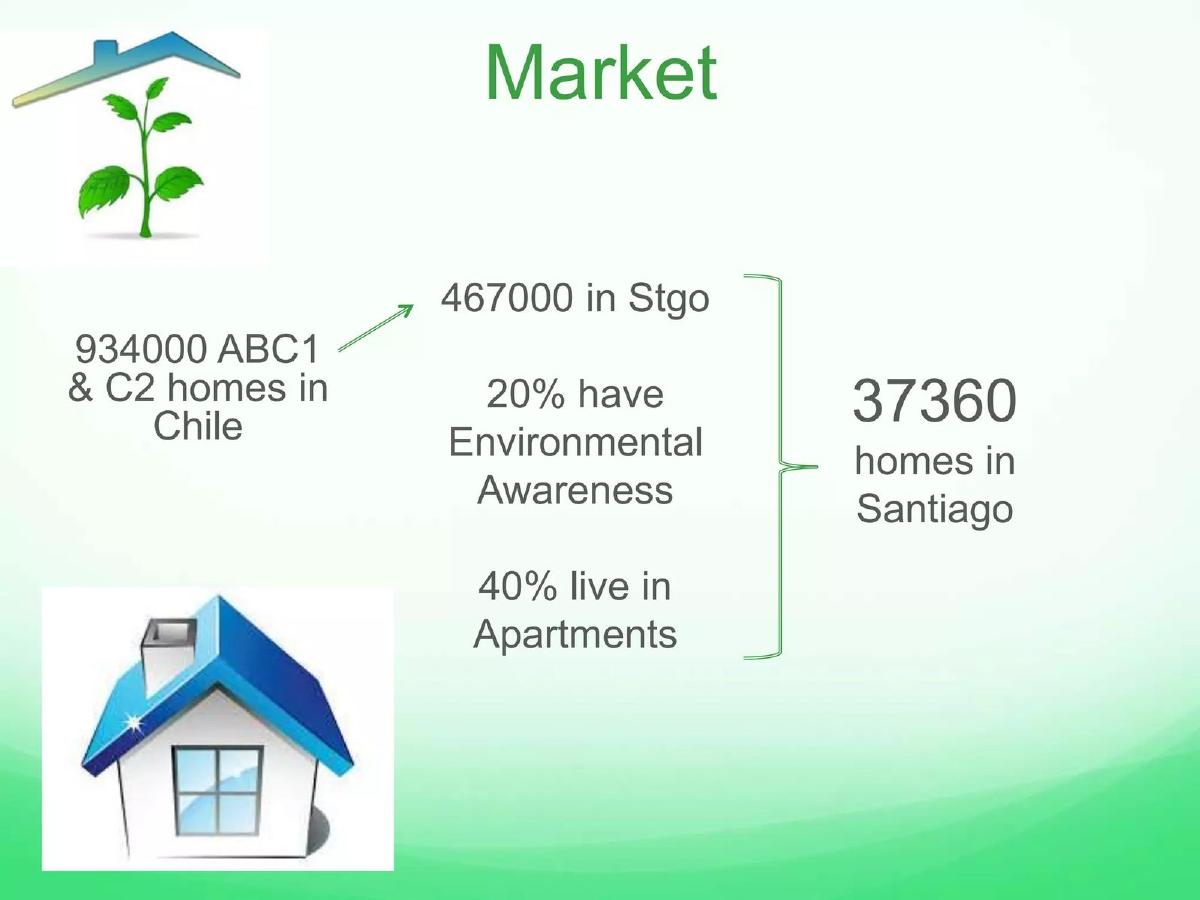
This slide attempts to quantify the target market in Santiago, Chile. It states that 20% of 'Environmental Awareness' exists between ABC1 & C2 people . In the Chilean market, ABC1 and C2 refer to high and upper-middle-class socioeconomic segments. The slide further narrows the focus by stating that in Santiago, 40% of them live in Apartments . This is a classic 'problem/opportunity' slide that identifies a specific pain point: people with the desire to grow plants and the financial means to do so, but who lack the outdoor space (yards) to facilitate traditional gardening.
Slide 3: Product Utility
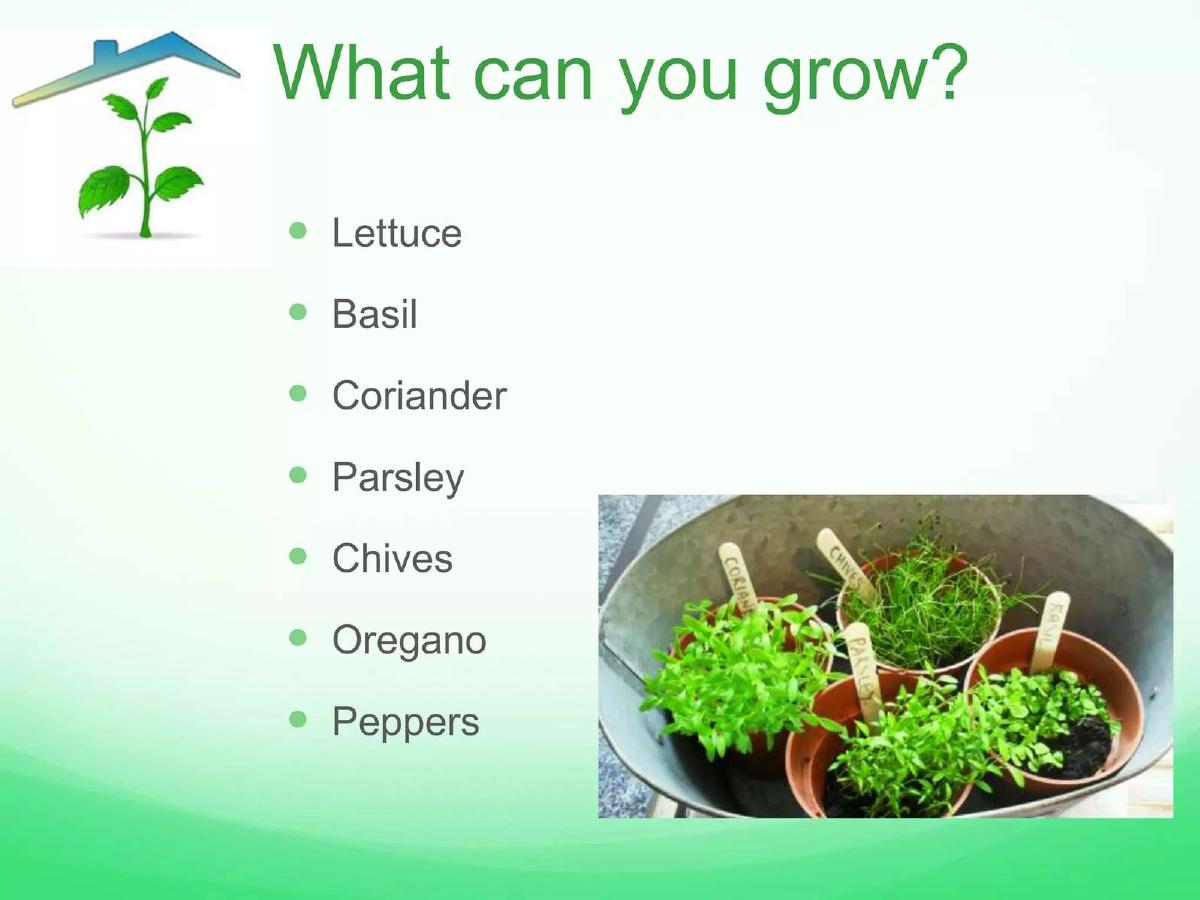
Titled 'What can you grow?', this slide lists the botanical capabilities of the system. The list includes Lettuce, Basil, Coriander, Parsley, Chives, Oregano, and Peppers . A photograph shows small herb pots in a metal basin, though it is unclear if this is the actual Pino system or a representative image of the types of plants supported. The focus on culinary herbs and leafy greens is standard for hydroponic systems, as these plants have high turnover and thrive in nutrient-rich water environments.
Slide 4: Business Model
The slide 'How do we win?' outlines the financial strategy. It lists Direct sales to customers with a Price of $90000 . Given the context of Santiago, this figure is almost certainly in Chilean Pesos (CLP), which would equate to roughly $95-$110 USD depending on the exchange rate at the time. The slide also mentions Presales at cost price as a market entry tactic. Crucially, it identifies Complementary products: Seeds, Nutrients as a secondary revenue stream, indicating a desire for long-term customer retention through consumables.
Slide 5: Go-to-Market Strategy
Titled 'How do we get to clients?', this slide focuses on localized marketing. It emphasizes Direct Marketing through Participation in Sustainability Fairs . It includes promotional graphics for 'Feria Diseño de Ambientes' and 'Feria Verde,' which are actual events in Santiago. The slide also lists Emails and Social media as supporting channels. This suggests a grassroots, community-focused approach to building brand awareness among eco-conscious consumers.
Slide 6: Roadmap
The final slide, 'What’s next?', serves as a rudimentary roadmap. The four bullet points are: Contact suppliers, Get a website, Contact organizations related to sustainability, and Sign in for sustainability fairs . This slide is a clear indicator that the company is in the pre-launch phase. It lacks specific dates or milestones, functioning more as a 'to-do' list for the founders rather than a strategic growth plan for investors.
What Works
Specific Demographic Targeting: The deck does an excellent job of narrowing down exactly who the customer is. By citing the ABC1 and C2 socioeconomic groups in Santiago and filtering for apartment dwellers, the founders show they understand their niche. They aren't trying to sell to everyone; they are selling to affluent urbanites with limited space.
Recurring Revenue Awareness: Identifying seeds and nutrients as complementary products (Slide 4) shows that the founders are thinking about the Lifetime Value (LTV) of a customer rather than just a one-off hardware sale. In the hardware space, recurring revenue from consumables is often the difference between a struggling hobbyist business and a scalable startup.
Localized Marketing Plan: For a physical product like a hydroponic system, being able to see and touch the unit is vital. The plan to attend specific sustainability fairs in Santiago (Slide 5) is a practical and cost-effective way to get the product in front of the exact target audience identified in Slide 2.
What is Missing
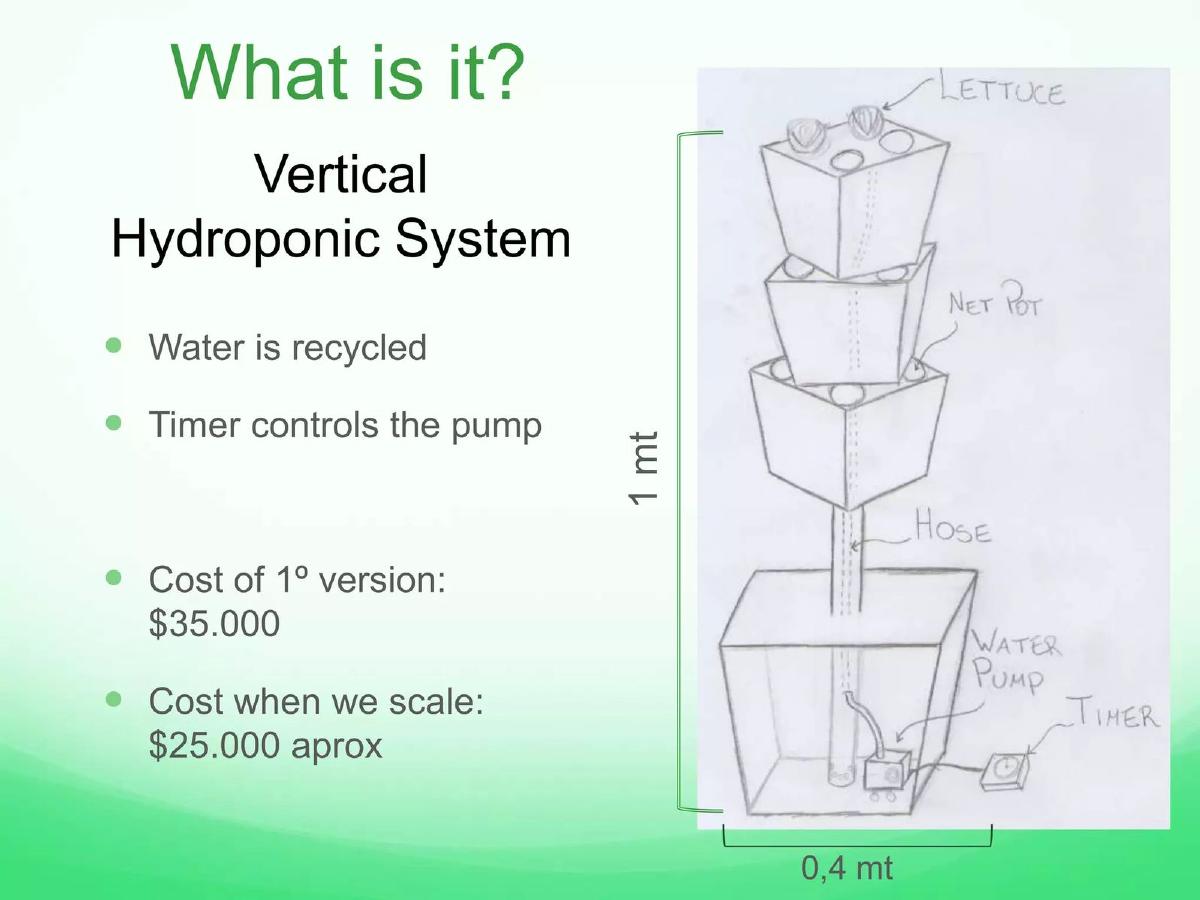
Product Design and Specs: The most glaring omission is the lack of a clear image or technical drawing of the actual 'Pino' system. Slide 1 has a logo, and Slide 3 has a picture of generic herb pots, but there is no information on the size, material, power requirements, or the 'vertical' nature of the system. Investors need to see the product to evaluate its 'stylish' claim.
Competitive Landscape: The deck does not mention any competitors. Even in a local market like Santiago, there are likely other hydroponic kits or traditional gardening solutions available at retail stores. A slide explaining why Pino is better or different than a standard pot or a competing hydroponic brand is necessary.
Financial Projections and Ask: There is no mention of how much money the founders are looking for or how they plan to spend it. Furthermore, there are no projections regarding unit sales, margins, or break-even points. The price point of $90,000 is stated, but the cost to manufacture the unit is omitted.
Team Background: While names and emails are provided on Slide 1, there are no bios or descriptions of expertise. Are the founders engineers, botanists, or designers? Their ability to execute on the 'What's next' list depends entirely on their skill sets, which are currently unknown.
Founder Takeaways
Validate the 'Why' with Data: Slide 2 is a strong example of using demographic data to justify a product's existence. If you are building a niche product, use local statistics to show that your niche is large enough to support a business. Pino's use of socioeconomic brackets (ABC1/C2) and housing types (apartments) is a professional way to segment a market.
Don't Forget the 'How': While Pino identifies the 'What' (hydroponics) and the 'Who' (urbanites), it fails to explain the 'How.' If your product is hardware, you must include a slide on the manufacturing process or at least a high-fidelity prototype image. A pitch deck for a physical product without a picture of the product feels incomplete.
Roadmaps Must Be Action-Oriented: The 'What's next' slide in this deck is too basic. Instead of 'Get a website,' a founder should say 'Launch e-commerce platform by Q3.' Instead of 'Contact suppliers,' say 'Finalize manufacturing agreement for 500 units.' Moving from vague intentions to specific milestones builds much more confidence with potential partners or investors.
Frequently asked questions
- What is the primary product being sold by Pino?
- Pino sells a vertical hydroponic system designed for indoor use in urban apartments. According to Slide 3, the system is intended for growing lettuce, basil, coriander, parsley, chives, oregano, and peppers. The deck emphasizes that the system is 'stylish and easy,' suggesting a focus on aesthetic design to fit modern home interiors.
- What is the target market for this hydroponic system?
- The deck specifically targets the city of Santiago, Chile. Slide 2 notes that 20% of the population shows 'Environmental Awareness' within the ABC1 and C2 socioeconomic groups. Furthermore, it highlights that 40% of this specific demographic lives in apartments, creating a need for space-efficient, soil-free gardening solutions.
- How does Pino plan to generate revenue beyond the initial hardware sale?
- Slide 4 outlines a 'razor and blade' business model. While the main unit is sold for $90,000 (likely CLP), the company plans to sell 'Complementary products' such as seeds and nutrients. This creates a recurring revenue stream as customers need to replenish these consumables to continue using the vertical system.
- What is the current stage of the company based on the deck?
- Pino appears to be in the very early ideation or prototype stage. Slide 6, titled 'What’s next?', lists fundamental tasks such as contacting suppliers, building a website, and signing up for sustainability fairs. The lack of a website or established supply chain indicates the company has not yet reached full commercial operations.
- What marketing channels is the company prioritizing?
- The company is prioritizing direct, high-touch marketing. Slide 5 highlights participation in sustainability fairs like 'Feria Verde' and 'Diseño de Ambientes.' They also plan to use direct marketing through emails and social media to reach their target demographic of environmentally conscious apartment dwellers.