Pipefy’s pitch deck is remarkably lean, consisting of only nine slides that prioritize speed and simplicity over dense financial modeling. The deck positions the product as the 'easy button' for complex enterprise processes, directly attacking the high costs of IT support. By highlighting a library of ready-to-use templates and demonstrating rapid adoption—growing to 12,000+ companies across 110 countries in just six months—the company built a compelling case for the scalability of its no-code platform. While it lacks traditional slides for competition, market size, and specific financial ask…
Key takeaways
- The deck uses a consistent 'easy button' metaphor to position the product as a solution for complex workflows (Slide 1).
- Pipefy identifies a specific cost pain point: companies spend 3x more on IT support than on software licenses to implement and maintain tools (Slide 3).
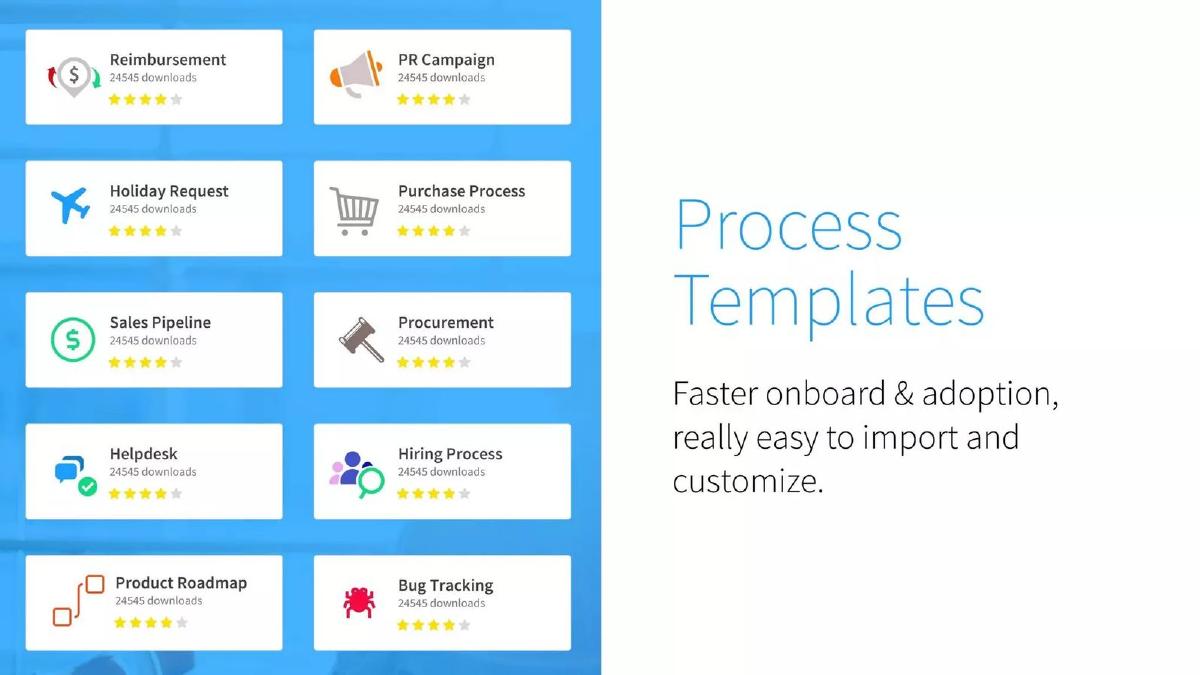
- The product strategy relies heavily on pre-built templates for common tasks like Sales Pipelines and Bug Tracking to drive adoption (Slide 5).
- Traction is the deck's strongest point, showing growth to 12,000+ companies in 110 countries within six months (Slide 7).
- The deck features high-profile early adopters including Walgreens, Discovery Channel, Zapier, and Deloitte (Slide 7).
- Founder Leandro Johann brings significant domain authority with 20+ years of experience at Microsoft, Salesforce, and TOTVS (Slide 8).
- The deck completely omits a business model slide, competitive landscape, and a specific funding ask.
- The visual design is minimalist, using large icons and high-contrast text to ensure readability (Slide 2, Slide 5).
The Minimalist Approach to Enterprise SaaS
Pipefy’s pitch deck is an exercise in restraint. In an industry—enterprise workflow management—often characterized by dense feature lists and complex integration diagrams, Pipefy chose to present itself as the 'easy button.' This 9-slide deck, used during their early stages, focuses almost entirely on the friction of existing solutions and the rapid adoption of their own. According to catalogue facts, the company eventually raised $122,700,000, suggesting that this high-level narrative successfully captured investor interest by focusing on scale and speed rather than granular mechanics.
Slides 1-3: The Problem of IT Friction
Slide 1 introduces the brand with a simple toggle switch icon and the tagline: "The easy button for processes and workflows." This sets a psychological anchor for the rest of the presentation; every subsequent slide is intended to reinforce the idea that Pipefy removes complexity.
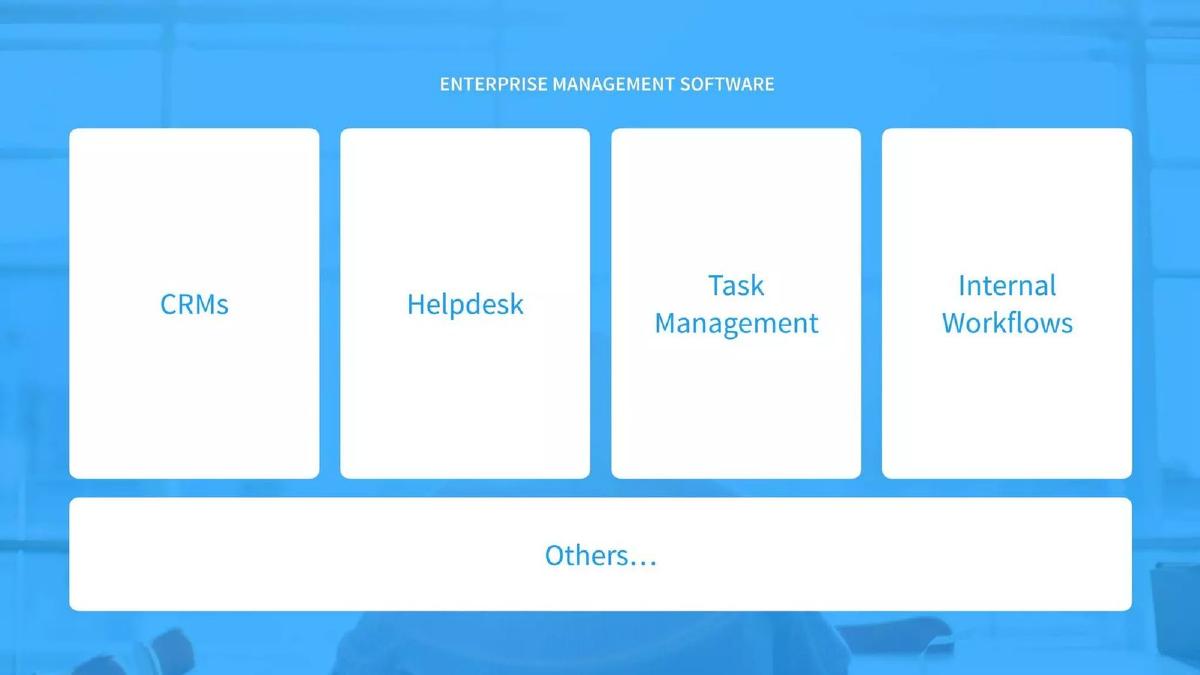
Slide 2 categorizes the 'Enterprise Management Software' landscape into four buckets: CRMs, Helpdesk, Task Management, and Internal Workflows. By grouping these together, Pipefy hints at a horizontal platform play—they aren't just a tool for one department, but a layer that can sit across all of them.
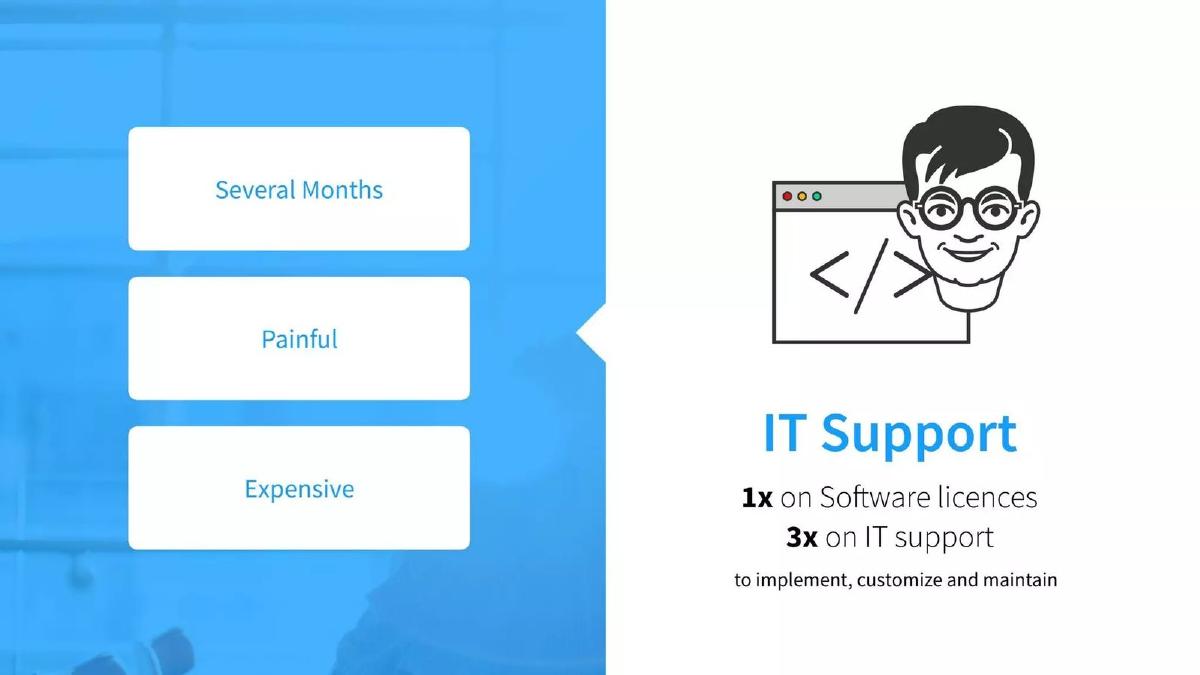
Slide 3 is the most critical 'Problem' slide. It lists three adjectives for current solutions: 'Several Months' (time), 'Painful' (effort), and 'Expensive' (capital). The most striking figure here is the claim that companies spend 1x on Software licenses but 3x on IT support to implement, customize, and maintain those systems. This identifies a massive 'hidden' market of wasted spend that Pipefy intends to capture by enabling no-code customization.
Slides 4-6: The Template-Driven Solution
Slide 4 repeats the 'easy button' branding over a whimsical image of a boy and a chimpanzee. While this slide adds little in the way of data, it reinforces the 'so easy a monkey could do it' subtext, which is a common trope in early no-code marketing.
Slide 5 introduces 'Process Templates.' The slide shows a grid of common business functions: Reimbursement, PR Campaign, Holiday Request, Purchase Process, Sales Pipeline, Procurement, Helpdesk, Hiring Process, Product Roadmap, and Bug Tracking. Each icon is accompanied by the placeholder text '24545 downloads' and a five-star rating. This slide communicates that Pipefy is a marketplace of solutions, not just a blank canvas, which reduces the 'cold start' problem for new users.
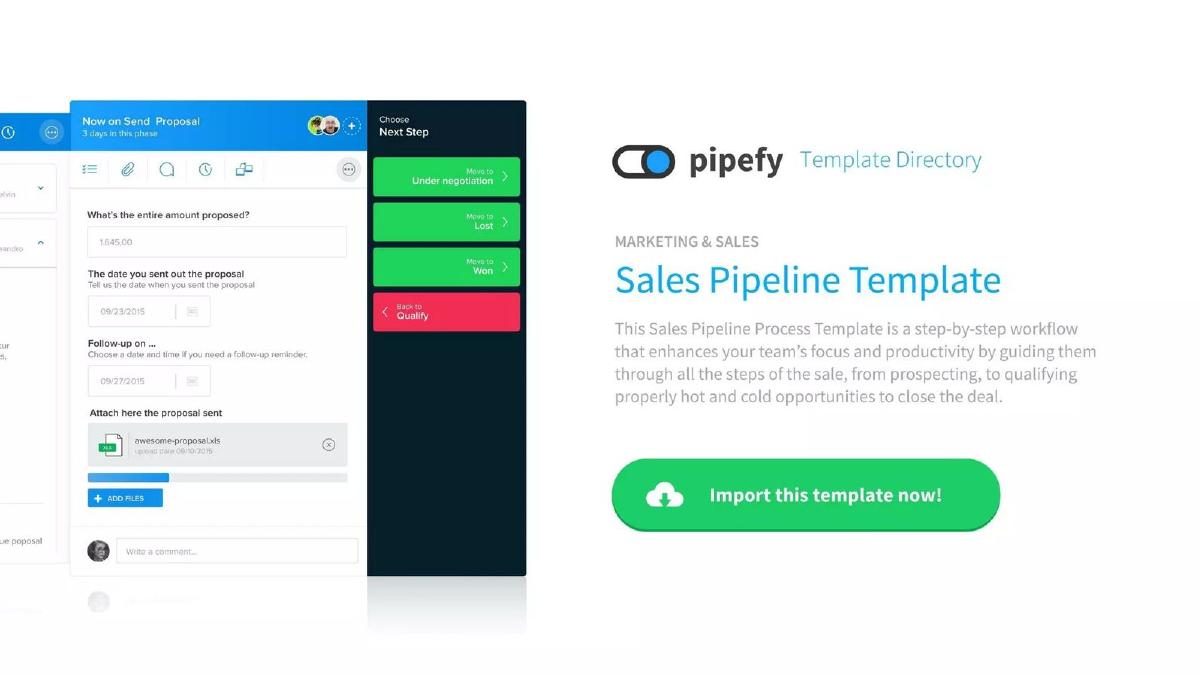
Slide 6 provides a product deep-dive using the 'Sales Pipeline Template' as an example. It shows a UI screenshot with clear 'Next Step' buttons (Move to Under negotiation, Move to Lost, Move to Won). The copy emphasizes that this guides teams through a 'step-by-step workflow,' highlighting the transition from a tool that stores data to a tool that enforces a process.
Slides 7-9: Traction and Team
Slide 7 is the 'Traction' slide, and it is the strongest evidence in the deck. It features a hockey-stick growth curve covering a 12-month period (labeled Nov through October). The headline metrics are 6 months , 12,000+ companies , and 110 countries . The inclusion of logos like Walgreens, Discovery Channel, Zapier, and Deloitte provides the necessary enterprise validation to prove that the 'easy button' works for both small startups and global conglomerates.
Slide 8 introduces the founders. Alessio Silva Alionço is credited with a 'Previous Successful Exit,' which reduces perceived founder risk. Leandro Johann is positioned as the domain expert with '+20 years on ERP & BPM & CRM' and experience with Microsoft, Salesforce, and TOTVS . This combination of entrepreneurial success and deep corporate software experience is a classic 'winning' team profile for VCs.
Slide 9 is a simple contact slide for the CEO, including his email and the company's AngelList (angel.co) profile link. It is notable for what it doesn't include: there is no mention of the round size, valuation, or use of proceeds.
What Works in the Pipefy Deck
The primary strength of this deck is its clarity of purpose . The '3x on IT support' metric on Slide 3 is a powerful hook because it quantifies the pain of the status quo in a way that any CFO or IT Director would immediately recognize. By framing Pipefy as the solution to this specific inefficiency, the founders move the conversation from 'features' to 'ROI.'
Furthermore, the traction slide (Slide 7) does a lot of heavy lifting. In the early stages of a SaaS company, geographic diversity (110 countries) and high-volume adoption (12,000+ companies) are excellent proxies for product-market fit. The fact that they achieved this in just six months suggests a viral or highly efficient distribution model, which is exactly what Series-stage investors look for.
What is Missing from the Pipefy Deck
This deck is remarkably incomplete by traditional standards. The following elements are entirely absent:
Business Model: There is no explanation of how Pipefy makes money. Is it per-user, per-process, or a freemium model? Investors need to know if 12,000 companies are paying customers or free users. · Market Size (TAM): There is no slide estimating the total addressable market. While the problem is clearly large, the deck doesn't quantify the multi-billion dollar opportunity. · Competition: The deck ignores the existence of competitors. In 2013, companies like Trello, Asana, and even legacy players like SharePoint were active. Failing to differentiate against them is a significant omission. · The Ask: The deck does not state how much money the company is looking to raise or what the milestones for the next 18 months will be. · Unit Economics: There is no mention of Churn, LTV (Lifetime Value), or CAC (Customer Acquisition Cost), which are the lifeblood of SaaS fundraising.
What Founders Should Copy
Founders should emulate Pipefy’s visual simplicity . The deck avoids 'wall of text' slides, opting instead for large, legible headers and clear iconography. This makes the deck easy to digest in under two minutes, which is often the maximum time an associate at a VC firm will spend on an initial screen.
The use of templates as a value prop is also a smart move for any platform startup. Instead of trying to explain every possible use case, Pipefy shows a menu of ready-made solutions. This makes the product feel 'tangible' and 'ready-to-use,' which directly counters the 'Several Months' implementation pain mentioned in their problem slide. Finally, the quantification of the problem (the 1x vs 3x ratio) is a masterclass in identifying a 'burning platform' that justifies a new software purchase.
Frequently asked questions
- How does Pipefy define its market problem?
- Pipefy frames the problem through the lens of friction and hidden costs. On Slide 3, they argue that traditional enterprise management software is 'Painful' and 'Expensive,' taking 'Several Months' to implement. Most importantly, they quantify the burden on IT, stating that companies spend three times as much on IT support as they do on the software licenses themselves just to customize and maintain their workflows.
- What is the core product value proposition presented?
- The value proposition is 'The easy button for processes and workflows.' As shown on Slide 5 and Slide 6, Pipefy focuses on 'Process Templates' that allow for faster onboarding and adoption. The deck emphasizes that these templates are easy to import and customize, specifically showcasing a Sales Pipeline template that guides teams through prospecting and qualifying without requiring custom code.
- What metrics does the deck use to prove traction?
- Pipefy relies on volume and geographic spread rather than revenue figures. Slide 7 displays a steep growth curve over a six-month period, reaching over 12,000 companies across 110 different countries. They also leverage social proof by displaying the logos of major enterprise clients like Walgreens and Deloitte, alongside tech-forward companies like Zapier.
- Who are the founders and what is their background?
- The team consists of Alessio Silva Alionço and Leandro Johann. Slide 8 notes that Alionço has a 'Previous Successful Exit,' while Johann is positioned as the technical/domain expert with over 20 years of experience in ERP, BPM, and CRM systems, specifically mentioning tenures or experience with Microsoft, Salesforce, and TOTVS.
- What critical information is missing from this deck?
- This is a very high-level deck that omits several standard venture capital requirements. There is no slide dedicated to the business model (pricing or LTV/CAC), no competitive analysis against incumbents like Jira or ServiceNow, no Total Addressable Market (TAM) calculation, and no 'Ask' slide detailing how much capital is being raised or how it will be spent.