How research-heavy startups show on the team slide that scientists can build a company: what the research produced, who has shipped products.
Deeptech Team Slides: Scientist Founders
Seven team slides from deeptech, science and infrastructure startups, shown in full, compare how research-heavy founding teams answer the investor's real question: can these people turn the science into a business?
TL;DR
Degrees alone don't answer an investor's question about a research team. What does: what each founder's research produced (a system people use, a record result, patents), whether anyone has taken technology to market before, and who owns sales and operations. The strongest example below (Databricks) ties each professor to software they created and to companies they co-founded. Eliyan pairs 130+ patents with an IPO and an acquisition. Pepper Bio puts an MBA chief executive with a scaling record next to its MIT PhD scientist. The weakest list PhDs and job titles with nothing they built (BiEx, Fundmylife). Show outputs, not credentials, and name the person who will sell.
Deeptech team slides from real pitch decks
Each example shows the exact stored slide above its analysis and links to the full teardown. Credentials, patents and outcomes are the companies' own claims as shown on the slides and have not been independently verified. Stage and year are given only where the slide or deck states them.
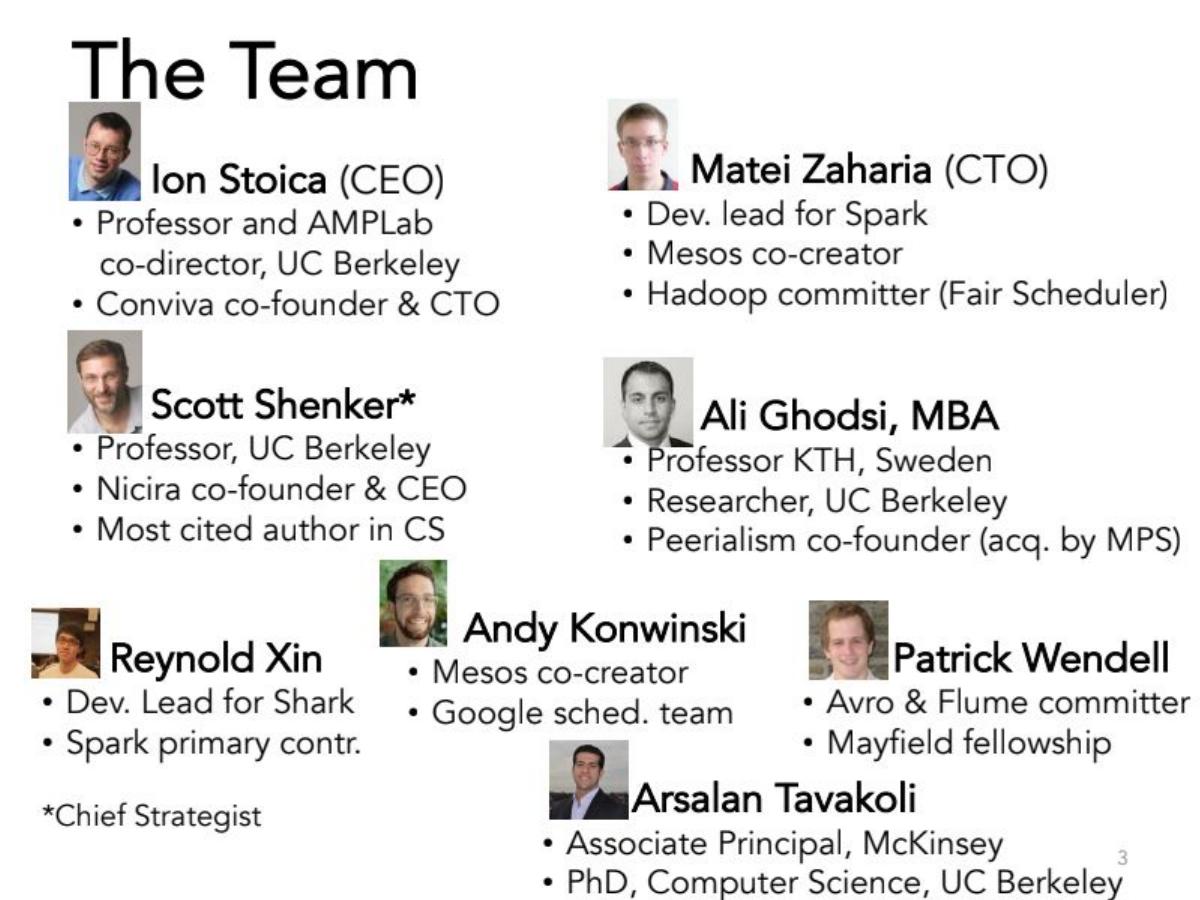
Databricks team slide — slide 3
Data and analytics platform; the deck is labelled as its Series A deck. Year is not stated on the slide.
Databricks deck, slide 3. Exact stored slide matched to this analysis.
Our analysis: Almost every line names software the person built or a company they co-founded. The research is shown as working systems and past companies, not as titles.
Evidence and limitation: Nine people with equal weight makes it hard to see who does what, and no one is shown owning sales. Group by role and say who leads go-to-market.
What a founder can adapt: Next to each technical founder, name the system, paper or product they are known for, and any company they started.
Supporting analysis
What the deck claims: "The Team": nine people with two or three lines each. Ion Stoica (CEO): professor and AMPLab co-director at UC Berkeley, Conviva co-founder and CTO. Matei Zaharia (CTO): development lead for Spark, Mesos co-creator, Hadoop committer. Scott Shenker (chief strategist): professor at UC Berkeley, Nicira co-founder and CEO, "most cited author in CS". Others are credited with Shark, Spark, Avro and Flume work; one is an associate principal from McKinsey.
Presentation choice: Almost every line names software the person built or a company they co-founded. The research is shown as working systems and past companies, not as titles.
When it does not fit: Nine people with equal weight makes it hard to see who does what, and no one is shown owning sales. Group by role and say who leads go-to-market.
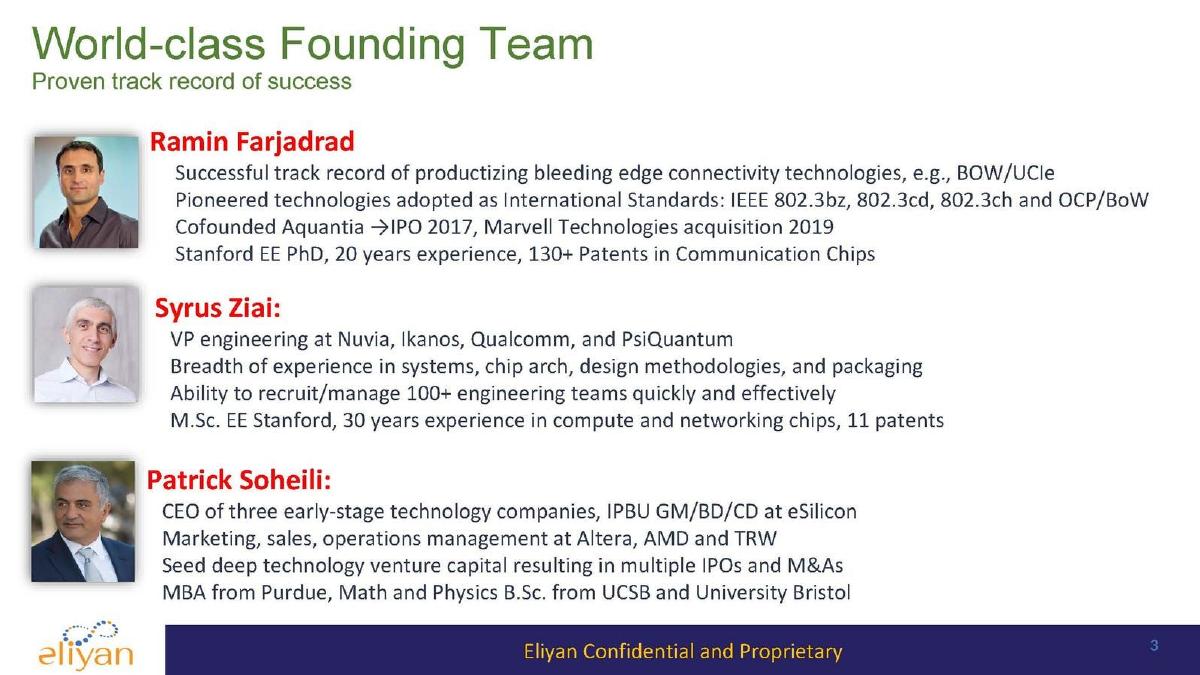
Chip-to-chip connectivity for semiconductors. Stage and year are not stated on the slide.
Eliyan deck, slide 3. Exact stored slide matched to this analysis.
Our analysis: The three founders cover invention (patents, standards), engineering scale (100+ engineers) and commercial leadership (sales, operations, business development), and the lead inventor already has an IPO and an acquisition behind him.
Evidence and limitation: "World-class" is the company's word. The patents and exits already make the point, so cut the adjective.
What a founder can adapt: Give each founder one line on what they invented or built, and one on their commercial outcome.
Supporting analysis
What the deck claims: "World-class Founding Team — Proven track record of success". Ramin Farjadrad: technologies adopted as IEEE and OCP standards, co-founded Aquantia (IPO 2017, Marvell acquisition 2019), Stanford EE PhD, 20 years' experience, 130+ patents. Syrus Ziai: VP engineering at Nuvia, Ikanos, Qualcomm and PsiQuantum, able to recruit and manage 100+ engineers. Patrick Soheili: CEO of three early-stage technology companies, business development at eSilicon, sales and operations at Altera, AMD and TRW.
Presentation choice: The three founders cover invention (patents, standards), engineering scale (100+ engineers) and commercial leadership (sales, operations, business development), and the lead inventor already has an IPO and an acquisition behind him.
When it does not fit: "World-class" is the company's word. The patents and exits already make the point, so cut the adjective.
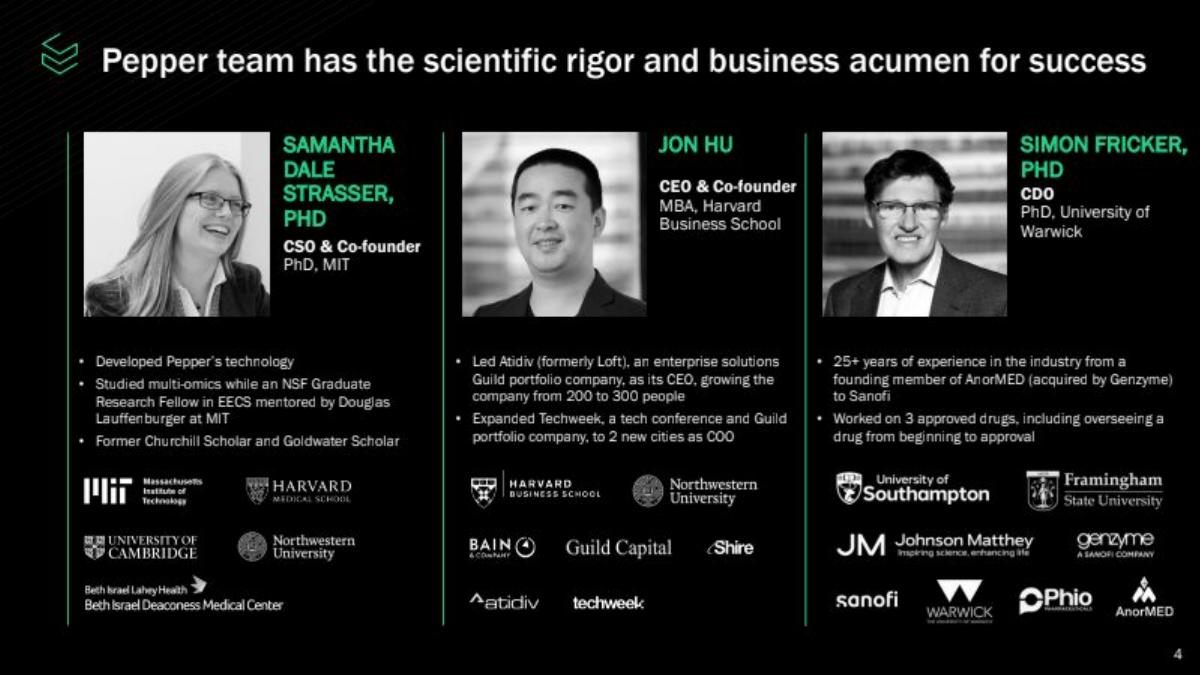
Drug discovery platform based on multi-omics data. Stage and year are not stated on the slide.
Pepper Bio deck, slide 4. Exact stored slide matched to this analysis.
Our analysis: The headline states the investor's concern and the three columns answer it: the scientist who built the technology, the operator who has scaled a company, and a drug developer who has taken products to approval.
Evidence and limitation: Scholarships and fellowships take space that could show what the platform has found so far. Replace one award with a research result.
What a founder can adapt: Name the concern in your headline and give each founder one proof point that answers it.
Supporting analysis
What the deck claims: "Pepper team has the scientific rigor and business acumen for success". Samantha Dale Strasser, PhD (CSO and co-founder): PhD from MIT, developed Pepper's technology, NSF Graduate Research Fellow, Churchill and Goldwater Scholar. Jon Hu (CEO and co-founder): MBA from Harvard Business School, led Atidiv as CEO, growing it from 200 to 300 people, expanded Techweek to two new cities as COO. Simon Fricker, PhD (CDO): 25+ years in the industry, founding member of AnorMED (acquired by Genzyme), worked on three approved drugs.
Presentation choice: The headline states the investor's concern and the three columns answer it: the scientist who built the technology, the operator who has scaled a company, and a drug developer who has taken products to approval.
When it does not fit: Scholarships and fellowships take space that could show what the platform has found so far. Replace one award with a research result.
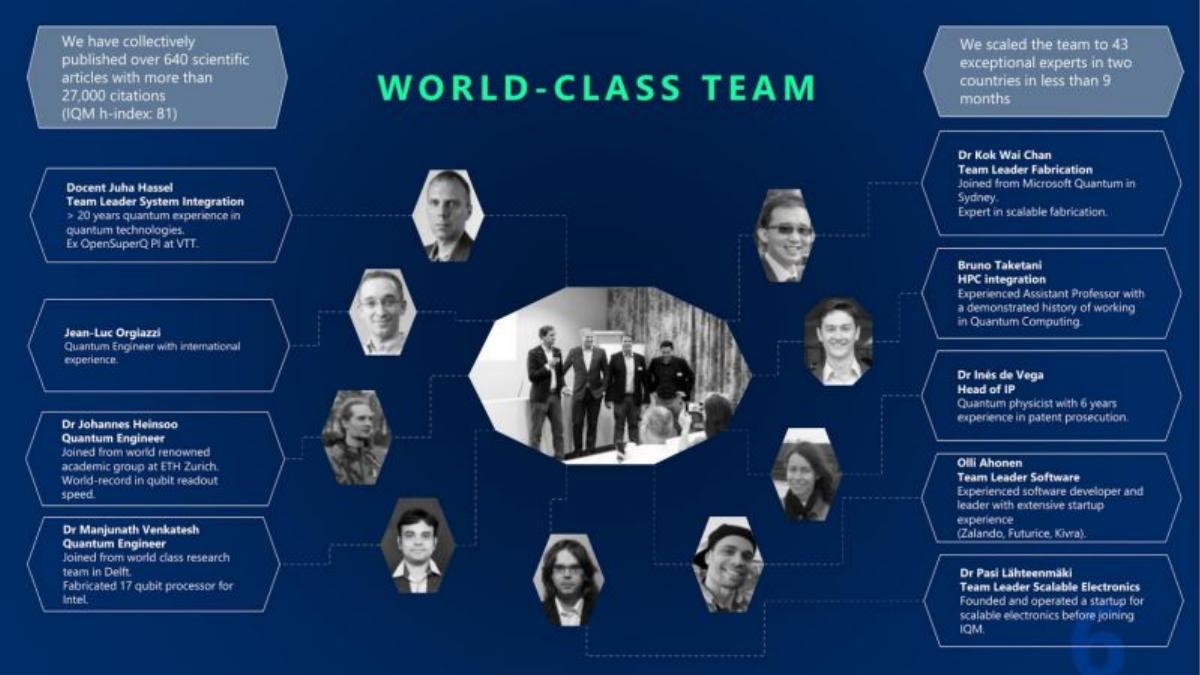
Quantum computer hardware. Stage and year are not stated on the slide.
IQM deck, slide 6. Exact stored slide matched to this analysis.
Our analysis: For a hardware company, the ability to hire scarce specialists quickly is itself evidence. The slide also covers the roles investors look for beyond physics: fabrication, IP, software and electronics.
Evidence and limitation: The founders and chief executive aren't identified, so it is unclear who leads the company or sells its product. Put the leadership team first.
What a founder can adapt: If your team is larger than the founders, give one collective output figure and name specialists by function.
Supporting analysis
What the deck claims: "World-Class Team": "We have collectively published over 640 scientific articles with more than 27,000 citations (IQM h-index: 81)" and "We scaled the team to 43 exceptional experts in two countries in less than 9 months". Eleven specialists are named with roles, for example a quantum engineer who "fabricated 17 qubit processor for Intel", another who set a world record in qubit readout speed at ETH Zurich, a head of IP with six years in patent prosecution, and a software lead from Zalando, Futurice and Kivra.
Presentation choice: For a hardware company, the ability to hire scarce specialists quickly is itself evidence. The slide also covers the roles investors look for beyond physics: fabrication, IP, software and electronics.
When it does not fit: The founders and chief executive aren't identified, so it is unclear who leads the company or sells its product. Put the leadership team first.
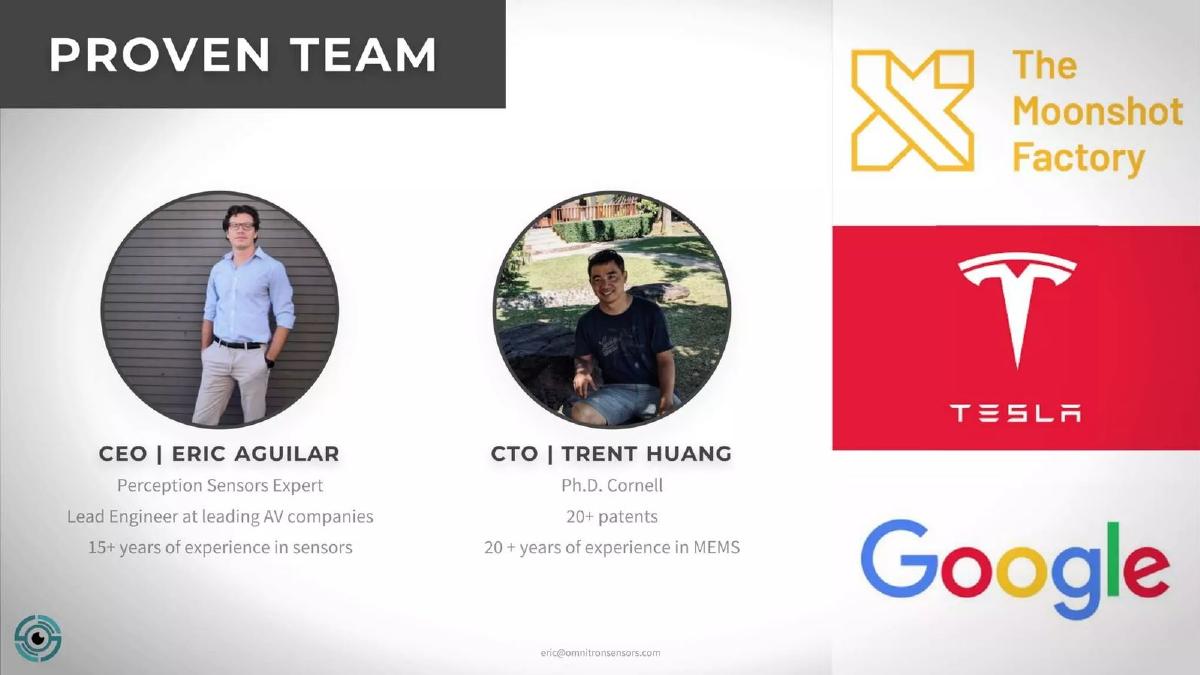
MEMS sensors for autonomous vehicles and other uses. Stage and year are not stated on the slide.
Omnitron Sensors deck, slide 3. Exact stored slide matched to this analysis.
Our analysis: Two people, two clearly separate roles: the CEO knows the customer's problem from building autonomous-vehicle systems, the CTO knows how to make the sensor. Patents give the CTO's experience a number.
Evidence and limitation: The logos aren't linked to either person, and "leading AV companies" isn't named. Say who worked where and what they shipped.
What a founder can adapt: With a two-person team, make the split explicit: who knows the customer, who knows the technology.
Supporting analysis
What the deck claims: "Proven Team": two founders. CEO Eric Aguilar: perception sensors expert, lead engineer at leading autonomous-vehicle companies, 15+ years in sensors. CTO Trent Huang: PhD from Cornell, 20+ patents, 20+ years in MEMS. Logos of The Moonshot Factory, Tesla and Google appear alongside.
Presentation choice: Two people, two clearly separate roles: the CEO knows the customer's problem from building autonomous-vehicle systems, the CTO knows how to make the sensor. Patents give the CTO's experience a number.
When it does not fit: The logos aren't linked to either person, and "leading AV companies" isn't named. Say who worked where and what they shipped.
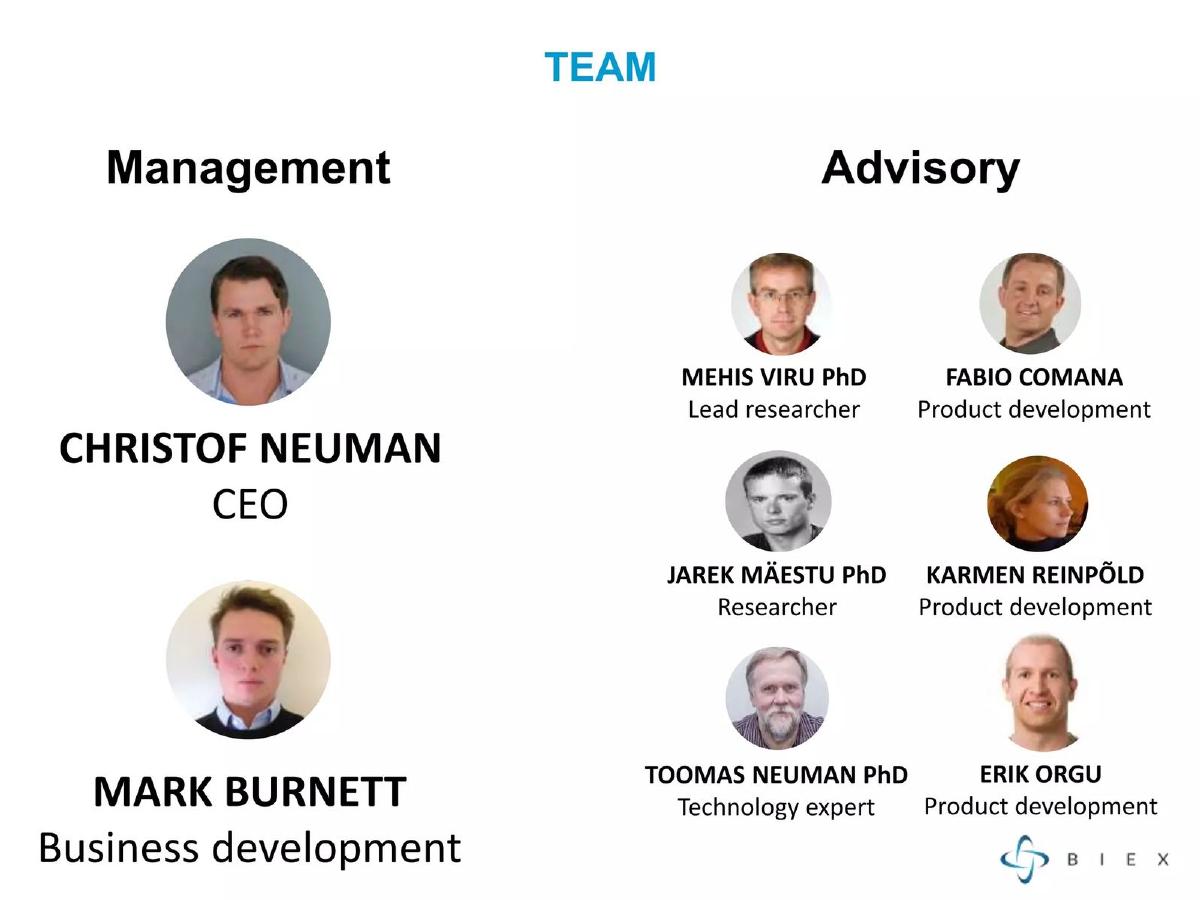
Science-based product development company from Estonia. Stage and year are not stated on the slide.
BiEx deck, slide 4. Exact stored slide matched to this analysis.
Our analysis: Separating management from research advisers makes clear that the scientists advise rather than run the company, which is honest.
Evidence and limitation: There is no line on what anyone has done: no publications, results, prior companies or products. Add one proof point per person, starting with the CEO and business development lead.
What a founder can adapt: Treat this as a slide to improve on. Keep the split between operators and advisers.
Supporting analysis
What the deck claims: "Team": Management (Christof Neuman, CEO; Mark Burnett, business development) and Advisory (Mehis Viru PhD, lead researcher; Jarek Mäestu PhD, researcher; Toomas Neuman PhD, technology expert; Fabio Comana, Karmen Reinpõld and Erik Orgu, product development). Photos and titles only.
Presentation choice: Separating management from research advisers makes clear that the scientists advise rather than run the company, which is honest.
When it does not fit: There is no line on what anyone has done: no publications, results, prior companies or products. Add one proof point per person, starting with the CEO and business development lead.
Personal finance start-up in Singapore. The slide refers to a 2015 hackathon; stage is not stated.
Fundmylife deck, slide 6. Exact stored slide matched to this analysis.
Our analysis: How long the founders have worked together and how fast they shipped a first product are useful signals for an early team.
Evidence and limitation: The PhDs aren't linked to the product (what field, what it contributes), and neither founder shows experience in finance, the market they are entering. Say what the PhDs are in and add one line of domain experience or an adviser who has it.
What a founder can adapt: Treat this as a slide to improve on. Keep the history of working together and the time to first product.
Supporting analysis
What the deck claims: "Team": Jackie Tan (NTU PhD, business co-founder, business competition finalist, "Jackie of all trades") and Wesley Goi (NUS PhD, tech co-founder, Ideas Inc 2013 winning team, big data specialist, full stack dev). "NUS classmates for 4 years. Met in a hackathon in 2015. Ideation to MVP in 6 months."
Presentation choice: How long the founders have worked together and how fast they shipped a first product are useful signals for an early team.
When it does not fit: The PhDs aren't linked to the product (what field, what it contributes), and neither founder shows experience in finance, the market they are entering. Say what the PhDs are in and add one line of domain experience or an adviser who has it.
What each slide proves about turning research into a company
Check your team slide against each column. A research team usually scores well on the first and needs to work hardest on the last two.
Example
Research output shown
Built or shipped before
Commercial lead named
Scale of hiring
Databricks
Yes: Spark, Mesos, most-cited author
Yes: Conviva, Nicira
Not clear
Not stated
Eliyan
Yes: 130+ patents, standards
Yes: IPO, acquisition
Yes
Yes: 100+ engineers managed
Pepper Bio
Partly: developed the platform
Yes: 3 approved drugs
Yes: MBA CEO
Yes: 200 to 300 people
IQM
Yes: 640+ articles, h-index 81
Partly: 17-qubit processor
No
Yes: 43 people in 9 months
Omnitron Sensors
Yes: 20+ patents
Partly: AV sensor work
CEO knows customer
Not stated
BiEx
No
No
Named, not described
Not stated
Fundmylife
PhDs, field not stated
MVP in 6 months
Named, no domain
Not stated
Key Takeaways
Tie each researcher to something they built. Databricks lists Spark, Mesos and Shark next to the names, so the credentials point to software already in use.
Show a commercial track record next to the science. Eliyan's founders list patents alongside an IPO (Aquantia, 2017) and an acquisition by Marvell (2019).
Name the business lead. Pepper Bio's CEO has an MBA and grew a company from 200 to 300 people; its CDO has worked on three approved drugs.
Collective research output can work when a team is large. IQM gives 640+ scientific articles, 27,000+ citations and an h-index of 81, then names the specialists by function.
A list of PhDs is not a team slide. BiEx names three PhDs as advisers with one-line titles and no results; the business development lead has no description at all.
Build your research team slide
Answer for each founder. Use numbers where you can.
Output. What has their research produced: a system in use, a record result, patents, standards?
Shipped. Have they taken technology to market before? What happened to it?
Role. Who owns the technology, who owns customers and revenue, who owns operations?
Hiring. How many specialists have you hired, and how fast? Who can you recruit?
Gap. What experience is missing, and which named adviser or planned hire covers it?
Copyable framework: [Name], [role]: [research output, e.g. created X / N patents]; previously [company or product taken to market, outcome]. · [Name], [CEO]: [commercial proof, e.g. grew Y from A to B]. · Gap: [missing skill], covered by [named adviser or planned hire].
Illustrative example 1 — written by us
Before: Dr. A. Smith — PhD, Physics. Dr. B. Lee — PhD, Materials Science.
After: Dr. A. Smith, CTO: invented the [coating process] behind our product, [12] patents; previously led [pilot line] at [company]. B. Lee, CEO: sold [industrial sensors] to [automotive suppliers] for [8] years. Gap: manufacturing scale-up, covered by [named adviser].
What improved: Our illustrative rewrite, not any company's text. It replaces degrees with outputs, shows who sells, and names the gap; bracketed values are placeholders.
What investors worry about with scientist founders
Investors rarely doubt that a PhD founder understands the technology. They doubt whether the team can hire engineers, manufacture at scale, sell to enterprises and make trade-offs between research and shipping. The team slide should answer that doubt directly.
The general team slide guide covers founder–market fit for any company, and the healthcare team guide covers clinical credibility. This guide covers teams whose advantage is research: computer science, semiconductors, quantum, materials, sensors and life-science platforms.
Common mistakes
Degrees instead of outputs. Say what the research produced.
No one owns sales. Name the person who will win customers.
Advisers presented as the team. Separate full-time founders from advisers.
Logos not tied to people. Say who worked where and what they did.
Adjectives instead of evidence. "World-class" adds nothing a patent count doesn't.
Diagnostic checklist
Each technical founder has one research output named.
At least one person has taken technology to market before, or the gap is named.
A commercial lead is named with a proof point.
Full-time founders and advisers are shown separately.
Hiring ability is shown if specialists are scarce.
Every logo is tied to a person.
Frequently asked questions
How we chose these examples
Corpus: published pitch deck teardowns on StartupFundraising.com. Founder-uploaded private decks are excluded.
Selection (2026-09-24): we searched extracted text of slides 2–6 for team or founder slides that mention PhDs, professors or postdoctoral researchers, excluding slides about physicians or clinical teams (covered by the healthcare team guide), where a stored slide image exists. Seven slides from research-heavy companies were selected. Help Lightning was excluded as a healthcare software company; Headsted and mWater were excluded because they already appear in the team guides; Rootine was excluded as a consumer brand.
Overlap check: the general team slide guide covers founder–market fit for any company; the healthcare team guide covers clinical credibility. This guide covers only research-led founding teams and how they show commercial ability. BiEx also appears in the roadmap guide, with a different slide.
Review: all seven stored slide images were inspected on 2026-09-24 and matched to company, deck and slide number (editorial model review). No person has yet completed an editorial review of this page.
Credentials, patents, citations and exits are the companies' own claims and have not been independently verified. We make no claim that any slide caused a fundraising outcome.