Developer Tools Team Slides: 6 Real Pitch Deck Examples
How developer tools founders show they have built the thing their users build: prior open source projects, platform roles at named companies.
Developer Tools Team Slide: Show You Have Been the Developer You Sell To
Developer tools are bought, or at least chosen, by engineers, and engineers trust tools made by people who have done their job. Investors read a devtools team slide to see whether the founders have built and run the kind of systems their product serves, and whether anyone has taken a developer product to market. This guide compares six real team slides from decks tagged devtools in our library, from a slide that ties the founders' last open source project to the new product to one that lists first names and titles.
TL;DR
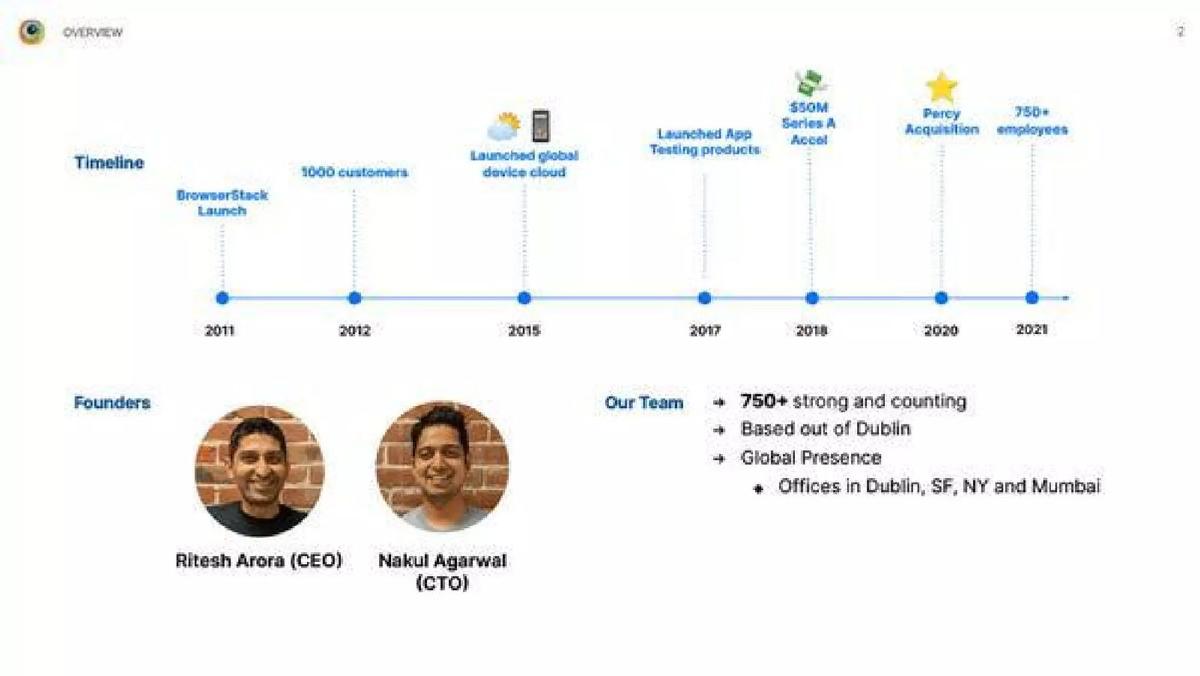
Show what the founders built before that their users would recognise, with a result. Apollo's founders made Meteor, a "Top 10 most-starred GitHub project", and explain how that led to Apollo. Skyflow's CTO was "EVP & CTO, AthenaHealth" and its CEO "Built force.com, AppExchange" at Salesforce. Lumigo's founders show parallel timelines through Linux kernel and cloud security work. BrowserStack pairs its two founders with a timeline and "750+ strong". Datagen names academic advisors but not its founders, and Chotmai shows first names only.
Developer tools team slides from real pitch decks
Each example shows the exact stored slide above its analysis and links to the full teardown. The clearest slides come first; weaker ones follow for contrast. Claims are as shown on the slides; comments are ours.
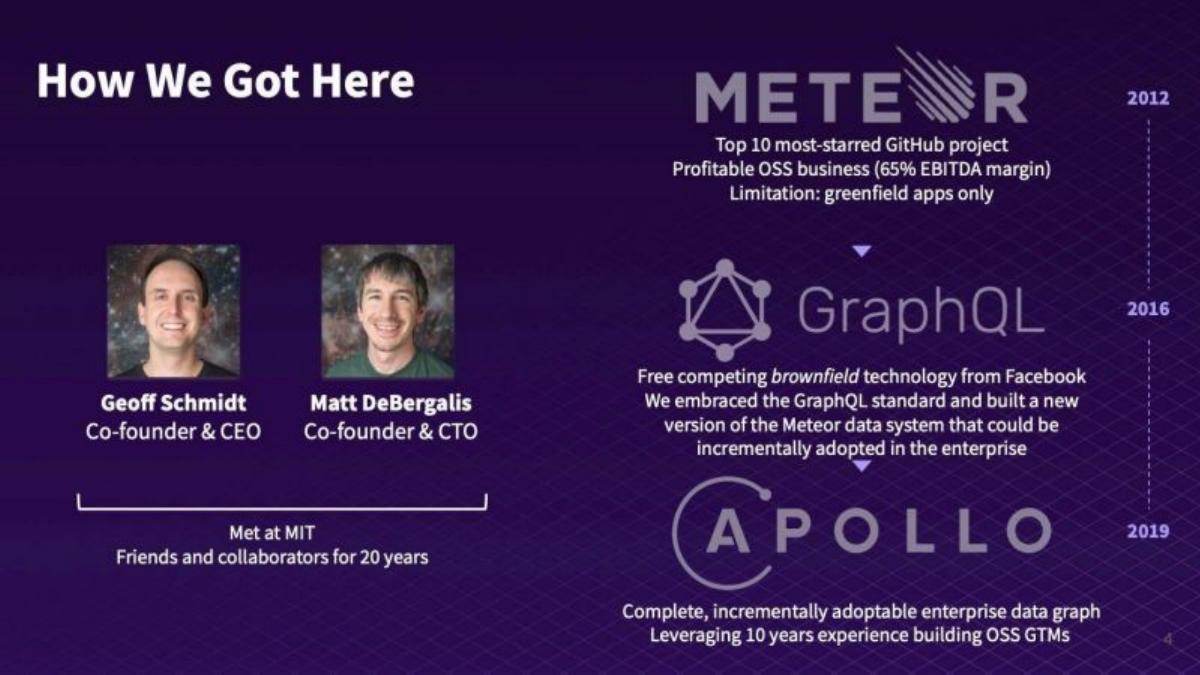
Apollo team slide — slide 4
GraphQL data platform. Slide titled "How We Got Here".
Apollo deck, slide 4. Exact stored slide matched to this analysis.
Our analysis: The slide shows the founders have already won developers once and turned it into a business, and it explains what they learned (the limitation) that shaped Apollo.
Evidence and limitation: A prior open source project with a popularity measure and a margin, how long the founders have worked together, and the path to the current product.
What a founder can adapt: Tell your team story as a sequence: what you built, what it taught you, why this product follows.
Supporting analysis
What the deck claims: Geoff Schmidt, "Co-founder & CEO"; Matt DeBergalis, "Co-founder & CTO"; "Met at MIT", "Friends and collaborators for 20 years". Timeline: 2012 Meteor, "Top 10 most-starred GitHub project", "Profitable OSS business (65% EBITDA margin)", "Limitation: greenfield apps only". 2016 GraphQL: "We embraced the GraphQL standard and built a new version of the Meteor data system that could be incrementally adopted in the enterprise". 2019 Apollo: "Complete, incrementally adoptable enterprise data graph", "Leveraging 10 years experience building OSS GTMs".
Presentation choice: For open source products, investors want proof the team can get adoption and then earn money from it; this slide shows both from the last project.
When it does not fit: Nothing major; individual backgrounds beyond Meteor are left out.
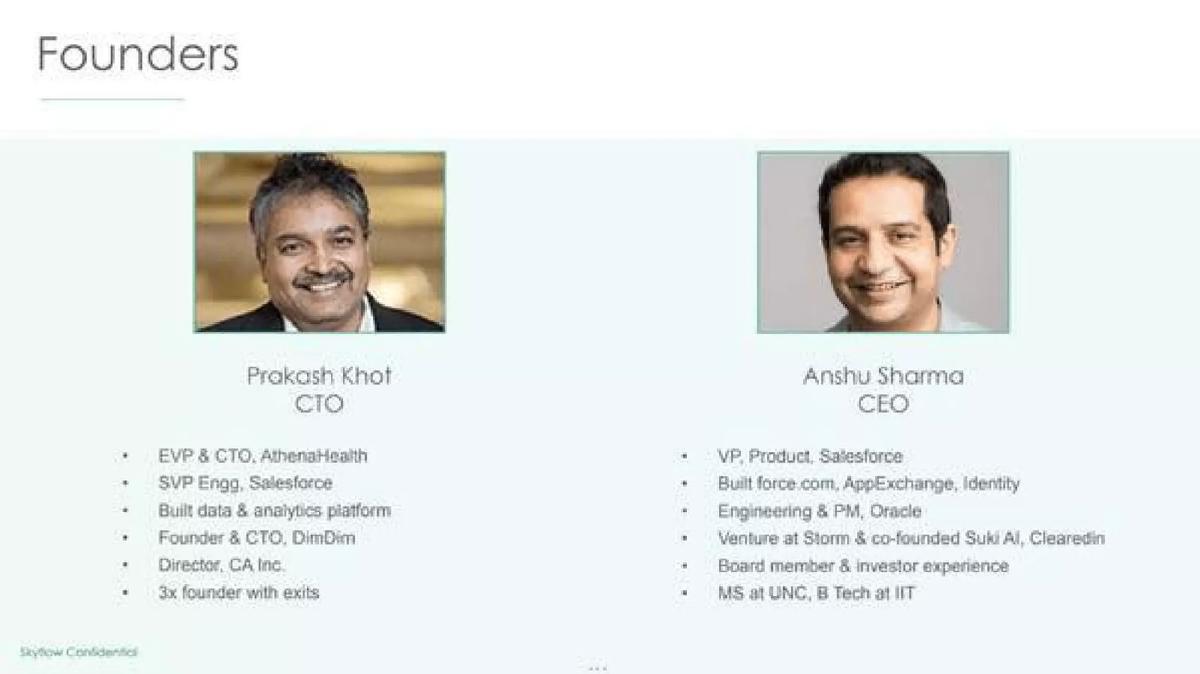
Data privacy API. Slide titled "Founders"; footer marked "Skyflow Confidential", from a deck whose full teardown is published on the site.
Skyflow deck, slide 2. Exact stored slide matched to this analysis.
Our analysis: Both founders have built developer platforms at scale (force.com, AppExchange) and handled sensitive data (a healthcare company), which is what a data privacy API needs.
Evidence and limitation: Senior roles at named companies, named platforms built, and prior founding and exits.
What a founder can adapt: Put the line most relevant to the product first for each founder.
Supporting analysis
What the deck claims: Prakash Khot, "CTO": "EVP & CTO, AthenaHealth", "SVP Engg, Salesforce", "Built data & analytics platform", "Founder & CTO, DimDim", "Director, CA Inc", "3x founder with exits". Anshu Sharma, "CEO": "VP, Product, Salesforce", "Built force.com, AppExchange, Identity", "Engineering & PM, Oracle", "Venture at Storm & co-founded Suki AI, Clearedin", "Board member & investor experience", "MS at UNC, B Tech at IIT".
Presentation choice: Buyers of infrastructure trust teams that have run it at large companies; this slide makes that case in six lines each.
When it does not fit: Lists without results; say what force.com or the data platform achieved.
Serverless monitoring; deck from a $29m round. Slide titled "Nice to Meet You".
Lumigo deck, slide 3. Exact stored slide matched to this analysis.
Our analysis: Both founders did low-level engineering and then led cloud and research work at the same company, so they have shipped developer-facing products together.
Evidence and limitation: Parallel dated timelines with named roles at one employer.
What a founder can adapt: Add one result on the timeline, such as a product launched or customers reached.
Supporting analysis
What the deck claims: Erez Berkner, "CEO & Co-founder": "BSc cum laude in Computer Sciences (during high school)", "Developer at an IDF elite tech unit", "Linux Kernel Developer" at Check Point, "Director of cloud security products" at Check Point. Aviad Mor, "CTO & Co-founder": "Squad leader at IDF intelligence unit", "BSc cum laude in Computer Sciences", "Linux Kernel Developer", "Founded Check Point NextGen research group". Timeline 1998, 2005, 2015, then "2018 founded Lumigo (Tel Aviv)".
Presentation choice: A timeline makes the path easy to follow and shows the founders have worked together for years.
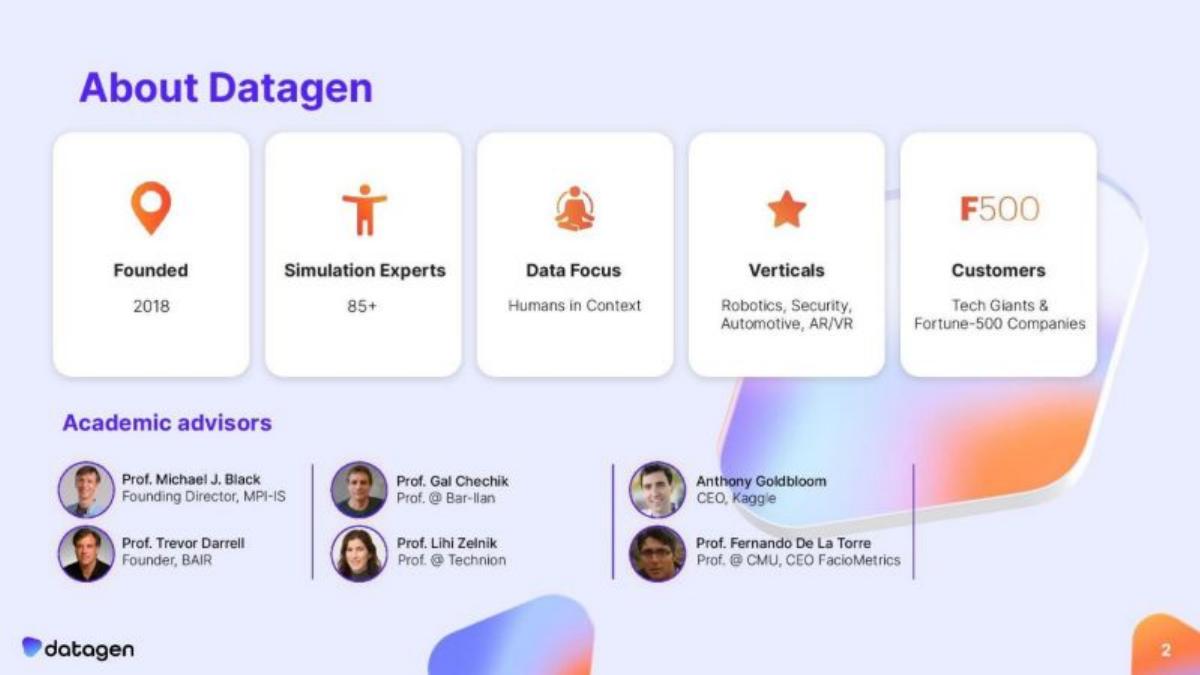
Synthetic data for computer vision. Slide titled "About Datagen". (weaker)
Datagen deck, slide 2. Exact stored slide matched to this analysis.
Our analysis: Included for contrast: the advisors are strong for a computer vision product, but the slide doesn't say who runs the company.
Evidence and limitation: A headcount of specialists and named advisors with institutions; no founders named.
What a founder can adapt: Add the founders with one line each before the advisors.
Supporting analysis
What the deck claims: "Founded 2018", "Simulation Experts 85+", "Data Focus: Humans in Context", "Verticals: Robotics, Security, Automotive, AR/VR", "Customers: Tech Giants & Fortune-500 Companies". "Academic advisors": Prof. Michael J. Black ("Founding Director, MPI-IS"), Prof. Trevor Darrell ("Founder, BAIR"), Prof. Gal Chechik, Prof. Lihi Zelnik, Anthony Goldbloom ("CEO, Kaggle"), Prof. Fernando De La Torre.
Presentation choice: Investors back the operators; advisors support them but can't replace them.
When it does not fit: "Tech Giants & Fortune-500 Companies" without a name or count.
Whether an investor can see prior technical work, go-to-market experience, and something checkable about the founders.
Example
Business
Prior technical work
Go-to-market experience
Checkable facts
Apollo
GraphQL platform
Yes (Meteor)
Yes (profitable OSS business)
GitHub rank, margin
Skyflow
Data privacy API
Yes (force.com, AthenaHealth)
Product VP, exits
Employers, roles, exits
Lumigo
Serverless monitoring
Yes (kernel, cloud security)
Director of products
Dated roles, employer
BrowserStack
Testing cloud
Company timeline
Company timeline
Launches, headcount
Datagen
Synthetic data
Not shown for founders
Not shown
Advisors, headcount
Chotmai
Devtools
Not shown
Sales titles
First names only
Key Takeaways
Show a system, platform or open source project the founders built before.
Name the company and the role: CTO, kernel developer, platform lead.
Connect the past work to the product in one line.
Show who takes the product to market, not only who writes code.
Name the founders before the advisors.
Build your developer tools team slide
Show what you built before, then who will take the product to developers.
Built before. What system, platform or open source project did each founder build, and where?
Result. What measure shows it worked: users, stars, uptime, customers, revenue?
Connection. In one line, why does that past work lead to this product?
Go-to-market. Who has taken a developer product to market or run developer relations?
Together. How long have the founders worked together, and where?
Copyable framework: Headline: [what you built before] → [this product]. [Name], CTO: built [system] at [company], [result]. [Name], CEO: [product or go-to-market role], [result].
Illustrative example 1 — written by us
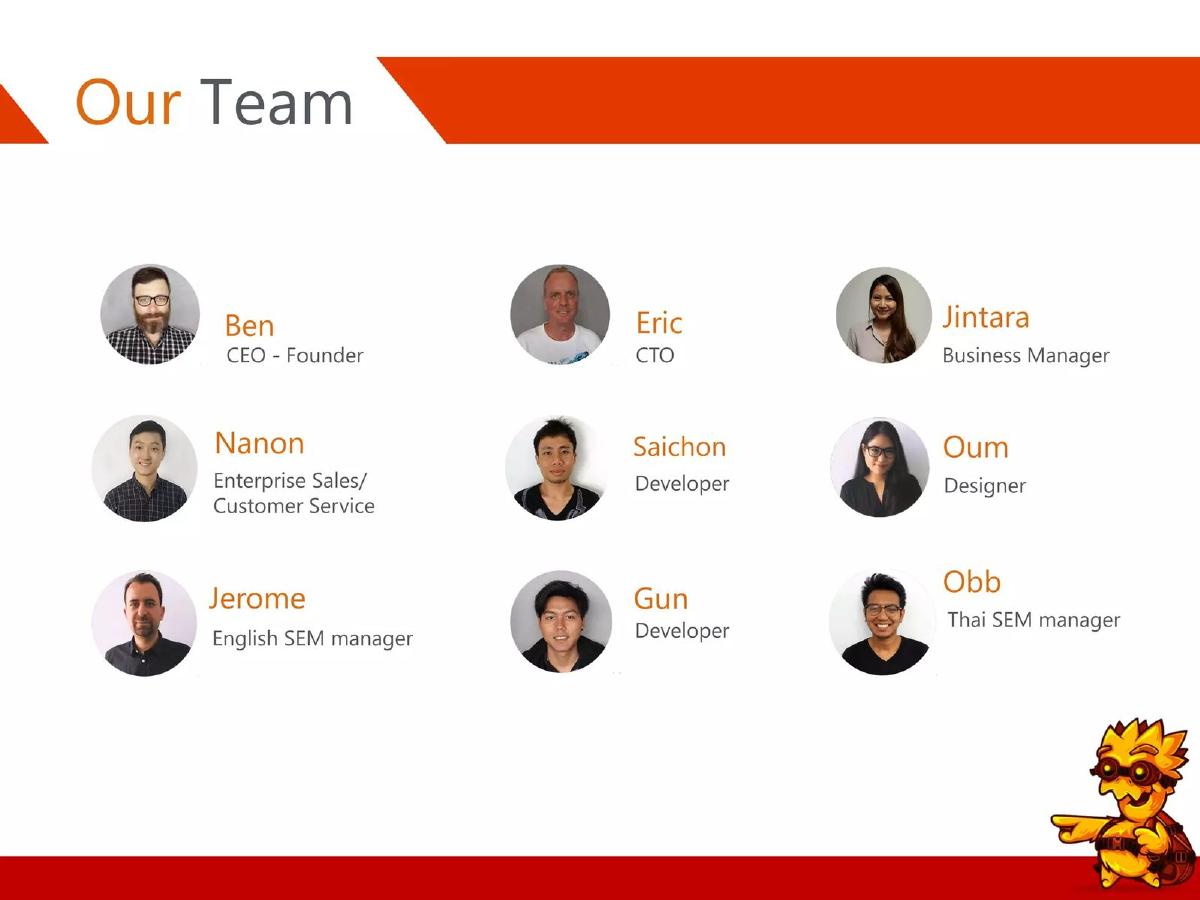
Before: Ben, CEO - Founder. Eric, CTO.
After: Ben [Surname], CEO: [previous product], [users or revenue]. Eric [Surname], CTO: built [system] at [company], [scale].
What improved: Our illustrative rewrite; the bracketed details are placeholders, not Chotmai's facts. It makes each founder checkable.
What this guide adds
The general team slide guide covers any company. Developer tools have a particular question: have the founders been the developer they sell to, and can they get developers to adopt the product? This guide looks at how real devtools team slides answer it.
Our library's devtools tag covers data APIs, testing platforms, serverless monitoring, synthetic data and open source infrastructure. We note each company's business in the examples.
How we read each slide
We quote the text on the stored slide images. We have not checked any employer, role, project, headcount or exit claim.
Common mistakes
No prior technical work. Show what the founders built that your users would recognise.
No go-to-market owner. Say who gets developers to adopt and pay.
Advisors before founders. Name the people running the company first.
Roles without results. Add a measure of what each project achieved.
First names only. Use full names so investors can check.
Diagnostic checklist
Each founder's most relevant past system or project, with a result.
One line connecting that work to the product.
A go-to-market or developer adoption owner.
How long the founders have worked together.
Advisors labelled apart from the team.
Frequently asked questions
What should a developer tools startup's team slide show?
What the founders built before that developers would recognise, with a result, and who will take the product to market. Apollo shows its founders made Meteor, a top 10 most-starred GitHub project, and ran it as a profitable business.
Should I show my open source history on the team slide?
Yes, if it is relevant. Apollo uses the Meteor project to explain both the team's credibility and why the new product exists.
Can advisors replace founder backgrounds?
No. Datagen names strong academic advisors, but without its founders an investor still doesn't know who runs the company.
How we chose these examples
Corpus: published pitch deck teardowns on StartupFundraising.com. Founder-uploaded private decks are excluded.
Selection (2026-09-27): we searched extracted slide text in decks tagged devtools for team or founder together with CEO or CTO. About 20 slides matched; nine unused ones had stored images and were reviewed as images.
Kept six. Left out: Rasgo p4 (a problem slide), OctoML p3 (an open source ecosystem slide that mentions the founders only in passing), and Skyflow p4 (a second team slide from the same deck). Tracer p6 is used elsewhere. No uploads were requested.
Review: stored slide text and images were checked on 2026-09-27 and matched to company, deck and slide number (editorial model review). No person has yet completed an editorial review of this page.
Claims are as shown on the slides; we have not verified them. We make no claim that any slide caused a fundraising outcome.