Alliance MMA's March 2017 deck presents a post-IPO vision for consolidating the highly fragmented regional Mixed Martial Arts (MMA) market. The company, which listed on the NASDAQ in October 2016, aimed to build a 'prodigious showcase' for aspiring fighters by acquiring regional promotions and integrating them into a single enterprise with centralized business support units like CageTix and SuckerPunch. The deck highlights a disciplined acquisition model, paying 5-7 times projected annual profitability with an 80/20 equity-to-cash split. While the deck provides clear unit metrics for events a…
Key takeaways
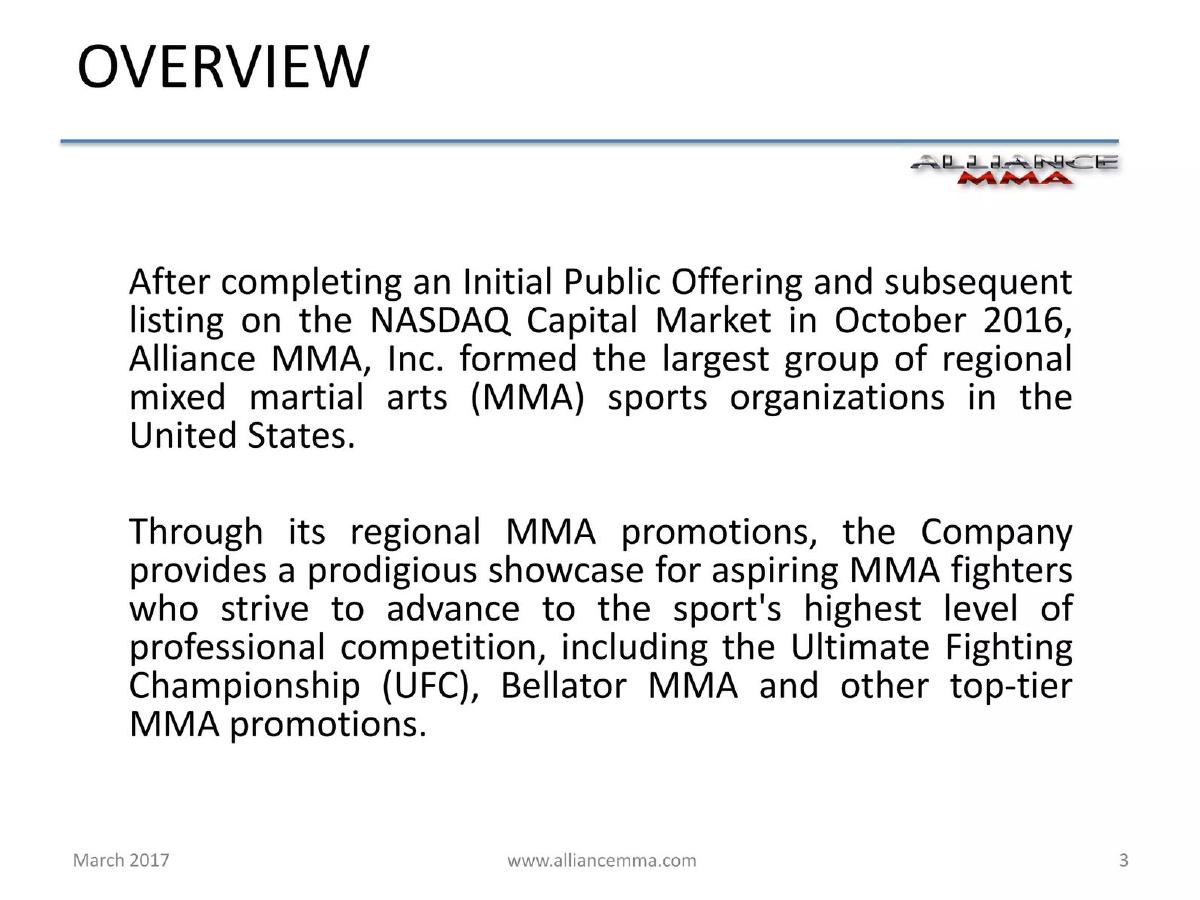
- The company completed an Initial Public Offering and listed on the NASDAQ Capital Market in October 2016 (Slide 3).
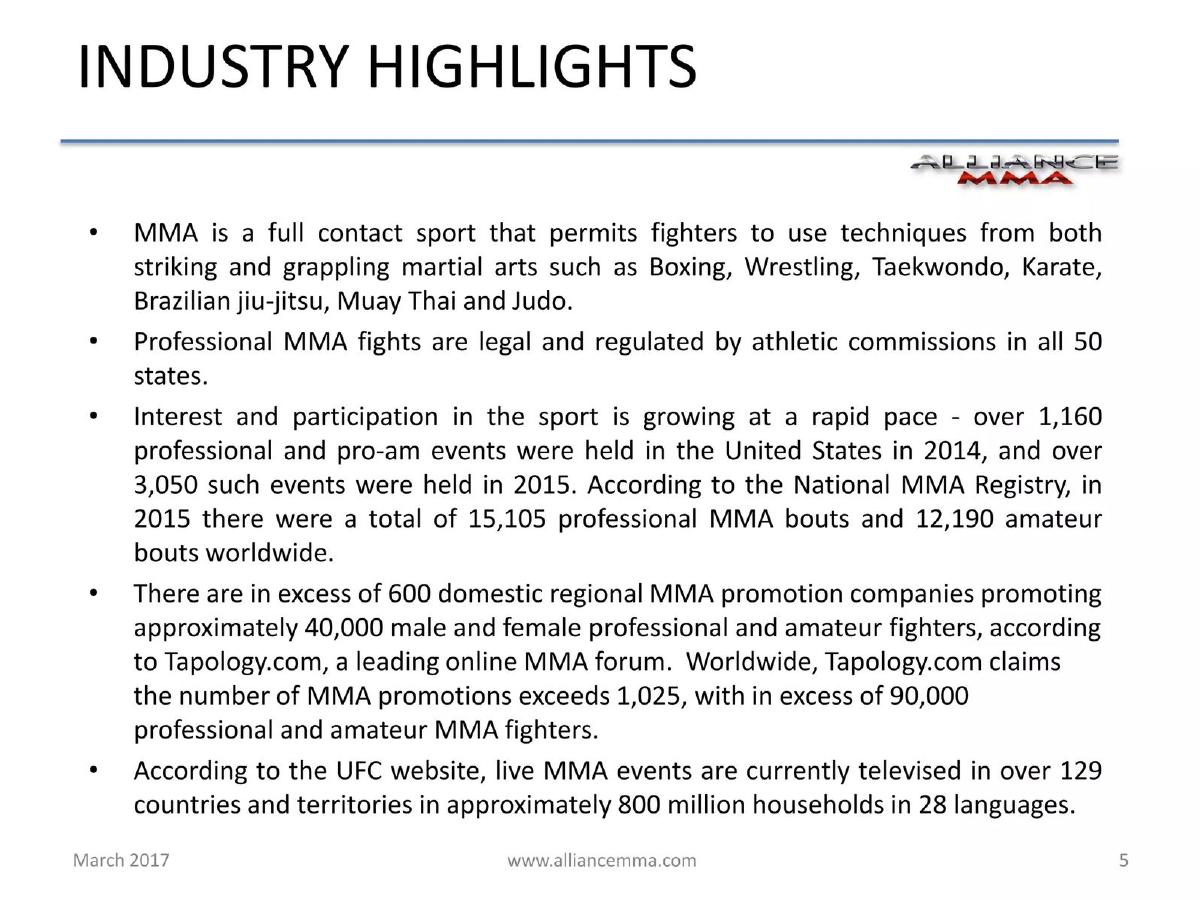
- Alliance MMA identifies a market of over 600 domestic regional MMA promotion companies involving approximately 40,000 fighters (Slide 5).
- The business model relies on two pillars: Promotional Events (regional brands) and Business Support Units like CageTix and SuckerPunch (Slide 7).
- Acquisition pricing is strictly defined at 5-7 times projected annual profitability, paid in 80% equity and 20% cash (Slide 11).
- A performance-based escrow holds 30% of the purchase value, released only upon hitting 100% of first-year EBITDA targets (Slide 11).
- The company uses a weighted scoring system for acquisitions, where 'Attitude & Leadership' and 'Resistance to Change' are the highest-weighted factors at 15 points each (Slide 13).
- The long-term goal is to build a family of 20 domestic regional promotions producing over 150 events per year (Slide 15).
- Ticket prices for events are targeted between $40 and $200, with a $20,000 local sponsorship target per event (Slide 11).
Alliance MMA: The Consolidation Playbook for Regional Combat Sports
The March 2017 investor presentation for Alliance MMA, Inc. serves as a strategic roadmap for a company that had recently transitioned to the public markets. Having listed on the NASDAQ in October 2016, the deck is less about 'proving' a concept and more about explaining the execution of a roll-up strategy. The presentation focuses on how Alliance MMA intends to professionalize a fragmented industry by acquiring regional promotions and applying centralized business logic to them.
Slide 1: Title Slide
The cover slide is minimalist, featuring the Alliance MMA logo and the date 'March 2017.' It identifies Jim Platek as the contact for Investor Relations. The inclusion of a specific IR contact and a physical address in later slides signals that this is a corporate communication intended for institutional and retail investors following their IPO.
Slide 3: Company Overview
Slide 3 establishes the company's current status and mission. It explicitly mentions the completion of the IPO and the NASDAQ listing in October 2016. The core value proposition is defined: forming the 'largest group of regional mixed martial arts (MMA) sports organizations in the United States.' The slide positions Alliance MMA as a 'prodigious showcase' or feeder system for top-tier promotions like the UFC and Bellator MMA. This is a crucial strategic distinction; they are not trying to compete with the UFC, but rather to own the supply chain of talent that feeds into it.
Slide 5: Industry Highlights
This slide provides the market validation. It defines MMA as a full-contact sport and notes that professional fights are legal and regulated in all 50 states. The data points are specific: over 3,050 events held in 2015 and a total of 15,105 professional bouts worldwide. Most importantly for their business model, the slide notes there are 'in excess of 600 domestic regional MMA promotion companies.' This confirms a highly fragmented market, which is the prerequisite for a successful roll-up strategy.
Slide 7: Operating Entities
Slide 7 breaks down the company into two categories: Promotional Events and Business Support Units. The promotional side lists seven regional brands including Cage Fury Fighting Championship and Shogun Fights, covering territories from New Jersey to Florida to Washington. The support units include CageTix (ticketing), SuckerPunch (fighter representation), and Alliance Sports Media (production). This slide illustrates the 'hub and spoke' model where centralized services support regional operations.
Slide 9: Organizational Structure
The structure slide is a detailed hierarchy chart. It shows Paul Danner as CEO, supported by a C-suite including a President, CMO, CFO, and CTO. Below the executive level, the chart shows how regional promoters (like John Rallo for Shogun Fights) integrate into the corporate structure. Notably, several boxes are labeled 'TBD' or 'Prospective Position,' particularly in regional production and graphic design, indicating that the company was still in the process of scaling its centralized support staff at the time of the presentation.
Slide 11: Unit Metrics
This is perhaps the most important slide for an investor. It provides hard numbers for event performance and acquisition mechanics. Events are expected to generate tickets between $40 and $200, with a $20k sponsorship target and $4k merchandise target. The acquisition section is highly disciplined: they buy at 5-7x projected annual profitability, use 80% equity to preserve cash, and hold 30% of the purchase price in escrow. The escrow release is tied to the seller hitting 100% of their first-year EBITDA target, which serves as a significant de-risking mechanism for the buyer.
Slide 13: Prospect Evaluation Criteria
Slide 13 introduces a weighted scoring system for potential acquisitions. It is unusual to see 'Resistance to Change' weighted as highly (15 points) as 'Attitude & Leadership Effectiveness.' This suggests that the management team viewed the primary risk not as financial, but as operational—specifically, the difficulty of integrating independent, 'mom-and-pop' promoters into a corporate environment. 'Historic Revenue & Profitability' only receives 5 points, reinforcing the idea that Alliance MMA is buying the territory and the leadership, not necessarily the past balance sheet.
Slide 15: Summary and Future Intent
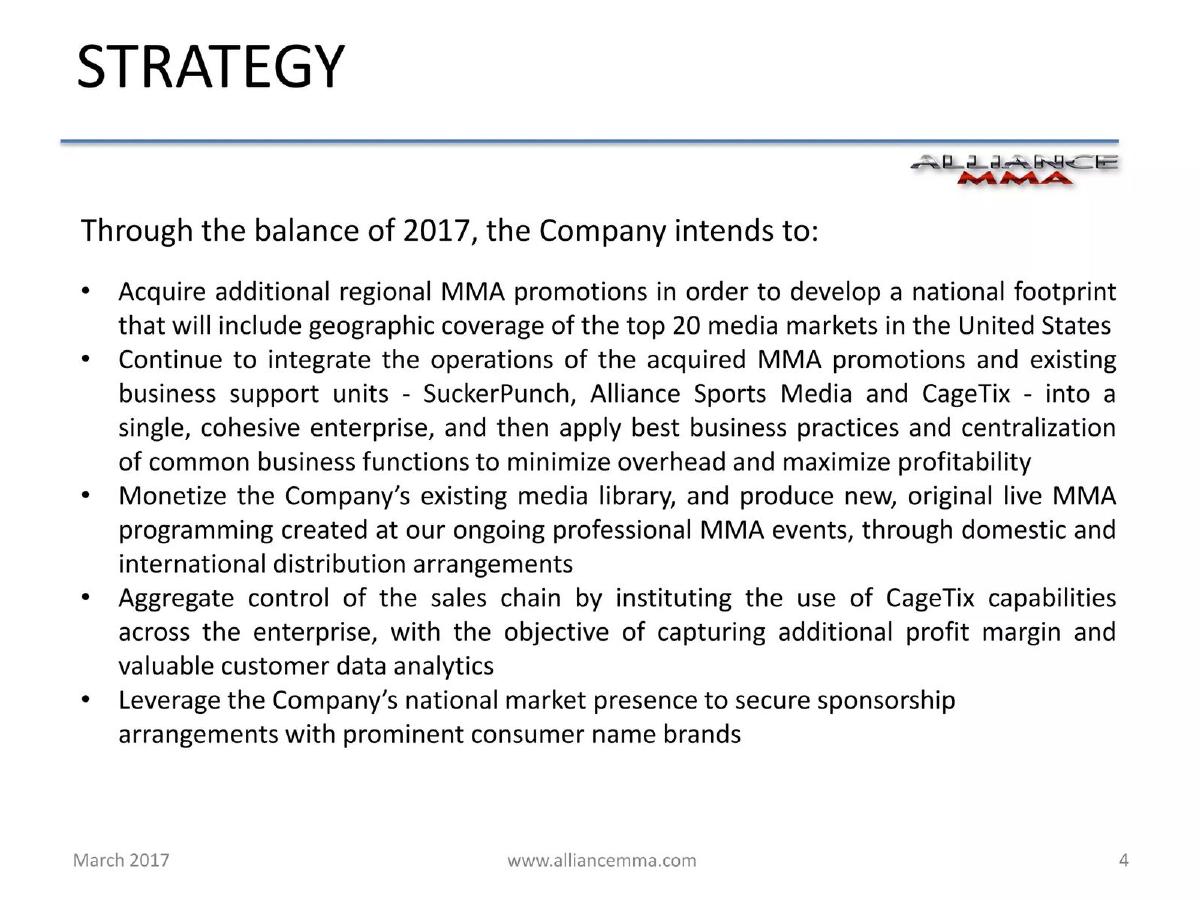
The summary slide outlines the goal: 20 domestic regional promotions and 150+ events per year. It reiterates the plan to integrate assets into a 'single, cohesive enterprise' to minimize overhead and maximize revenue. It also mentions the intention to secure national sponsorship arrangements, which would be difficult for a single regional promoter to achieve but possible for a national conglomerate. The final bullet point mentions transforming their support units (SuckerPunch, CageTix) into 'world class operations.'
Slide 17: Contact Information
The deck concludes with contact details for Jim Platek, Director of Investor Relations, including a Madison Avenue address in New York and a direct phone number and email. This is standard for a public company deck.
What Alliance MMA Does Well
The deck is exceptionally clear about its business model. The roll-up strategy is not just mentioned; it is quantified. By providing the exact multiples they pay (5-7x) and the exact payment structure (80/20 equity/cash), they signal to the market that they are disciplined buyers. The use of a performance-based escrow (Slide 11) is a sophisticated way to align incentives with the founders of acquired companies.
Furthermore, the 'Prospect Evaluation Criteria' (Slide 13) is a standout feature. Most pitch decks gloss over how they will choose targets. Alliance MMA's transparency regarding their weighted scoring system shows a level of operational maturity. It tells investors that the company has a repeatable process for growth, rather than just chasing deals haphazardly.
What is Missing from the Deck
The most glaring omission is the lack of historical financial statements. While the deck mentions being listed on the NASDAQ, it does not provide a summary of the previous year's revenue, net income, or cash flow. For a public company, this information is available in SEC filings, but its absence in the presentation makes it difficult to assess the current health of the 'Operating Entities' listed on Slide 7.
Additionally, there is no 'Ask' slide. In a typical startup deck, the founders specify how much capital they are raising and how they will use it. Because this is an investor relations deck for an already-public company, the 'ask' is implied (buy the stock), but it lacks a specific catalyst or milestone that the next round of funding (if any) would achieve. There is also no mention of the competitive landscape—specifically, other regional consolidators or the risk of major leagues like the UFC launching their own regional feeder systems.
Lessons for Founders
Founders planning a roll-up or consolidation strategy should study Slide 11 and Slide 13. The clarity of the acquisition formula is a masterclass in building investor confidence. If you are telling investors you will grow through M&A, you must be able to explain exactly how you value those companies and how you protect yourself if the acquired company underperforms.
Another lesson is the 'Hub and Spoke' organizational chart (Slide 9). It clearly differentiates between the 'talent' (the regional promoters) and the 'infrastructure' (the C-suite and support units). This helps investors visualize how the company scales without the CEO having to manage every single event personally. Finally, the focus on 'Resistance to Change' as a top-tier evaluation metric is a reminder that in service-based or sports-based businesses, the human element is often a greater risk than the financial one.
Frequently asked questions
- What is the core business model of Alliance MMA?
- Alliance MMA operates as a roll-up of regional Mixed Martial Arts promotions. According to Slide 3 and Slide 7, they acquire local fighting organizations (like Cage Fury or Shogun Fights) and support them with centralized services including a ticketing platform (CageTix), fighter representation (SuckerPunch), and media production. The goal is to create a unified feeder system for major leagues like the UFC.
- How does Alliance MMA value the companies it acquires?
- As detailed on Slide 11, the company uses a standardized valuation formula of 5-7 times projected annual profitability. The consideration is structured to minimize cash outlay, using 80% equity and 20% cash. Furthermore, 30% of the total value is held in escrow and only released if the acquired entity meets 100% of its first-year EBITDA target.
- What are the primary revenue drivers for their events?
- Slide 11 outlines the unit metrics for their events. Revenue is generated through ticket sales (priced between $40 and $200), local sponsorships (with a target of $20,000 per event), and merchandise sales (target of $4,000 per event). They aim for an average of 8 events per year for each regional promotion they own.
- What criteria does the company use to select acquisition targets?
- Slide 13 presents a 'Prospect Evaluation Criteria' table. Interestingly, qualitative factors carry the most weight: 'Attitude & Leadership Effectiveness' and 'Resistance to Change' account for 30% of the total score. Financial metrics like 'Historic Revenue & Profitability' only account for 5% of the weighting, suggesting the company prioritizes cultural fit and integration potential over past performance.
- What is the scale of the MMA market according to the deck?
- Slide 5 cites data from the National MMA Registry and Tapology, stating there were over 3,050 MMA events in 2015. Domestically, there are over 600 regional promotion companies. Globally, the deck claims the sport reaches approximately 800 million households in 28 languages, highlighting a massive, albeit fragmented, audience.