Alto (then ScriptDash) presented a compelling seed-stage case by combining a massive, stagnant market with precise unit economics. The deck identifies a $263 billion U.S. market dominated by legacy players like CVS and Walgreens, then proposes a digital-first solution offering 2-hour delivery windows. What makes this deck stand out is its 'wedge' strategy: starting specifically with birth control to capture users with a 15-year recurring need. By contrasting a $3.20 CAC (selling to doctors) against a $72 CAC (online ads), the founders proved they understood the distribution hurdles of health-…
Key takeaways
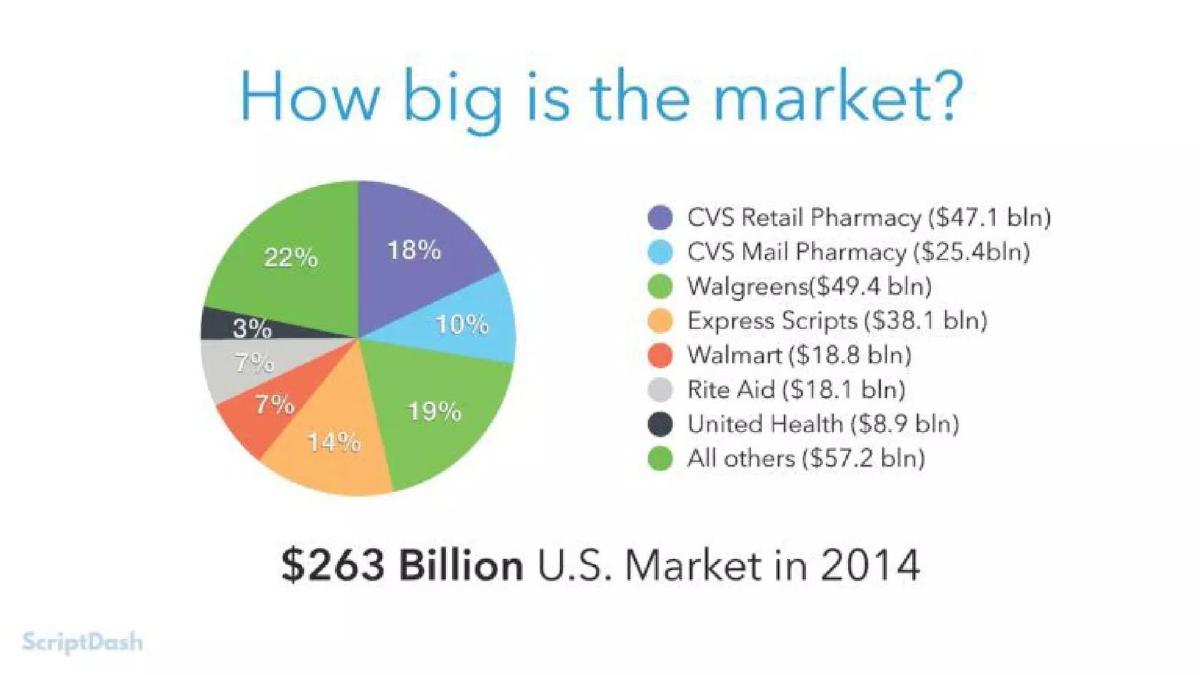
- The company identifies a $263 billion U.S. pharmacy market as of 2014, with legacy retail and mail-order players holding the majority share (Slide 4).
- Alto uses birth control as a strategic wedge, citing a 15-year average duration of use for patients aged 18-33 (Slide 7).
- The business model projects a $9 monthly margin for birth control, leading to an annual Life Cycle Value (LCV) of $108 (Slide 7).
- Expansion to all prescriptions is projected to increase the average annual LCV per patient to $323 (Slide 8).
- The deck highlights a massive discrepancy in customer acquisition costs: $3.20 CAC when selling through doctors versus $72 CAC via online advertising (Slide 9).
- The founding team emphasizes technical pedigree, featuring former engineers from Parse and Facebook (Slide 10).
- The service offering includes a 2-hour on-demand delivery window and recurring monthly mail delivery (Slide 2).
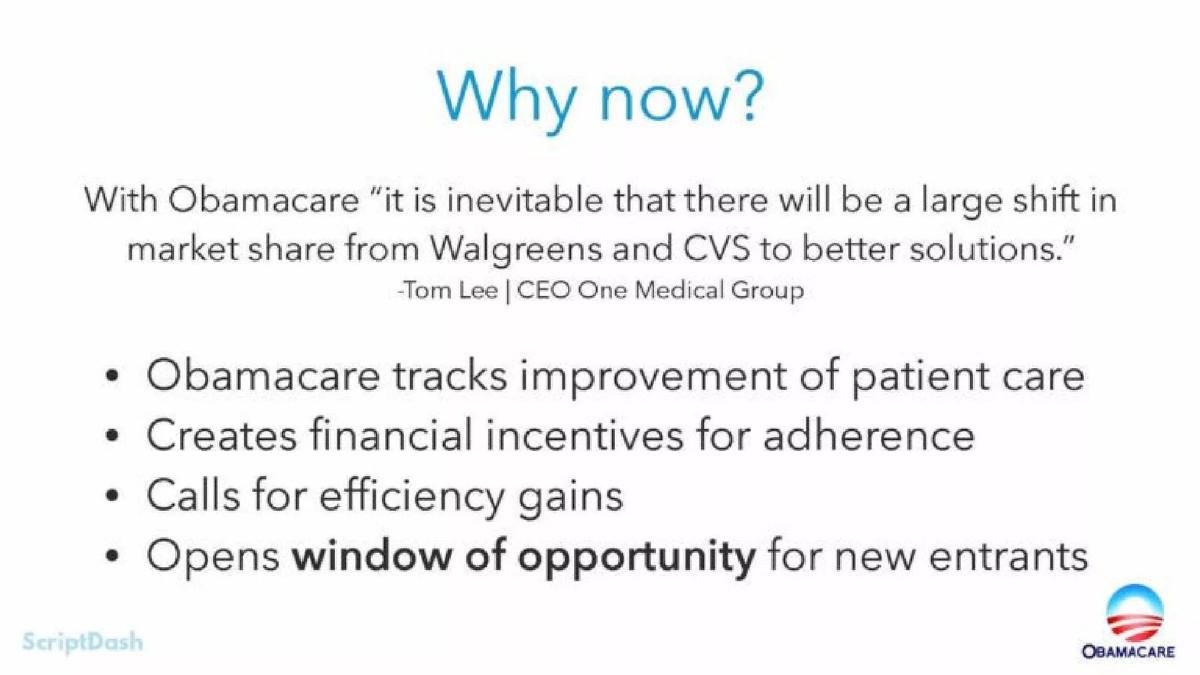
- The deck leverages regulatory tailwinds, specifically citing Obamacare as a catalyst for a market shift toward more efficient solutions (Slide 3).
The ScriptDash (Alto) Seed Deck: Engineering the Modern Pharmacy
In 2015, the pharmacy industry was ripe for disruption, yet notoriously difficult to enter due to regulatory and logistical hurdles. This 14-slide deck from ScriptDash—now known as Alto—shows how an engineering-led team planned to dismantle the $263 billion legacy pharmacy market. Instead of trying to be everything to everyone on day one, they presented a calculated, data-driven entry strategy focused on high-retention medication and doctor-led acquisition.
The Vision and the Market Opportunity (Slides 1-4)
Slide 1 introduces the brand with a simple, bold tagline: "The pharmacy. Reinvented." It is a classic 'X for Y' or 'Reinventing X' opening that immediately signals a disruption play. Slide 2 defines the product as a technology-focused online pharmacy. The core value proposition is convenience, specifically highlighting a 2-hour on-demand delivery window and recurring monthly mail delivery. This addresses the primary friction point of traditional retail pharmacies: the physical trip and the wait time.
Slide 3 addresses the 'Why Now?' question. It uses a quote from Tom Lee, CEO of One Medical Group, regarding Obamacare (the Affordable Care Act). The slide argues that regulatory shifts are creating financial incentives for medication adherence and opening a window for new entrants. This is a crucial slide because it moves the business from a 'nice-to-have' delivery service to a 'must-have' healthcare efficiency tool. Slide 4 quantifies the market at $263 billion in 2014. The pie chart shows a fragmented but dominated market, with Walgreens ($49.4 bln) and CVS Retail ($47.1 bln) as the primary targets. By listing the revenue of these giants, Alto establishes the massive ceiling for a successful competitor.
Product Workflow and the Patient Experience (Slides 5-6)
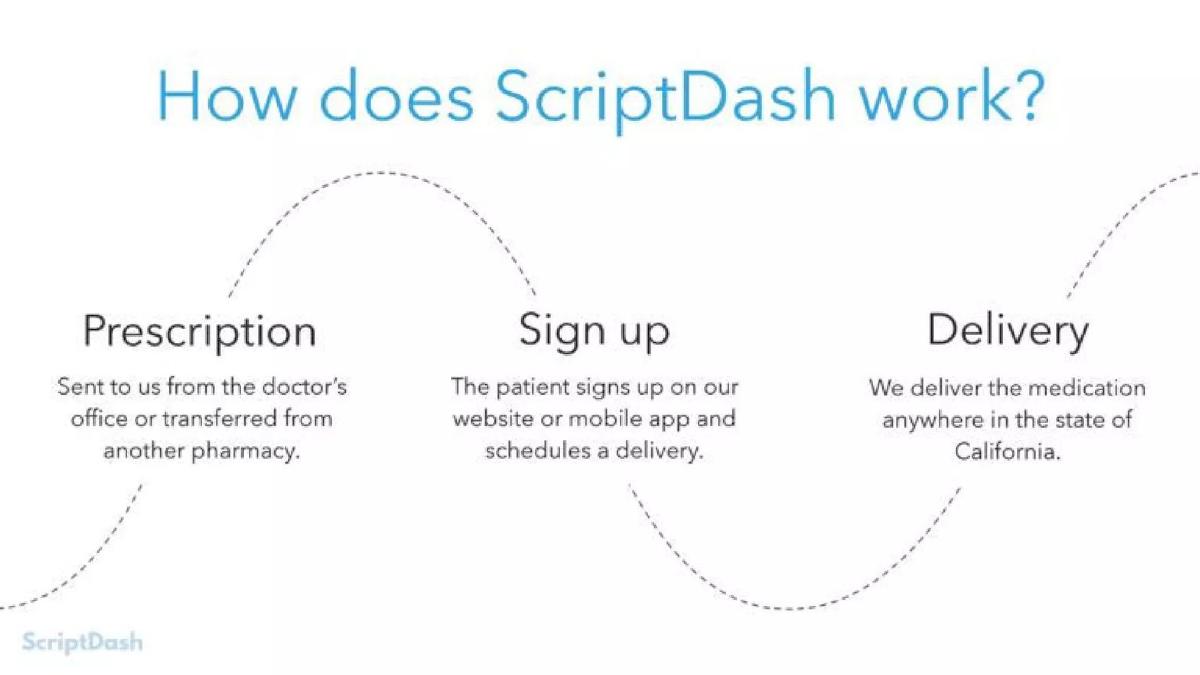
Slide 5 explains the mechanics of the service in three simple steps: Prescription, Sign up, and Delivery. It notes that prescriptions can be sent directly from a doctor or transferred from another pharmacy, and that they deliver anywhere in the state of California. This simplicity is vital for a seed-stage deck; it proves the founders have mapped out the user journey from the legacy system into their new ecosystem.
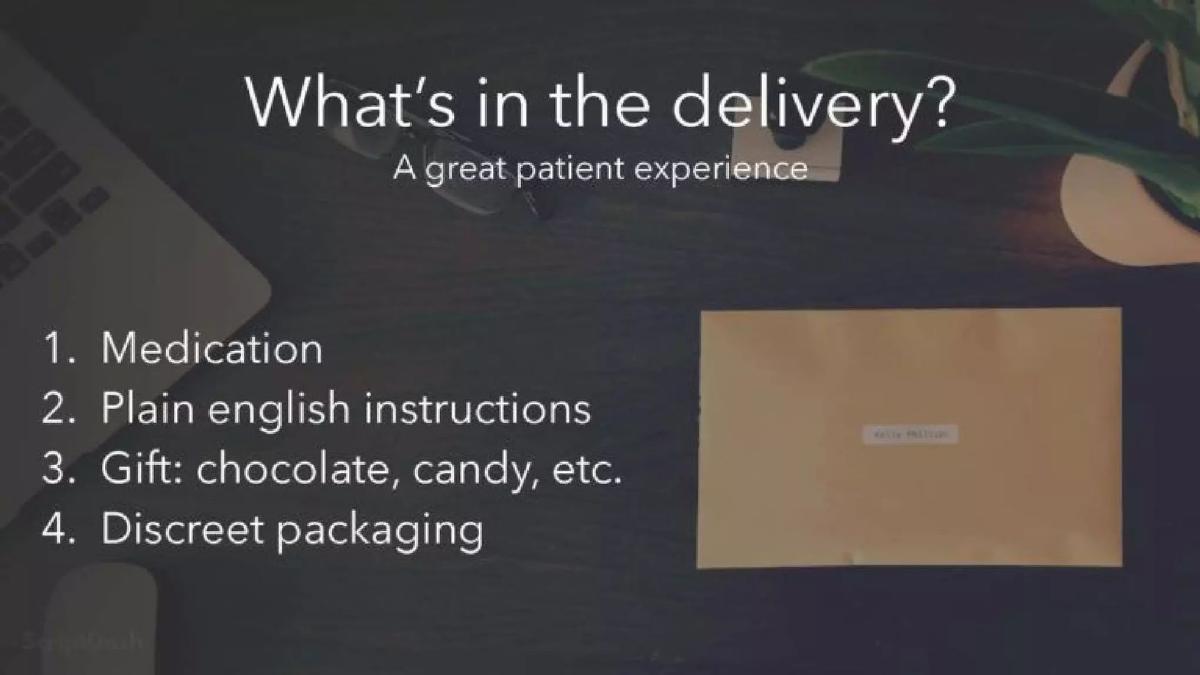
Slide 6 focuses on the 'unboxing' experience. In a sector as sterile as healthcare, Alto highlights 'plain English instructions' and 'discreet packaging.' Most notably, they include 'Gift: chocolate, candy, etc.' in the delivery. This emphasizes that they are building a consumer brand, not just a medical utility. It is an attempt to win the emotional loyalty of the patient, which is key to the long-term retention they project in later slides.
The Birth Control Wedge and Unit Economics (Slides 7-9)
This section is the heart of the deck and likely why it was successful. Slide 7 introduces birth control as the starting point. They cite a 15-year average duration of use for the 18-33 age bracket. The math is clear: a $9 monthly margin leads to a $108 annual LCV, with a total potential LCV of $1,600. By starting with a predictable, long-term medication, they solve the problem of high churn that plagues many e-commerce startups.
Slide 8 shows the expansion path. They move from the $108 annual LCV of birth control to a $323 annual LCV for the average patient across all prescriptions. They cite 160 million active patients in the US and 4.1 billion prescriptions filled in 2014. This slide proves that the 'wedge' is just the beginning of a much larger revenue story.
Slide 9 is perhaps the most impressive slide in the deck. It breaks down the Cost of Acquisition (CAC). They compare 'Online Advertising' ($72 CAC per prescription) with 'Sell To Doctors' ($3.20 CAC per prescription). By calculating the man-hours required to convert a doctor and the resulting monthly prescriptions from that doctor's office, they demonstrate a scalable, low-cost growth engine. Investors love seeing a 'hack' or a non-obvious distribution channel that results in a 20x improvement in CAC over traditional digital marketing.
The Team and Technical Approach (Slides 10-14)
Slide 10 introduces the founding team: Mattieu Gamache-Asselin, Jamie Karraker, and Vlad Blumen. The pedigree is heavily technical, with two founders coming from Parse (acquired by Facebook) and one with prior founder experience. This signals to investors that the 'technology-focused' claim on Slide 2 is backed by actual engineering talent capable of building a complex, secure healthcare platform.
Slide 11 is a transition to the Appendix, which contains two additional slides. Slide 12 details the 'Technology Focused Approach,' mentioning an iPhone/web app, push notifications, and 'text to talk.' Interestingly, it explicitly states the product is 'By generation Y for generation Y,' further cementing their target demographic. Slide 13 adds a layer of social impact and urgency, titled 'Not Just Better Tech: Life Saver!' It cites that 16% of hospital admissions are due to adverse drug reactions and that these reactions are the 4th leading cause of death in the U.S. This slide reframes the business from a delivery convenience to a safety necessity. Finally, Slide 14 repeats the title slide, closing the presentation.
What Works in the Alto Deck
The Wedge Strategy: Focusing on birth control is brilliant. It is a high-frequency, long-duration medication that builds a 15-year relationship with a young, tech-savvy demographic. · Granular CAC Analysis: Most seed decks guess at CAC. Alto provided a specific formula for acquiring doctors, which showed a clear path to profitability. · Market Context: They didn't just say the market is big; they showed exactly who the incumbents are and how much revenue they are 'stealing' from. · Regulatory Alignment: Mentioning Obamacare showed that the founders were thinking about the macro environment and how it would force the industry to change.
What is Missing from the Alto Deck
Current Traction: The deck is almost entirely forward-looking. There are no slides showing how many patients they had already served or what their actual (rather than projected) retention looked like at the time of the pitch. · The 'Ask': There is no slide detailing how much money they are raising, what the valuation is, or what the specific milestones are for the next 18 months. · Regulatory/Pharmacy Licensing: Pharmacy is a highly regulated space. The deck mentions delivering in California, but it doesn't explain how they secured (or plan to secure) the necessary pharmacy licenses and DEA registrations. · Unit Economics (Opex): While they show 'margin per prescription,' they don't account for the cost of the 2-hour delivery logistics, which is notoriously expensive.
What a Founder Should Copy
The 'Why Now' Slide: Use a combination of regulatory changes and industry expert quotes to create a sense of inevitability. · The LCV Progression: Show how you start with a specific, high-retention niche (the wedge) and how that naturally expands into a larger, higher-value market. · The Distribution Comparison: Don't just list your marketing channels. Compare the costs of different channels to show you've found the most efficient way to grow. · Clean Design: The deck uses a consistent, professional color palette and avoids clutter. Each slide has one clear message.
Frequently asked questions
- What was Alto's original name and why did it change?
- Alto was founded in 2015 as ScriptDash, which is the branding seen throughout this 14-slide pitch deck. According to the catalogue listing, the company rebranded to Alto in 2017 following a $23 million investment round. The original name reflected their 'dash' delivery promise, while the new name likely aimed for a more premium, healthcare-centric identity.
- How does Alto plan to acquire customers cheaply?
- Slide 9 outlines a dual-track acquisition strategy. While online advertising (Facebook, Google, WebMD) costs $72 per prescription, the company focuses on 'Selling to Doctors.' By spending 10 man-hours per doctor at $50/hour to secure 160 monthly prescriptions, they achieve a CAC of just $3.20 per prescription, demonstrating a highly efficient B2B2C model.
- What is the 'wedge' product in this deck?
- The wedge is birth control. Slide 7 explains that birth control is a recurring prescription with a 15-year average duration for the 18-33 age demographic. This provides a high-retention entry point into a household, allowing the company to later expand into all other prescription types which carry higher margins (Slide 8).
- Who were the founders at the time of the seed round?
- The founding team consisted of Mattieu Gamache-Asselin (5th engineer at Parse), Jamie Karraker (Engineer at Parse and Facebook), and Vlad Blumen (Founder of WalkSource). The team slide (Slide 10) emphasizes their engineering background and experience at high-growth tech companies rather than traditional pharmaceutical backgrounds.
- What specific problem in the pharmacy experience does Alto solve?
- Beyond just delivery, the deck highlights the 'patient experience' on Slide 6. This includes plain English instructions (replacing confusing medical jargon), discreet packaging, and even small gifts like chocolate or candy in the delivery. Slide 12 also mentions 'transparent smart management of insurance' as a key technology focus.