Althea, a Korean beauty e-commerce platform targeting Southeast Asia, utilized a remarkably brief 9-slide deck to raise $10.7 million in 2015. The deck eschews traditional slides like 'Problem' or 'Solution' in favor of raw momentum. It leads with a Forbes endorsement and quickly pivots to three core metrics: $12 million in annualized sales, 45% product margins, and 20% month-over-month growth. By highlighting a CAC payback period of less than five months and a team of 'Veterans' from industry giants like Groupon and Memebox, Althea positioned itself as an execution-heavy winner in a high-gro…
Key takeaways
- The deck relies heavily on a third-party validation from Forbes to establish immediate credibility on slide 3.
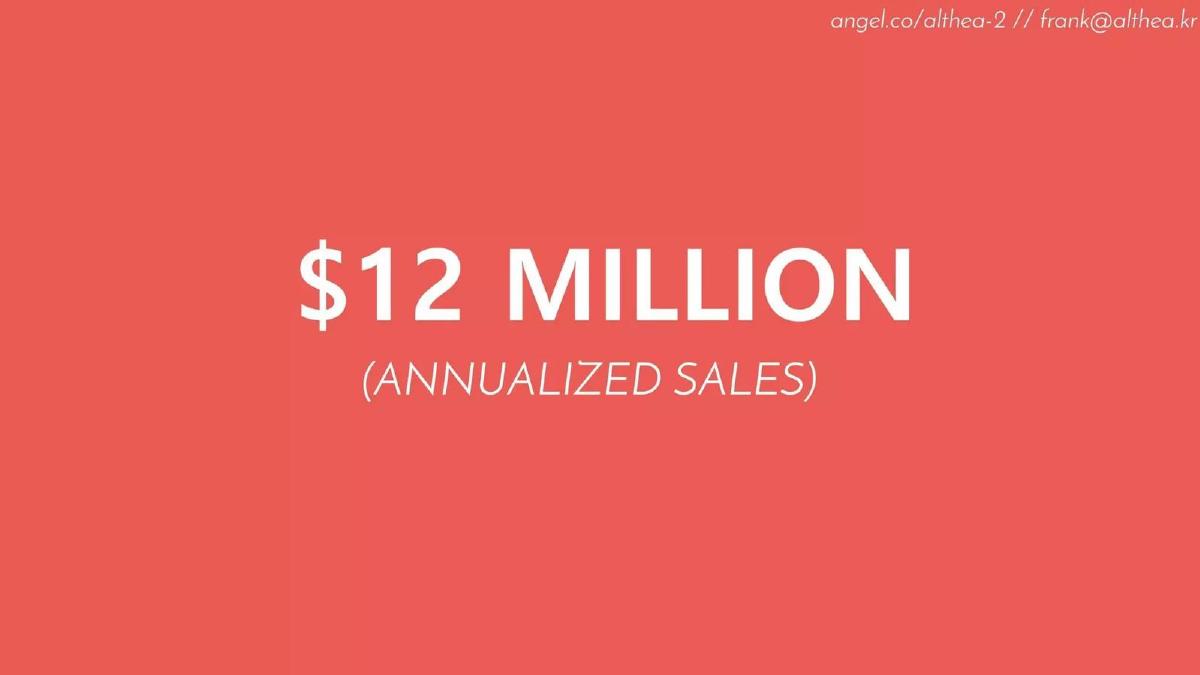
- Annualized sales are stated at $12 million on slide 4, providing a clear scale of the business at the time of the pitch.
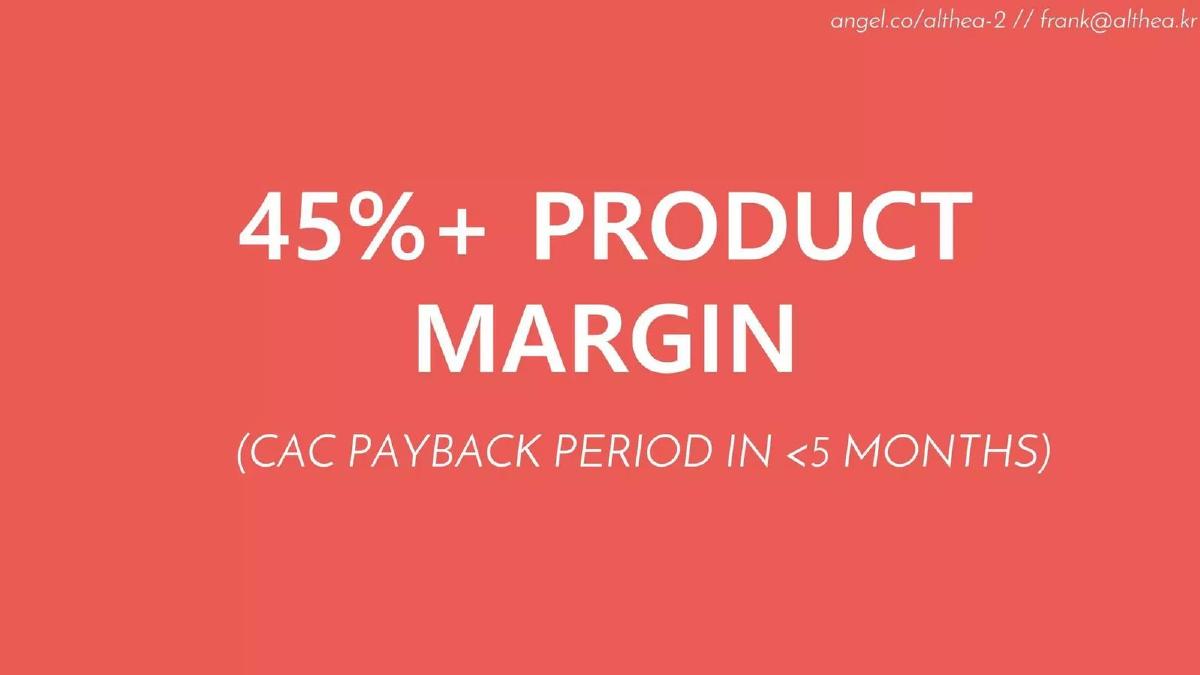
- Unit economics are highly favorable, with slide 5 citing a 45%+ product margin and a CAC payback period of under 5 months.
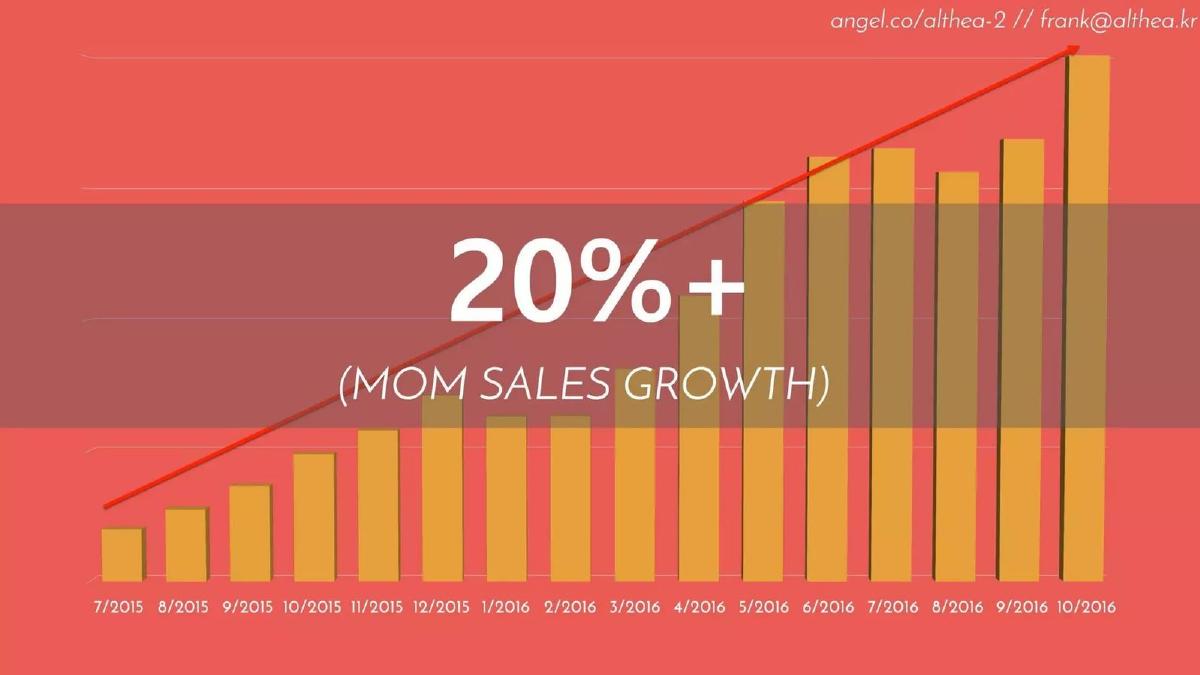
- Growth is demonstrated visually on slide 6 with a bar chart showing consistent month-over-month increases exceeding 20%.
- The team slide (slide 7) emphasizes pedigree, listing former experience at TMON, Memebox, and Groupon.
- Market opportunity is framed through a 30% CAGR for Korean beauty, which slide 8 claims is 6 times faster than any other country.
- The deck completely omits a 'Problem' slide, assuming the investor already understands the demand for K-beauty.
- There is no specific 'Ask' slide detailing how much capital is being raised or how it will be spent within the 9 slides provided.
The Power of Brevity in Growth-Stage Fundraising
The Althea pitch deck is a fascinating artifact from the 2015 e-commerce boom. At only nine slides, it defies the conventional wisdom that a deck must be a comprehensive 20-page document covering every facet of the business. Instead, Althea leans into a "traction-first" strategy. When a company is generating $12 million in annualized sales with 20% monthly growth, the narrative shifts from "what we might do" to "what we are already doing." This teardown examines how Althea used minimalist design and high-impact data to secure a significant later-stage investment.
The Hook: Authority and Speed (Slides 1-3)
Slide 1: Title Slide The deck opens with high-quality lifestyle imagery of four women, immediately establishing the aesthetic of the beauty industry. The central logo is flanked by the bold claim: "NO. 1 KOREAN BEAUTY AUTHORITY IN SOUTHEAST ASIA." This sets the stage not just as a store, but as a market leader.
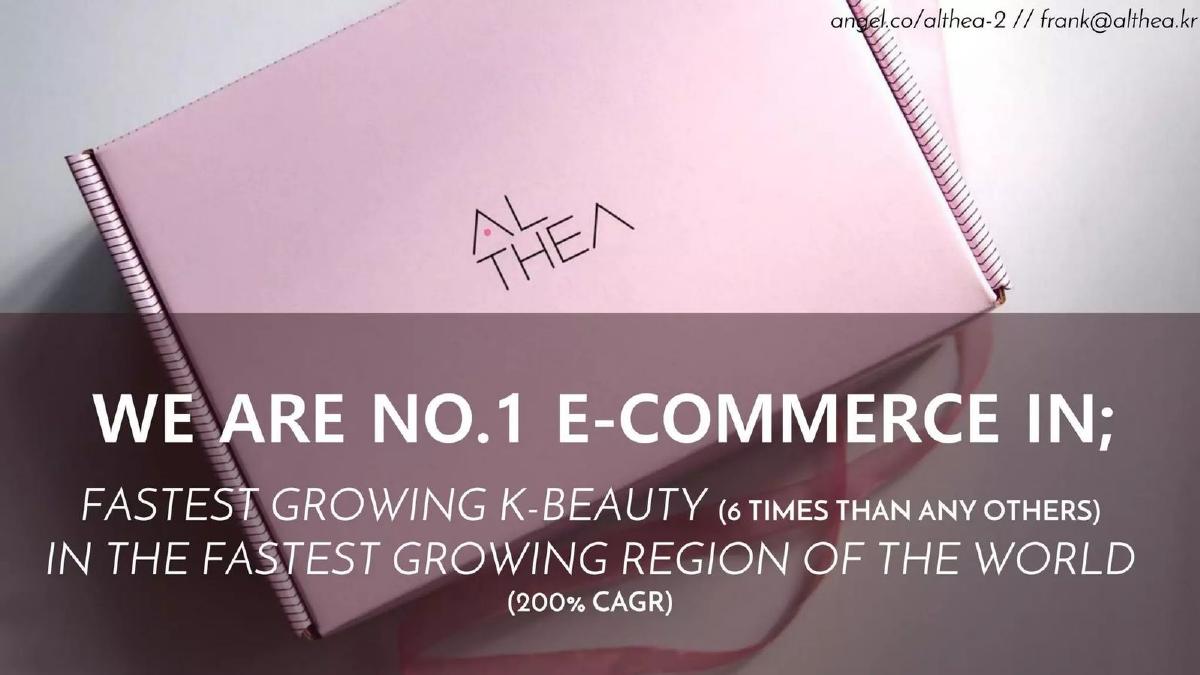
Slide 2: The Value Proposition Slide 2 is a text-heavy overlay on a product box. It introduces two critical numbers: Althea is growing "6 times than any others" and operates in a region with a "200% CAGR." By framing the business within the context of the "fastest growing region of the world," they make the investment seem like a macro-economic necessity rather than just a bet on a single company.
Slide 3: Social Proof Before showing a single internal metric, Althea uses slide 3 to showcase a Forbes quote from August 2016: "THIS YEAR-OLD STARTUP IS NOW SOUTHEAST ASIA’S LARGEST ONLINE KOREA BEAUTY MARKET." Using a third-party, reputable source to validate their "No. 1" claim is a powerful move that builds immediate trust with the investor.
The Core Metrics: The "Why Now" (Slides 4-6)
Slide 4: Revenue Scale Slide 4 is perhaps the simplest slide in the deck. Against a solid red background, it simply states: "$12 MILLION (ANNUALIZED SALES)." There is no fluff, no projections, and no complex charts. For a later-stage round, this is the number that matters most. It proves the business has moved past the experimental phase.
Slide 5: Unit Economics High revenue is meaningless if the margins are thin. Slide 5 addresses this by highlighting a "45%+ PRODUCT MARGIN." More importantly, it includes a parenthetical note: "(CAC PAYBACK PERIOD IN <5 MONTHS)." This is the "golden ratio" for e-commerce investors. It suggests that for every dollar spent on marketing, the company recovers the cost in less than two quarters, allowing for rapid, sustainable scaling.
Slide 6: Visualizing Momentum Slide 6 provides a bar chart showing sales from July 2015 to October 2016. The chart shows a clear, upward trajectory, supported by the text "20%+ (MOM SALES GROWTH)." The visual representation of the bars nearly quadrupling in height over 15 months reinforces the "fastest growing" narrative established in the earlier slides.
The Execution Engine: Team and Market (Slides 7-8)
Slide 7: The Veterans The team slide is titled "VETERANS." It features five key members: Frank Kang (CEO), Christopher Cynn (COO), Jae Kim (CFO), Tammy Lim (Head, Branding), and Hye Young Park (Head, Merchandizing). Below their photos are the logos for TMON, Memebox, and Groupon. This is a classic "pedigree" slide. It tells the investor that the leadership team has already worked at the biggest names in Asian e-commerce and beauty, implying they have the operational expertise to handle the growth shown on the previous slides.
Slide 8: Market Context Slide 8 uses a line graph to compare the growth of beauty markets in France, the US, Japan, and Korea from 2004 to 2020 (projected). The headline is "$15BN, 30% CAGR (6 TIMES FASTER THAN ANY OTHER COUNTRY)." The graph shows Korea's trajectory (the pink line) spiking sharply upward compared to the more mature, flatter growth of France and the US. This slide justifies why a beauty startup should focus specifically on Korean products.
The Summary (Slide 9)
Slide 9: The Closer The final slide returns to a blue background and summarizes the three most important points of the deck: $12M annualized sales, 45% product margins, and 20% MoM growth. It serves as a final reminder of the company's strength as the investor closes the presentation.
What Works in the Althea Deck
The primary strength of this deck is its extreme focus . Most founders feel the need to explain their technology, their warehouse logistics, and their customer personas. Althea ignores all of that to focus on the three things that move the needle for a growth-stage investor: Scale, Efficiency, and Velocity. By repeating the $12M, 45%, and 20% figures multiple times, they ensure these numbers are the only things the investor remembers.
The visual hierarchy is also excellent. The use of bold, white text on high-contrast backgrounds (red, blue, pink) makes the data points impossible to miss. The deck feels modern, clean, and confident. It doesn't look like a company that is begging for money; it looks like a company that is offering an opportunity to participate in an inevitable success.
What is Missing from the Althea Deck
While the minimalism is a strength, there are several glaring omissions that would typically be required in a fundraising process:
The Ask: There is no slide indicating how much money Althea is raising or what the specific terms are. While this information is often handled in a separate document or a verbal conversation, its absence makes the deck feel incomplete as a standalone fundraising tool. · Use of Funds: Even if the amount isn't stated, investors usually want to see a breakdown of how the capital will be deployed (e.g., 40% marketing, 30% geographic expansion, 30% hiring). · Competition: The deck claims to be "No. 1," but it doesn't mention who No. 2 or No. 3 are. A competitive matrix or a "Why Althea Wins" slide would have helped contextualize their market position. · Technology/Platform: For an e-commerce company, there is no mention of their tech stack, mobile app performance, or proprietary algorithms. This suggests Althea viewed themselves strictly as a retail/distribution play rather than a tech play.
What a Founder Should Copy
Founders should emulate Althea's data-driven storytelling . If you have great metrics, don't bury them on slide 14. Put them on slide 4 in 80-point font. Althea understands that investors are looking for reasons to say "no," and by leading with undeniable traction, they make it very difficult for an investor to dismiss them.
Another lesson is the use of parenthetical details . On slide 5, the mention of the "CAC payback period in <5 months" is a masterstroke. It’s a small detail that answers a massive question about the sustainability of the business model without requiring a dedicated slide for unit economics. It shows that the founders know exactly which metrics professional investors care about.
Finally, the Team Pedigree approach is highly effective. Instead of listing every job a founder has ever had, Althea just used the most recognizable logos. This creates an immediate association between the startup and established, successful companies. If your team has worked at name-brand firms, let the logos do the heavy lifting for you.
Conclusion
Althea’s deck is a reminder that the best pitch is often the simplest one. By focusing on a high-growth market (K-beauty), a high-growth region (Southeast Asia), and high-performance metrics ($12M sales, 45% margins), they created a compelling case for a $10.7 million investment in just nine slides. For startups with significant traction, this deck is a perfect example of how to cut through the noise and get straight to the deal.
Frequently asked questions
- Why does this deck skip the 'Problem' and 'Solution' slides?
- Althea likely assumed that by 2015, the global demand for Korean beauty (K-beauty) was a well-understood trend among regional investors. Instead of educating the investor on why K-beauty is popular, they focused entirely on their ability to capture that existing demand more efficiently than competitors, as evidenced by their $12 million in annualized sales and 20% monthly growth.
- Is a 9-slide deck enough to raise $10.7 million?
- While unusual, it is sufficient when the metrics are this strong. The deck functions more as a 'teaser' or a high-level summary intended to secure a meeting rather than a comprehensive due diligence document. The combination of high margins (45%) and fast CAC payback (<5 months) provides enough financial incentive for an investor to move to the next stage of the process.
- How does Althea define its market advantage in this deck?
- Althea defines its advantage through speed and regional focus. Slide 2 claims they are growing 6 times faster than others in a region with a 200% CAGR. Slide 8 further supports this by showing Korea's beauty export growth outperforming established markets like France, the US, and Japan, positioning Althea as the primary gateway for this growth in Southeast Asia.
- What role does the team play in a deck with so little text?
- The team slide (slide 7) is critical because it uses brand logos (TMON, Memebox, Groupon) to signal 'founder-market fit.' By labeling the founders as 'Veterans,' Althea tells investors that this isn't their first time scaling an e-commerce or beauty business, which reduces the perceived risk of the aggressive growth targets shown on other slides.
- What is the most important metric in the Althea deck?
- The most important metric is the combination of the 20% month-over-month growth (slide 6) and the 45% product margin (slide 5). High growth is common in e-commerce, but maintaining 45% margins while growing that fast suggests a very efficient supply chain and strong brand loyalty, which is what likely attracted the $10.7 million investment.