Altruist’s Series B deck is a concise, 10-slide narrative that prioritizes structural industry problems over raw data. By framing the current Registered Investment Advisor (RIA) ecosystem as a 'rent-seeking oligopoly' on slide 4, the company sets the stage for its vertically integrated solution. The deck successfully positions Altruist as the 'best of both worlds' between traditional custodians like Fidelity and robo-advisors like Betterment (slide 9). While it lacks common Series B metrics such as revenue growth, churn, or CAC/LTV, it leans heavily on the founder's previous success—citing a…
Key takeaways
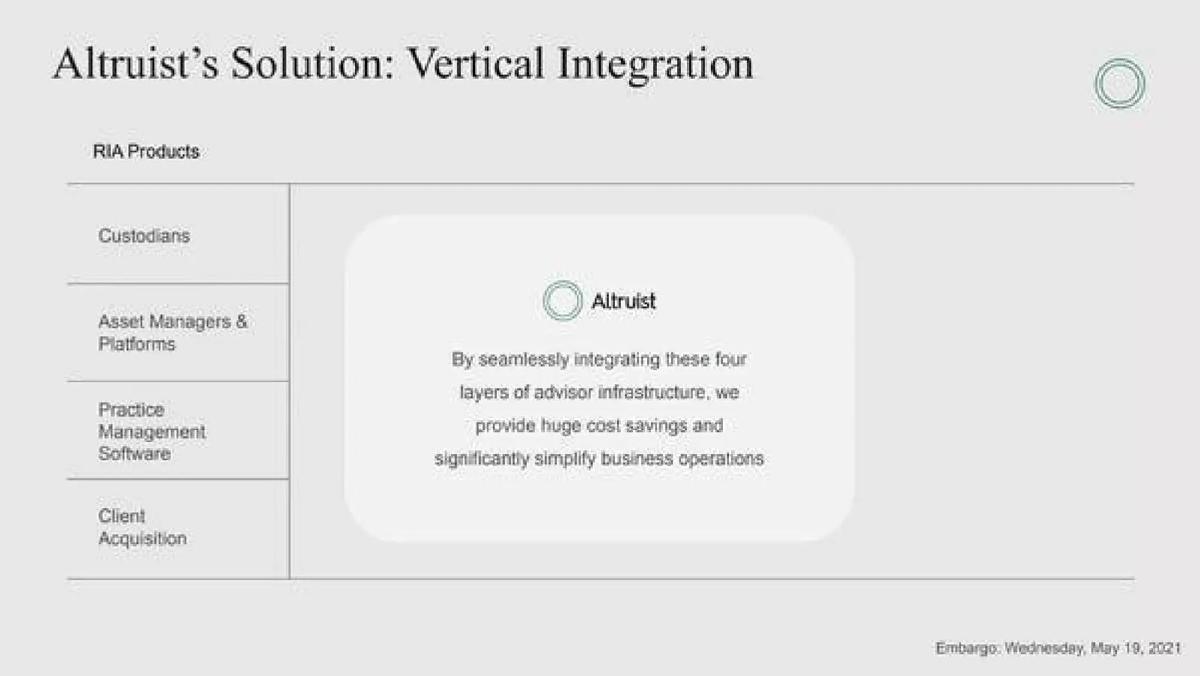
- The deck identifies four distinct layers of advisor infrastructure—Custodians, Asset Managers, Practice Management, and Client Acquisition—that it aims to consolidate (slide 5).
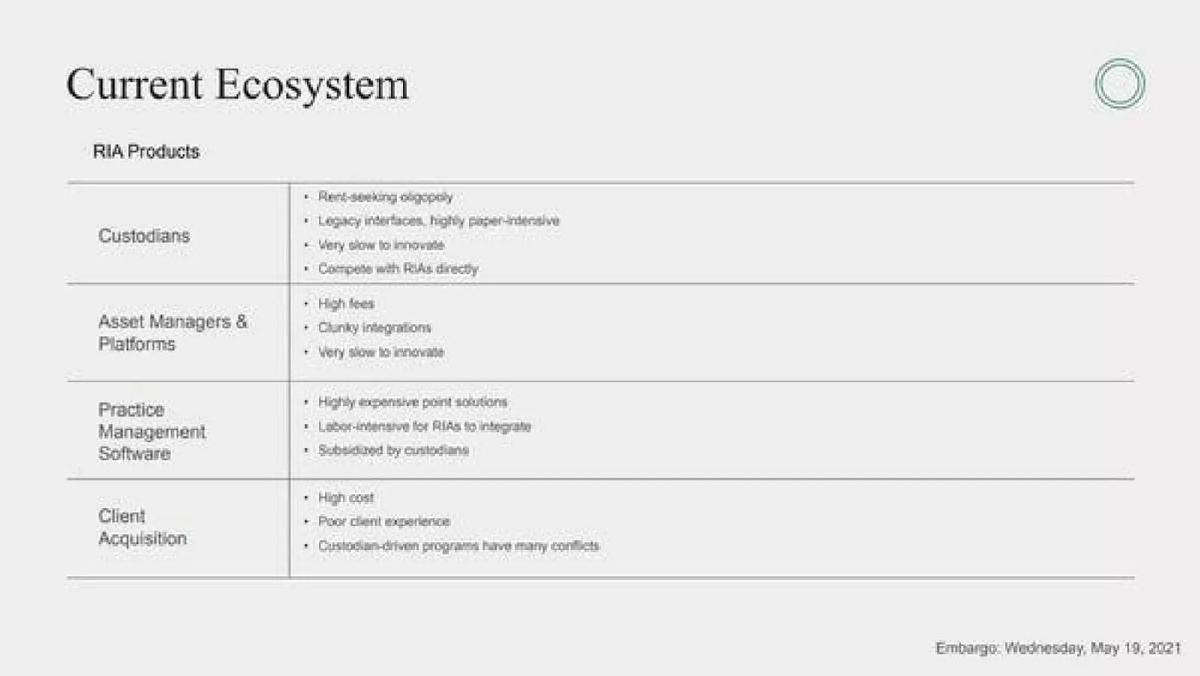
- Altruist labels the existing custodian market as a 'rent-seeking oligopoly' that is 'very slow to innovate' (slide 4).
- Founder Jason Wenk’s track record is a central pillar of the pitch, noting he previously led a firm to a 13,927% 3-year growth rate and $3.2 billion in AUM (slide 7).
- The product is positioned as a 100% digital, out-of-the-box solution to eliminate paperwork and radically lower costs (slide 3).
- The deck explicitly names competitors like Fidelity, Charles Schwab, and TD Ameritrade, critiquing them for being 'robust but not user-friendly' (slide 9).
- Altruist differentiates itself from robo-advisors by stating it 'does not compete with advisor' but rather partners with them (slide 9).
- The deck omits all financial projections, current revenue figures, and specific user growth metrics, functioning more as a strategic overview than a data room.
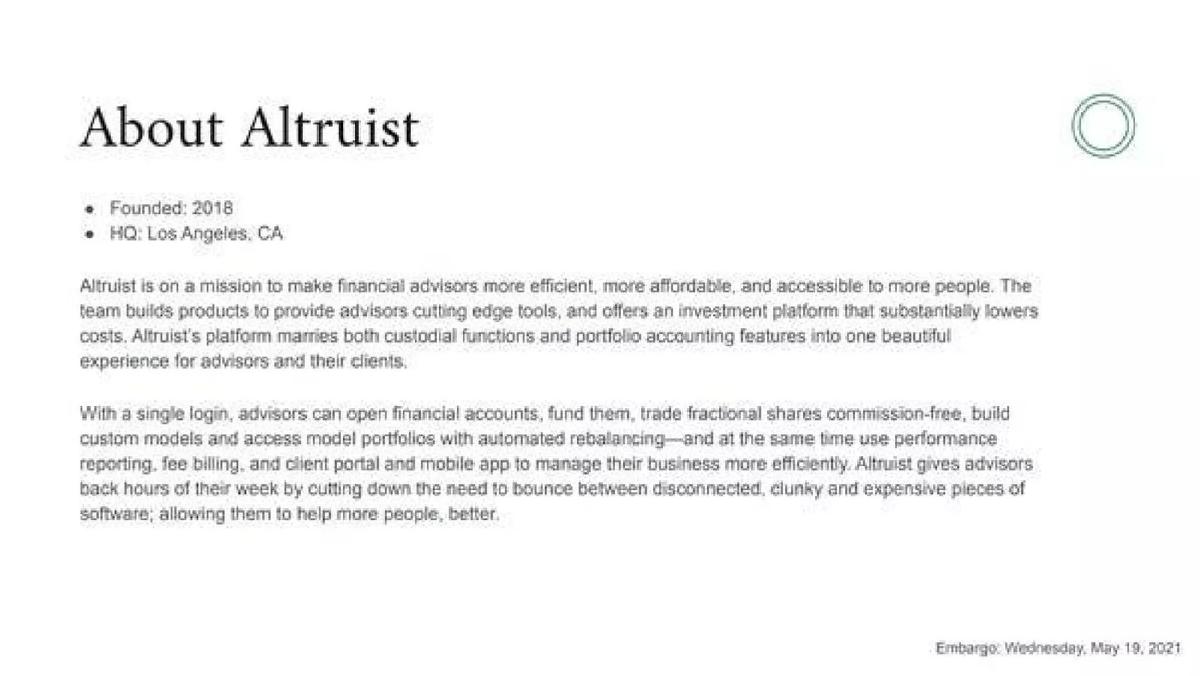
- The technical value proposition includes fractional trading, automated rebalancing, and flexible fee billing within a single login (slide 6).
The Strategy of Simplification
Altruist’s Series B deck, dated May 19, 2021, is a study in narrative-driven fundraising. At a stage where most companies are drowning in spreadsheets, Altruist opted for a high-level 'Briefing Deck' that focuses on the structural rot of the financial services industry. The company, founded in 2018 in Venice Beach, used these 10 slides to help secure $58.5 million by positioning itself not just as a software tool, but as a new category of infrastructure.
Slides 1-3: The Mission and The Hook
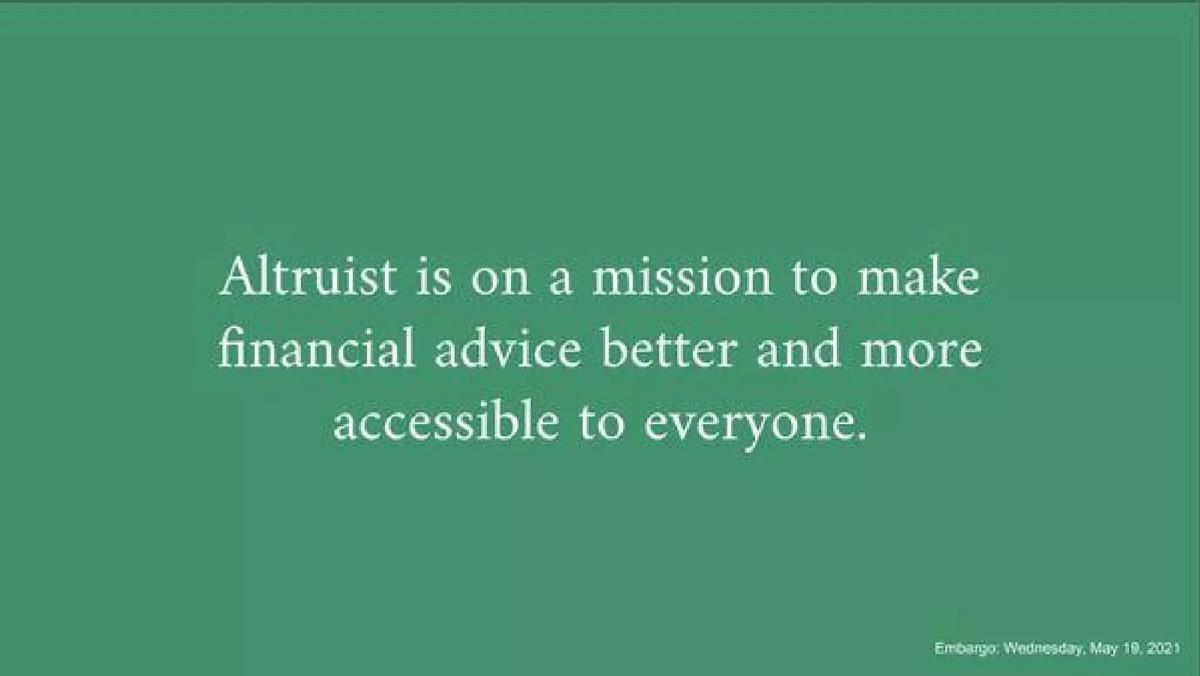
The deck opens with a minimalist title slide (Slide 1) and immediately moves to a mission statement on Slide 2: 'Altruist is on a mission to make financial advice better and more accessible to everyone.' This is a classic 'big vision' opening that avoids technical jargon in favor of a broad social benefit.
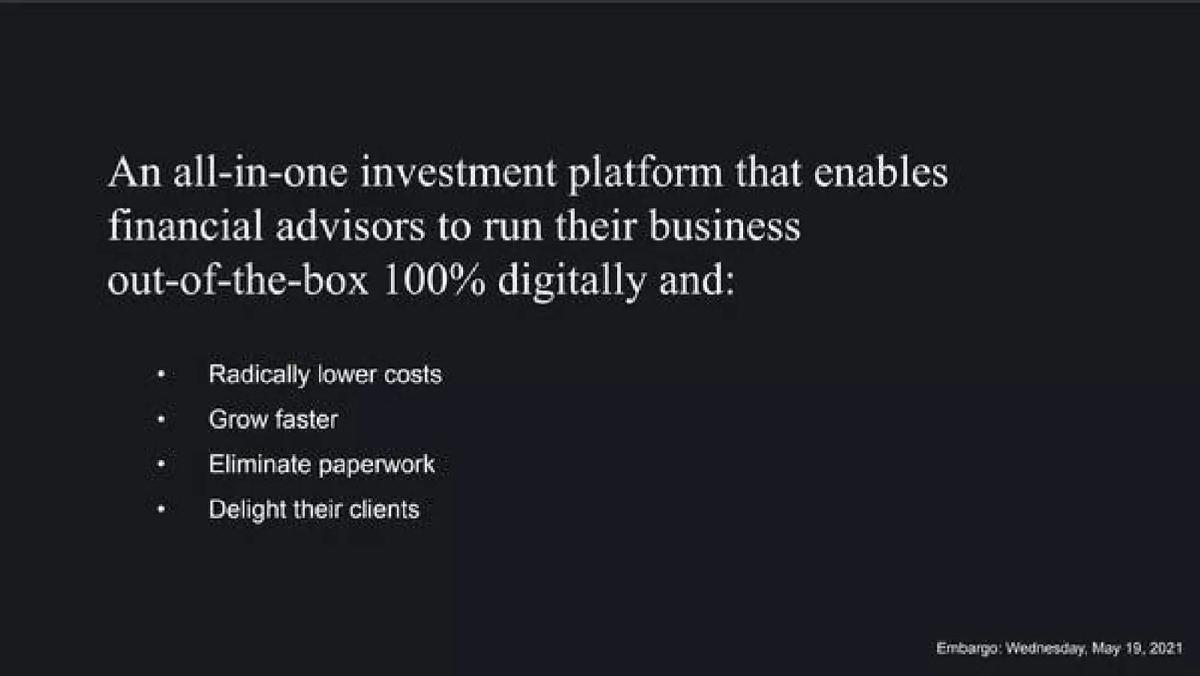
Slide 3 defines the product category: 'An all-in-one investment platform that enables financial advisors to run their business out-of-the-box 100% digitally.' It lists four primary value drivers: radically lower costs, faster growth, elimination of paperwork, and client delight. By leading with 'radically lower costs,' Altruist signals that its primary disruption is economic, not just aesthetic.
Slides 4-5: The Problem of the 'Rent-Seeking Oligopoly'
Slide 4, titled 'Current Ecosystem,' is the most aggressive slide in the deck. It breaks the RIA (Registered Investment Advisor) product market into four buckets: Custodians, Asset Managers, Practice Management Software, and Client Acquisition. It describes the incumbents as a 'rent-seeking oligopoly' with 'legacy interfaces' that are 'highly paper-intensive.' This slide is designed to create a sense of urgency and frustration in the investor, highlighting that the current system is built on 'clunky integrations' and 'expensive point solutions.'
Slide 5 provides the 'Altruist Solution: Vertical Integration.' It uses the same four-bucket framework from the previous slide but shows Altruist encompassing all of them. The text claims that by 'seamlessly integrating these four layers of advisor infrastructure,' the company provides 'huge cost savings.' This is the core thesis of the Series B: Altruist is building a full-stack replacement for the fragmented legacy market.
Slides 6-7: The 'Why Now' and The 'Who'
Slide 6, 'About Altruist,' provides the company's origin details (Founded 2018, HQ in Los Angeles) and elaborates on the product's capabilities. It mentions 'fractional shares commission-free,' 'automated rebalancing,' and 'performance reporting.' The key phrase here is 'single login,' which addresses the 'clunky' problem identified in Slide 4.
Slide 7 introduces the 'Executive Team.' While it lists several VPs, the focus is squarely on CEO and Founder Jason Wenk. The slide includes a detailed bio noting his 20 years in the industry and his previous success with FormulaFolios. The inclusion of specific metrics—a '13,927% 3-year growth rate' and '$3.2 billion' in assets managed—is crucial. It tells investors that the founder knows how to scale in this specific, highly regulated niche.
Slides 8-9: Product Specifics and Competitive Landscape
Slide 8, 'Product Features,' reiterates the technical advantages: digital account opening in minutes, flexible fee billing, and a modern technology stack 'unencumbered by legacy tools.' This slide acts as a checklist for the '100% digital' promise made earlier in the deck.
Slide 9 is a competitive matrix that compares Altruist to two groups: 'Advisor solutions' (Fidelity, Charles Schwab, TD Ameritrade) and 'Robo advisors' (Wealthfront, Betterment, Wealthsimple). Altruist positions itself as 'The best of both.' It claims to offer the 'advisor relationship' of the traditional players with the 'user-friendly' and 'affordable' nature of the robos. Crucially, it notes that unlike robos, Altruist 'does not compete with advisor,' which is a major selling point for the B2B customer base.
Slide 10: The Conclusion
The deck ends on Slide 10 with a simple 'Thank you' and a contact email. The footer contains a dense legal disclaimer regarding Altruist Financial LLC’s status as an SEC registered investment adviser and member of FINRA/SIPC. This is a subtle but important reminder that the company has already cleared the significant regulatory hurdles required to operate as a custodian and broker-dealer.
What Works in This Deck
The Vertical Integration Narrative: The deck does an excellent job of explaining why a 'unified' solution is better than 'point solutions.' By showing the four layers of the industry and then showing Altruist covering all of them, the complexity of the fintech stack is simplified into a single, compelling graphic.
Founder-Market Fit: The specific mention of the 13,927% growth rate at the founder's previous firm is a powerful 'de-risking' mechanism. For a Series B, investors want to know that the leadership can handle the transition from 'product-market fit' to 'aggressive scaling.'
Aggressive Positioning: Calling the incumbents a 'rent-seeking oligopoly' is a bold move that clearly defines Altruist as the disruptive underdog. It gives the company a clear 'enemy' and a reason to exist beyond just being 'better software.'
What is Missing from This Deck
Revenue and AUM Growth: For a Series B deck, the total absence of Altruist’s own growth metrics is surprising. There is no mention of current Assets Under Management (AUM), the number of advisors on the platform, or monthly recurring revenue (MRR). While this information was likely in the full data room, its absence here makes the deck feel more like a Series A or Seed pitch.
Unit Economics: There is no mention of Customer Acquisition Cost (CAC) or Lifetime Value (LTV). In the RIA space, where sales cycles can be long, investors typically want to see how efficiently the company is acquiring new advisor firms.
The 'Ask': The deck does not state how much money is being raised or how the funds will be used. While the catalogue confirms a $58.5M raise, the deck itself is silent on the terms or the roadmap for the capital.
What a Founder Should Copy
The 'Best of Both' Comparison: If you are entering a market with two distinct types of competitors (e.g., legacy giants vs. modern niche players), use Slide 9’s format. By listing the pros and cons of both groups and then showing how you combine the pros of both, you create a unique 'category of one.'
The Problem/Solution Framework: Use the 'Current Ecosystem' vs. 'Our Solution' layout from Slides 4 and 5. It is a highly visual way to show how your product replaces multiple line items in a customer's budget, which is the strongest argument for 'ROI' you can make.
Minimalist Design: The deck uses a clean, consistent color palette and avoids cluttered slides. This forces the reader to focus on the narrative rather than getting lost in small-font charts. For a 'briefing deck,' this is the correct approach.
Frequently asked questions
- Why does a Series B deck have so few slides?
- This is labeled as a 'Briefing Deck' (slide 1), which suggests it was used as a high-level introduction or a leave-behind for a specific announcement rather than the full due diligence deck. In later stages, founders often use a narrative deck to secure the first meeting and a separate, data-heavy deck for the actual partnership review.
- How does Altruist justify its competitive advantage against giants like Fidelity?
- Altruist uses a 'Vertical Integration' argument (slide 5). They claim that by owning the entire stack—from the custodian level to the client portal—they can eliminate the 'clunky integrations' and 'high fees' associated with legacy players who rely on disconnected point solutions.
- What is the significance of the founder's previous company in this deck?
- Slide 7 highlights Jason Wenk’s success with FormulaFolios, which reached #10 on the Inc. 5000 list. This provides 'social proof' and de-risks the investment by showing the founder has successfully scaled a multi-billion dollar AUM business in the exact same sector before.
- What are the specific product features mentioned?
- According to slide 8, the platform includes a modern UI, digital account opening/funding in minutes, commission-free fractional trading, automated rebalancing, performance reporting, and flexible fee billing. The goal is to provide a 'single login' experience for the advisor.
- Who is the primary target customer for Altruist?
- The deck focuses on 'fiduciary financial advisors' and 'independent financial advice' (slide 6 and catalogue). It specifically targets RIAs who are currently frustrated by the 'paper-intensive' and 'expensive' nature of traditional custodial relationships.