A 'Series B' Deck Written for Reporters: Altruist's
A whole-deck walkthrough of Altruist's 2021 Series B briefing deck, made for the press under an embargo. Its only metric belongs to the CEO's previous company.
A 'Series B' Deck Written for Reporters: Altruist's Briefing Deck
Many decks that circulate online as 'pitch decks' were never shown to investors. Altruist's 10-page deck, for an investment platform used by financial advisors, says 'Series B' on its cover, but every page carries 'Embargo: Wednesday, May 19, 2021' and the last page gives a public relations agency's email address. It was written for reporters covering a funding announcement. Read as a pitch, it contains almost no evidence: the only performance figures in it describe the CEO's previous company. We read the deck page by page and show what a briefing deck is built to do, and what an investor deck would have to add.
TL;DR
Altruist's deck is a press briefing deck. Every page carries a 'May 19, 2021' embargo line, and page 10 lists a contact address at a PR agency's domain. It states no customers, no assets on the platform, no revenue, no growth rate, no price and no amount raised.
The only metrics are on page 7, and they belong to the CEO's previous company: 'a 13,927% 3-year growth rate', 'over $3.2 billion' managed, and an Inc. magazine ranking. They show the founder's track record, not Altruist's progress.
The lesson for founders: a briefing deck and a pitch deck answer different questions. If you reuse press materials with investors, add the numbers a reporter's deck leaves out, and say whose numbers each one is.
The deck page by page, as a reader would meet it
Six pages from Altruist's briefing deck, from the cover to the competition.
Altruist executive summary slide — slide 1
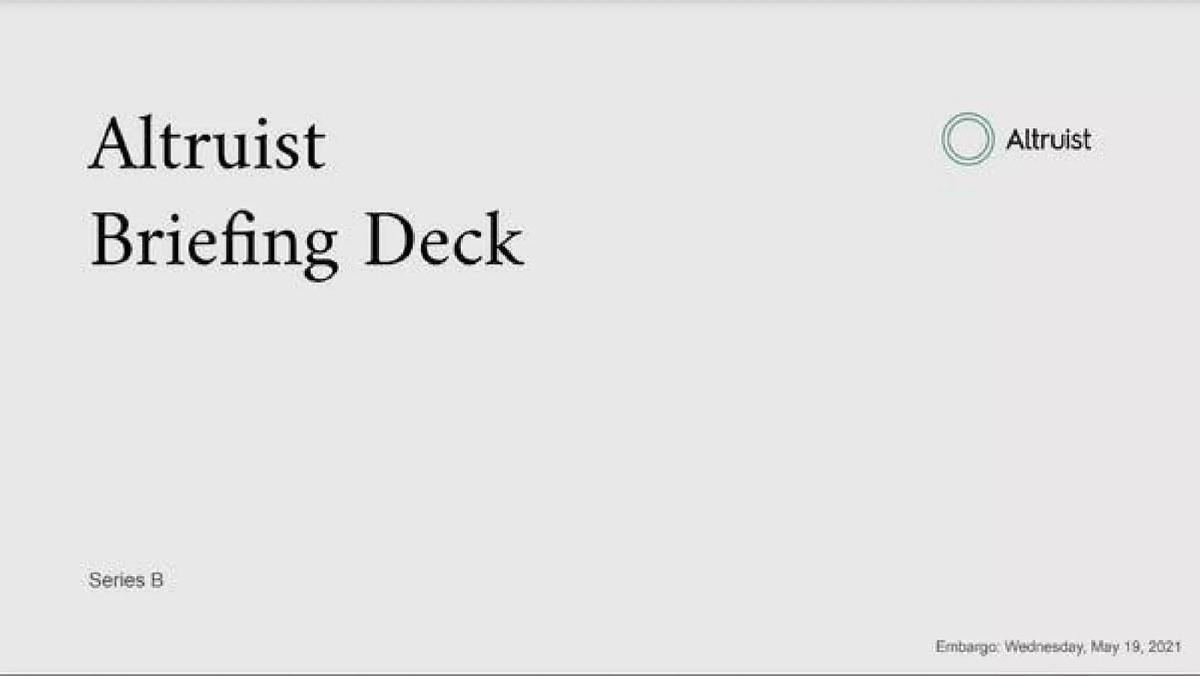
Investment platform for financial advisors. Cover.
Altruist deck, slide 1. Exact stored slide matched to this analysis.
Our analysis: Our reading: the audience is reporters, not investors.
Evidence and limitation: Title and embargo identify a press briefing.
What a founder can adapt: Make the audience clear on the cover.
Supporting analysis
What the deck claims: 'Altruist Briefing Deck', 'Series B', embargo line dated May 19, 2021.
Presentation choice: Who a deck is for explains what it leaves out.
When it does not fit: Don't send a press deck to investors unchanged.
Every figure and benefit in the deck, with whom it describes.
Page
Claim
Figure given
Describes
3
Lower costs, faster growth
None
Altruist (promised)
5
'Huge cost savings'
None
Altruist (promised)
6
Founded, headquarters
2018, Los Angeles
Altruist
7
Growth rate
13,927% over 3 years
CEO's previous company
7
Assets managed
Over $3.2 billion
CEO's previous company
9
Price position
'Affordable'
Altruist (described)
Key Takeaways
Know who a deck was written for.
Press decks tell the story; pitch decks prove it.
Label a founder's past results as past.
A percentage needs a starting point.
A comparison table needs at least one number.
Check a press deck before investors see it
Answer these before reusing announcement materials in a pitch.
Audience. Are embargo lines and press contacts removed?
Traction. Is there a page with your own customers and growth?
Ownership. Is every past-company figure named and dated?
Benefits. Does each claimed benefit have a number?
Price. Is your price stated next to any cost claim?
Copyable framework: [n] advisors manage $[n] on the platform, up [n]% in [period]. Price: $[n] per [unit]. Typical advisor saves $[n] a year.
Illustrative example 1 — written by us
Before: 'By seamlessly integrating these four layers of advisor infrastructure, we provide huge cost savings.'
After: One platform replaces four layers; a typical advisor's costs fall from $[n] to $[n] a year ([source]).
What improved: Our illustrative rewrite. The first clause follows page 5; bracketed values are placeholders, not Altruist's figures. It turns 'huge' into a number a reader can check.
The question this guide answers
Our teardown of this deck praises its vertical integration story. No guide uses this deck. Other drafts cover decks whose numbers belong to a parent or sister company, and decks built around a product demo. This walkthrough asks a different question: what happens when a deck written for the press is read as a deck written for investors? Founders face this whenever an announcement deck, a briefing pack or a public summary gets passed around as 'the pitch deck'.
How we read the deck
We rendered all 10 pages of the original file in our library and read them on a contact sheet at about 600 pixels per page; pages 7 and 9 were also read at full size. Our library lists PitchDeckHunt as the source. Page 1 reads 'Altruist Briefing Deck' and 'Series B'. Every page carries the embargo line 'Embargo: Wednesday, May 19, 2021', which dates it. Page 7 names the executive team and shows a photo of the CEO; we don't name them or reproduce that page.
The deck states no amount raised and no investors. We make no claim about the round's size, about whether the deck played any part in it, or about the company since. We report the deck's claims as written and do not check them.
Step one: who the deck is for
Page 1 is titled 'Briefing Deck'. The embargo line on every page tells a reader not to publish before a set date, which is how companies brief journalists ahead of an announcement. Page 10 says 'Thank you.', gives an address at the domain clarity.pr, and adds regulatory small print about which Altruist entities provide which services.
Our reading: these three signals together say the audience is the press. That explains much of what follows. A reporter needs a mission, a plain description, a team and a sense of the competition; a reporter doesn't need unit economics. None of that is a fault in a briefing deck. It becomes a gap only when the deck is read as the case for investment.
Step two: mission and product
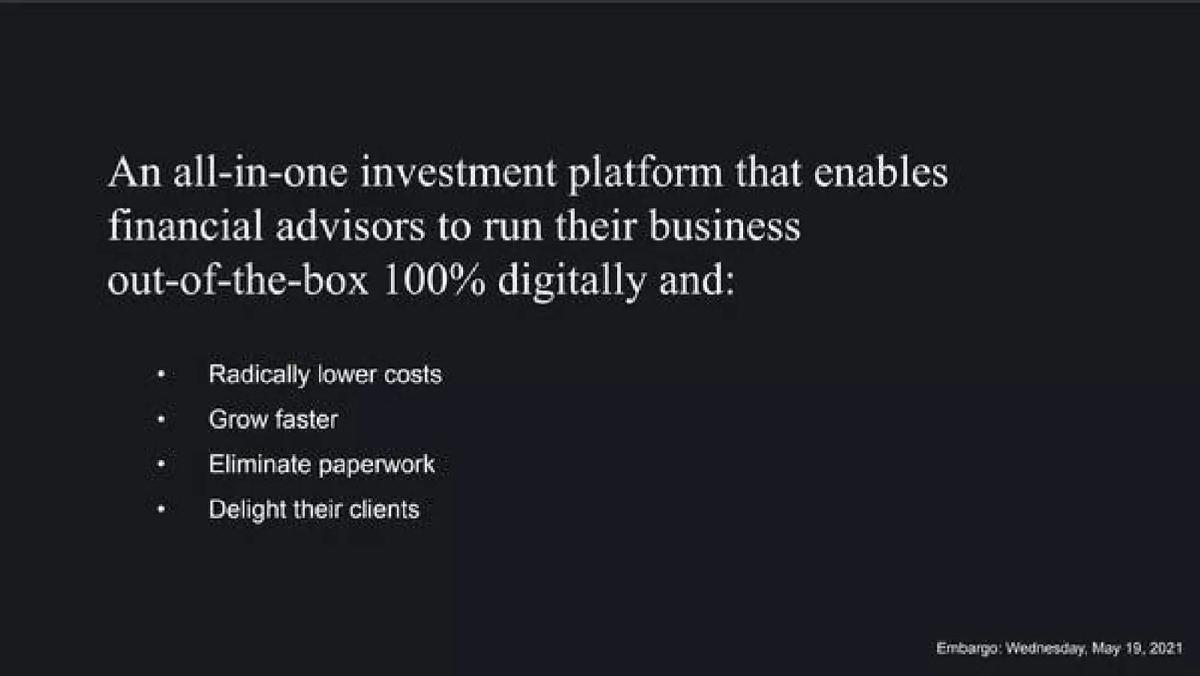
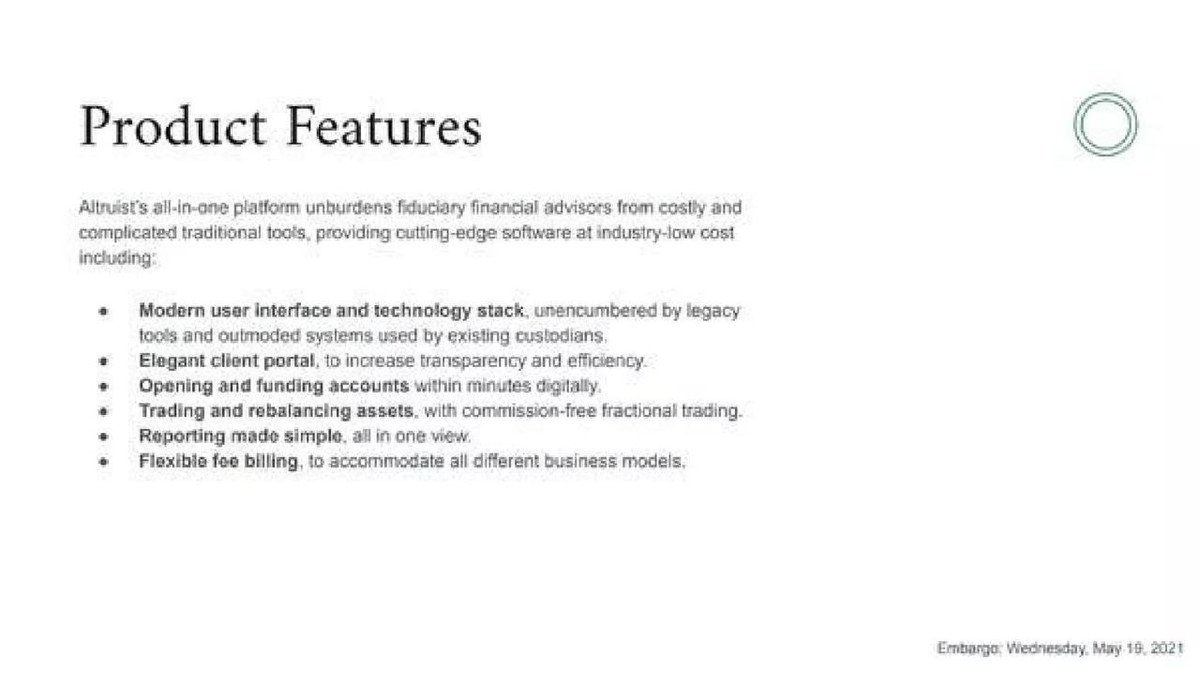
Page 2 states the mission: 'to make financial advice better and more accessible to everyone.' Page 3 describes 'An all-in-one investment platform that enables financial advisors to run their business out-of-the-box 100% digitally' with four results: 'Radically lower costs', 'Grow faster', 'Eliminate paperwork', 'Delight their clients'. Page 6 adds 'Founded: 2018' and 'HQ: Los Angeles, CA', with two paragraphs describing the platform. Page 8 lists six product features.
Our reading: the description is clear and consistent across pages. Each of page 3's four results is a measurable claim, though. 'Radically lower costs' could be stated as dollars saved per advisor per year, and 'grow faster' as a growth rate for advisors on the platform. The deck states none of them, so a reader learns what Altruist promises, not what it has delivered.
Step three: the market structure
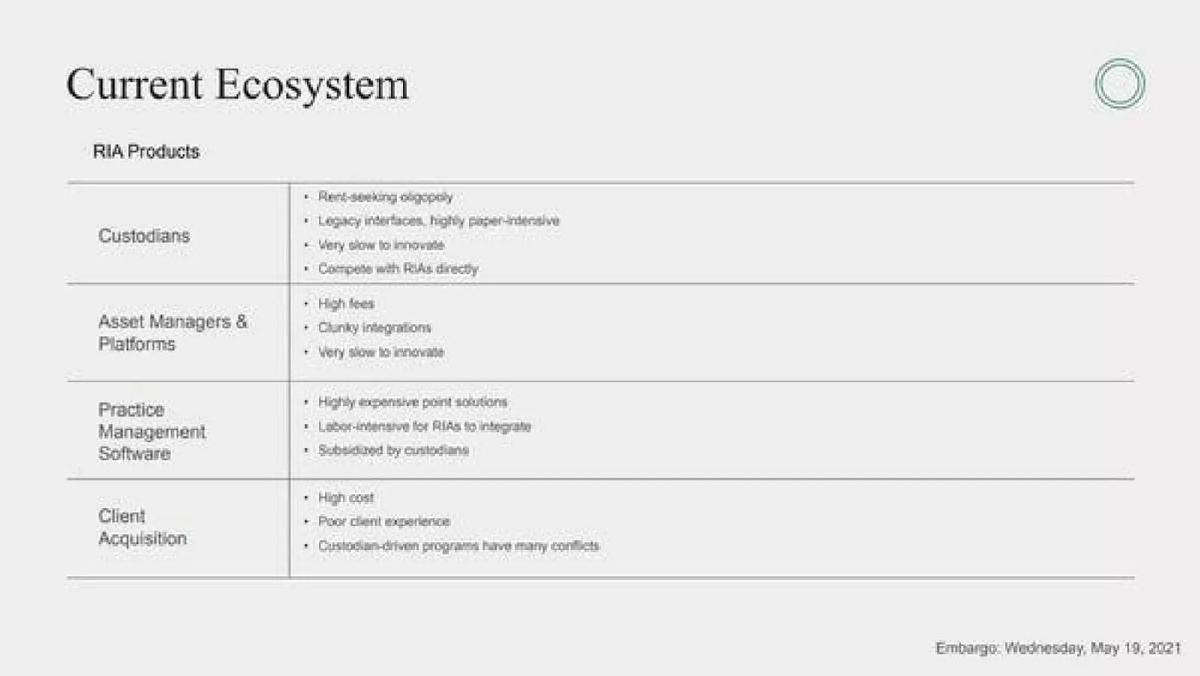
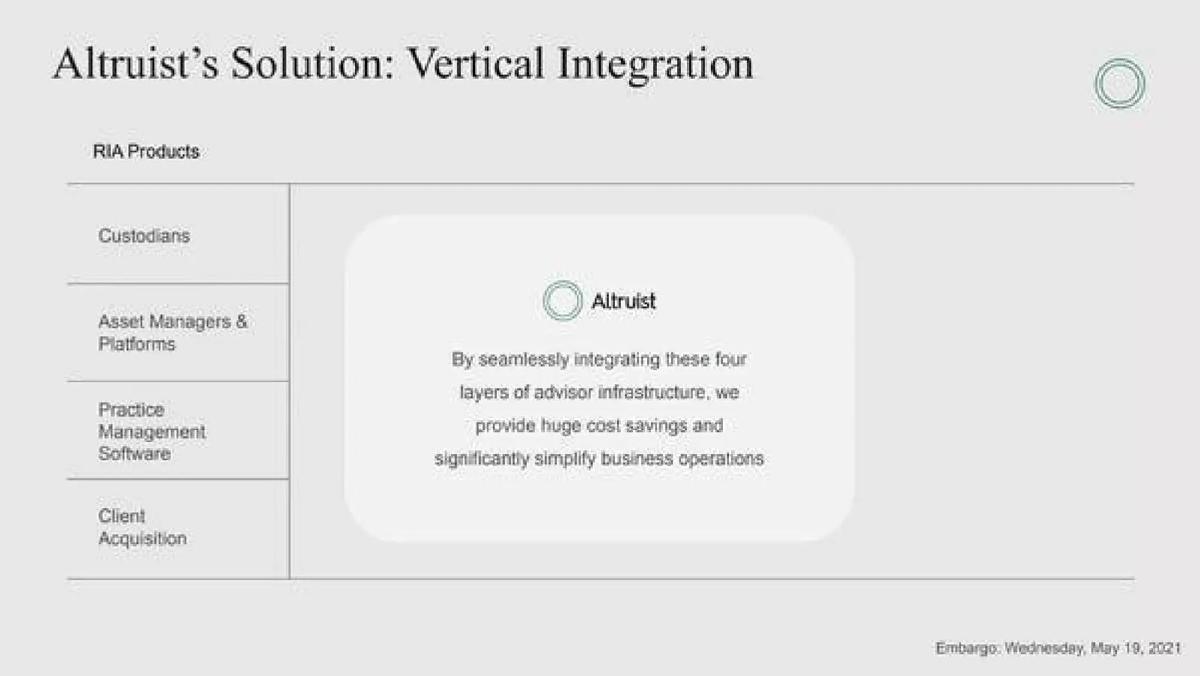
Page 4, 'Current Ecosystem', lists four layers of products for registered investment advisors (RIAs): custodians, asset managers and platforms, practice management software, and client acquisition. Each has short complaints such as 'Rent-seeking oligopoly', 'High fees', 'Highly expensive point solutions' and 'High cost'. Page 5, 'Altruist's Solution: Vertical Integration', shows the same four layers with one Altruist box beside them: 'By seamlessly integrating these four layers of advisor infrastructure, we provide huge cost savings and significantly simplify business operations.'
Our reading: the two pages work as a pair and make the deck's strongest argument, which our teardown also highlights. But every complaint is about cost, and no cost appears anywhere: not what an advisor pays today across the four layers, not what Altruist charges, not the size of the 'huge cost savings'. The deck also gives no count of advisors or firms, so there is no market size at all.
Step four: the only numbers belong to another company
Page 7, 'Executive Team', describes the CEO's 20 years in financial services and his previous company. It says that company 'achieved a 13,927% 3-year growth rate and managed over $3.2 billion', and was ranked by Inc. magazine as a fastest-growing private company '4 years in a row, reaching as high as #10'. Eight other executives are listed by name and title, with a link to biographies.
Our reading: these are the only performance figures in the deck, and they are about a different firm. They are clearly labelled, which is the right thing to do, but a reader skimming for numbers will find them and nothing else. The growth rate also has no starting point: 13,927% means the measure ended about 140 times where it began (our arithmetic), which could be large or small depending on the base, and the deck doesn't say what was measured. The $3.2 billion is assets that firm managed, not Altruist's. Track record is legitimate evidence about a team; it isn't evidence about this company's traction.
Step five: a comparison with no numbers
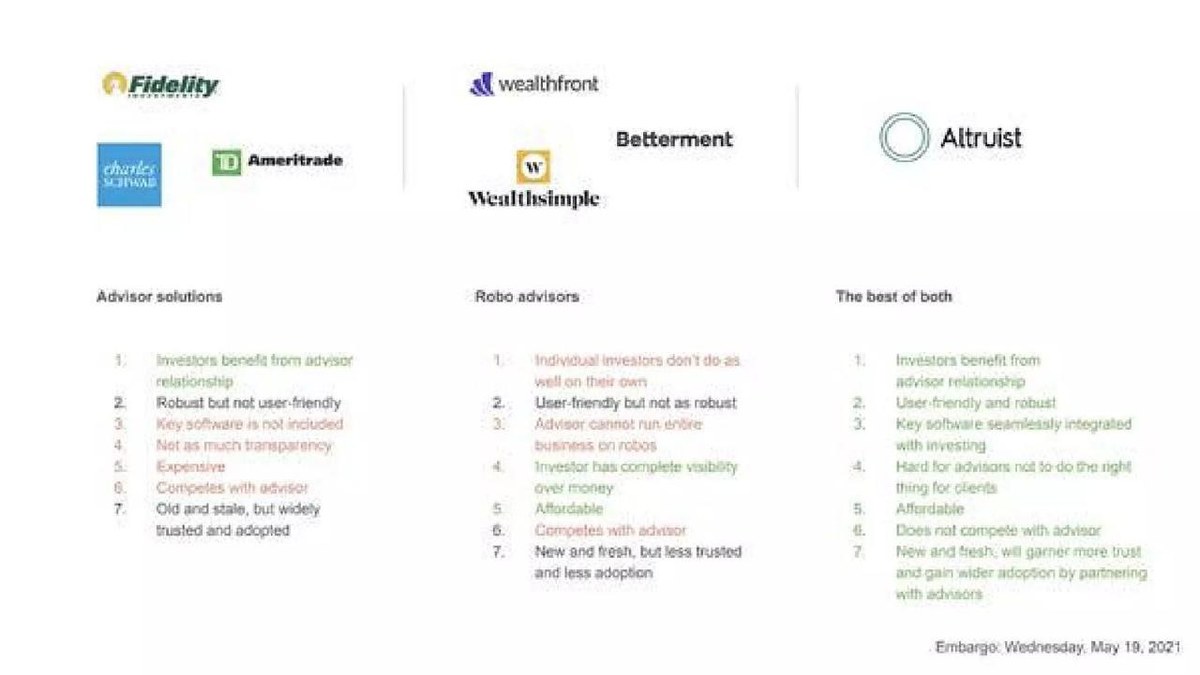
Page 9 sets three columns side by side: 'Advisor solutions' (logos of Fidelity, Charles Schwab and TD Ameritrade), 'Robo advisors' (Wealthfront, Betterment and Wealthsimple) and Altruist as 'The best of both'. Each column has seven numbered points, coloured green for strengths, red for weaknesses and black for mixed points such as 'Robust but not user-friendly'. Altruist's seven are all green, including 'Affordable', 'User-friendly and robust' and 'Does not compete with advisor'.
Our reading: the table is easy to follow and names real competitors, which many decks avoid. But 'Affordable' and 'Expensive' are the only price comparison, and no column carries a figure. Altruist's own column is all strengths and describes the product's design, not its results. A reader can't tell from the deck how much cheaper Altruist is, or for which advisors.
What a briefing deck is for
A press deck gives a reporter what's needed to write an accurate story on announcement day: who the company is, what it does, why it matters, who runs it and who it competes with. Companies often keep revenue and customer numbers out of it on purpose, because anything in it may be printed. Altruist's deck does that job tidily.
An investor deck has to do something else: show that the business is working and will keep working. That needs the numbers this deck leaves out, such as how many advisors use the platform, how much money they manage on it, how fast that is growing, what Altruist charges and what it costs to win an advisor. A copy of the press deck, passed to investors unchanged, would leave every one of those questions open.
What an investor would ask next
Five questions follow from these pages. How many advisors and firms use Altruist, and how much in client assets sits on the platform? How fast are those numbers growing? What does Altruist charge, and how much does a typical advisor save compared with the four layers on page 4? What does it cost to win an advisor, and how many stay? And what will the Series B money be spent on? Each answer would turn a description into evidence. None of them requires giving up the story the deck tells well; each one simply attaches a measured result to a claim the deck already makes, so the narrative and the evidence support each other.
What the deck proves, and what it leaves open
Shown: a clear mission, a consistent product description, a well-argued market structure across pages 4 and 5, named competitors on page 9, a full executive team and the CEO's labelled track record. Left open: customers, assets on the platform, revenue, growth, price, savings per advisor, acquisition cost, retention, the amount raised and its use.
Turning a press deck into an investor deck
Keep what works: the mission, the plain description and the before-and-after structure of pages 4 and 5. Then add, for every claimed benefit, the figure behind it: the savings in dollars, the growth rate with its starting point and period. Put your own traction on its own page, separate from any team track record, and label past-company results with the company's name and dates. Add your price, and one number to each comparison row you can support. Finally, remove embargo lines and press contacts so the reader knows the document was prepared for them.
Common mistakes
Press deck sent as pitch. Add the evidence investors need.
Past company's numbers only. Show your own traction separately.
Percentage without a base. State what was measured and from where.
Cost argument, no cost. Give today's cost and yours.
All-green comparison. Add figures and honest trade-offs.
Diagnostic checklist
The deck is prepared for its actual audience.
Your own traction has its own page.
Past-company results are named and dated.
Each growth figure has a starting point.
Each benefit claim has a number.
Your price is stated.
Frequently asked questions
What is a briefing deck?
A deck prepared for journalists ahead of an announcement. Altruist's is titled 'Briefing Deck' and carries an embargo date on every page.
Is Altruist's deck a pitch deck?
It says 'Series B' on the cover, but its embargo line and PR contact show it was written for the press. We can't say what investors saw.
What numbers does the deck give about Altruist?
Only its founding year, 2018, and its Los Angeles headquarters. It gives no customers, assets, revenue, growth or price.
What does the 13,927% figure describe?
The 3-year growth rate of the CEO's previous company, per page 7. It doesn't say what was measured or from what starting point.
Can I reuse a press deck with investors?
Yes, as a starting point. Keep the story, add your traction, price and savings figures, and remove embargo lines and press contacts.
How we chose these examples
Selection (2026-10-02): the Altruist deck is unused by any guide. Other drafts cover numbers that belong to sister or parent companies and decks led by product demos; no guide examines a press briefing deck read as an investor deck.
All 10 pages of the original deck file were rendered at 1280 px wide and read on a contact sheet at about 600 px per page; pages 7 and 9 were also read at full size (AI editorial model review, not human). Six images are used: pages 1, 3, 4, 5, 8 and 9 were stored for this draft on 2026-10-02 from the renders. Page 7, which shows a photo of the CEO, is not reproduced.
The 140-times figure is our arithmetic from the deck's 13,927%. No Altruist customer, asset, revenue or funding figure is estimated, and the deck's claims are not independently checked.
Eligibility: private startup deck, already in our library with an existing teardown; no takedown request is recorded. Executives are not named. No funding or outcome claim is made.