PatientSchedulingApp, incorporated in March 2016, proposes a dynamic appointment management system specifically designed to reduce hospital waiting times. The company’s strategy relies on a 'zero cost to hospital' model, where revenue is generated via a 3.7p micro-payment per patient journey under five-year contracts. Uniquely, the solution requires patients to use provided Android tablets rather than their own devices to ensure security and integration with internal wayfinding systems. With £238,980 already invested as of April 2017, the deck forecasts £1.7m in sales by year three. While the…
Key takeaways
- The company was incorporated on March 29, 2016, and had invested £238,980 by the time of the April 2017 presentation (Slide 6).
- The business model is based on a micro-payment of 3.7p per patient journey, targeting an average annual income of £48,456 per hospital (Slide 31).
- Unlike most modern apps, patients cannot download the software to their own devices; they are issued a 'basic Android device' upon arrival (Slide 16).
- Revenue projections estimate £1.7m in sales within three years, predicated on signing 50 hospitals (Slide 6).
- The product includes five core components: Wayfinding, Tablet Devices, Scheduling Software, PaaS system, and 24-hour support (Slide 16).
- The Board of Directors includes clinical expertise from Dr. Torsten Beutlhauser, a lead consultant at The Royal Marsden Hospital (Slide 36).
- The deck lists significant technical and clinical partners including Microsoft, Neofonie Mobile, and The Charite Hospital in Berlin (Slide 6, 41).
- Financial modeling assumes an average annual gross margin of £16,370 per hospital against an annual cost of £32,068 (Slide 31).
Executive Summary and Corporate Status
Slide 1: Title Slide
The presentation is titled "Patient Scheduling App - Investor Presentation." It is dated April 2017 and lists D. Andrew J. Grant and Colin Coffey (CDir FIoD) as the primary contacts. The visual theme uses a green network/node graphic, suggesting connectivity and technology integration.
Slide 6: Company Overview and Traction
This slide provides the foundational business facts. PatientSchedulingApp Ltd was incorporated on March 29, 2016 (Company number SC530799). The company reports having invested £238,980 over the 24 months preceding the deck. It lists a panel of partners including TechAdVenture, The Royal Marsden NHS Trust, The Charite Hospital in Berlin, Microsoft, Neofonie Mobile GmbH, Polestar, and Scottish Enterprise. The financial forecast stated is £1.7m in sales within three years, based on acquiring 50 hospitals and generating a profit of £603,000 .
Vision and Product Mechanics
Slide 11: The Vision
The company defines its short-term objective as building loyalty and trust through basic admin functions. The long-term vision involves managing the end-to-end patient journey. This includes accessing records via mobile for first responders, allowing patients to choose appointment slots, and enabling employers to book out-of-hours appointments. The slide also mentions data utility for management, from "Ward Sisters to national governments," to track treatment costs and resource allocation.
Slide 16: The Product Components
The product is described as a dynamic appointment management system designed to reduce waiting times. It consists of five specific components:
1. Mapping & Wayfinding: Partnered with Polestar for indoor navigation. · 2. Tablet Devices: A critical distinction—patients cannot download the app to their own phones. They are issued a "very basic Android device." · 3. PatientSchedulingApp software: The core tool for scheduling and wayfinding. · 4. PaaS system: For account configuration and service usage. · 5. Support: Includes 24-hour replacement for lost or broken tablets.
Slides 21 & 26: User Experience (UX) Walkthrough
Slide 21 shows a mockup of a push notification on a tablet. The alert features a doctor's photo (Dr. J Smith) with the message "I'm ready to see you" and an estimated travel time of 1 minute 43 seconds. Slide 26 shows the conclusion of the journey, where the tablet instructs the patient: "Please hand this device back to the scheduling nurse before you leave." This confirms the circular logistics model of the hardware.
Financial Model and Unit Economics
Slide 31: The Revenue Model
This slide breaks down the "micro-payment" strategy. The system is offered at zero upfront cost to the hospital in exchange for a five-year contract. The figures for a "typical hospital" include:
Average monthly visits: 18,189 · Average monthly journeys: 109,134 · Average hospital charge: 3.7p per journey · Average monthly charge: £4,038 · Average annual income per hospital: £48,456 · Average annual cost per hospital: £32,068 · Average annual gross margin per hospital: £16,370
Leadership and Partnerships
Slide 36: Board of Directors
Colin Coffey (Finance Director): A Chartered Director and Fellow of the Institute of Directors with experience in corporate governance and start-up financial reporting. · Dr. Torsten Beutlhauser (Director): A lead consultant in Critical Care and Anaesthesia at The Royal Marsden Hospital. His background includes work at The Charite in Berlin and involvement in pre-assessment research groups.
Slide 41: Partners & Suppliers
Neofonie: A mobile specialist for app development. · StormID: A digital technology consultancy for multichannel services. · MediCatrix: Producers of medical animation films for patient education. · Pole Star: A provider of indoor positioning technology (NAO Campus).
Slide 46: Contact Information
The final slide features Andrew Grant, Director, with a contact email at techadventure.uk.com, suggesting the company may have originated or been incubated within the TechAdVenture consultancy.
What Works and What is Missing
What Works
The unit economics on Slide 31 are exceptionally transparent. By breaking down the revenue to a per-journey micro-payment, the founders demonstrate a clear understanding of how they intend to bypass the difficult capital expenditure (CapEx) hurdles in NHS procurement. The inclusion of a lead consultant from a major NHS Trust (Slide 36) provides essential clinical validation for a product that changes hospital workflows. Furthermore, the partnership with Pole Star for wayfinding addresses a specific, high-friction problem in large hospital campuses that generic scheduling apps often ignore.
What is Missing
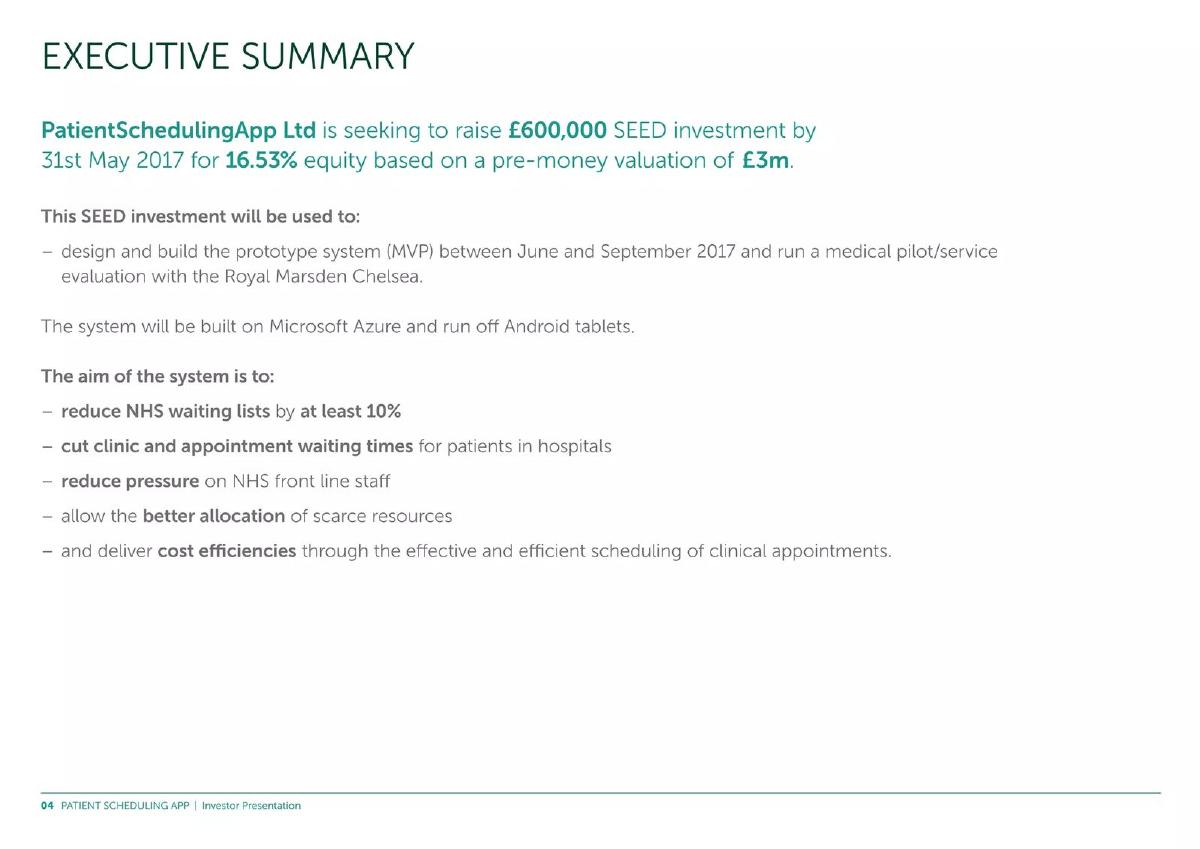
The most glaring omission is a detailed explanation of the hardware logistics. Providing, charging, sanitizing, and tracking thousands of Android tablets (Slide 16) is a massive operational undertaking. The deck does not explain the cost of the hardware itself or how it is amortized over the five-year contract. Additionally, there is no mention of competition. While the deck focuses on the NHS, there are numerous patient flow and EMR (Electronic Medical Record) providers that offer similar scheduling modules. Finally, the "Ask" is missing from these slides; while it is an investor presentation, the specific amount of capital being raised and the intended use of funds are not stated in the provided pages.
Founder Takeaways
The 'Zero Cost' Entry Strategy: Founders targeting the public sector or large institutions should study Slide 31. By shifting the cost to a per-use micro-payment, PatientSchedulingApp removes the primary barrier to entry—budget approval for new technology. Clinical Integration: Having a practicing consultant on the Board of Directors (Slide 36) is a powerful signal to investors that the product is designed for the reality of the ward, not just a theoretical office environment. Logistical Honesty: The deck is honest about the need for proprietary hardware (Slide 16). While this is a harder sell than SaaS, being upfront about the system requirements prevents due diligence surprises later. However, founders should ensure they have a robust plan for the 'hidden costs' of hardware, such as theft, breakage, and technical obsolescence.
Frequently asked questions
- What is the primary problem PatientSchedulingApp solves?
- The deck identifies hospital waiting times for planned operations as the primary friction point. It aims to manage the end-to-end patient journey, from pre-assessment to discharge, using dynamic scheduling and indoor wayfinding to ensure patients are in the right place at the right time, thereby reducing resource waste and improving the patient experience.
- Why does the company provide hardware instead of a mobile app?
- Slide 16 explicitly states that patients will not be able to download the app to their own devices. This is likely a security and reliability choice, ensuring the hardware is compatible with the indoor wayfinding sensors (provided by partner Pole Star) and preventing issues related to patient data privacy on personal phones.
- How does the 'micro-payment' revenue model work?
- The company offers the system at 'zero cost' to the hospital upfront. Instead, they charge 3.7p per 'journey.' Based on their projections of 109,134 monthly journeys per hospital, this generates roughly £4,038 in monthly revenue. This shifts the financial burden from capital expenditure to operating expenditure for the NHS trusts.
- Who are the key people behind the project?
- The deck highlights D. Andrew J. Grant and Colin Coffey (Finance Director). Clinical credibility is provided by Dr. Torsten Beutlhauser, who serves as a Director and brings direct experience from The Royal Marsden and The Charite in Berlin. The project also involves TechAdVenture for market research and scoping.
- What are the biggest risks visible in this deck?
- The reliance on physical hardware (tablets) introduces significant overhead, including 24-hour replacement logistics and charging infrastructure. Additionally, the gross margin per hospital is relatively thin (£16,370 profit on £48,456 revenue), meaning the company requires massive scale (50+ hospitals) to reach their £1.7m sales target and maintain profitability.