How B2B software startups present the solution in a pitch deck: where it sits among the tools a company already uses, what the workflow looks like.
B2B SaaS Solution Slide: Real Pitch Deck Examples
Eight solution slides from business software startups, shown in full, compare how each shows where the product fits among a customer's existing tools, how the work flows through it, and what the customer saves.
TL;DR
A business software solution slide should show where the product sits among the tools a customer already uses, walk through the new workflow in a few steps, and restate the problem's cost next to the saving. Payhawk draws itself as a layer between "ERP or accounting systems" above and "Bank accounts in multiple countries" below, working "without the need to change banks or ERPs". IriusRisk prices the old way ("3000 application x 3 days x €1000 = €9,000,000") beside its promise to cut threat modelling "from days to minutes". A grid of 40 feature boxes, like Convious's, shows breadth but not what changes for the customer.
B2B SaaS solution slides from real pitch decks
Each example shows the exact stored slide above its analysis and links to the full teardown. Figures are as shown on the slides; we have not verified them.
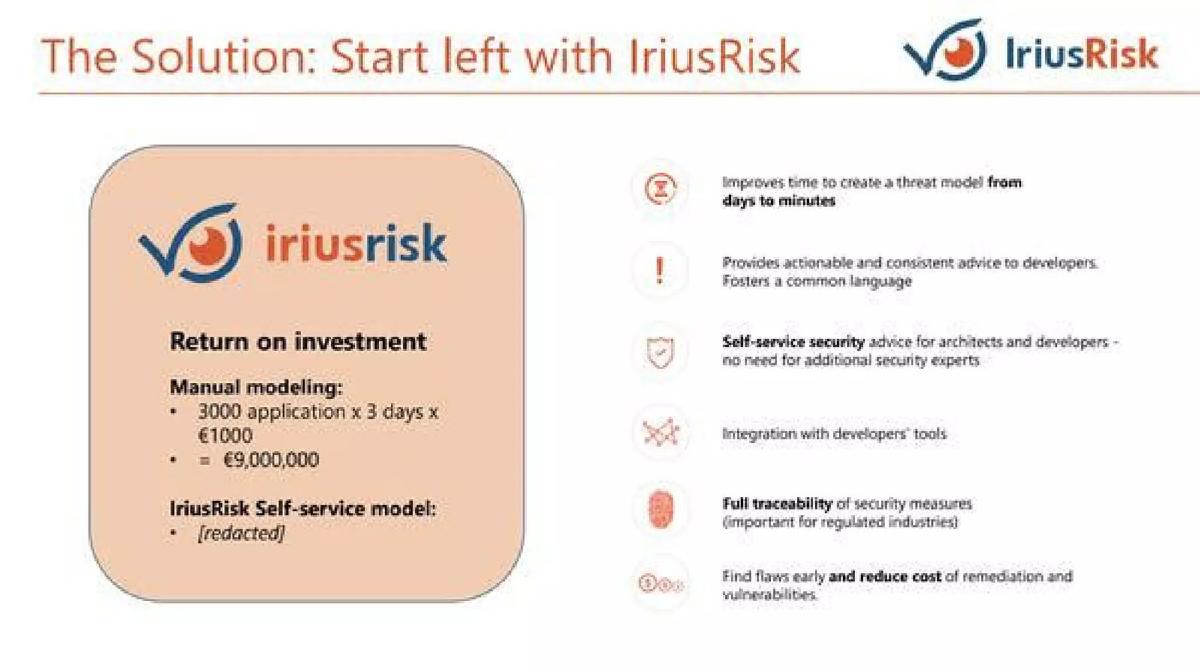
IriusRisk solution slide — slide 6
Application security design. Return on investment beside the benefits.
IriusRisk deck, slide 6. Exact stored slide matched to this analysis.
Our analysis: It carries the problem slide's numbers (3,000 apps, 3 days) into a total cost, then shows the new time.
Evidence and limitation: A cost calculation from the deck's own assumptions; the comparison figure is redacted in the shared version.
What a founder can adapt: Repeat your problem slide's cost and put your product's cost or time beside it.
Supporting analysis
What the deck claims: "The Solution: Start left with IriusRisk." "Return on investment — Manual modeling: 3000 application x 3 days x €1000 = €9,000,000." "IriusRisk Self-service model: [redacted]." Benefits: "Improves time to create a threat model from days to minutes"; "Self-service security advice for architects and developers - no need for additional security experts"; "Integration with developers' tools".
Presentation choice: The investor sees the saving in the same units as the problem.
When it does not fit: Keep the per-day figure consistent: the problem slide says $3,000 per application, this slide €1,000 per day.
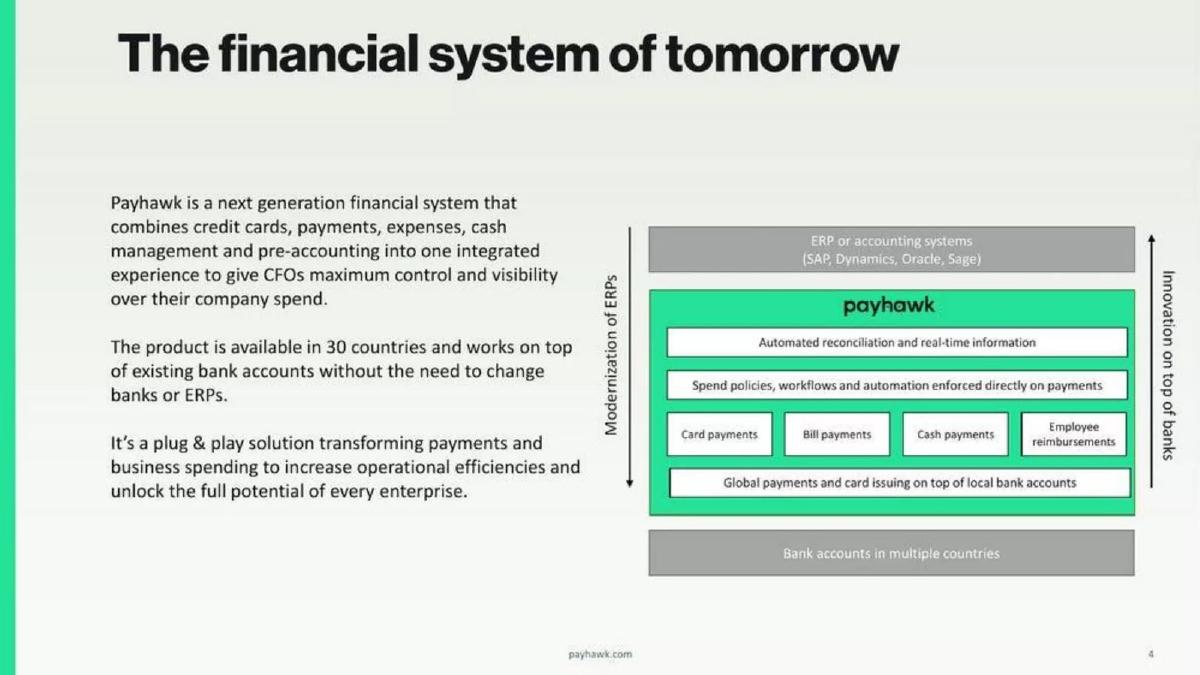
Spend management. A stack diagram between the ERP and the bank.
Payhawk deck, slide 4. Exact stored slide matched to this analysis.
Our analysis: The diagram shows what stays (bank, ERP) and what Payhawk adds in between.
Evidence and limitation: 30 countries; named ERP systems.
What a founder can adapt: Draw your product as a layer between the systems the customer already runs.
Supporting analysis
What the deck claims: "The financial system of tomorrow." Payhawk "combines credit cards, payments, cash management and pre-accounting into one integrated experience to give CFOs maximum control." "The product is available in 30 countries and works on top of existing bank accounts without the need to change banks or ERPs." The diagram places Payhawk between "ERP or accounting systems (SAP, Dynamics, Oracle, Sage)" and "Bank accounts in multiple countries".
Presentation choice: Buyers fear replacing core systems; the slide says they don't have to.
When it does not fit: Name the user as well as the buyer: the CFO buys, but employees and accountants use it.
Employee wellness benefits. A three-column table: problem, usual fix, SportID.
SportID deck, slide 4. Exact stored slide matched to this analysis.
Our analysis: Each row compares the product with what a company would otherwise do, not just with the problem.
Evidence and limitation: No figures.
What a founder can adapt: Add a column for today's workaround between the problem and your product.
Supporting analysis
What the deck claims: "Problems for Companies." Columns: "PROBLEM", "SOLUTION", "SPORTID SOLUTION". "Lots of paperwork managing benefits" → "Employees bring their cheques and get compensated" → "No cheques – just one contract and one invoice!" "Wrong person uses your company's benefits" → "Trust your employees" → "Start using SportID that is secure."
Presentation choice: The middle column shows the investor the real alternative the product must beat.
When it does not fit: Add a number per row, such as hours of paperwork per month.
AI research tool for universities. A three-stage workflow.
Kanonic deck, slide 5. Exact stored slide matched to this analysis.
Our analysis: It uses the university's existing login to reach paywalled papers, which is its difference from other tools.
Evidence and limitation: No figures; named login systems.
What a founder can adapt: Show the stages of use and name the system that makes your key step possible.
Supporting analysis
What the deck claims: "OUR SOLUTION." "Stage 1: Prompt — Authenticate your SAML token using OpenAthens or Shibboleth." "Stage 2: Deep Research — The AI model can now access OA and non-OA content across multiple sources using your SAML token." "Stage 3: Iteration." "Output: Get a detailed research report." "Unlike ordinary web search models, KANONIC has see otherwise inaccessible content."
Presentation choice: Naming the systems it plugs into (OpenAthens, Shibboleth) shows how it gets access competitors lack.
When it does not fit: Add a result: time to a literature review, or papers reached versus a standard search.
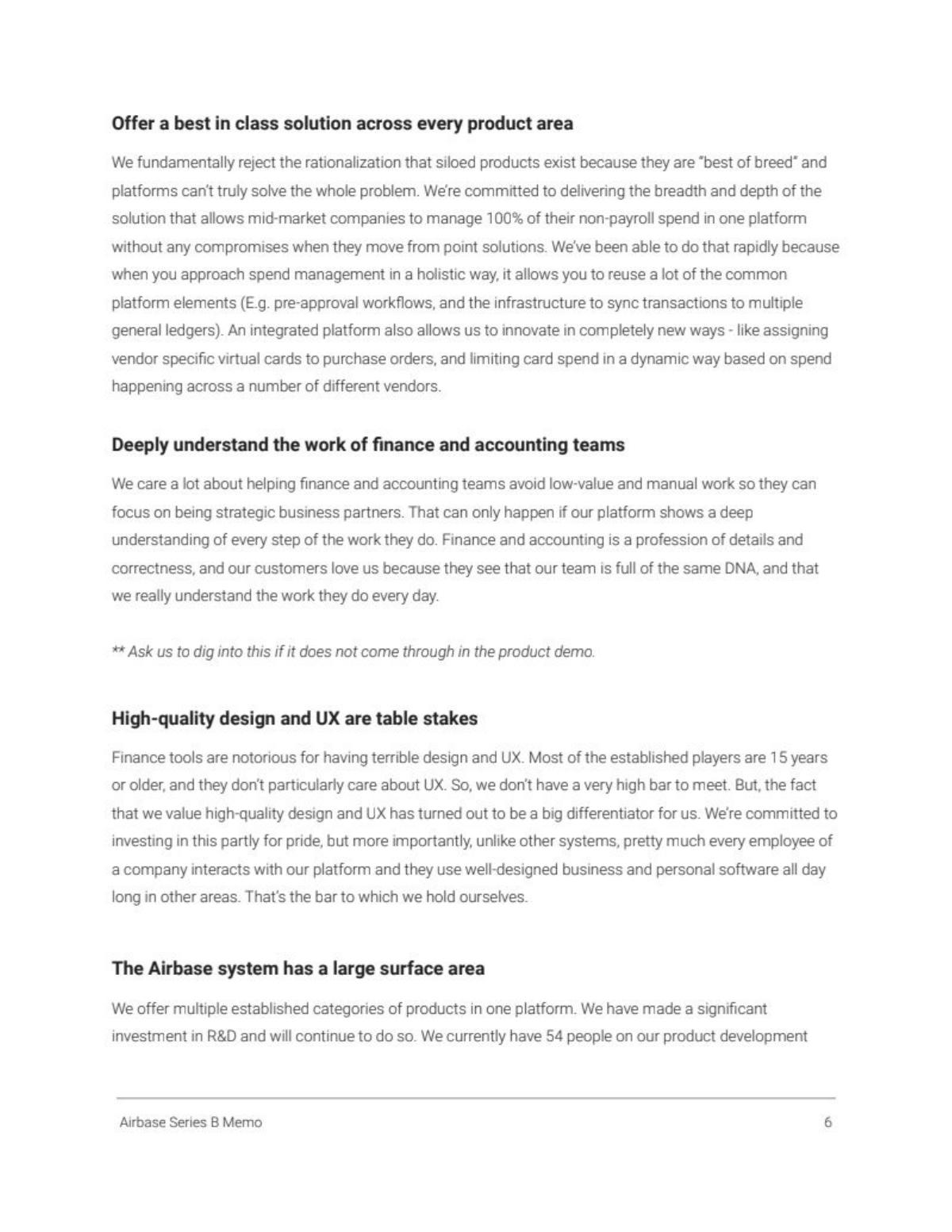
Spend management. A memo page of product principles.
Airbase deck, slide 6. Exact stored slide matched to this analysis.
Our analysis: It answers the buyer's worry that one platform is worse than several specialist tools.
Evidence and limitation: 54 people on product development; no customer figures.
What a founder can adapt: If you replace several tools, say why one platform won't be weaker at each job.
Supporting analysis
What the deck claims: "Offer a best in class solution across every product area." "We fundamentally reject the rationalization that siloed products exist because they are 'best of breed'." The platform "allows mid-market companies to manage 100% of their non-payroll spend in one platform." "Deeply understand the work of finance and accounting teams." "High-quality design and UX are table stakes."
Presentation choice: It follows from the deck's problem page, which sorted existing tools into three groups.
When it does not fit: Show the platform itself; this page explains principles without a diagram.
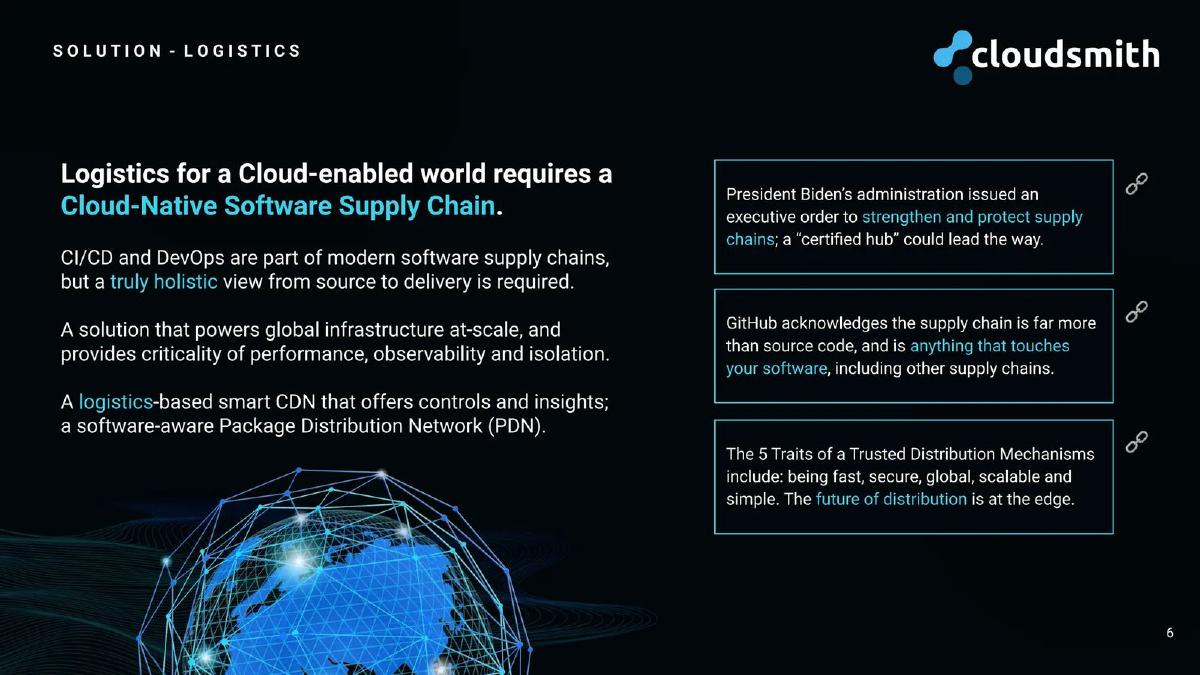
Software package distribution. A category framing with outside support.
Cloudsmith deck, slide 6. Exact stored slide matched to this analysis.
Our analysis: It names a new category and backs it with outside sources, but doesn't show the product at work.
Evidence and limitation: Linked outside references; no customer results.
What a founder can adapt: Pair a category claim with one picture of where the product sits in the delivery pipeline.
Supporting analysis
What the deck claims: "Logistics for a Cloud-enabled world requires a Cloud-Native Software Supply Chain." "A logistics-based smart CDN that offers controls and insights; a software-aware Package Distribution Network (PDN)." Boxes cite a US executive order on software supply chains, GitHub, and "The 5 Traits of a Trusted Distribution Mechanisms".
Presentation choice: Useful for why-now, less so for explaining what the customer does differently.
When it does not fit: Abstract terms ("truly holistic", "smart CDN") without a workflow.
Content management for .NET Core. Three benefit claims.
Redakt CMS deck, slide 5. Exact stored slide matched to this analysis.
Our analysis: Where it runs is concrete; the cost claim has no comparison.
Evidence and limitation: No figures.
What a founder can adapt: Say where it runs and what it integrates with, then quantify the cost claim.
Supporting analysis
What the deck claims: "Redakt CMS is the first in its class built from the ground up for .NET Core." "Redakt CMS runs on Windows, Linux and macOS, and can be hosted anywhere on-premise or in the cloud." "Ease of implementation compared to other enterprise CMS products keeps application development costs down."
Presentation choice: Stating deployment options answers an IT buyer's first question.
When it does not fit: "Mass adoption over a short period is possible" is a hope, not a solution.
Vertical software for leisure venues. Included as a weaker pattern.
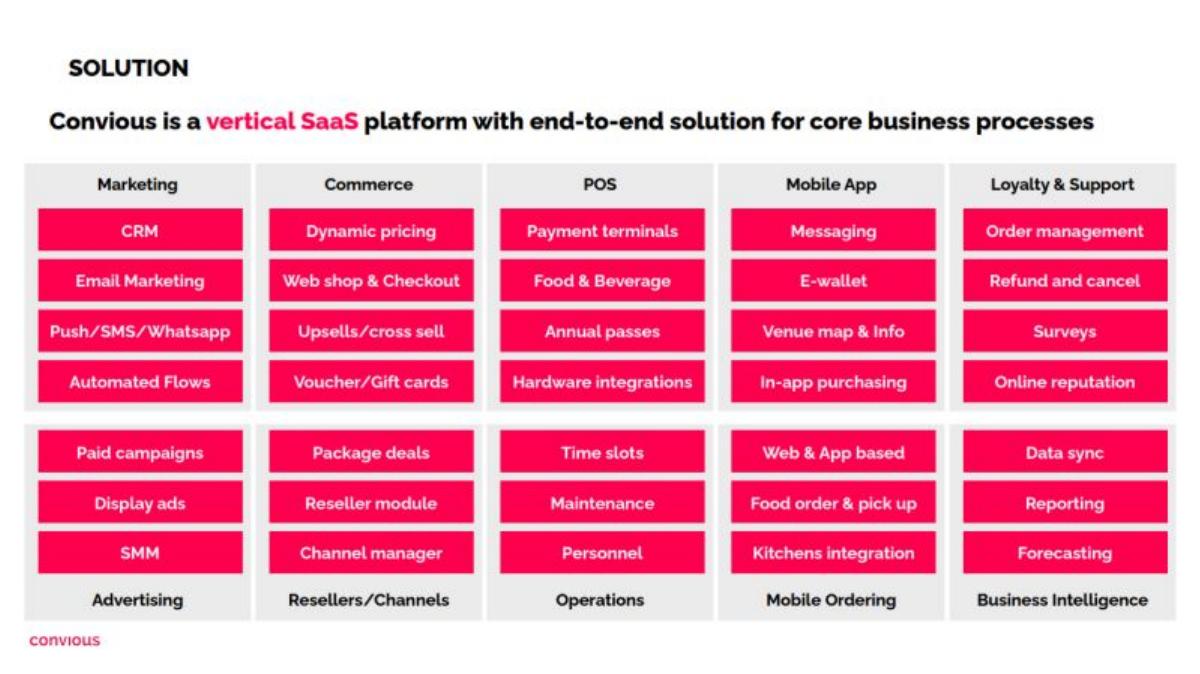
Convious deck, slide 5. Exact stored slide matched to this analysis.
Our analysis: It shows how much the platform covers, but not which tools it replaces or what a venue gains.
Evidence and limitation: No figures.
What a founder can adapt: Group features under three outcomes and name the tools they replace.
Supporting analysis
What the deck claims: "Convious is a vertical SaaS platform with end-to-end solution for core business processes." Ten columns (Marketing, Commerce, POS, Mobile App, Loyalty & Support, Advertising, Resellers/Channels, Operations, Mobile Ordering, Business Intelligence) holding 40 feature boxes such as "CRM", "Dynamic pricing", "Payment terminals" and "Forecasting".
Presentation choice: Included as a contrast: breadth shown as a feature wall.
When it does not fit: Forty equal boxes with no hierarchy.
Whether each slide shows fit with existing systems, the new workflow, and a return against the problem.
Example
Fit with existing systems
Workflow shown
Return shown
IriusRisk
Developer tools (mentioned)
No
Yes (€9m manual cost vs days to minutes)
Payhawk
Yes (ERP above, banks below)
No
No
SportID
No
Yes (today vs SportID)
No
Kanonic
Yes (SAML login)
Yes (3 stages)
No
Airbase
Replaces point tools
No
No
Cloudsmith
No
No
No
Redakt CMS
Yes (OS, hosting)
No
Claimed, not measured
Convious
No
No
No
Key Takeaways
Show what the product connects to: the ERP, the bank, the code repository, the login system.
Say what the customer doesn't have to replace. "Works on top of existing bank accounts" lowers the buying risk.
Draw the new workflow in three to five steps.
Put the cost from your problem slide next to the saving.
Group features under two or three outcomes instead of listing all of them.
Build your B2B SaaS solution slide
One line per part, each with a number if you have one.
Fit. Which systems does it connect to, and which does the customer keep?
Workflow. What are the three to five steps a user now follows?
Return. What did the problem cost, and what does it cost with your product?
Grouping. Which two or three outcomes do your features add up to?
Copyable framework: [Product] connects to [existing systems] without replacing them. [User] now [step 1], [step 2], [step 3]. [Task] drops from [old cost/time] to [new cost/time].
Illustrative example 1 — written by us
Before: An all-in-one AI platform for modern finance teams.
After: Connects to NetSuite and your existing bank. Receipts are captured at purchase, matched automatically and posted to the ledger. Month-end close drops from 8 days to 3.
What improved: Our illustrative rewrite; figures are invented for the example. It names the systems, the workflow and one saving.
What this guide adds
The general solution slide guide covers presenting a product in any business. Business software has to fit alongside systems a company already runs, and buyers weigh the cost of switching. This guide compares how software startups show that fit.
It pairs with the B2B SaaS problem slide guide: three of the companies here (IriusRisk, Payhawk, Cloudsmith) appear there with their problem slides, so you can read each deck's problem and solution together.
Three parts of a business software solution
Fit: where the product sits among the customer's existing systems, and what it leaves in place (Payhawk, Kanonic).
Workflow: the new way the work gets done, in a few steps (Kanonic, SportID).
Return: the saving measured against the problem's cost (IriusRisk).
Strong slides cover all three. Most real slides cover one or two.
Common mistakes
Feature wall. Group features into outcomes; investors won't read 40 boxes.
No fit shown. Say what it connects to and what the customer keeps.
No return. Carry the problem slide's cost forward and show the saving.
Category words only. "Holistic" and "next generation" don't explain the product.
Inconsistent numbers. Use the same units and figures as your problem slide.
Diagnostic checklist
The slide shows which existing systems the product works with.
The new workflow fits in three to five steps.
The saving is measured against the problem's cost.
Features are grouped under a few outcomes.
Figures match the problem slide.
Frequently asked questions
How we chose these examples
Corpus: published pitch deck teardowns on StartupFundraising.com. Founder-uploaded private decks are excluded.
Selection (2026-09-24): we searched extracted text of slides 2–6 for solution slides in decks mentioning SaaS, subscriptions or business customers, excluding healthcare decks (covered by the healthcare solution guide), and checked the solution slides of decks in the B2B SaaS problem guide. About twenty candidates were inspected.
Overlap check: the general solution slide guide uses seven different decks (HelloBello, Eikona, Improvado, HomeHub, Arbol, Buynomics, Pakam); none appears here. IriusRisk, Payhawk, Cloudsmith and Airbase appear in the B2B SaaS problem guide with different slides.
Convious is included to show a weaker pattern. Airbase is a written memo page rather than a presented slide.
Review: all eight stored slide images were inspected on 2026-09-24 and matched to company, deck and slide number (editorial model review). No person has yet completed an editorial review of this page.
Figures are as shown on the slides; we have not verified them. We make no claim that any slide caused a fundraising outcome.