Airbase’s Series B deck is a masterclass in narrative positioning, opting for a text-heavy memo format over traditional visual slides. Raising $60M in 2021, the company focused on the 'mid-market' (defined as 50-1000 employees on slide 2) and argued that the real value in fintech lies in software workflows rather than payment interchange. The deck explicitly distances Airbase from 'corporate card wars' by positioning cards as a commodity and software as the strategic 'system of record.' While it lacks a traditional team slide or specific 'ask' amount, it provides a transparent summary of perf…
Key takeaways
- Airbase defines its target mid-market as companies with 50-1000 employees on slide 2.
- The company claims a 90.12% gross margin for the financial year ending Jan 31, 2021, on slide 10.
- Airbase positions itself as 'workflow-driven software first and a fintech company second' on slide 5.
- The deck identifies two competitor categories: legacy players like Bill.com and emerging players like Brex and Ramp on slide 7.
- The company reports a team of 96 employees spread across 9 countries as of April 2021 on slides 10 and 12.
- Airbase explicitly rejects the 'interchange-only' revenue model, opting for a subscription-heavy split on slide 7.
- The deck omits a traditional team slide, though it mentions having 54 people in product development on slide 6.
- Future growth is tied to five adjacent opportunities including Budgeting, CLM, and SaaS management on slides 11 and 12.
The Narrative Shift: Why Airbase Chose a Memo
The Airbase Series B deck is not a 'deck' in the traditional sense. It is a 12-page internal-style memo. By 2021, the 'memo' format—popularized by firms like Sequoia and companies like Rippling—had become a signal of intellectual rigor. For a fintech company tackling the unsexy world of accounts payable and expense management, this format allows the founders to build a logical case from first principles rather than relying on flashy UI mockups.
Slide 1: Title Page
The cover slide is minimalist, titled 'Airbase Memo' and dated April 2021. It establishes a professional, sober tone suitable for a Series B round where the audience is sophisticated institutional investors.
Slide 2: Introduction and Problem Definition
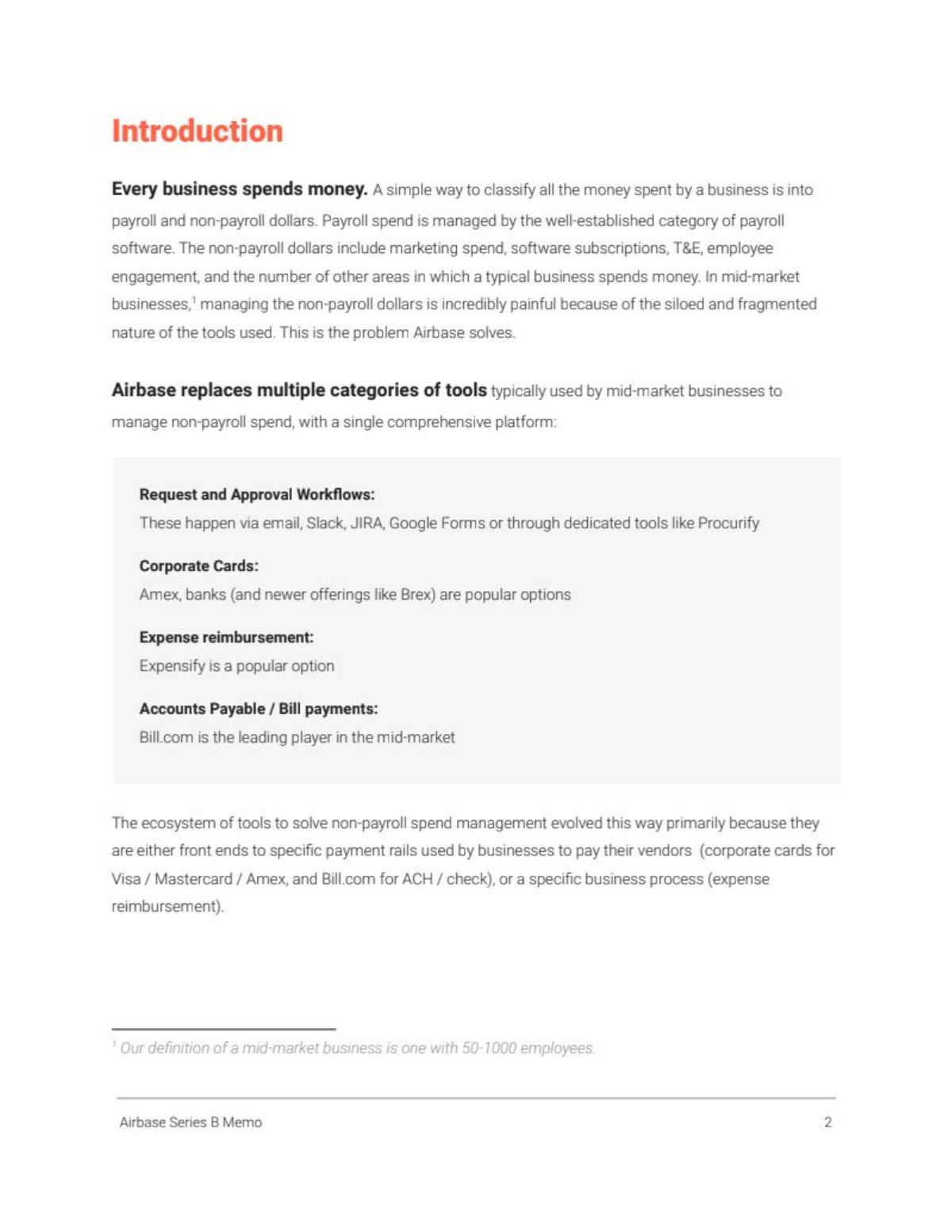
Airbase starts by categorizing business spend into payroll and non-payroll. The slide identifies the 'painful' nature of managing non-payroll dollars due to siloed tools. Crucially, it lists the categories it intends to replace: Request and Approval Workflows (Slack/Google Forms), Corporate Cards (Amex/Brex), Expense Reimbursement (Expensify), and Bill Payments (Bill.com). A footnote on this slide defines their target mid-market as companies with 50-1000 employees.
Slide 3: The Finance Team's Perspective
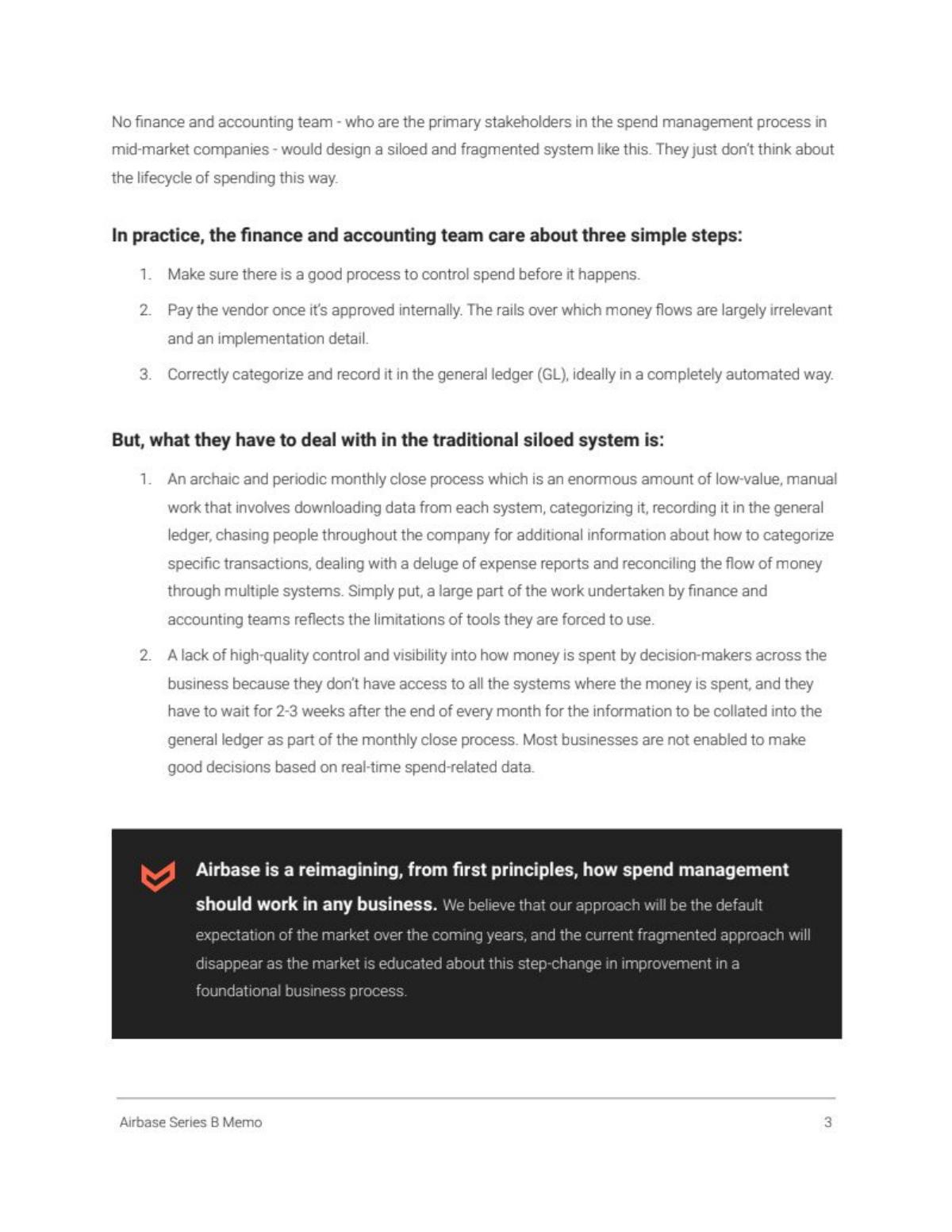
This slide shifts the focus to the primary stakeholder: the finance and accounting team. Airbase argues that these teams care about three things: control before spending, paying the vendor, and automated categorization in the general ledger (GL). It contrasts this with the 'archaic' monthly close process that involves manual data downloading and reconciliation. The slide concludes with a bold statement: Airbase is a 'reimagining, from first principles, how spend management should work.'
Slide 4: The 'Why Now' Factor
Airbase addresses why this problem hasn't been solved previously. It attributes the delay to a lack of maturity in payment infrastructure. It cites the rise of developer-friendly card issuing platforms like Marqeta, Stripe, Galileo, and Adyen, as well as improved bank APIs, as the catalysts that finally allowed software workflows to integrate deeply with payment rails.
Slide 5: Product Principles and Software-First Identity
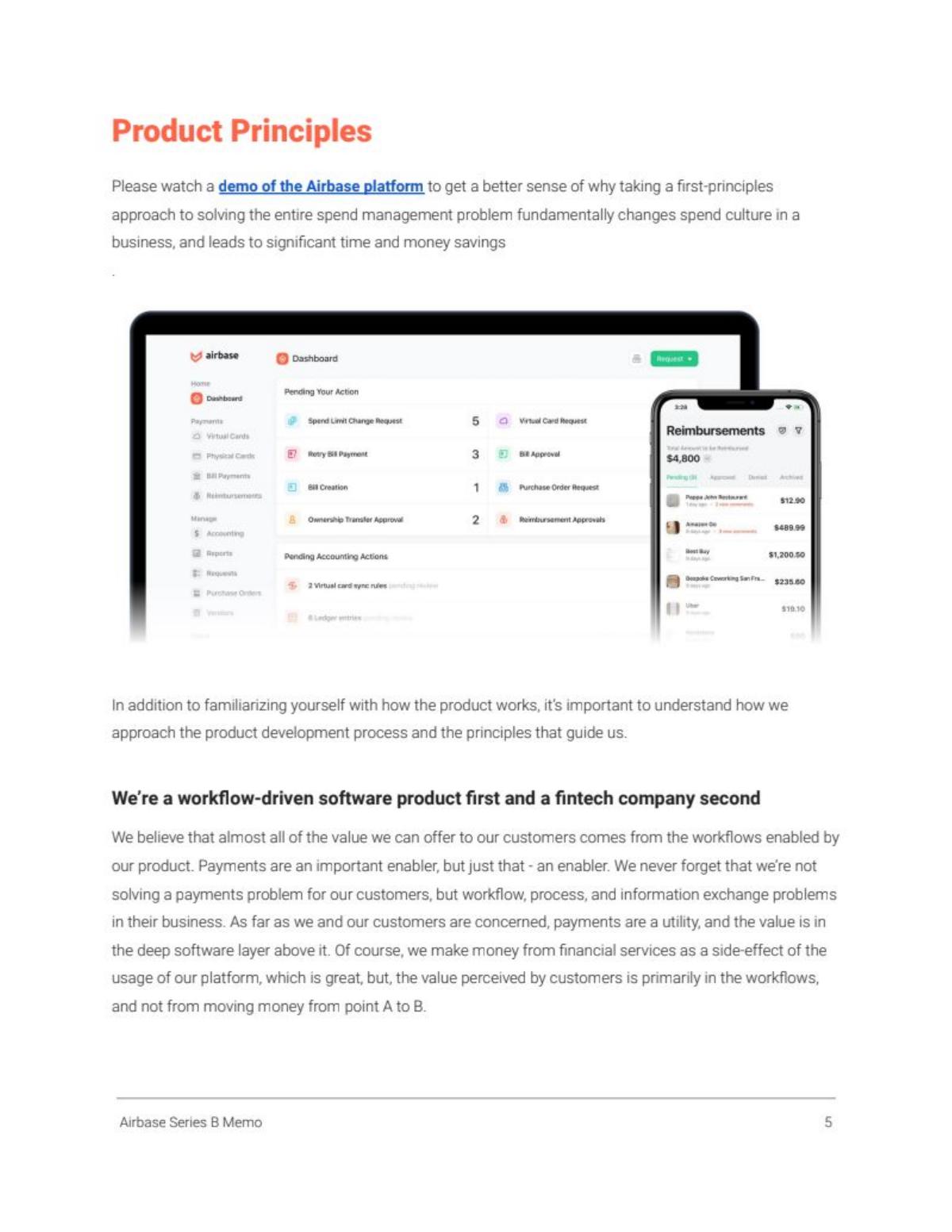
Slide 5 contains the only significant product imagery in the deck, showing a dashboard and a mobile app. However, the text is the real driver here. Airbase explicitly states: 'We’re a workflow-driven software product first and a fintech company second.' They argue that payments are a 'utility' and the real value is the 'deep software layer above it.'
Slide 6: Depth of Solution and Team Focus
The company rejects the idea of 'best of breed' siloed products, committing to a platform that handles 100% of non-payroll spend. A key organizational metric is shared here: Airbase has 54 people on their product development team, which they state is more than half the total company headcount.
Slide 7: Competition and Strategy
This is perhaps the most strategic slide in the deck. Airbase divides competitors into 'Established, legacy players' (Bill.com, Expensify) and 'Emerging players' (Brex, Divvy, Ramp, Teampay). Airbase positions its subscription-fee model as a 'contrarian opinion' compared to the 'billion dollars invested' in competitors who give the product away for free to earn interchange. They argue that an interchange-only model forces a 'corporate card centric view' that doesn't solve the whole problem.
Slide 8: Strategic Real Estate and Commodity Cards
Airbase doubles down on its software-first stance, calling corporate cards a 'commodity product' and a 'race to the bottom.' They claim that by focusing on the software layer, they can partner with incumbent banks rather than competing with them. The slide mentions an upcoming integrated offering with 'XYZ' in mid-2021 and discussions with 'ABC' (names redacted).
Slide 9: Global Opportunity and Market Expansion
The deck notes that the pandemic accelerated the trend of globally distributed teams, making spend management a global problem. Airbase states they will be delivering a single global platform to manage spend across currencies and locations by the end of 2021. Their strategy is to win the mid-market first and then move upmarket.
Slide 10: Progress So Far (The Metrics)
This slide provides the hard data. While ARR and customer counts are redacted, several key figures remain: a 90.12% gross margin for FY2021, a net burn of $9M, and $21.5M cash in the bank. They also claim they 'did not lose a single customer' because they failed to find value; churn was driven by acquisitions. The headcount is listed as 96, spread across 9 countries.
Slide 11: Future Upside and Adjacent Opportunities
To justify a Series B valuation, Airbase points to five adjacent markets they can enter because they own the 'strategic real estate' of spend data: Budgeting and planning, Contract Lifecycle Management (CLM), SaaS management, Procurement management, and Invoice factoring.
Slide 12: Conclusion and Global Footprint
The final slide features a world map with pins representing their distributed workforce. It reiterates the scale: 1 Product, 9 Countries, 96 Employees. It ends on a high note regarding 'upside potential.'
What Airbase Does Well
Intellectual Honesty: By using a memo, Airbase doesn't hide behind icons. They explain exactly why they think their competitors' business models (interchange-only) are flawed. This builds significant trust with investors who are wary of 'commodity' fintech plays.
Stakeholder Empathy: The deck spends a significant amount of time discussing the 'monthly close' and 'GL categorization.' This shows they deeply understand the day-to-day pain of their actual buyer (the CFO/Controller), not just the end-user who wants a shiny metal card.
Efficiency Metrics: Reporting a 90% gross margin and a relatively low net burn ($9M) for a company that had raised $30M+ is a strong signal of capital efficiency, which was a key theme in 2021 for sustainable SaaS growth.
What is Missing from the Deck
The Team Slide: There is no slide introducing the founders or the leadership team. While the text mentions the size of the product team, investors usually want to see the pedigree of the people building a 'system of record' for finance.
The Ask: The deck does not explicitly state how much they are looking to raise or how they will spend the capital. While we know from the catalogue that they raised $60M, the deck itself focuses entirely on the 'why' and 'how' of the business rather than the transaction details.
Detailed Unit Economics: While gross margin is provided, there is no mention of Customer Acquisition Cost (CAC), Payback Period, or LTV (Lifetime Value). For a Series B, these are usually expected metrics to prove the go-to-market engine is ready for a $60M injection.
What Founders Should Copy
The 'First Principles' Approach: If you are in a crowded market (like spend management was in 2021), don't just say you are 'better.' Explain why the current market structure is fundamentally broken. Airbase’s argument that 'cards are a commodity' is a perfect example of repositioning the competition.
Defining the Segment: Airbase doesn't just say 'B2B.' They define their mid-market precisely (50-1000 employees). This allows investors to model the Total Addressable Market (TAM) with much higher accuracy.
The Future Roadmap as Logic: Instead of a random list of features, Airbase presents its future products (CLM, SaaS management) as 'adjacent opportunities' that they have 'earned the right' to enter by becoming the system of record. This makes the expansion feel inevitable rather than speculative.
Frequently asked questions
- Why did Airbase use a memo format instead of a standard pitch deck?
- At the Series B stage, investors are looking for deep strategic clarity and evidence of a 'system of record' status. The memo format allows Airbase to explain complex workflow problems that simple icons and bullet points cannot capture. It forces the reader to engage with the company's philosophy on why software is more valuable than the underlying payment rails.
- How does Airbase differentiate itself from Brex and Ramp?
- According to slide 7, Airbase views competitors like Brex and Ramp as being 'corporate card centric' and focused on making money from interchange. Airbase differentiates by charging a subscription fee for its software, arguing that the true pain point for finance teams is the workflow (approvals, GL categorization) rather than the card itself.
- What are the key financial metrics disclosed in the deck?
- Slide 10 provides a 'Progress so far' summary. It notes a 90.12% gross margin for FY2021, a net burn of $9M against $30.5M raised, and $21.5M remaining in the bank at the time of the memo. Specific ARR and customer counts are redacted as 'X' and 'Y' in this public version.
- What is missing from the Airbase Series B deck?
- The deck lacks a dedicated team slide featuring founder bios or previous exits. It also lacks a specific 'Ask' slide detailing how the $60M would be allocated. Furthermore, there are no detailed case studies or testimonials, though it mentions that 'not a single customer' was lost due to lack of value (slide 10).
- What is Airbase's definition of the mid-market?
- Airbase specifically defines the mid-market as businesses with 50 to 1,000 employees. This is noted in a footnote on slide 2. They argue this segment is underserved because they are forced to use siloed tools like Expensify and Bill.com which do not talk to each other.