This deck is a visual redesign of the original 2009 Airbnb pitch deck, maintaining the core narrative that secured their initial seed funding. The presentation focuses on solving three primary travel pain points: price, cultural disconnection, and the lack of a formal platform for local hosting. By utilizing market validation from CouchSurfing (670,000 users) and Craigslist (17,000 listings), the deck builds a case for a 10.6 million trip market share. The business model is remarkably simple, proposing a 10% commission on transactions to reach $200M in revenue. While this version lacks the or…
Key takeaways
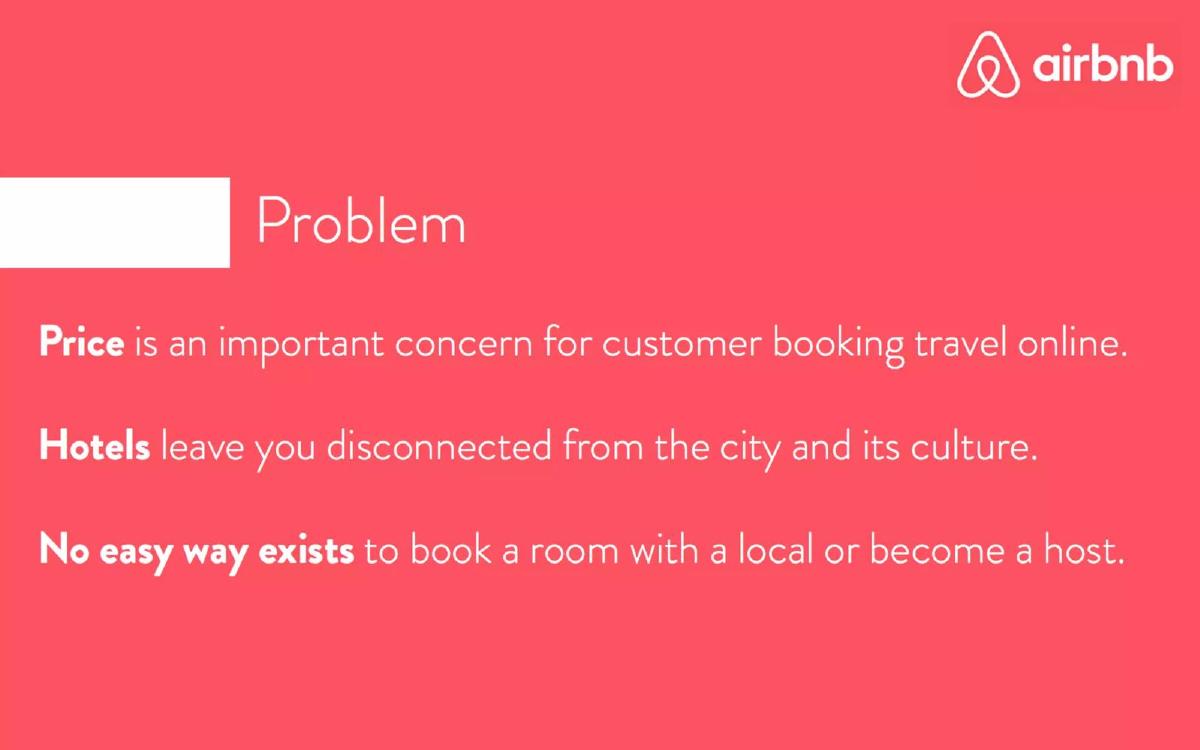
- The problem slide identifies price, cultural disconnection, and the lack of a hosting platform as the three core market gaps (Slide 2).
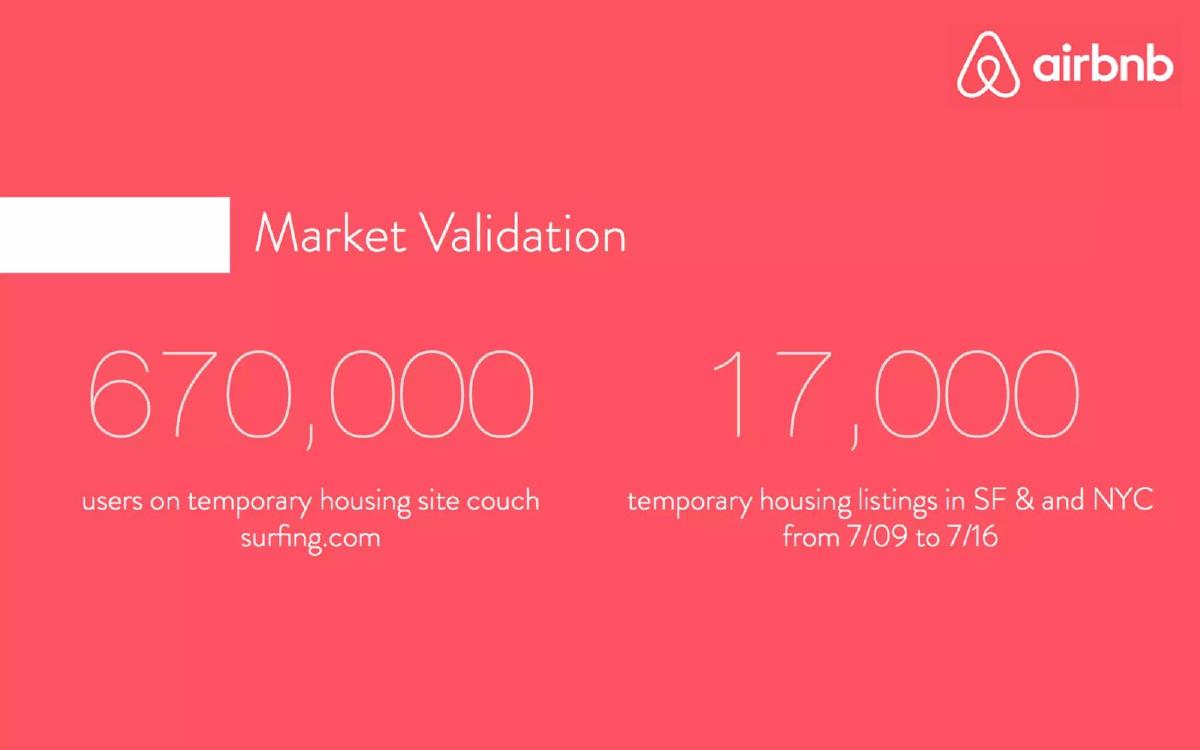
- Market validation is established by citing 670,000 users on CouchSurfing and 17,000 temporary housing listings on Craigslist in SF and NYC (Slide 4).
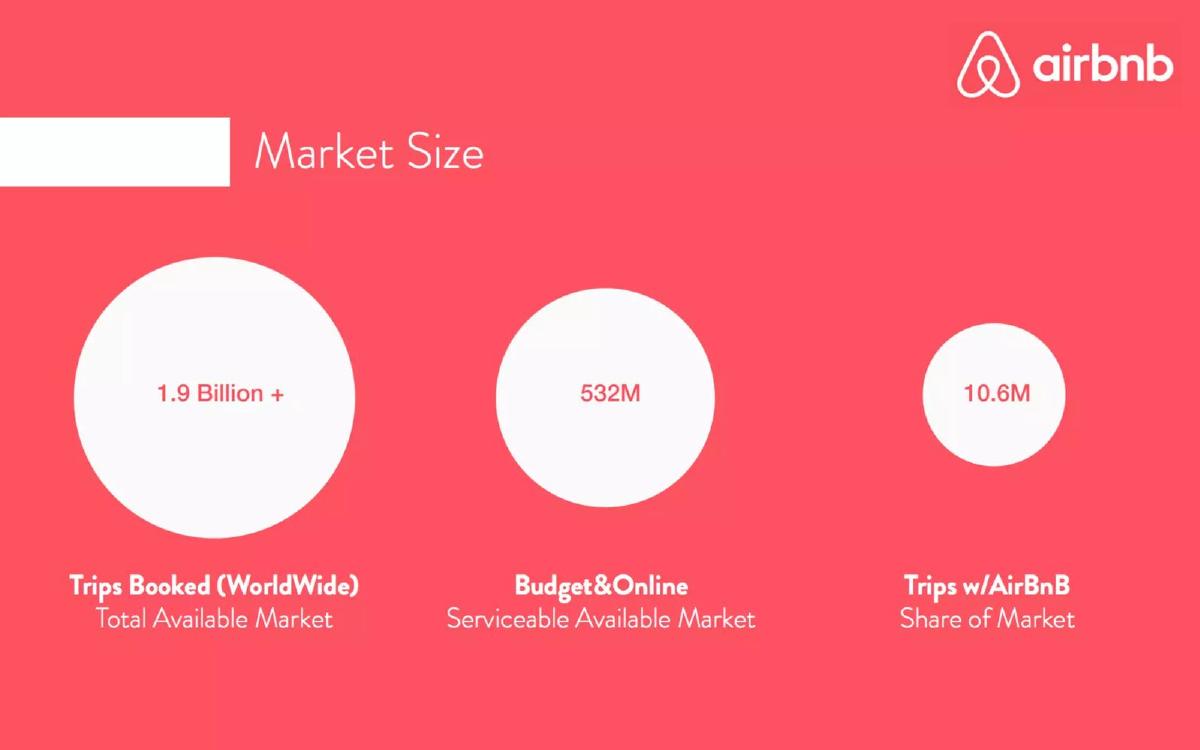
- The Total Available Market is defined as 1.9 Billion+ trips booked worldwide (Slide 5).
- The business model relies on a 10% commission per transaction, estimating a $20 average fee based on a $70/night stay for 3 nights (Slide 7).
- Revenue projections for the 2008-2011 period are stated at $200M (Slide 7).
- Market adoption strategy includes targeting major events like Octoberfest (6M people) and a Craigslist 'dual posting' feature (Slide 8).
- Competitive positioning places Airbnb in the 'Affordable' and 'Online Transaction' quadrant, distinct from VRBO and Hotels.com (Slide 10).
- The deck omits a team slide, financial ask, and specific use of funds, which were present in the original historical version (Slides 1-13).
Introduction
The Airbnb pitch deck is perhaps the most studied document in startup history. This specific version is a redesign of the original 2009 seed deck. It strips away the dated aesthetic of the late 2000s and replaces it with a clean, brand-aligned visual style. However, the core logic—the logic that convinced Sequoia Capital and Y Combinator to back a company renting out air mattresses—remains intact. This teardown looks at the narrative structure and the specific data points used to validate a then-radical idea.
Slide 1: Title Slide
The deck opens with the modern Airbnb logo and the tagline: "Book rooms with locals rather than hotels." This is a classic 'X for Y' or 'High Concept Pitch' that immediately establishes the category and the value proposition. It positions the company as a direct alternative to the established hotel industry.
Slide 2: The Problem
The problem slide is remarkably concise, listing three bullet points: Price is a concern for online travelers, Hotels leave travelers disconnected from local culture, and No easy way exists to book a room with a local or become a host. By framing the lack of a platform as a problem, they create a vacuum that only their product can fill.
Slide 3: The Solution
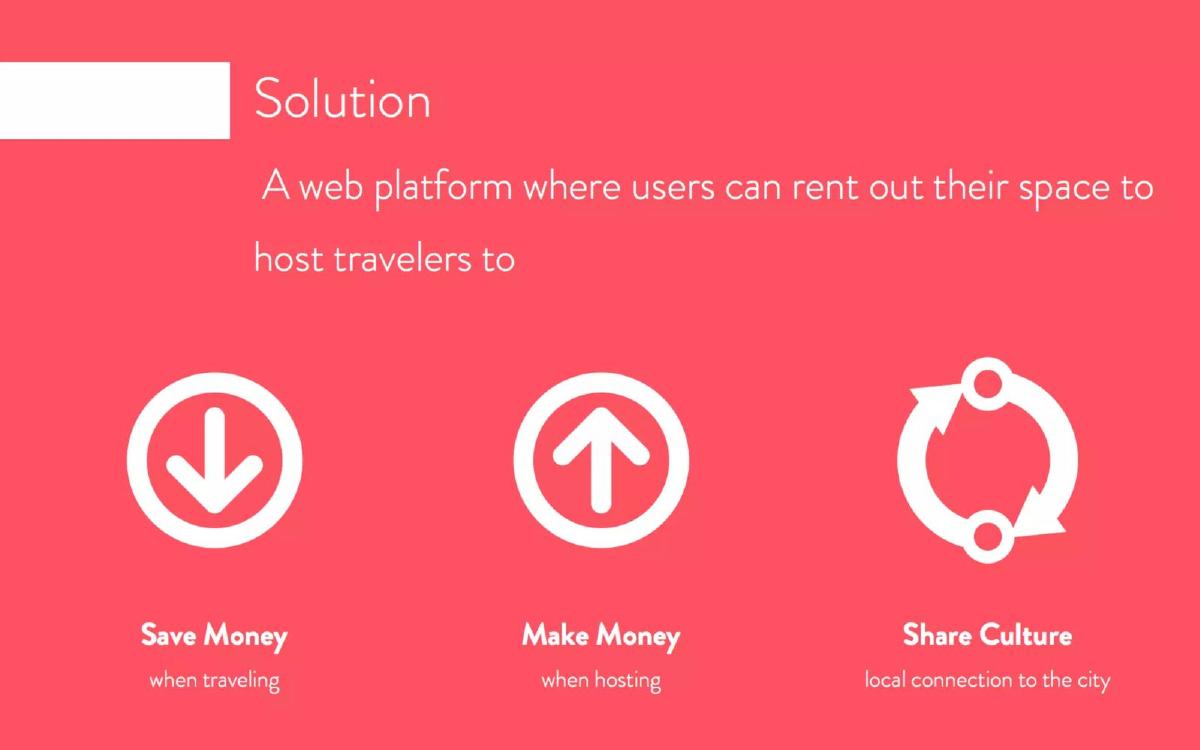
The solution is described as a "web platform where users can rent out their space to host travelers." The slide uses three icons to represent the core benefits: Save Money (travelers), Make Money (hosts), and Share Culture (local connection). This addresses both sides of the marketplace simultaneously, which is crucial for any platform business.
Slide 4: Market Validation
To prove that people actually want to stay in private homes, the deck cites two existing behaviors. First, it notes 670,000 users on CouchSurfing.com. Second, it highlights 17,000 temporary housing listings on Craigslist in SF and NYC during a single week in July 2009. This proves that the demand exists; it just lacks a centralized, safe transaction layer.
Slide 5: Market Size
The market sizing follows the standard TAM/SAM/SOM model. Total Available Market: 1.9 Billion+ trips booked worldwide. Serviceable Available Market: 532M budget and online trips. Share of Market: 10.6M trips. This shows a path to scale by capturing just a small percentage of a massive, existing industry.
Slide 6: Product
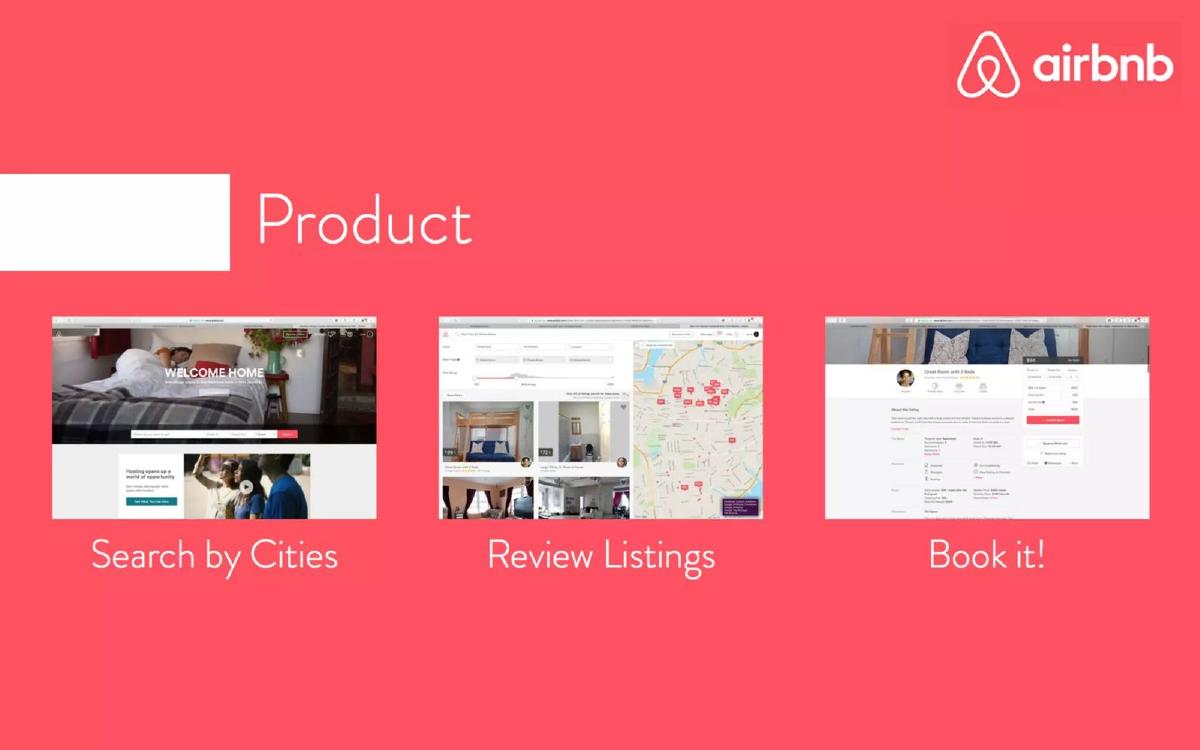
The product slide uses three screenshots to show the user journey: "Search by Cities," "Review Listings," and "Book it!" The simplicity of the three-step process is intended to counter the 'problem' of there being no easy way to book with locals. It emphasizes a frictionless user experience.
Slide 7: Business Model
This is the 'money' slide. Airbnb proposes a 10% commission on each transaction. They provide a concrete example: a $20 average fee based on a $70/night stay for 3 nights. They then project $200M in revenue for the 2008-2011 period based on their 10.6M trip market share goal. The math is transparent and easy for an investor to verify.
Slide 8: Market Adoption (Go-to-Market)
The strategy for growth is three-pronged. First, they target high-demand Events (Octoberfest, Eurocup, Mardi Gras) where hotels are likely to be sold out. Second, they mention Partnerships with Kayak and Orbitz. Third, and most famously, they mention the Craigslist dual posting feature , which allowed them to tap into an existing supply of users.
Slide 9 & 10: Competition
Slide 9 is a transition slide, while Slide 10 provides the competitive matrix. They plot competitors on two axes: Offline vs. Online transactions and Affordable vs. Expensive. Airbnb places itself in the top-right quadrant (Affordable and Online), distinguishing itself from Craigslist (Offline) and Hotels.com (Expensive).
Slide 11 & 12: Competitive Advantage
These slides list six advantages: First to Market, Host Incentive, List Once, Ease of Use, Profiles, and Design and Brand. While "First to Market" is often a weak argument, the inclusion of "Profiles" and "Design and Brand" highlights their focus on trust and user experience, which were the primary barriers to entry for home-sharing.
Slide 13: Conclusion
The final slide is a promotional slide for the redesign tool, Slidebean. Notably, this version of the deck ends without a team slide or a financial ask, which are standard components of a fundraising pitch.
What Works in This Deck
The narrative flow is exceptionally logical. It moves from a clear problem to a simple solution, then immediately backs up the potential with market validation. The business model is not over-engineered; a flat percentage of transactions is easy to understand and scale. Furthermore, the market adoption slide (Slide 8) shows that the founders weren't just thinking about the product, but about the specific 'hacks' and events required to solve the cold-start problem of a marketplace.
What is Missing
As a standalone fundraising tool, this version of the deck is incomplete. The Team Slide is missing, which is arguably the most important slide for a seed-stage company. Investors need to know why these specific founders are equipped to build a global marketplace. The Ask is also absent; there is no mention of how much money is being raised or what the milestones are. Finally, there is no mention of Unit Economics beyond the commission rate—specifically, the cost to acquire a customer (CAC) versus the lifetime value (LTV).
Founder Takeaways
Keep the business model simple: Airbnb didn't pitch complex advertising tiers or data monetization. They pitched a 10% cut of a transaction. · Use existing behavior as validation: If you are building something new, show where people are already trying to do it poorly (e.g., Craigslist). · Target specific events: For marketplaces, 'boiling the ocean' doesn't work. Airbnb's focus on high-traffic events like Octoberfest provided a clear entry point for supply and demand. · Design is a competitive advantage: Even in 2009, Airbnb recognized that a better UI/UX and a focus on 'Profiles' (trust) would be their moat against incumbents like Craigslist.
Frequently asked questions
- Is this the original Airbnb pitch deck?
- No, this is a visual redesign created by Slidebean. While it uses the text and data from the original 2009 Airbnb seed deck, the layout, fonts, and graphics have been modernized. The content reflects the state of the company between 2008 and 2011, as evidenced by the revenue slide.
- What was Airbnb's primary growth hack mentioned in the deck?
- The deck explicitly mentions a 'Craigslist dual posting feature' on Slide 8. This refers to the famous technical integration that allowed Airbnb hosts to cross-post their listings to Craigslist with one click, effectively siphoning traffic from the larger incumbent platform to build their own supply and demand.
- How did Airbnb calculate its market share in this deck?
- On Slide 5, they narrow the market from 1.9 Billion+ total trips to a Serviceable Available Market (SAM) of 532 million 'Budget & Online' trips. They then target a 'Share of Market' of 10.6 million trips, which represents roughly 2% of their SAM.
- What are the biggest omissions in this version of the deck?
- This specific redesign omits the Team slide, which is critical for seed-stage investing. It also lacks a 'The Ask' slide, meaning there is no information on how much capital they were raising, at what valuation, or what the specific milestones for the funding would be.
- How does Airbnb differentiate itself from competitors like VRBO?
- According to the competitive matrix on Slide 10, Airbnb differentiates itself from VRBO and Rentobi.com by being more 'Affordable' and focusing on 'Online Transactions.' At the time, many vacation rental sites were more expensive and required offline coordination for payment.