Voxeet’s 9-slide deck is a lean, high-impact presentation that successfully pivoted the company from a standalone conferencing app to a powerful Communications Platform as a Service (cPaaS). The deck identifies a visceral pain point—'audio friction'—and solves it with 'Dolby-Level Quality' spatial audio. Most impressive is the traction slide, which shows a 80% month-over-month revenue jump from $10k to $18k immediately following their API launch. While the deck lacks a formal market size (TAM) slide and a specific 'Ask,' it relies heavily on social proof, featuring a Gartner 'Cool Vendor' nod…
Key takeaways
- The deck identifies the core problem as 'Audio Friction' in conference calls on Slide 1.
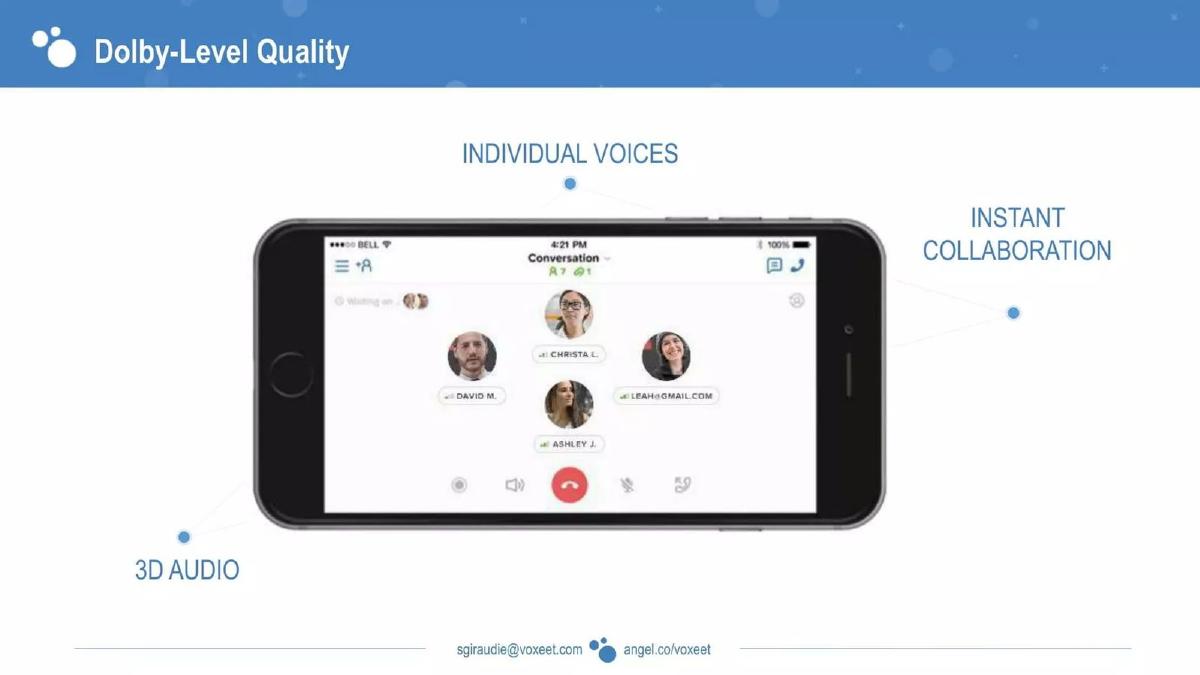
- Product value is defined by '3D Audio' and 'Individual Voices' to mimic real-life spatial awareness on Slide 2.
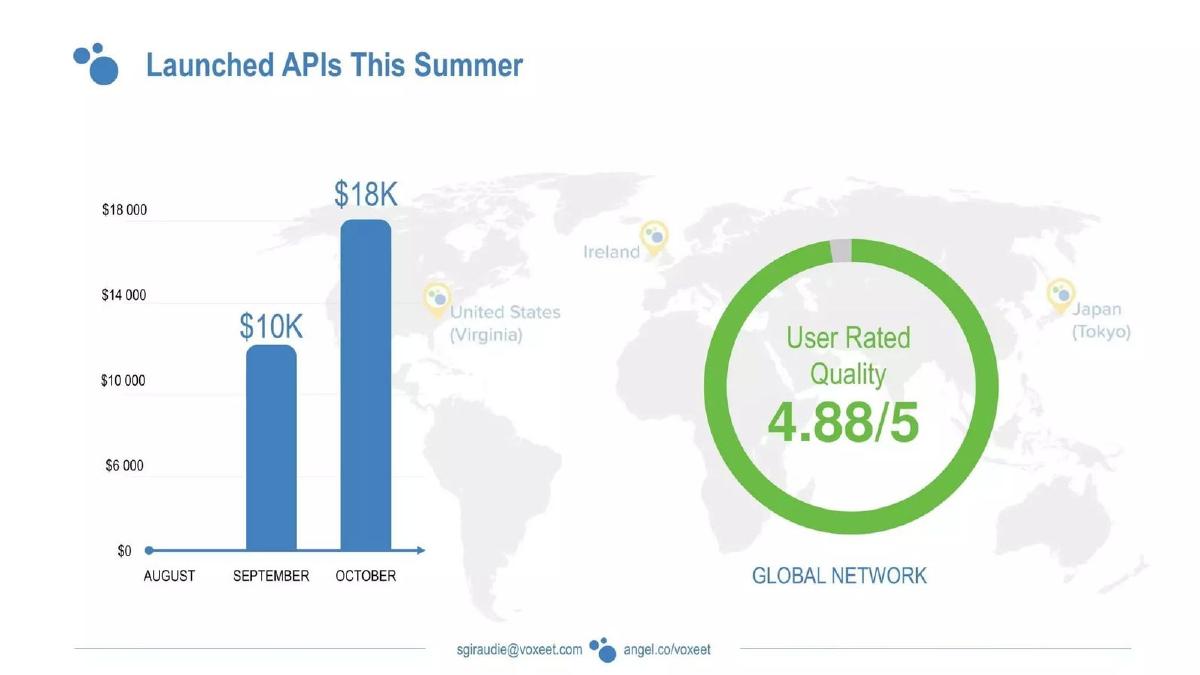
- The company demonstrates a pivot to an API-first model, showing revenue growth from $10,000 in September to $18,000 in October on Slide 4.
- User satisfaction is high, with a cited 'User Rated Quality' of 4.88/5 on Slide 4.
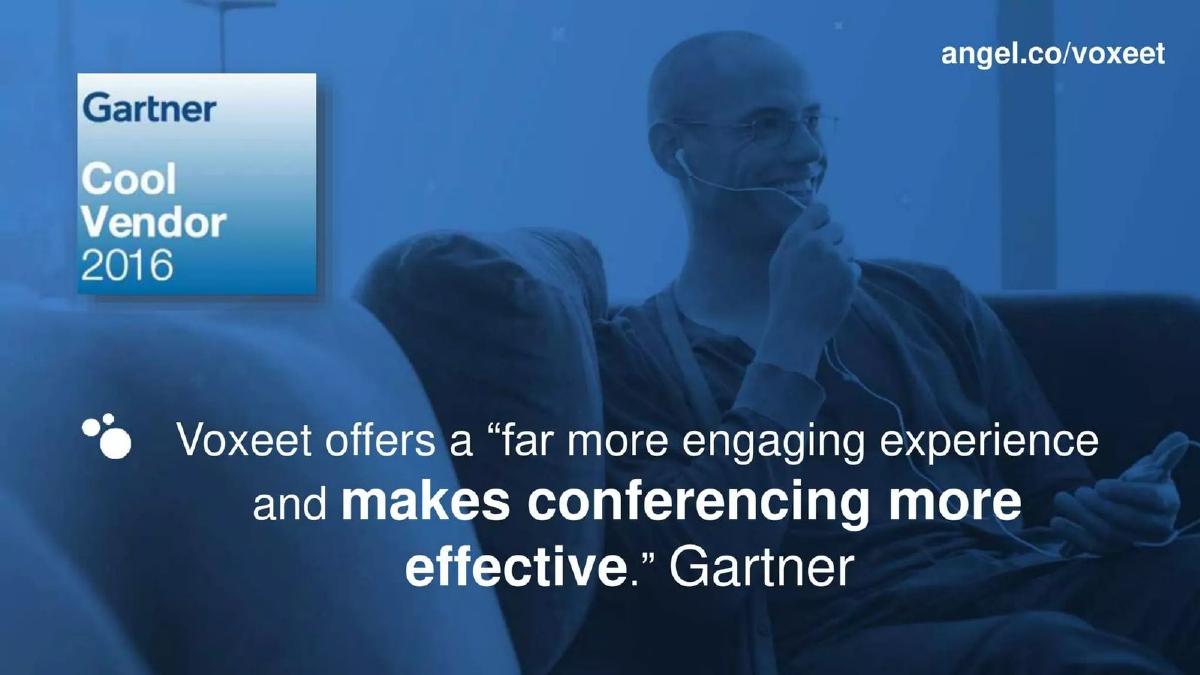
- Significant third-party validation is provided by a Gartner 'Cool Vendor 2016' designation on Slide 5.
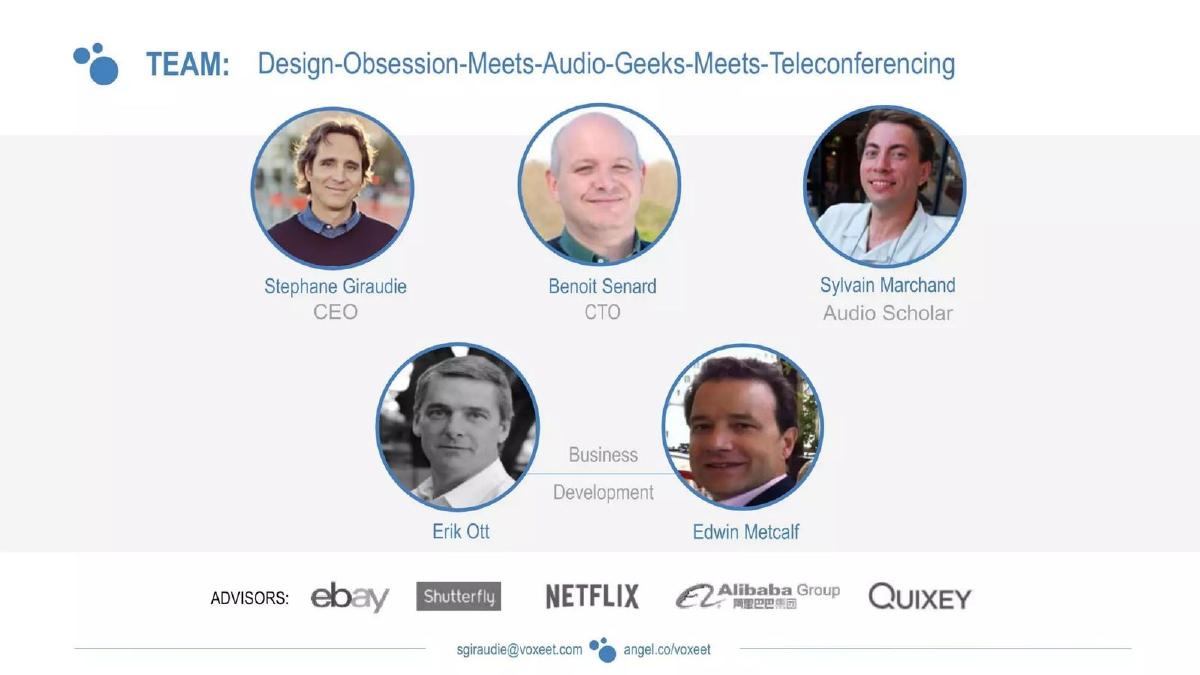
- The team includes a specialized 'Audio Scholar,' signaling deep technical expertise on Slide 6.
- The cap table features strategic business angels from competitors/predecessors Webex and Skype on Slide 7.
- The deck omits a traditional 'Competition' slide, choosing to focus on its unique technical moat instead.
The Pivot to cPaaS: A Teardown of Voxeet’s 9-Slide Deck
Voxeet’s 2012 pitch deck is a fascinating look at a company that understood its technical moat early on. While many startups in the communication space try to win on UI/UX or price, Voxeet focused entirely on the science of sound. This deck represents the moment the company moved from being a 'better conference call app' to a 'platform for spatial audio.' This transition eventually led to their acquisition by Dolby, and the seeds of that outcome are visible in every slide of this presentation.
The Hook and the Product (Slides 1-2)
Slide 1: Problem Statement The deck opens with a stark, minimalist slide: "CONFERENCE CALLS = AUDIO FRICTION." This is a classic 'hair on fire' problem. In 2012, VoIP was notorious for lag, echo, and the 'cocktail party effect' where users couldn't distinguish between multiple people talking at once. By labeling this as 'friction,' Voxeet positions itself as the lubricant for global business communication.
Slide 2: The Solution The solution is framed as "Dolby-Level Quality." This is a bold claim for a startup, but they back it up with three specific features: 3D Audio, Individual Voices, and Instant Collaboration. The visual shows a mobile interface where user avatars are spread out in a circle. This isn't just aesthetic; it represents the spatial positioning of the audio. If a person's avatar is on the left, their voice comes from the left. This immediately explains the 'how' behind their solution to audio friction.
Market Application and Traction (Slides 3-4)
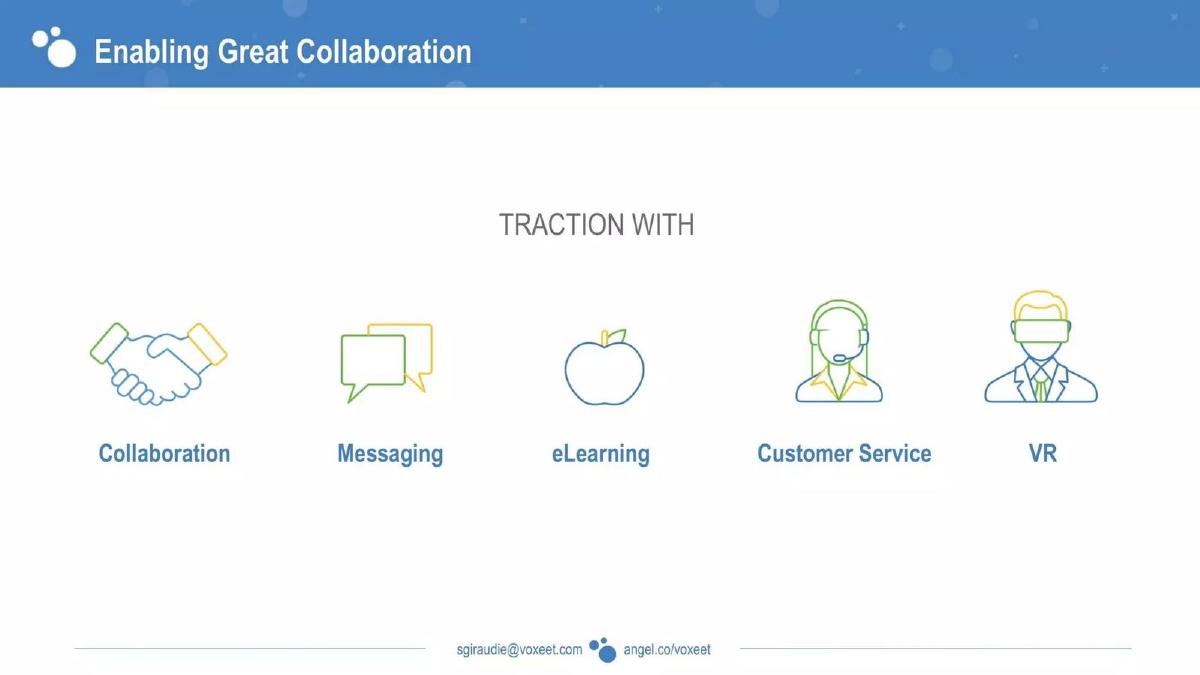
Slide 3: Enabling Great Collaboration Voxeet identifies its 'Traction With' five distinct categories: Collaboration, Messaging, eLearning, Customer Service, and VR. This slide is critical because it moves the company beyond the crowded 'business meeting' space. By including VR (Virtual Reality) in 2012, they signaled they were thinking about the next frontier of human interaction, where spatial audio is a requirement, not a luxury.
Slide 4: The Revenue Jump This is the 'money slide.' It titles the achievement: "Launched APIs This Summer." The bar graph shows a rapid ascent: $0 in August, $10,000 in September, and $18,000 in October. While the absolute numbers are small, the 80% month-over-month growth is the signal investors look for. It proves that there is a developer appetite for their API. The slide also includes a 'User Rated Quality' of 4.88/5 and a map of their 'Global Network' (Virginia, Ireland, Tokyo), proving they have the infrastructure to scale.
Validation and Team (Slides 5-6)
Slide 5: Third-Party Social Proof Voxeet leverages the Gartner 'Cool Vendor 2016' badge. The slide includes a quote: "Voxeet offers a 'far more engaging experience and makes conferencing more effective.'" For an enterprise-facing startup, a nod from Gartner is a massive de-risking event. It tells investors that industry analysts have vetted the tech and found it superior to the status quo.
Slide 6: The Team The team slide is titled "Design-Obsession-Meets-Audio-Geeks-Meets-Teleconferencing." This is a great way to summarize their culture. The key roles listed are CEO (Stephane Giraudie), CTO (Benoit Senard), and notably, an "Audio Scholar" (Sylvain Marchand). Having a 'scholar' on the team reinforces the idea that this is a deep-tech company, not just another wrapper on top of existing WebRTC libraries. The 'Advisors' section is equally heavy-hitting, featuring logos from eBay, Shutterfly, Netflix, Alibaba Group, and Quixey.
The Cap Table and The Vision (Slides 7-9)
Slide 7: Seed Funding The deck reveals a "Total Raised: $3.1M" in their Seed round. The investor list is a mix of institutional VC (Kima, Partech, Aquiti, LDV) and strategic 'Business Angels' from Webex and Skype. When your competitors' founders are investing in you, it’s the ultimate validation. It suggests that the people who built the $1B+ incumbents know their own tech is outdated and that Voxeet is the successor.
Slide 8: The API Engine This slide reinforces the 'Platform' play. It shows a smartphone with "Your App" in the center, surrounded by bubbles for 3D Audio, Video, Screen Sharing, and Translation. This is a clear message to developers: "Don't build your own communication stack; plug into ours." It positions Voxeet as the 'Stripe for Audio/Video.'
Slide 9: Closing The final slide reiterates the core offering: "APIs for 3D Surround Sound Voice and Video Communication." It provides the CEO’s contact information and the AngelList URL. It’s professional, consistent, and keeps the focus on the technology.
What Works in This Deck
1. Technical Moat: The deck doesn't shy away from being 'nerdy.' By using terms like '3D Audio' and 'Audio Scholar,' they convince the investor that this isn't a product that can be easily replicated by a weekend coder. They are selling proprietary IP.
2. The 'Before and After' of the API: Slide 4 is incredibly effective. It shows exactly when the API launched and how the market responded. It turns a theoretical platform into a proven revenue generator.
3. Strategic Social Proof: Including the Webex and Skype logos under 'Business Angels' is a masterstroke. It answers the question "Why hasn't Cisco or Microsoft done this?" by implying that the experts from those companies are actually betting on Voxeet.
What is Missing
1. Market Size (TAM): There is no slide detailing the Total Addressable Market. While we can infer it's huge (Unified Communications), investors generally want to see the founder's math on how big this can actually get.
2. Competitive Landscape: The deck ignores competitors. While they mention Webex and Skype as investors, they don't explain how they will win against Twilio or other emerging cPaaS players. A 'Magic Quadrant' or a feature comparison table would have been helpful.
3. The Ask: There is no mention of how much they are raising in this specific round or what the milestones for the next 18 months are. This suggests this deck might have been used for a specific, pre-negotiated conversation rather than a broad 'roadshow.'
What a Founder Should Copy
1. The Minimalist Problem Slide: Slide 1 is perfect. It uses five words to identify a universal pain point. Don't over-explain the problem; if it's a good one, the investor already knows it hurts.
2. The 'Platform' Visualization: Slide 8 is a great way to show an API's value. By putting "Your App" in the center, you help the investor (and the customer) visualize exactly how the product fits into the existing ecosystem.
3. Velocity over Volume: If your revenue is low, don't focus on the $18k total. Focus on the 80% growth rate. Voxeet did this perfectly by showing the month-over-month bars, which look much more impressive than a static number.
Frequently asked questions
- What was Voxeet's primary value proposition?
- Voxeet focused on eliminating 'audio friction' by providing 3D surround sound for digital communications. Unlike standard mono or stereo VoIP, Voxeet’s technology allowed users to hear voices coming from different spatial directions, making it easier to distinguish who was speaking in a crowded conference call. This 'Dolby-level quality' was their primary differentiator against established players.
- How did Voxeet demonstrate market traction?
- Instead of focusing on total users, Voxeet highlighted the immediate financial impact of their API launch. Slide 4 shows revenue growing from $10,000 in September to $18,000 in October. This 80% growth in a single month served as a powerful proof of concept for their transition into the cPaaS (Communication Platform as a Service) market.
- Who were the key investors in Voxeet?
- The deck lists several prominent VC firms including Kima Ventures, Partech Ventures, Aquiti Gestion, and LDV Partners. More importantly, it highlights 'Business Angels' from Webex and Skype, which provided massive industry credibility and suggested that the people who built the previous generation of communication tools believed in Voxeet’s tech.
- What industries did Voxeet target with its API?
- Slide 3 identifies five key verticals: Collaboration, Messaging, eLearning, Customer Service, and VR (Virtual Reality). By positioning themselves as an API, they weren't just a 'Zoom competitor'; they were the engine that could power audio for any app in these high-growth sectors.
- Is there a clear 'Ask' in the deck?
- No. The 9-slide deck provided does not include a slide detailing how much capital they were seeking or how they intended to spend it. This is common in 'teaser' decks or decks used for follow-on rounds where the terms are already being discussed privately with lead investors.