Vintage Wine Estates (VWE) utilizes this 45-slide investor presentation to position itself as a premier consolidator in the fragmented wine industry. The deck emphasizes a 'proven and successful track record' of acquisitions dating back to 2000, including brands like Girard, Clos Pegase, and Layer Cake. By highlighting a diversified portfolio that spans traditional luxury wines to high-growth 'category adjacencies' like hard seltzer and cannabis-infused beverages, VWE builds a case for significant margin expansion. The financial projections are aggressive, aiming to more than double net reven…
Key takeaways
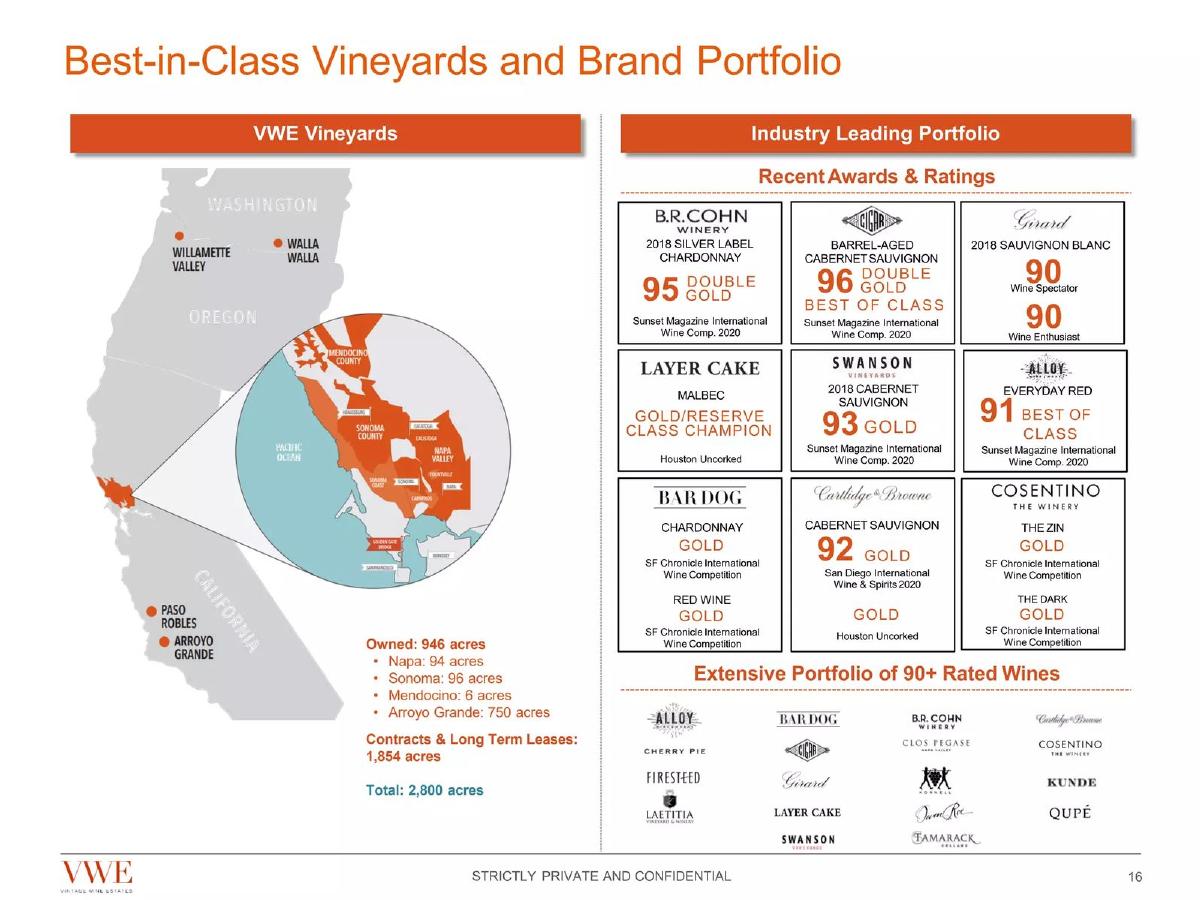
- The company manages a total of 2,800 acres, including 946 owned acres across Napa, Sonoma, Mendocino, and Arroyo Grande (Slide 16).
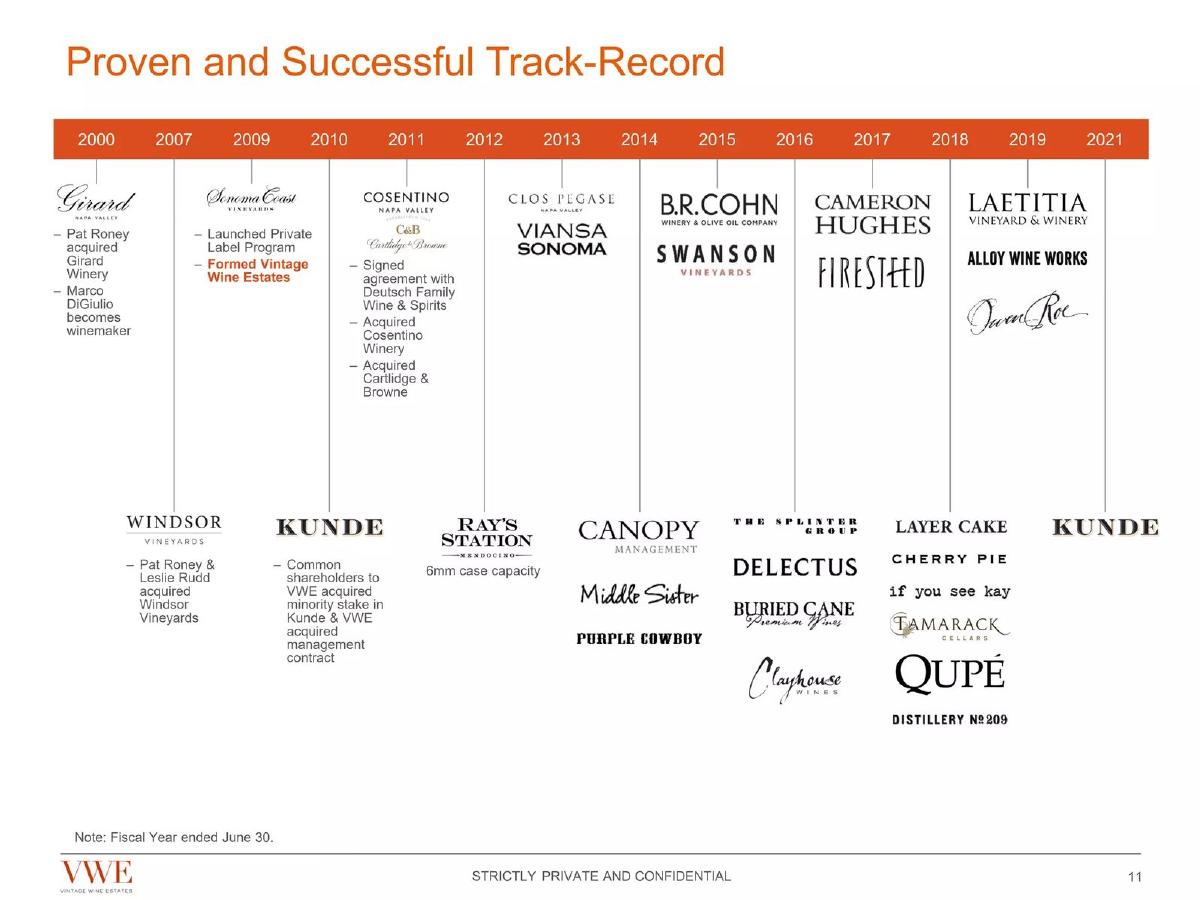
- VWE has executed a consistent acquisition strategy since 2000, acquiring over 20 brands and management contracts (Slide 11).
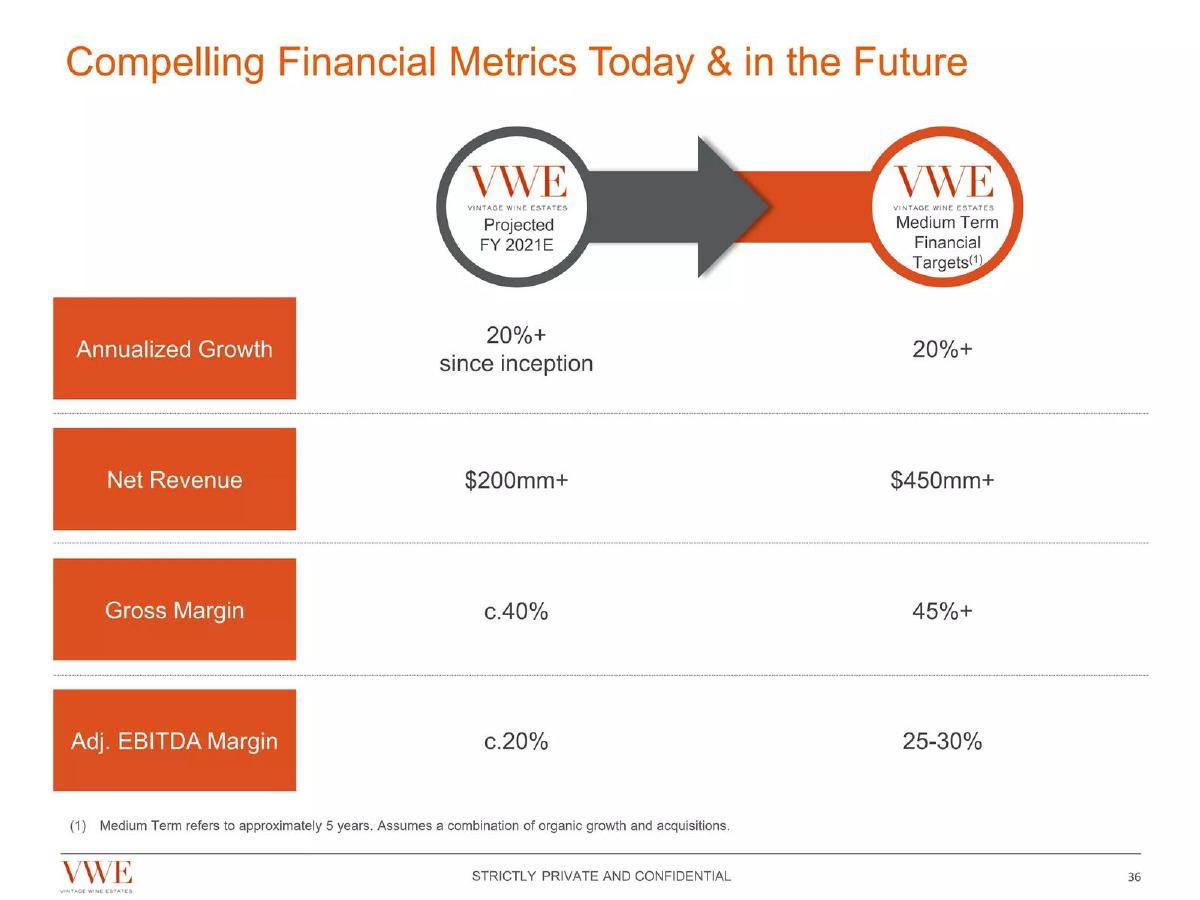
- Financial targets aim for a jump from $200mm+ projected FY 2021 revenue to $450mm+ in the medium term, defined as approximately 5 years (Slide 36).
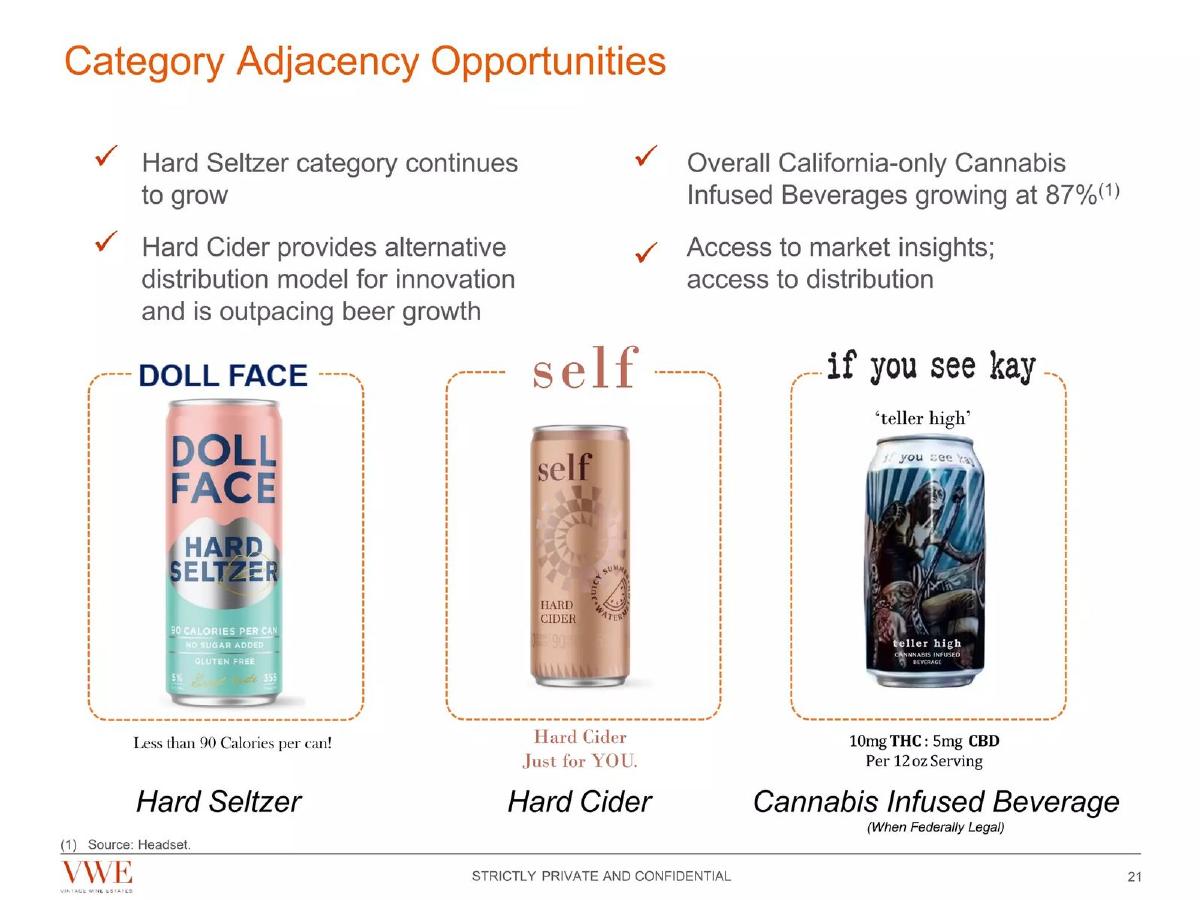
- The strategy includes aggressive expansion into non-wine categories, noting that California-only cannabis-infused beverages are growing at 87% (Slide 21).
- Gross margins are projected to improve from approximately 40% to over 45% through a combination of organic growth and acquisitions (Slide 36).
- The portfolio is highly decorated, featuring multiple 90+ rated wines and 'Double Gold' awards from competitions like the San Francisco Chronicle International Wine Competition (Slide 16).
- The management team is bolstered by oversight from BCAC, indicating a sophisticated corporate governance structure (Slide 45).
- The investment thesis relies heavily on the 'industry consolidator' model, leveraging a demonstrated track record of an actionable acquisition pipeline (Slide 45).
VWE Investor Presentation: A Deep Dive into Wine Industry Consolidation
The Vintage Wine Estates (VWE) investor presentation from June 2021 is a comprehensive look at a company positioned as a scale player in a traditionally fragmented industry. With 45 slides, the deck covers everything from agricultural assets to CPG innovation. The following teardown analyzes the strategic narrative presented in the selected slides.
Slide 1: Title and Brand Mosaic
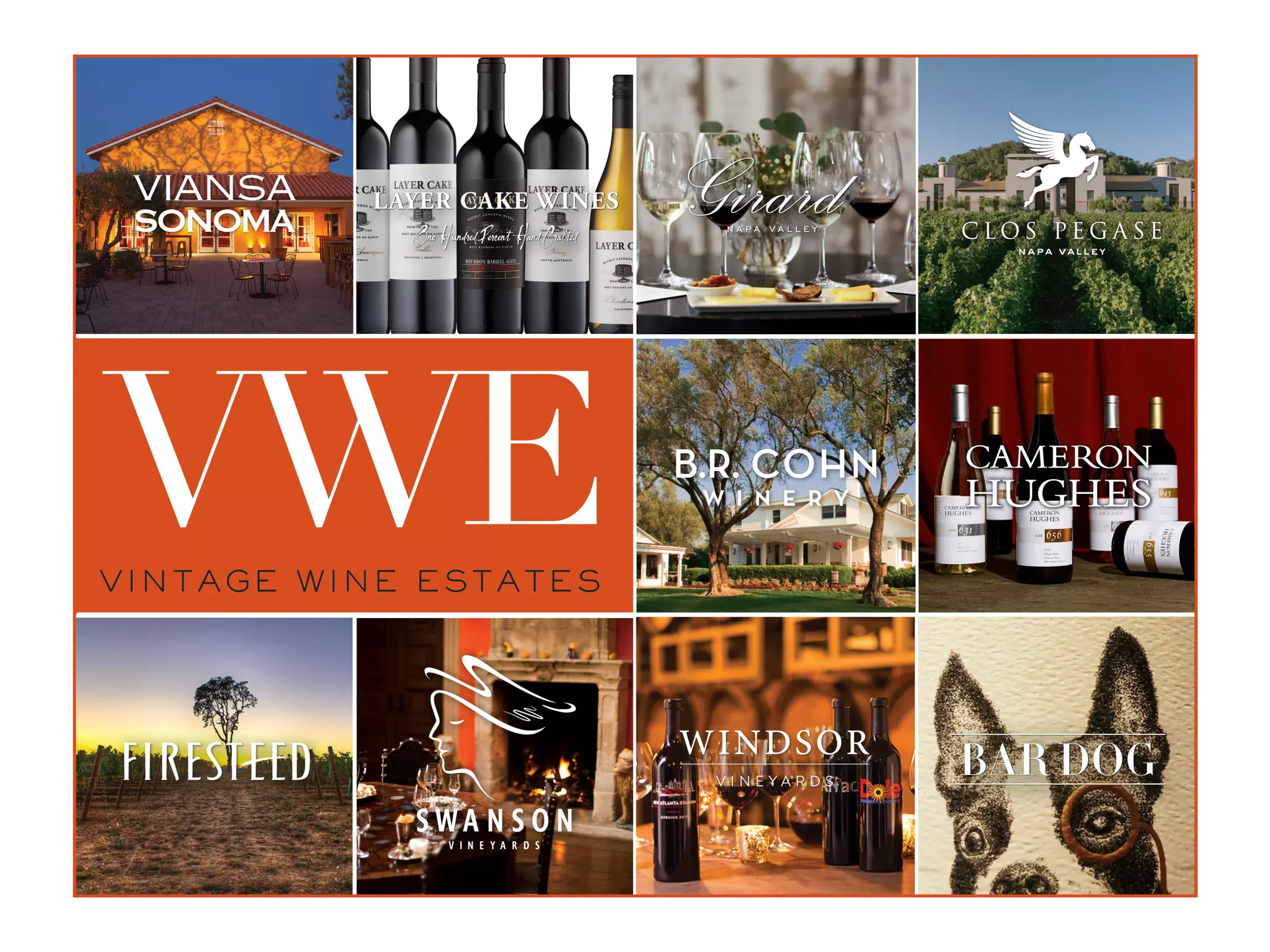
The cover slide serves as a visual portfolio summary. It features logos and imagery for ten distinct brands, including Viansa Sonoma, Layer Cake Wines, Girard, Clos Pegase, B.R. Cohn, Cameron Hughes, Firesteed, Swanson Vineyards, Windsor Vineyards, and Bar Dog. This immediately establishes VWE not as a single winery, but as a holding company for a diverse range of labels. The use of high-quality lifestyle photography alongside the central VWE logo suggests a balance between individual brand identity and corporate scale.
Slide 2: Introduction & Investment Thesis
This section divider continues the visual theme, using a grid of vineyard landscapes and product shots. By titling this section 'Introduction & Investment Thesis,' the company signals that the following slides will move beyond product descriptions and into the financial and strategic rationale for investing in the platform.
Slide 11: Proven and Successful Track-Record
This is a critical 'traction' slide that uses a timeline format to demonstrate M&A competency. Starting in 2000 with the acquisition of Girard Winery by Pat Roney, the timeline tracks over two decades of activity. Key milestones include the formation of Vintage Wine Estates in 2009, the acquisition of Clos Pegase and Viansa Sonoma in 2013, and the 2019 acquisitions of Laetitia Vineyard & Winery and Alloy Wine Works. The slide effectively communicates that VWE is a seasoned buyer with a repeatable process for integrating new assets into its portfolio. It also lists management contracts, such as the one for Kunde in 2010, showing flexibility in their business model.
Slide 16: Best-in-Class Vineyards and Brand Portfolio
Slide 16 provides the 'hard asset' backing for the company's valuation. It features a map of the U.S. West Coast, highlighting operations in Washington (Walla Walla), Oregon (Willamette Valley), and California (Paso Robles, Arroyo Grande, and a detailed inset of Napa/Sonoma). The data is specific: 946 owned acres and 1,854 acres under contract or lease, totaling 2,800 acres. The right side of the slide focuses on quality validation, listing 'Recent Awards & Ratings.' Notable figures include a 95-point Double Gold for B.R. Cohn Chardonnay and a 96-point Double Gold for Cigar Barrel-Aged Cabernet Sauvignon. This slide successfully marries the scale of their agricultural footprint with the prestige of their product output.
Slide 21: Category Adjacency Opportunities
This slide addresses the 'future-proofing' of the business. VWE identifies three high-growth areas outside of traditional bottled wine: Hard Seltzer, Hard Cider, and Cannabis Infused Beverages. They cite a growth rate of 87% for California-only cannabis-infused beverages and note that hard cider is outpacing beer growth. The inclusion of 'Doll Face' (Hard Seltzer) and 'Self' (Hard Cider) shows that these are not just theoretical markets but active product lines. The mention of 'If You See Kay' as a cannabis beverage with 10mg THC per serving, noted as 'When Federally Legal,' shows a forward-looking regulatory strategy.
Slide 26: Value Creation Strategy
Another section divider, this slide emphasizes the 'Value Creation' aspect of the business. The imagery shifts slightly toward the process—grapes, barrels, and the path through a vineyard—reinforcing the idea that VWE adds value through its operational expertise and distribution network.
Slide 31: Financial Overview
This divider introduces the quantitative portion of the deck. The imagery includes high-end spirits (No. 209 Gin), reminding investors that the portfolio extends into the spirits category, which often carries different margin profiles than wine.
Slide 36: Compelling Financial Metrics Today & in the Future
This is the most important financial slide in the deck. It compares 'Projected FY 2021E' metrics against 'Medium Term Financial Targets' (defined as approximately 5 years). The projections are ambitious: Net Revenue is expected to grow from $200mm+ to $450mm+; Gross Margin is targeted to increase from c.40% to 45%+; and Adj. EBITDA Margin is projected to rise from c.20% to 25-30%. The slide explicitly states that these targets assume a 'combination of organic growth and acquisitions,' which aligns with the track record established on Slide 11. This provides a clear 'north star' for investors regarding the company's scaling potential.
Slide 45: VWE Investment Highlights
The final slide summarizes the core pitch into six pillars: Market Opportunity (large, growing market), Business Model (proven, diversified channels), Financial Profile (strong historical growth), Consolidation (extensive acquisition pipeline), Asset Base (well-invested, strong balance sheet), and Management (experienced team with BCAC oversight). This slide serves as a comprehensive wrap-up, ensuring the key takeaways are reinforced before the presentation concludes.
What Works in the VWE Deck
Historical Context: By showing a 20-year timeline of acquisitions, VWE proves they aren't just a 'roll-up' concept but a functional operating entity with long-term experience in M&A. · Asset Transparency: Explicitly stating the number of owned vs. leased acres (Slide 16) provides a level of transparency that is often missing in CPG decks, giving investors a sense of the company's underlying collateral. · Balanced Growth Narrative: The deck doesn't just rely on 'more of the same.' The inclusion of category adjacencies (Slide 21) shows that management is aware of changing consumer tastes (seltzer, cannabis) and is positioned to capture that spend. · Clear Financial Targets: Slide 36 provides specific, measurable goals for revenue and margin expansion, which allows investors to model the potential return on investment.
What is Missing from the VWE Deck
Detailed Team Bios: While Slide 45 mentions an 'Experienced management team,' the provided slides do not include names, titles, or specific career histories for the leadership. In a consolidation play, the individual track records of the deal-makers are paramount. · Unit Economics: The deck provides high-level gross margins (40%), but it lacks a breakdown of unit economics by channel (e.g., Direct-to-Consumer vs. Wholesale). Given the diversity of the portfolio, understanding the contribution margin of a luxury Napa bottle versus a mass-market hard seltzer would be valuable. · Specific Use of Proceeds: There is no 'Ask' slide in this selection. While it is an investor presentation, it does not specify how much capital is being raised or exactly how that capital will be allocated between debt repayment, new acquisitions, or working capital. · Competitive Landscape: The deck positions VWE as a consolidator but does not mention other major players in the space (e.g., Constellation Brands, Treasury Wine Estates) or how VWE's acquisition multiples or integration strategies differ from theirs.
Founder Takeaways: Lessons from VWE
Show, Don't Just Tell, Your M&A Strategy: If your growth plan involves buying other companies, you must provide a timeline of past successes. VWE's Slide 11 is a perfect example of how to visualize a long-term acquisition strategy. · Leverage Third-Party Validation: For product-based startups, awards and ratings are the equivalent of 'social proof.' VWE's use of 90+ point ratings and 'Double Gold' awards (Slide 16) serves as an objective quality filter for their massive portfolio. · Define Your 'Medium Term': Many decks use vague terms like 'future' or 'target.' VWE specifically defines their medium term as 'approximately 5 years' (Slide 36), which helps set realistic expectations for institutional investors. · Visual Consistency: Despite having dozens of sub-brands, the deck maintains a consistent corporate identity through the use of the orange color palette and grid-based layouts. This reinforces the idea of a unified platform.
Frequently asked questions
- What is the primary growth driver for Vintage Wine Estates according to the deck?
- The primary growth driver is a dual-track strategy of organic growth and aggressive M&A. Slide 11 illustrates a 20-year timeline of acquisitions, and Slide 36 explicitly states that their medium-term revenue target of $450mm+ assumes a combination of these two factors. They position themselves as an 'industry consolidator' capable of absorbing smaller brands into their existing distribution and production infrastructure.
- How does VWE plan to diversify beyond traditional bottled wine?
- VWE identifies 'Category Adjacency Opportunities' in Slide 21. They are targeting the hard seltzer market with their 'Doll Face' brand, the hard cider market with 'Self,' and the cannabis-infused beverage market with 'If You See Kay.' The deck notes that hard cider is currently outpacing beer growth and that they intend to enter the THC space 'when federally legal.'
- What are the specific land assets owned by the company?
- According to Slide 16, VWE owns 946 acres. This is broken down into 94 acres in Napa, 96 acres in Sonoma, 6 acres in Mendocino, and a significant 750-acre holding in Arroyo Grande. Additionally, they control another 1,854 acres through contracts and long-term leases, giving them a total footprint of 2,800 acres across the West Coast.
- What are the projected financial improvements over the next five years?
- Slide 36 outlines significant margin expansion. VWE expects to move from a 40% gross margin to 45%+, and from a 20% Adjusted EBITDA margin to a range of 25-30%. This is paired with a revenue growth target of 20%+ annually, aiming to reach $450mm+ in net revenue within the medium-term window.
- Does the deck provide information on the management team?
- While Slide 45 mentions an 'Experienced management team' and shows photos of four key individuals, the specific names and professional biographies are not included in the provided slides. The slide does highlight that the team receives 'best-in-class oversight from BCAC,' suggesting a partnership with a Special Purpose Acquisition Company (SPAC) or similar investment vehicle.