Paperplane DefiniteDay positions itself as a specialized service provider for startups, defining its role as the '8th P' (Platform) in the traditional marketing mix. The deck focuses heavily on the philosophical and operational framework of the business rather than hard financial data or market size. It introduces a 'Digital Business Accelerator' concept that assists startups with digital infrastructure, maintenance, and optimization. The revenue model is flexible, offering equity-based, retainer-based, and transaction-based partnerships. However, the presentation lacks critical venture capit…
Key takeaways
- The company defines itself as a 'Digital Business Accelerator' providing technological infrastructure to startups (Slide 4).
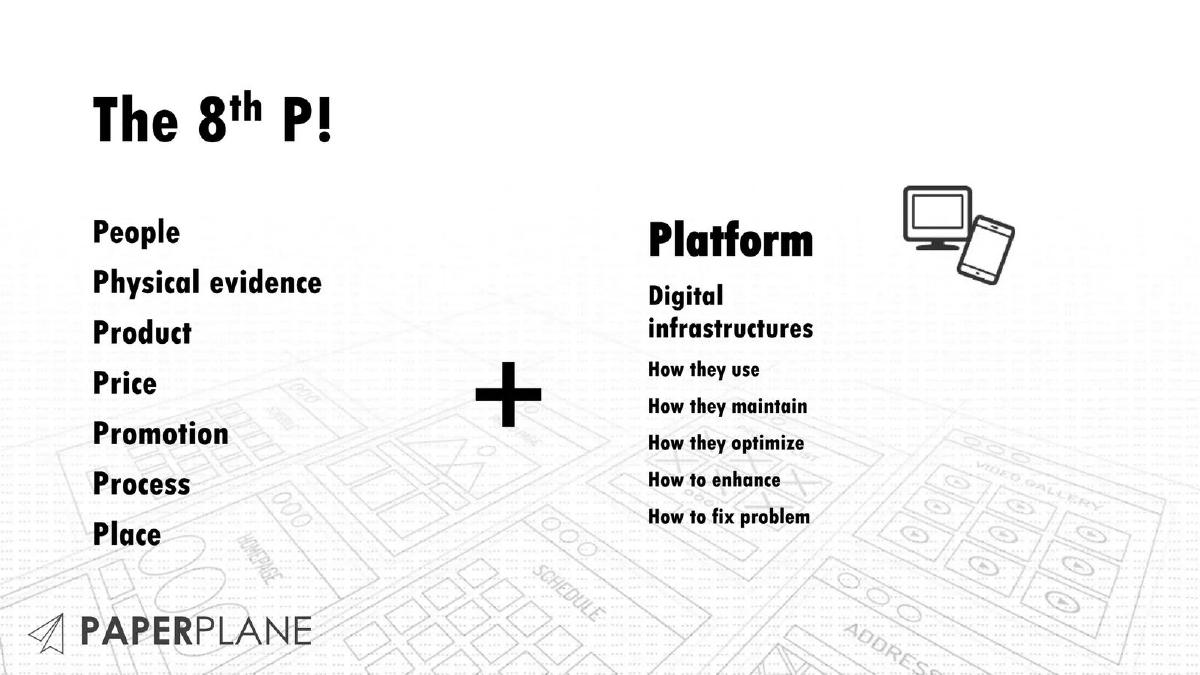
- Paperplane introduces 'Platform' as the '8th P' of marketing, alongside traditional elements like People, Product, and Price (Slide 2).
- The service workflow spans five stages: Opportunity analysis, Business concepting, Platform Development, Business maintenance, and Business enhancement (Slide 5).
- The partnership model is diversified across three pillars: Equity Based, Retainer Based, and Transaction Based (Slide 6).
- Operational efficiency is guided by '6 Core Values' including 'Limit WIP' (Work in Progress) and 'Manage Flow' (Slide 7).
- The deck identifies Persija and Motofied as 'Future partners,' though it does not clarify if these are signed LOIs or target leads (Slide 8).
- There is a total absence of financial projections, market size (TAM/SAM/SOM), or historical revenue data in the provided slides.
- The presentation lacks a team slide, omitting the backgrounds and expertise of the founders or engineering staff.
Slide-by-Slide Teardown
Slide 1: Title Slide
The cover slide features the Paperplane logo, which consists of a blue circle above the word 'PAPERPLANE' in blue and orange text. A stylized paper plane icon in blue and yellow is positioned in the bottom left. The background contains faint wireframe sketches of mobile and web interfaces, signaling a focus on UI/UX or digital product development.
Slide 2: The 8th P!
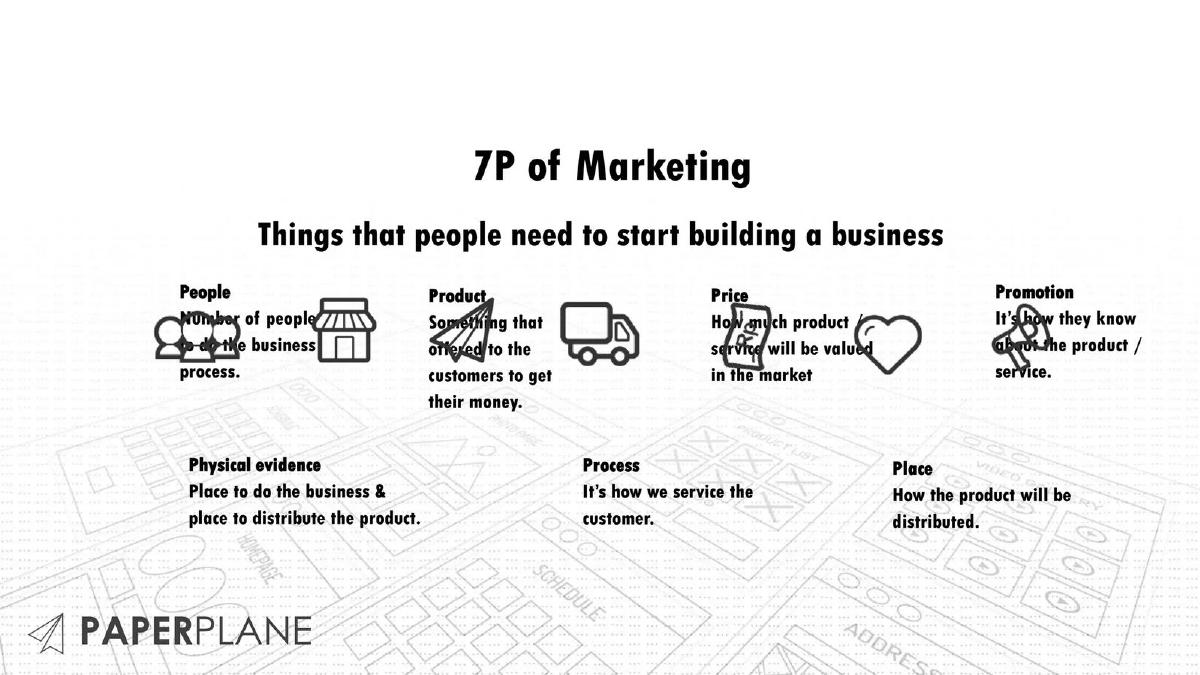
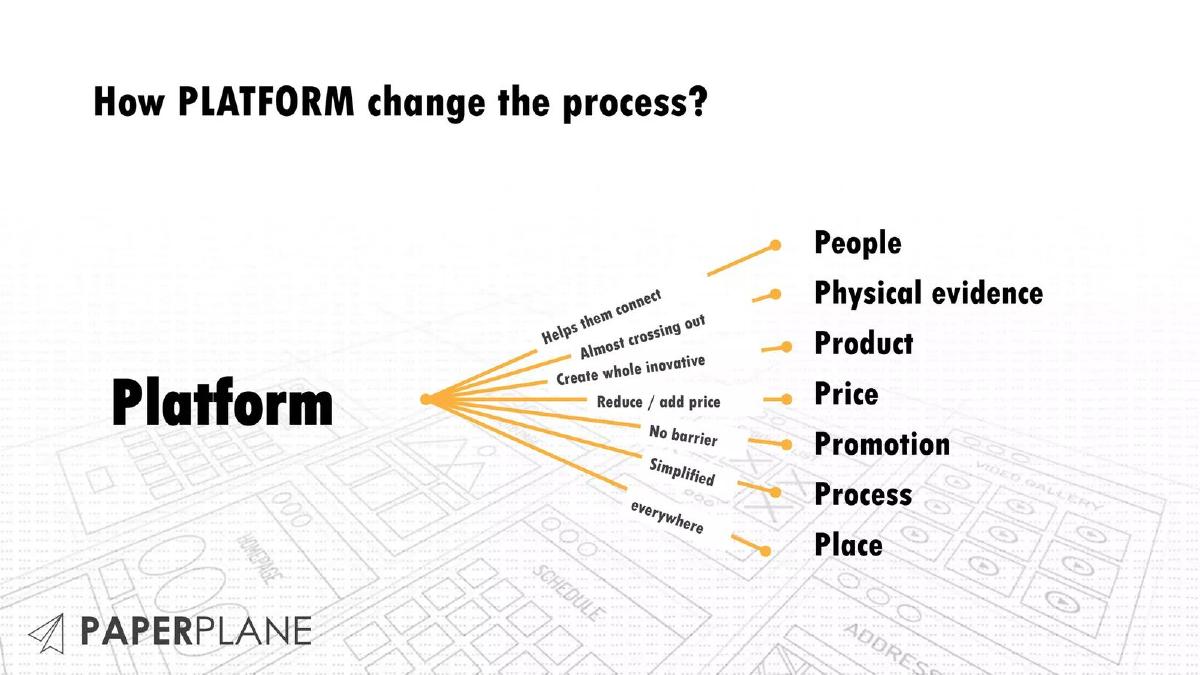
This slide attempts to establish a theoretical framework for the company's existence. It lists the traditional 7 Ps of the marketing mix (People, Physical evidence, Product, Price, Promotion, Process, Place) and adds 'Platform' as the '8th P.' Under 'Platform,' the slide lists digital infrastructures and five operational pillars: How they use, maintain, optimize, enhance, and fix problems. This slide positions the company as a foundational necessity for modern business.
Slide 3: Who We Are
A simple transition slide with the text 'WHO WE ARE' centered over the same wireframe background used throughout the deck. It serves no purpose other than to segment the presentation.
Slide 4: #DigitalBusinessAccelerator Definition
Paperplane uses a dictionary-style format to define their category. They describe a Digital Business Accelerator as 'Something which helping startups in fulfilling their technological needs in terms of building the digital infrastructure(s) they need to enhance their leverage points and deliver more values to their customers.' The grammar is slightly non-standard ('Something which helping'), but the intent is clear: they are a tech-enablement partner for startups.
Slide 5: The Workflow Process
This slide outlines the linear progression of their service model. The steps are: 1. Opportunity analysis, 2. Business concepting, 3. Platform Development, 4. Business maintenance (w/ Platform maintenance), and 5. Business enhancement (w/ Platform enhancement). This indicates that Paperplane intends to stay involved with a startup long after the initial build phase, moving into long-term maintenance and growth optimization.
Slide 6: Partnership Model
This is the most critical business slide in the deck. It lists three ways the company engages with clients: Equity Based (represented by a scales icon), Retainer Based (represented by a recurring dollar icon), and Transaction Based (represented by exchange arrows). This suggests a flexible business model that can act as a venture studio (equity) or a traditional agency (retainer/transaction).
Slide 7: 6 Core Values
The company lists its operational philosophy: Visualize, Limit WIP, Manage Flow, Make Policies Explicit, Implement Feedback Loops, and Improve Collaboratively Evolve Experimentally. These are standard Lean/Kanban principles. A stock photo of a team in an office setting is placed on the right, though it is unclear if this is the actual Paperplane team or a generic image.
Slide 8: Future Partners
The final slide in the set shows logos for 'Persija' (a professional football club based in Jakarta) and 'Motofied' (labeled as Est. 2014). They are categorized as 'Future partners,' which implies these are leads in the pipeline or desired clients rather than active accounts. No details are provided regarding the scope of these potential partnerships.
What Paperplane DefiniteDay Does Well
The deck is visually consistent and uses a clean, professional aesthetic. By defining themselves as the '8th P,' they attempt to create a unique category for their services, which can be a powerful way to differentiate from standard 'dev shops' or 'software agencies.' The inclusion of a clear partnership model (Slide 6) is helpful for potential partners to understand how they might engage with the company, showing a willingness to align incentives through equity.
The focus on 'Business Maintenance' and 'Business Enhancement' in Slide 5 is a strong selling point. Many agencies focus only on the 'Build' phase, leaving startups to struggle with technical debt or scaling issues later. Paperplane’s emphasis on the full lifecycle suggests a more integrated, long-term approach to startup success.
What is Missing from the Deck
As a fundraising or partnership deck, there are several glaring omissions based on the provided slides:
Team Slide: There is no information about the founders, their technical background, or their previous successes. In a service-based or 'accelerator' model, the pedigree of the people doing the work is the most important factor. · Market Size: There is no mention of the Total Addressable Market (TAM). How many startups need this service? What is the current spend on outsourced digital infrastructure? · Traction and Case Studies: The deck lists 'Future partners' but provides zero evidence of past success. Investors need to see what has already been built and how those startups performed after being 'accelerated.' · Financials and Unit Economics: There are no mentions of revenue, margins, or the cost of delivery. For a retainer-based business, understanding the LTV (Lifetime Value) and CAC (Customer Acquisition Cost) is essential. · The Ask: The deck does not state what it is looking for. Is this a seed round? A Series A? Are they looking for $500k or $5M? Without a clear 'Ask' slide, the presentation lacks a call to action. · Competitive Landscape: How does Paperplane differ from existing venture studios like Rocket Internet or Science Inc., or from high-end digital agencies?
What Founders Should Copy
Founders can learn from Paperplane's use of a Category Definition (Slide 4). If you are building something that doesn't fit neatly into an existing bucket, using a 'dictionary definition' slide can help anchor the audience's understanding of your value proposition. It forces you to be concise about what you are and what you do.
The Partnership Model (Slide 6) is also a good example of how to present complex revenue streams simply. Using clear icons and short labels for 'Equity,' 'Retainer,' and 'Transaction' allows an investor to immediately grasp the business's flexibility without needing a wall of text.
Finally, the Workflow Process (Slide 5) is a useful way to demonstrate that you have a repeatable system. Investors don't just buy a product; they buy a process that they believe can scale. Showing the steps from 'Opportunity analysis' to 'Enhancement' proves that the company has thought through the entire customer journey.
Final Analyst Thoughts
The Paperplane DefiniteDay deck feels more like a capabilities deck for a service agency than a pitch for a high-growth startup. While the 'Digital Business Accelerator' concept is interesting, the lack of team credentials and hard metrics makes it difficult to evaluate as an investment opportunity. The reliance on 'Future partners' suggests the company is in a very early, perhaps pre-revenue, stage. To move from a service provider to a fundable entity, the founders would need to demonstrate how this model scales beyond manual labor and provide proof of concept through successful portfolio companies.
Frequently asked questions
- What is a Digital Business Accelerator in the context of this deck?
- According to Slide 4, Paperplane defines this as a noun meaning 'Something which helping startups in fulfilling their technological needs in terms of building the digital infrastructure(s) they need to enhance their leverage points and deliver more values to their customers.' It essentially acts as a fractional CTO or outsourced product development shop that takes an active role in the business lifecycle.
- How does Paperplane DefiniteDay generate revenue?
- Slide 6 outlines three distinct revenue streams: Equity Based (taking ownership in client startups), Retainer Based (recurring service fees), and Transaction Based (likely project-based fees or success fees). This hybrid model suggests they are willing to trade immediate cash flow for long-term upside in the startups they accelerate.
- What is the '8th P' mentioned in the deck?
- Slide 2 references the traditional 7 Ps of marketing (People, Physical evidence, Product, Price, Promotion, Process, Place) and adds 'Platform' as the 8th P. They define Platform as digital infrastructure and the processes required to use, maintain, optimize, enhance, and fix it.
- Does the deck show any current traction?
- No. The provided slides do not list current revenue, number of active clients, or successful exits. Slide 8 lists 'Future partners' such as Persija and Motofied, but these are presented as prospective targets rather than confirmed case studies or current traction.
- What are the core operational values of the company?
- Slide 7 lists six core values: Visualize, Limit WIP (Work in Progress), Manage Flow, Make Policies Explicit, Implement Feedback Loops, and Improve Collaboratively Evolve Experimentally. These values are heavily influenced by Kanban and Lean manufacturing principles, suggesting a focus on operational efficiency in software delivery.