Parafin's 19-slide deck, used to secure a $60M Series B in 2023 as reported by Business Insider, is a study in structural clarity and technical authority. The presentation avoids the typical fluff of early-stage decks, instead focusing on the 'Investment Thesis' of why credit is the superior entry point for financial services. By positioning credit as the most difficult service to in-house, Parafin creates a compelling case for its infrastructure-as-a-service model. The deck relies heavily on the team's deep background in risk and machine learning at Robinhood and Numerai to justify their abi…
Key takeaways
- The deck defines credit as the most valuable but difficult embedded service to execute alone (Slide 3).
- Parafin claims platforms can get started with their infrastructure within days, emphasizing speed-to-value (Slide 4).
- Credit is positioned as a 'wedge' that is structurally superior to payments or insurance due to higher margins and evergreen demand (Slide 5).
- The product is designed to be 'processor-agnostic,' giving platforms end-to-end control over the user experience (Slide 4).
- The platform offers a 'no-code' integration option to lower the barrier for partners to launch capital programs (Slide 6).
- Small businesses are given the agency to customize offer sizes and repayment terms, such as a $26,000 loan at 10% of sales (Slide 8).
- The team slide highlights extreme technical pedigree, including a co-founder who was part of the team that discovered the Higgs-Boson (Slide 9).
- Parafin reports that even large platforms like Shopify rely on third parties for international lending, highlighting the difficulty of in-housing credit (Slide 5).
Parafin: The Infrastructure for Embedded Capital
Parafin’s Series B deck is a masterclass in strategic positioning. In an era where 'embedded finance' has become a buzzword, Parafin uses its 19-slide presentation to narrow the focus specifically to credit, arguing that it is the most difficult—and therefore most defensible—financial service to provide. As reported by Business Insider, this deck helped the company secure $60 million in 2023. The narrative is driven by a combination of technical authority and a clear understanding of the pain points faced by marketplaces and software platforms.
Slide 1: The Product in Action
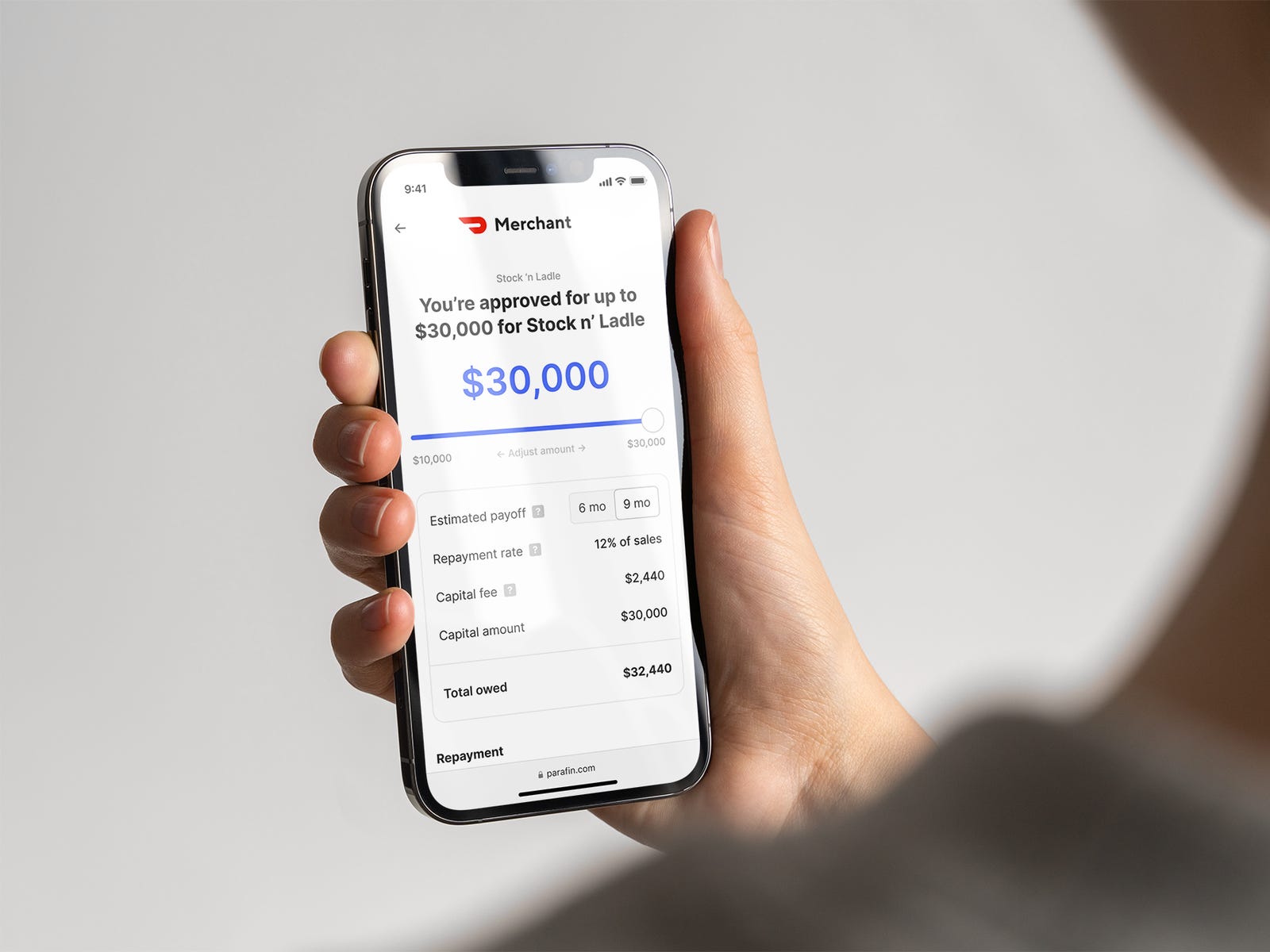
The deck opens with a high-fidelity mockup of the Parafin product on a mobile phone. It shows a merchant ('Stock n’ Ladle') approved for up to $30,000. The interface is clean, displaying a 'Capital fee' of $2,440 and a 'Total owed' of $32,440. This immediately establishes the product's simplicity and transparency, two critical factors in SMB lending.
Slide 2: The Mission Statement
Slide 2 is a minimalist transition slide with the text: 'We grow small businesses.' It serves to ground the technical infrastructure talk that follows in a human-centric outcome. By starting with the 'why,' Parafin attempts to align its interests with both the platforms and the end-users.
Slide 3: The Investment Thesis - Why Embedded Credit
Parafin spends significant time on the 'Investment Thesis.' Slide 3 posits that credit is the most valuable embedded financial service but also the most difficult for a platform to execute alone. The core argument is that credit attracts and retains sellers while multiplying revenue by supporting seller growth and platform Gross Merchandise Volume (GMV).
Slide 4: The Investment Thesis - Why Parafin
Following the 'Why Credit' slide, Slide 4 explains 'Why Parafin.' The company claims to be the 'partner of choice' based on three factors: Quickest Time-to-Value (getting platforms started in days), Most Reliable (vertically integrated and processor-agnostic), and Most Configurable (customized to platform workflows). This slide addresses the primary objections a platform might have: implementation time, technical debt, and lack of control.
Slide 5: The Credit Wedge
Slide 5 is perhaps the most important strategic slide in the deck. It visualizes a stack of financial services—Payments, Bank accounts, Card issuance, Insurance, etc.—and highlights 'Credit' at the bottom as the 'single best wedge.' The slide lists four reasons: high velocity/incidence, low switching costs for SMBs, highest margins, and its power to change seller behavior. Crucially, it notes that even a giant like Shopify relies on third parties for lending in certain regions, reinforcing the 'Most Difficult to In-House' claim.
Slide 6: Value Proposition Comparison
This slide uses a grid to compare Parafin’s approach against 'bad alternatives.' It breaks down the value prop into Speed and cost, User experience, and Customization. Parafin highlights its 'no-code integration' and 'zero risk' model for platforms, contrasted against the 'significant scale' and 'in-house underwriting' required for platforms to build their own programs. It also notes that most online lenders lack the infrastructure for real-time data sharing.
Slide 7: The Partner Experience
Slide 7 moves from the merchant view to the partner view. It shows the Parafin dashboard where a platform (in this case, 'Hearty Kitchens') can track the progress of its capital programs. Metrics shown include 'Total advanced' ($1,869,000.00), 'Total fees' ($179,242), and 'Avg. repayment rate' (12.23%). This demonstrates that Parafin provides the data transparency platforms need to justify the partnership.
Slide 8: The Merchant Experience
Returning to the merchant interface, Slide 8 shows how a small business can customize its offer. A red slider allows the user to select an amount (e.g., $26,000 out of a $30,000 limit). The terms are clear: a 10% repayment rate of sales and an estimated payoff of 9 months. This level of merchant agency is a key selling point for platforms that want to maintain high NPS among their users.
Slide 9: The Team
The 'About us' slide is a heavy hitter. The three founders—Vineet Goel, Ralph Furman, and Sahill Poddar—bring pedigrees from Robinhood, Numerai, and Facebook. The highlights are specific and impressive: Head of Risk & Fraud at Robinhood, Chief Scientist at Numerai, and a Physics PhD who 'Discovered the Higgs-Boson.' For a company whose core product is risk management and underwriting, this level of technical talent is a significant de-risking factor for investors.
Slide 10: Conclusion
The final slide in this sequence is a simple 'Thank you' on a black background. It signals the end of the core narrative, leaving the technical and strategic arguments to stand on their own.
What Parafin Does Well
The Parafin deck excels at strategic narrowing . Rather than trying to be an 'everything store' for fintech, they make a data-driven case for why credit is the only entry point that matters. By labeling credit as the 'most difficult' service, they automatically position their solution as high-value. If they can solve the hardest problem, the implication is that they can eventually solve the easier ones (payments, insurance) as well.
The technical credibility established on Slide 9 is another high point. In fintech, and specifically in lending, the 'who' is often as important as the 'what.' By showing they have the people who built the risk engines at Robinhood and the data science at Numerai, they preemptively answer questions about their ability to manage defaults and underwrite effectively.
What is Missing from the Deck
While the strategic narrative is strong, the public version of this deck is missing several key components typically expected in a Series B pitch:
Unit Economics: There is no mention of Customer Acquisition Cost (CAC), Lifetime Value (LTV), or specific take rates for Parafin itself. While Slide 7 shows partner revenue, it doesn't show Parafin's margins. · Market Size (TAM): The deck assumes the investor already understands the massive scale of SMB lending. There is no slide dedicated to the Total Addressable Market. · Competition: The deck mentions 'bad alternatives' generally but does not name specific competitors like Stripe Capital or other embedded finance players. · The Ask: The deck does not explicitly state how much they are raising or how the funds will be allocated, though Business Insider reported the round at $60M.
Lessons for Founders
Founders can learn two major lessons from Parafin. First, own the 'Hardest Problem.' If your industry has a specific task that everyone hates doing because it is legally, technically, or financially complex, make that your 'wedge.' Parafin didn't start with easy API integrations for payments; they started with the high-risk world of credit.
Second, leverage 'Pedigree as Proof.' If your team has worked at the frontier of your industry (like discovering the Higgs-Boson or running risk for a major brokerage), those facts should be front and center. They act as a proxy for the quality of the underlying technology, especially in a deck that is light on deep technical diagrams.
Frequently asked questions
- What is Parafin's core value proposition to platforms?
- Parafin provides a zero-cost, zero-risk embedded credit platform that allows software providers to offer capital to their users. According to Slide 6, the value lies in speed (no-code integration), optimized user experience for sellers, and the ability to use capital to drive seller behavior and platform GMV without the platform having to build underwriting infrastructure themselves.
- How does Parafin differentiate itself from other fintech infrastructure providers?
- On Slide 4, Parafin identifies three pillars: Quickest Time-to-Value (days to start), Most Reliable (vertically integrated and processor-agnostic), and Most Configurable (customized to platform workflows). They specifically highlight their ability to provide deep integration of real-time data, which most online lenders lack (Slide 6).
- Why does the deck focus so heavily on credit over other financial services?
- Slide 5 argues that credit is the 'single best wedge' for SMB platforms. It claims credit has higher margins than other services, high velocity/incidence (evergreen need for capital), and is the most effective tool to change seller behavior. It also notes that credit is the hardest service to build in-house due to high capital costs and concentrated risk.
- What technical expertise does the founding team bring to the table?
- The team, shown on Slide 9, features deep experience in risk, fraud, and machine learning. Vineet Goel was Head of Risk & Fraud at Robinhood; Ralph Furman was Chief Scientist at Numerai; and Sahill Poddar was Head of ML at Robinhood and holds a Physics PhD from CERN, where he contributed to the discovery of the Higgs-Boson.
- What does the Parafin product look like for the end-user (the small business)?
- Slide 8 shows a mobile-optimized interface where a business (e.g., 'Stock n' Ladle') can see an approved amount, such as $30,000. The user can use a slider to adjust the amount, choose an estimated payoff period (6 or 9 months), and see clear terms like a 10% repayment rate based on sales and a fixed capital fee.