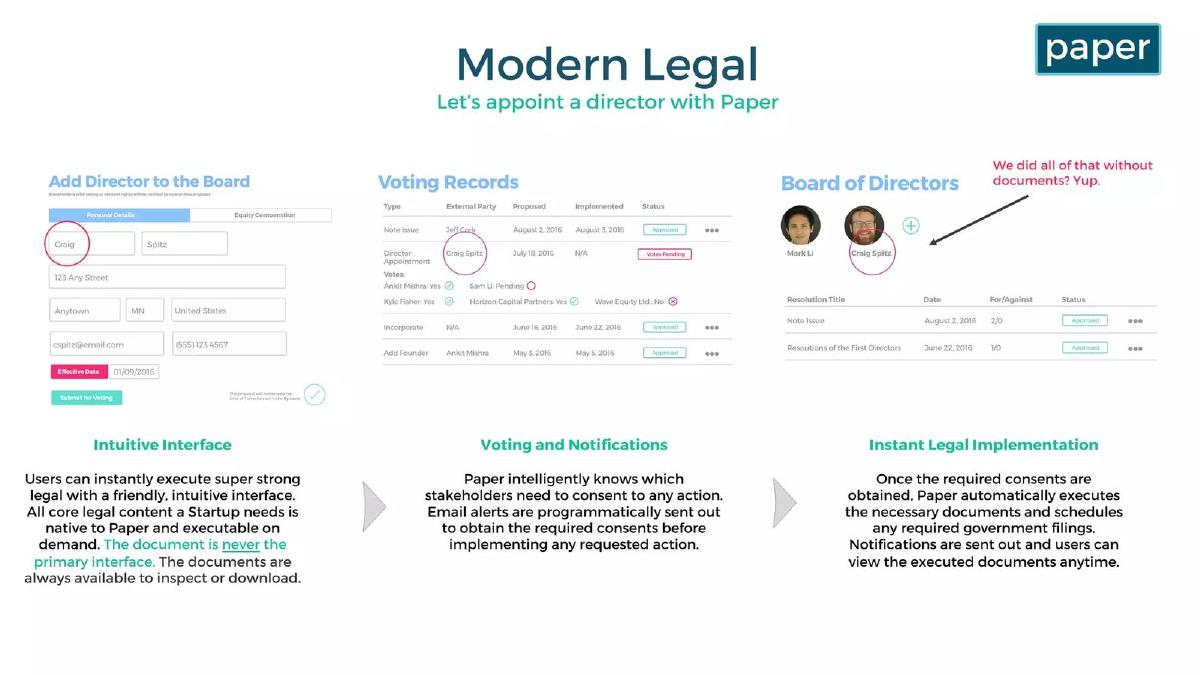
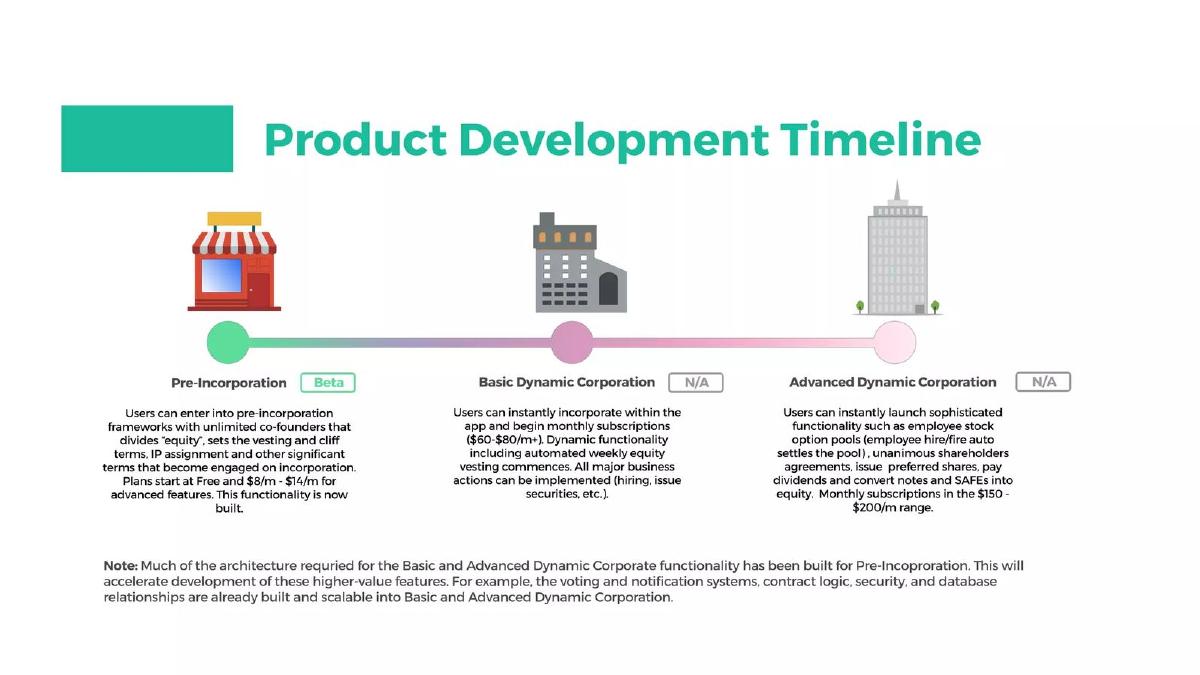
Paper Automated Legals (Paper Interactive, Inc.) positions itself as a disruptive force in the legal-tech sector by moving away from the document-centric models of incumbents like LegalZoom and Clerky. The deck argues that current solutions are 'painful' for entrepreneurs due to frustrating interfaces and a lack of guidance. Paper’s core thesis is that 'Legal is Code,' allowing for automated compliance and intelligent notifications. Their revenue model is diversified, combining SaaS subscriptions (ranging from free to $170/month) with a marketplace for in-app legal advice and premium contract…
Key takeaways
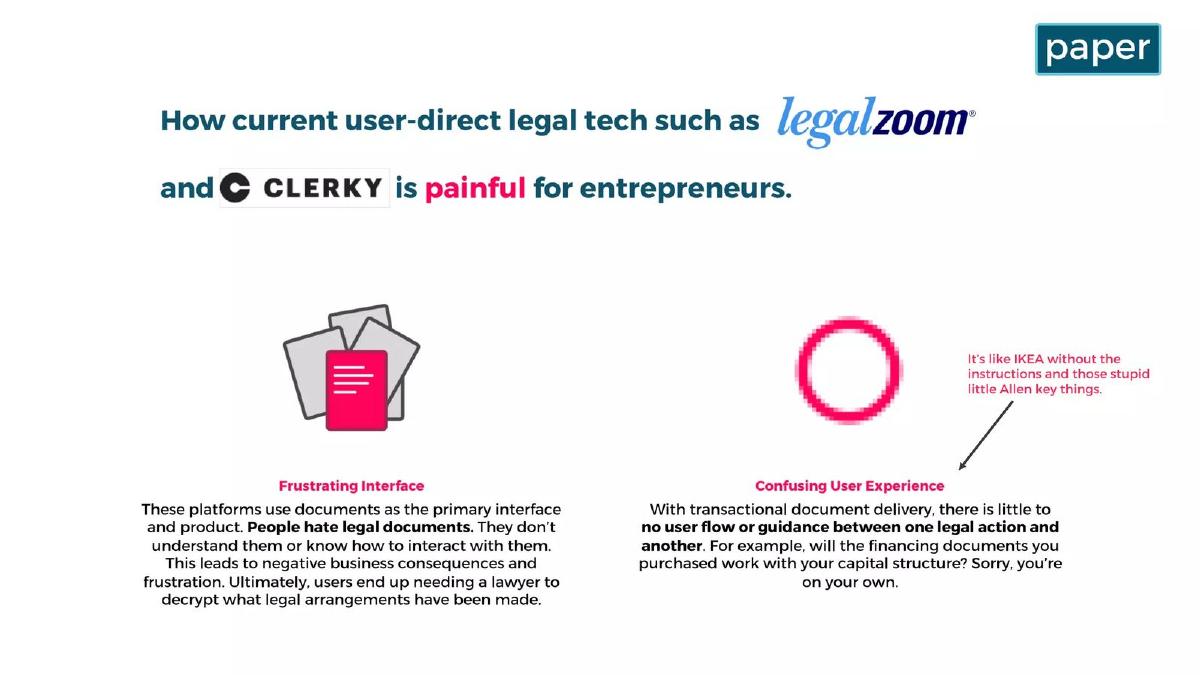
- The company defines its primary problem as the 'Frustrating Interface' of current legal tech, where documents are the product rather than the solution (Slide 2).
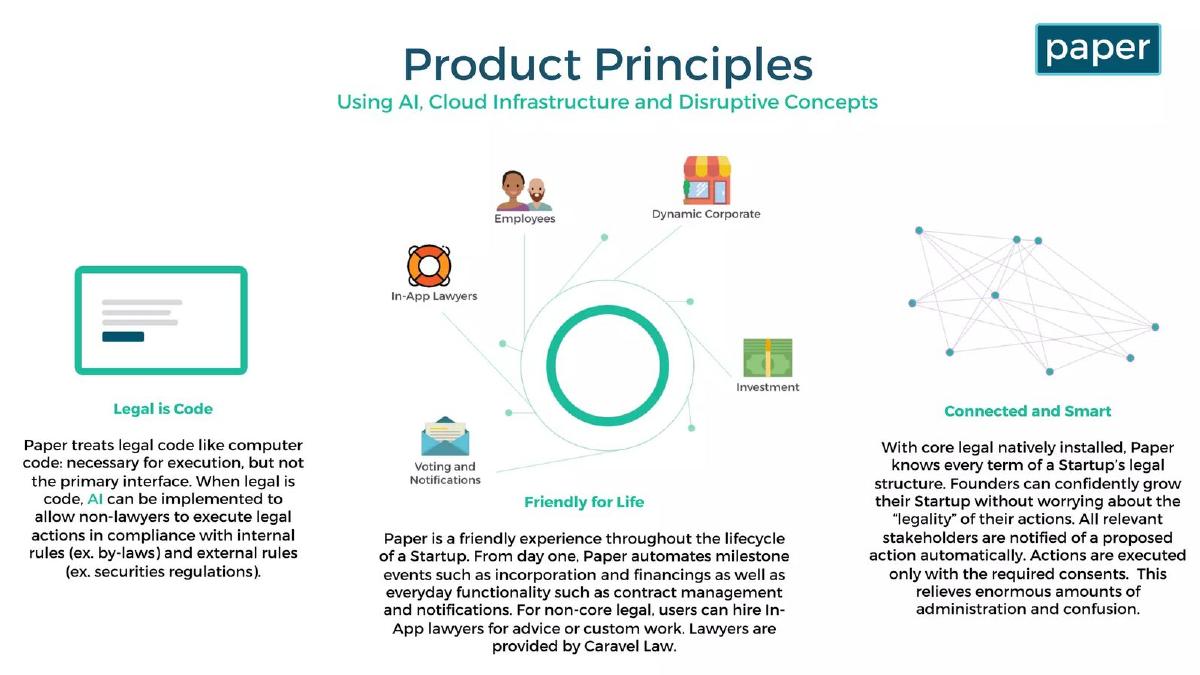
- Paper treats legal terms as 'code' to allow non-lawyers to execute actions in compliance with internal and external rules (Slide 3).
- The total addressable market is framed by 319,164 new US startups incorporated annually, representing an estimated $2.4b in legal spend (Slide 4).
- Revenue is generated through four subscription tiers: Free, $8/m, $90/m, and $170/m (Slide 5).
- The business model includes a 20% commission on in-app lawyer consultations and a 30% commission on marketplace contract purchases (Slide 5).
- Paper positions itself as the only 'Intuitive' and 'Affordable' player on a competitive matrix against Clerky, LegalZoom, and RocketLawyer (Slide 7).
- The team includes two JDs and four B.Eng leads, with one engineer noted for developing a Bitcoin farm generating $330 MRP (Slide 8).
- The company addresses regulatory risks by stating they provide 'legal product' rather than 'legal services,' similar to LegalZoom's regulatory space (Slide 9).
Slide-by-Slide Analysis
Slide 1: Title and Vision
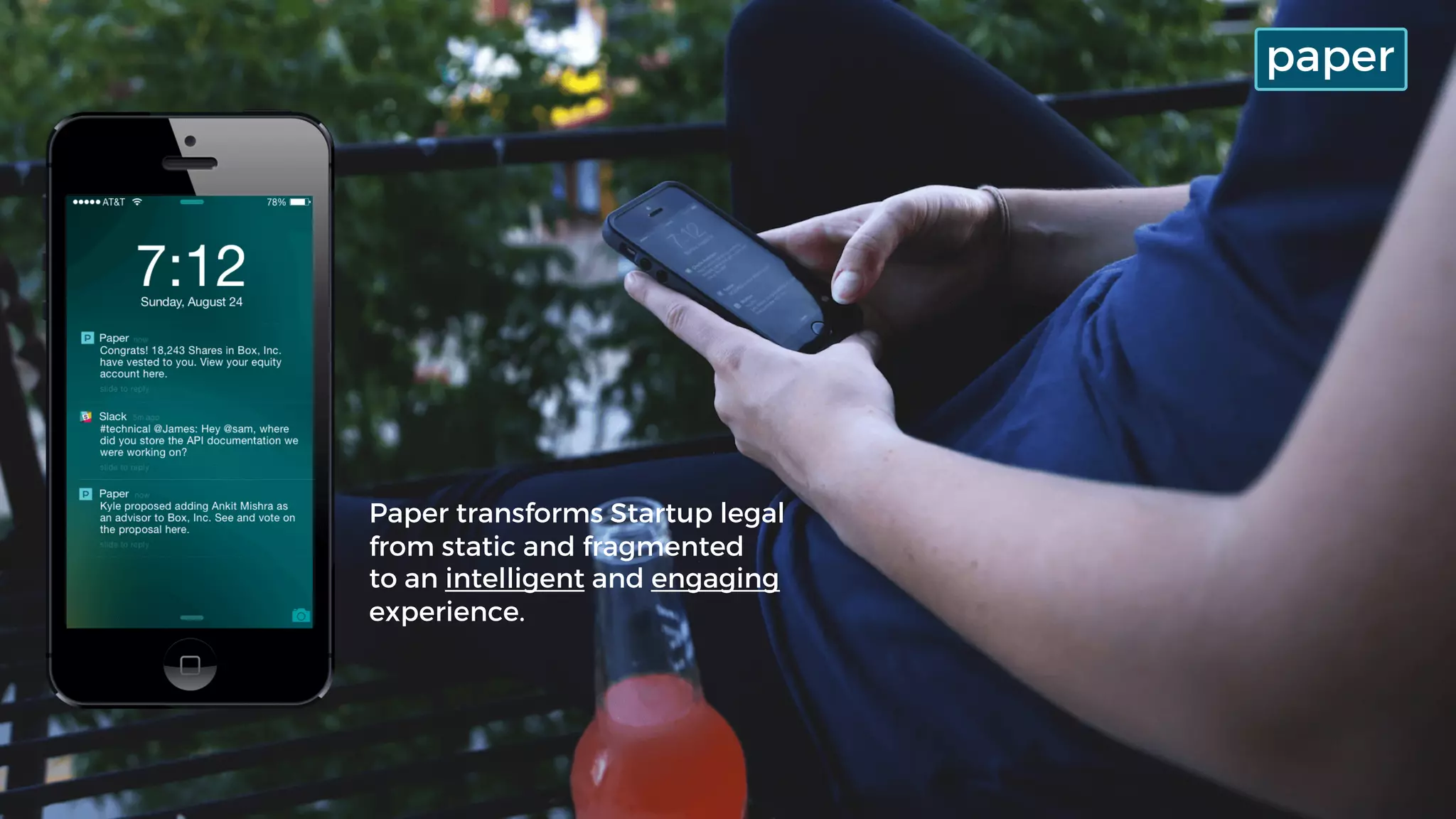
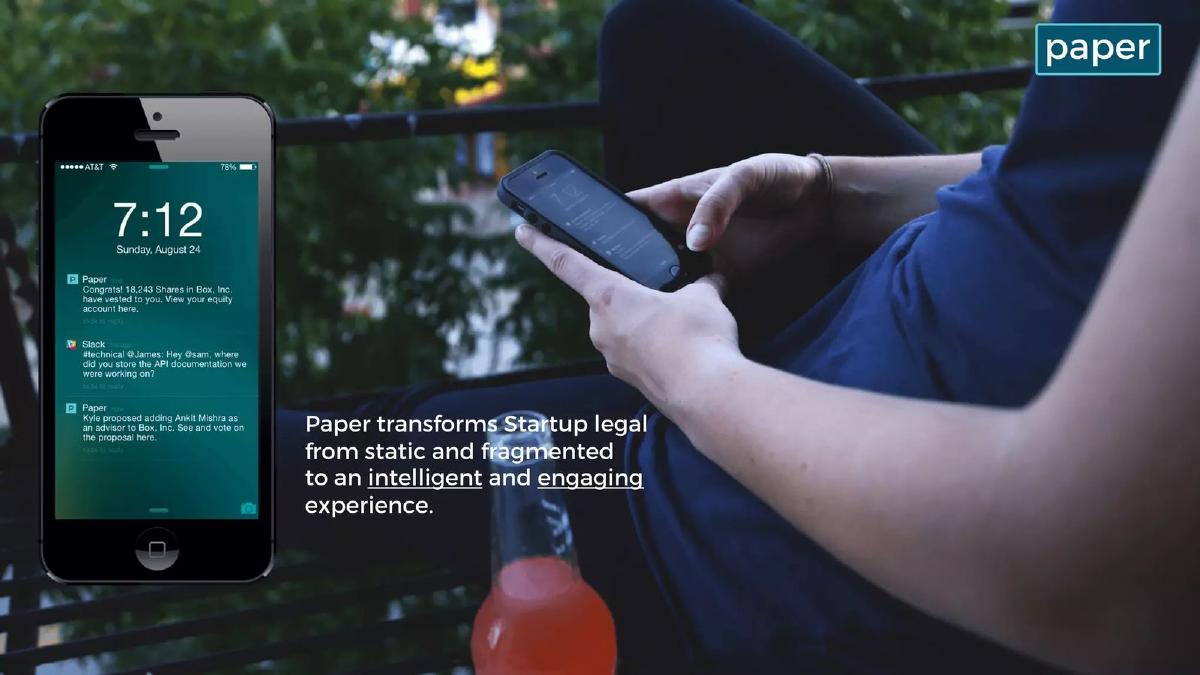
The cover slide features a high-resolution lifestyle image of a user interacting with a smartphone. The mobile interface shown displays notifications from 'Paper' regarding vested shares in 'Box, Inc.' and a proposal to add an advisor. The text states: 'Paper transforms Startup legal from static and fragmented to an intelligent and engaging experience.' This immediately establishes the product as a mobile-first, notification-driven platform rather than a desktop document repository.
Slide 2: The Problem
This slide identifies the pain points of 'user-direct legal tech' like LegalZoom and Clerky. It highlights two main issues: 'Frustrating Interface' (people hate legal documents and don't know how to interact with them) and 'Confusing User Experience' (a lack of guidance between one legal action and another). The slide uses a metaphor, comparing current solutions to 'IKEA without the instructions and those stupid little Allen key things.'
Slide 3: Product Principles
Paper outlines three core principles: 'Legal is Code,' 'Friendly for Life,' and 'Connected and Smart.' The 'Legal is Code' section is the most significant, explaining that by treating legal terms as computer code, AI can help non-lawyers execute actions in compliance with by-laws and securities regulations. The 'Friendly for Life' section mentions a partnership with Caravel Law to provide in-app lawyers for custom work.
Slide 4: Market Opportunity
The deck cites 319,164 new US Startups incorporated each year . It estimates the annual legal spend for these startups at $2.4b , which is a tiny fraction (0.006%) of the total $437b US legal market. The slide also makes a bold claim about 'Unlocking the Pre-Incorporation Market,' suggesting that if only 1 in 10 startups incorporate, there are 3.2 million potential users. It notes that Paper expects to be the first to offer 'SaaS-based legal content' rather than just document libraries.
Slide 5: Business/Revenue Model
Monthly Subscription: Tiers at Free, $8/m, $90/m, and $170/m. · In-App Lawyers: $215 per hour for expert advice, with Paper collecting a 20% commission . · Premium & Marketplace Contracts: A marketplace for non-core commercial contracts where Paper takes a 30% commission .
The slide also mentions upcoming university pilot projects for price testing.
Slide 6: The Platform Vision
This slide visualizes Paper as a central hub connected to various other services like eShares, Ironclad, UpCounsel, Gust, and Notarize . The strategy is to design Paper as a 'platform application' where third parties can implement functionality via a 'Paper Store.' The goal is to leverage network effects to create 'defensible technology' and aggregate legal-tech spend.
Slide 7: Why Now? / Competitive Landscape
The company argues that the current legal-tech model was established in the late 1990s and is ripe for disruption. A 2x2 matrix places Paper in the top-right quadrant as the only solution that is both 'Intuitive' and 'Affordable.' Competitors like Clerky are labeled 'Expensive,' while LegalZoom and RocketLawyer are labeled 'Hard to Use.'
Slide 8: The Team
The team slide features a group photo of seven men in 'Paper' branded t-shirts. Key members include:
Adrian Camara, JD: Business lead, former McCarthy Tétrault LLP. · Andre Garber, JD: Strategic Advisor, Director of Startup Programs at Dentons Canada LLP. · Kyle MacInnis, B. Eng: Tech Lead with a decade of experience. · Shane Fast, B. Eng: DB Engineering, noted for developing a Bitcoin farm.
The slide uses asterisks to indicate the number of prior businesses founded by each member.
Slide 9: Common Questions (FAQ)
This slide addresses regulatory and scalability concerns. It confirms that Paper is compliant with regulations by providing 'legal product' rather than 'legal services.' It also mentions that legal content is developed in partnership with Dentons Canada LLP and Dentons US LLP . Regarding scalability, it compares its infrastructure needs to Stripe and Uber, noting that the biggest bottleneck is developing processes for efficient incorporation across different jurisdictions (e.g., Delaware).
Slide 10: Legal Disclaimer
A standard, dense legal disclaimer slide covering 'Paper Interactive, Inc.' It includes typical language regarding forward-looking statements, investment risks, and the fact that the document does not constitute an offer to sell securities.
What Works Well in This Deck
The 'Legal is Code' Narrative: By framing legal documents as executable logic, Paper creates a compelling technical differentiator. This moves the conversation away from 'we have better templates' to 'we have a smarter system that prevents errors.' It appeals to the mindset of tech-savvy investors who understand the value of automation and compliance-as-code.
Clear Monetization Strategy: Unlike many early-stage decks that hand-wave revenue, Paper is very specific. Listing exact subscription prices ($8, $90, $170) and commission percentages (20% and 30%) shows that the founders have thought deeply about the unit economics and how to capture value from both software and services.
Strategic Partnerships: Mentioning established law firms like Dentons and Caravel Law provides much-needed credibility. In a highly regulated industry like law, showing that you have 'grown-ups' in the room helping to develop content mitigates significant risk for an investor.
What Is Missing from the Deck
Traction Data: The deck mentions 'two university pilot projects this fall,' but provides no data on current users, waitlists, or early feedback. For a platform claiming to be more intuitive than LegalZoom, some form of user validation or engagement metrics would be powerful.
The Ask: The provided slides do not include a 'Funding Ask' or 'Use of Funds' slide. While the disclaimer mentions an offering of securities, the deck doesn't state how much they are raising or what milestones that capital will help them achieve.
Product Walkthrough: While the first slide shows a mobile notification, there are no actual screenshots of the platform's interface. Given that 'Frustrating Interface' is a core part of the problem they are solving, seeing the 'Intuitive' solution they've built is a missed opportunity.
What a Founder Should Copy
The Problem Metaphor: The IKEA metaphor on Slide 2 is excellent. It takes a complex, dry subject (legal tech) and makes the pain point immediately relatable to anyone who has ever struggled with flat-pack furniture. Using simple, evocative analogies helps investors 'feel' the problem.
The Platform Hub Visualization: Slide 6 does a great job of showing how a startup fits into a larger ecosystem. Instead of just saying 'we will integrate,' they show a web of connections that makes the 'defensible technology' argument visual and easy to grasp.
The FAQ Slide: Including a 'Common Questions' slide (Slide 9) is a pro move. It allows the founders to proactively address the 'elephant in the room'—in this case, the legality of non-lawyers providing legal products—before an investor even has to ask. This demonstrates maturity and regulatory awareness.
Frequently asked questions
- What is Paper's core product philosophy?
- Paper operates on the principle that 'Legal is Code.' Instead of viewing legal documents as static text files, they treat them as executable logic. This allows the platform to monitor a startup's legal structure in real-time, sending automated notifications for milestones like equity vesting or voting requirements, and ensuring all actions comply with the company's specific by-laws and external regulations.
- How does Paper plan to make money?
- The company employs a multi-stream revenue model. This includes a tiered SaaS subscription for the platform (up to $170/month), a marketplace for premium and niche commercial contracts where Paper takes a 30% commission, and an in-app lawyer consultation service. For the latter, they partner with Caravel Law and take a 20% commission on the $215 per hour legal fees.
- Who are the primary competitors identified in the deck?
- The deck explicitly names LegalZoom, Clerky, RocketLawyer, and LawDepot as competitors. It categorizes these incumbents as 'low-innovation platforms' that simply replicate traditional legal models online. Paper also mentions more modern players like eShares (now Carta), Ironclad, and UpCounsel, but positions itself as a central platform hub that could eventually integrate with these services.
- What is the background of the founding team?
- The team is a mix of legal and technical expertise. It features Adrian Camara (JD) and Andre Garber (JD) for business and strategy, alongside four engineers. Notably, the technical team has experience in app development, Apache Spark engines, and even cryptocurrency mining. The deck emphasizes their 'high-velocity' technical capabilities as a core competitive advantage against established legal-tech players.
- How does the company handle the 'practice of law' regulations?
- Paper addresses this in their FAQ slide, stating they occupy the same regulatory space as LegalZoom and Clerky. They distinguish between 'legal services' (the exclusive monopoly of qualified lawyers) and 'legal product' (self-help providers). They clarify that any actual legal advice is provided by third-party lawyers from Caravel Law via the platform, rather than by Paper itself.