Founder Salaries in Use of Funds: How to Show What You Will
Should founder pay appear on your ask slide, and how? Four real use-of-funds slides show the difference between a monthly figure investors can check.
Founder Salaries on the Ask Slide: Show the Monthly Amount, the Months and the Reason
Early founders often have to decide whether to pay themselves out of the round, and whether to say so on the deck. Many skip it. Others add 'Founder Salaries' as a slice of a use-of-funds pie and move on. Investors, especially angels writing small cheques, look for this line on purpose: it tells them how much of their money goes to the people asking for it, whether the founders can now work full time, and whether the pay is modest enough to leave room for the work the round is meant to fund. This guide looks at four early ask slides that name founder pay and shows which details make the line useful.
TL;DR
If the round pays the founders, say so, and give the amount per founder per month, the number of founders and the number of months it covers. Paper does this best: 'Proceeds will fund founder salaries of approximately $2,000 to $2,500 per month', alongside '10 months of run'. Tattle gives a clear dollar line, 'Founder Salary & Benefits $65,000' out of $150,000, but leaves the reader to work out that this is 43% of the round and doesn't say how many founders or months it covers. M&A Nexus gives 'G&A (founder salary) – 25%' of $500k, folding pay into overheads. Lollipop Audio gives a 29% 'Founder Salaries' slice of $500K over ten months, about $14,500 a month in total, without saying how many founders share it. A monthly figure per person lets an investor judge the line in seconds; a percentage makes them do arithmetic and still guess.
Four ask slides that name founder pay
Each slide is read at full size. Quotes are exact; calculated figures are our arithmetic from the slide.
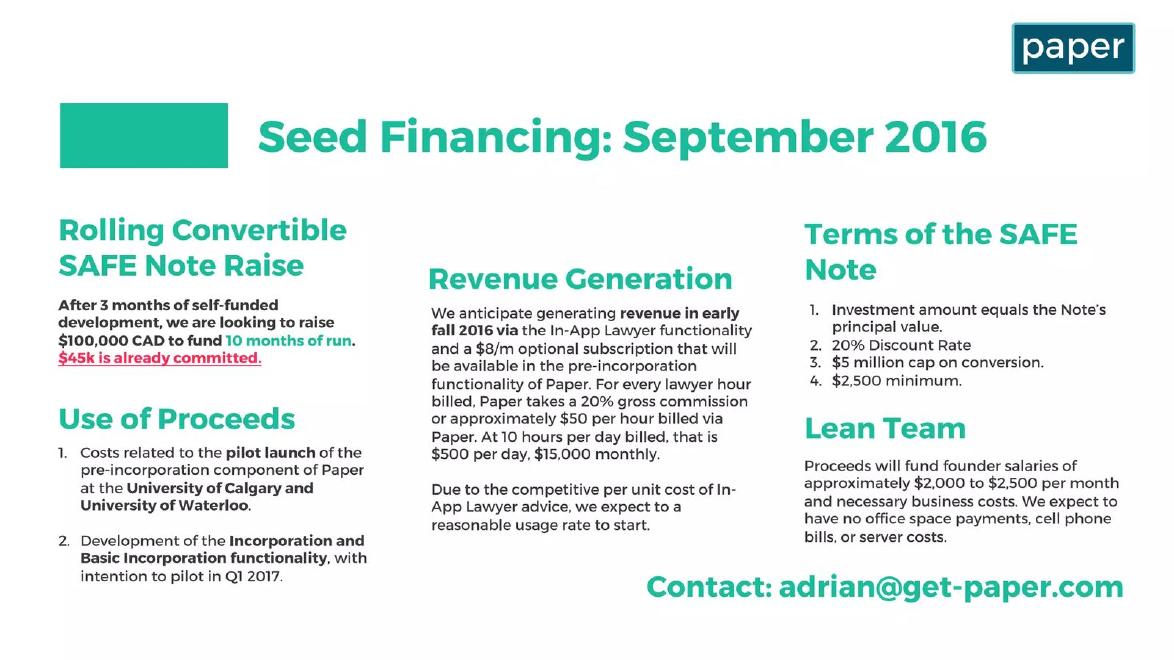
Paper ask slide — slide 16
Legal paperwork automation. Seed financing slide with SAFE terms and use of proceeds.
Paper deck, slide 16. Exact stored slide matched to this analysis.
Our analysis: The clearest presentation: an investor can judge the pay at once.
Evidence and limitation: Monthly pay range, ten-month period and a stated reason (lean team, no office or server costs).
What a founder can adapt: Add the number of founders, the total and the currency of the salary.
Supporting analysis
What the deck claims: "Proceeds will fund founder salaries of approximately $2,000 to $2,500 per month and necessary business costs." Raise: "$100,000 CAD to fund 10 months of run."
Presentation choice: Shows a monthly figure with a period and a reason.
When it does not fit: Leaving the reader unable to calculate the total.
What each slide tells an investor about founder pay
Whether founder pay is separate, and which figures an investor can read or calculate.
Example
Own line
Monthly amount
Number of founders
Period
Share of round
Reason given
Paper
Yes
Yes ($2,000–2,500)
No
10 months
No
Yes (lean team)
Tattle
Yes
No (annual $65,000)
No
Year one
Calculable (43%)
No
M&A Nexus
No (inside G&A)
No
No
Unclear
25% incl. G&A
No
Lollipop Audio
Yes
Calculable total only
No
10 months
29%
No
Key Takeaways
If the round pays founders, say so on the ask slide rather than hiding it in a wider category.
Give pay per founder per month, the number of founders and the months covered.
Show the share of the round as well, so investors see the trade-off.
Say what full-time founders will deliver in that period.
Separate founder pay from hires, overheads and general and administrative costs.
Check that the figures add up with your burn rate and runway.
Write your founder pay line
Answer these before you finalise the ask slide.
Who. How many founders will be paid from this round, and will all of them be full time?
How much. What is each founder's monthly pay, in which currency, and does it include benefits?
How long. How many months does it cover, and does that match your runway and burn rate?
Why. What will full-time founders deliver in that period that they couldn't otherwise?
Copyable framework: "Founder salaries: [N] founders at $[X] a month for [M] months ($[total], [P]% of the round), so we can work full time on [milestone]."
Illustrative example 1 — written by us
Before: "G&A (founder salary) – 25%"
After: "Founder salaries: [N] founders at $[X] a month for 15 months ($[Y], [P]%). Other G&A: [Q]%."
What improved: Our illustrative rewrite of M&A Nexus's line. Bracketed details are not stated on the slide.
The question this guide answers
This guide answers one founder question: if part of the round will pay the founders, should the ask slide say so, and what exactly should it say?
Our use-of-funds guide covers how to split a round into categories, our hiring plan guide covers new roles, and our runway guide covers how many months the money lasts. One of the slides here, M&A Nexus, also appears in the runway guide, where the lesson is about burn rate and break-even. None of these guides makes founder pay its subject. The advice here is specific to that line: whether to show it, which figures investors look for, and how to present it so it reads as a plan rather than a request for a salary.
The question matters most at pre-seed and seed, when the round is small, founders may have been working unpaid or part time, and each investor can easily calculate what share of their cheque goes to founder pay.
How we chose and read the examples
We searched extracted slide text for 'founder salary' and 'founder salaries'. Matches came mostly from early-stage ask and use-of-funds slides. We left out listed companies and slides where founder pay appeared only as a word in a long list with no amount or share. We kept four slides that each present founder pay differently: a monthly figure per founder, a dollar line in a budget table, a percentage inside overheads, and a pie slice.
Each slide was rendered from the source deck and read at full size. Where we give a calculated figure, such as a percentage or a monthly total, we did the arithmetic from the numbers printed on the slide and say so. We did not check any figure against company accounts or other outside sources, and we don't know what these founders were actually paid.
Four examples are enough because each represents one common way of handling the line, and together they show what each format leaves out.
Why investors look for this line
It tells them who gets their money. In a $150,000 round, a $65,000 salary line is a large part of the cheque. Investors would rather see that on the slide than discover it in the budget later.
It tells them whether the founders can work full time. A round that pays modest salaries can mean founders leave jobs and commit fully. For many angels that is a reason to invest, not a concern, provided the pay is modest.
It tells them whether the pay is reasonable. Investors compare founder pay with what the company needs to build and sell. They don't need a market-rate salary to feel comfortable; they want to see that the founders aren't the largest single use of the money unless there is a good reason.
It tests the rest of the numbers. Pay per month, months covered and total spend should agree with the burn rate and runway on the same slide. When they don't, investors notice.
It signals openness. Naming founder pay clearly shows the founders expect the question. Leaving it out, or burying it in 'G&A' or 'Operations', often means it gets asked anyway, with less goodwill.
A monthly figure with the reason: Paper
Paper, which was building software to automate legal paperwork for new companies, has a slide headed 'Seed Financing: September 2016'. On the left: 'After 3 months of self-funded development, we are looking to raise $100,000 CAD to fund 10 months of run. $45k is already committed.' On the right, under 'Lean Team': 'Proceeds will fund founder salaries of approximately $2,000 to $2,500 per month and necessary business costs. We expect to have no office space payments, cell phone bills, or server costs.' The slide also shows the SAFE terms and a use-of-proceeds list for a pilot and product development.
This is the clearest example. A reader learns the monthly pay, the period (ten months), and why the pay is low: the heading 'Lean Team' and the list of costs the company won't incur explain the choice. A founder salary of $2,000 to $2,500 a month reads as living costs while working full time, which is what most early investors hope to see. The note that the founders self-funded three months of development adds to the impression of commitment.
Two details are missing. The slide doesn't say how many founders will be paid, so an investor can't calculate the total; if there are two, ten months at that rate would be roughly $40,000 to $50,000 of a $100,000 round, which is a large share that the slide doesn't state. And the salary figure has no currency label; since the raise is stated in Canadian dollars, it is probably Canadian dollars too, but the slide doesn't say. Adding 'for [N] founders, about $[X] in total' would complete the line.
A dollar line in a budget: Tattle
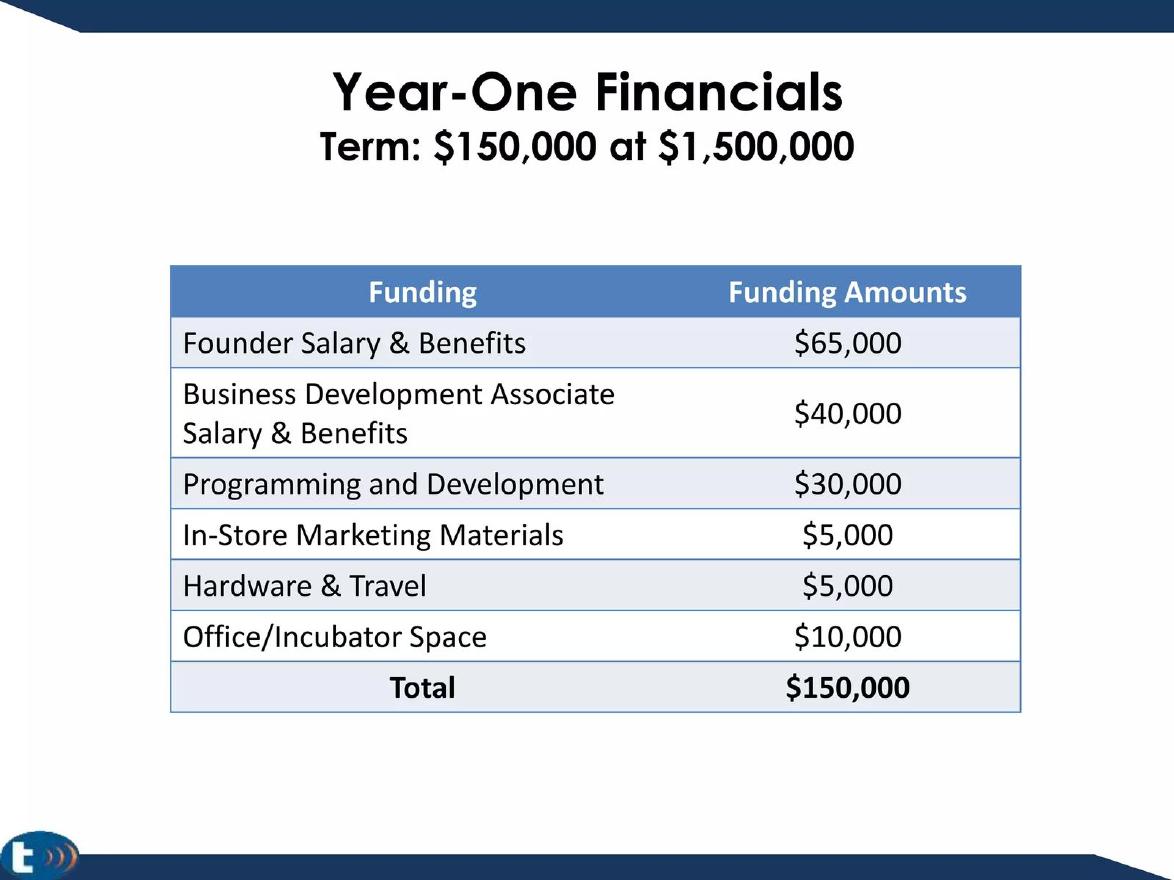
Tattle, which offered feedback software for small businesses, has a slide headed 'Year-One Financials' with the subtitle 'Term: $150,000 at $1,500,000'. A table lists 'Founder Salary & Benefits $65,000', 'Business Development Associate Salary & Benefits $40,000', 'Programming and Development $30,000', 'In-Store Marketing Materials $5,000', 'Hardware & Travel $5,000', 'Office/Incubator Space $10,000', and 'Total $150,000'.
The strength here is that founder pay is its own line, separate from the first hire, with an exact amount and a period (year one). An investor can see immediately that founder pay is the largest single item. Including benefits in the line is honest, since it is part of the real cost.
What the table leaves to the reader is the share and the reason. $65,000 is 43% of the round, by our arithmetic; that is the kind of figure an investor will calculate anyway, and stating it, with a reason, is stronger than leaving it unsaid. The line reads 'Founder' in the singular, but the slide doesn't say how many founders there are or whether the amount is shared. A note such as 'one full-time founder at $5,400 a month including benefits, so the company can launch in [N] stores' would turn the number into a plan. The subtitle 'at $1,500,000' also doesn't say whether that valuation is before or after the money; that is a separate point covered in our deal terms guide.
Founder pay inside overheads: M&A Nexus
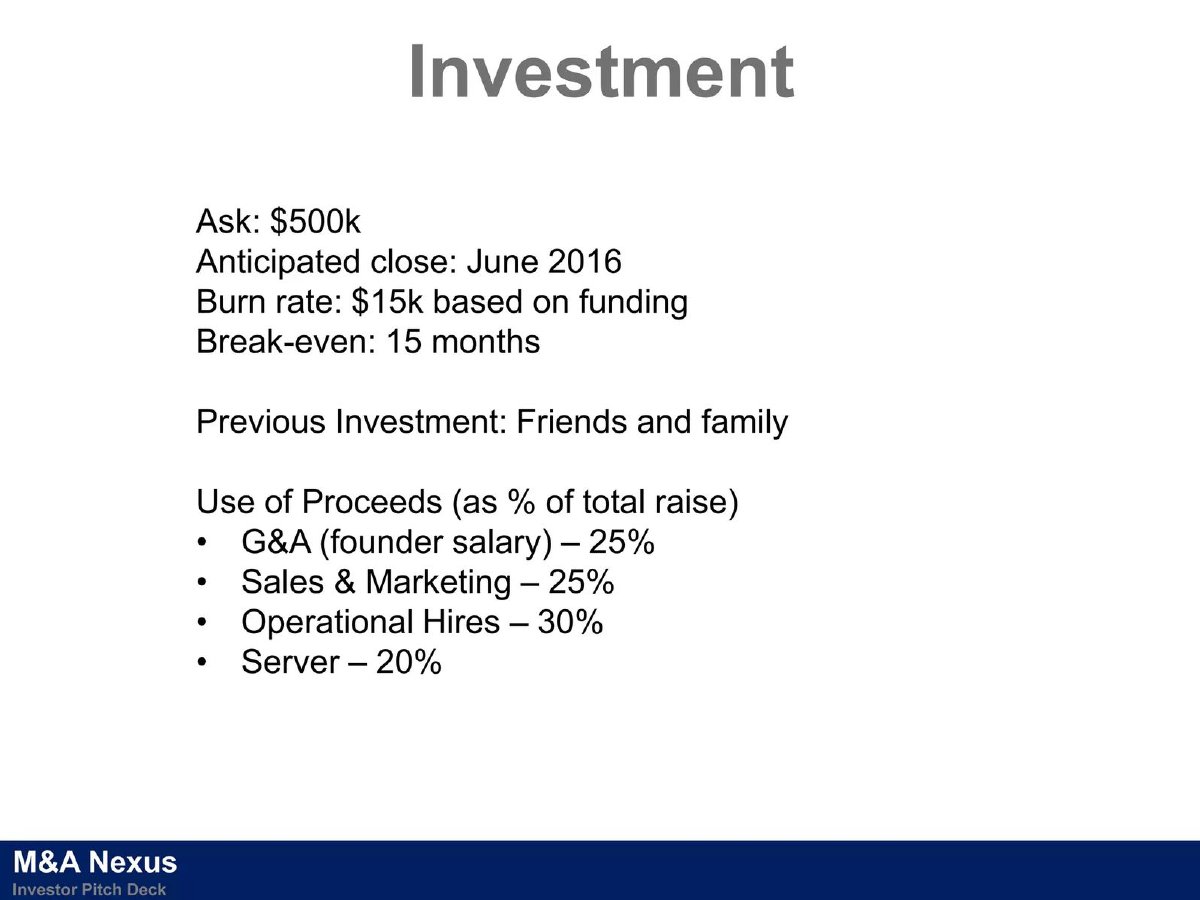
M&A Nexus, which was building an online marketplace for buying and selling small companies, has a slide headed 'Investment'. It reads 'Ask: $500k', 'Anticipated close: June 2016', 'Burn rate: $15k based on funding', 'Break-even: 15 months' and 'Previous Investment: Friends and family'. Then 'Use of Proceeds (as % of total raise)': 'G&A (founder salary) – 25%', 'Sales & Marketing – 25%', 'Operational Hires – 30%', 'Server – 20%'.
The slide deserves credit for naming founder salary at all; many decks put it inside general and administrative costs without saying so. Putting it in brackets tells the reader what most of that 25% is for.
But the format makes the line hard to judge. 25% of $500k is $125,000, by our arithmetic, but the slide gives no monthly amount, number of founders or period. Combining founder pay with general overheads also means an investor can't tell how much is pay and how much is rent, legal fees or accounting. And the other figures don't settle it: a $15k monthly burn would make $500k last about 33 months, well beyond the 15-month break-even, so a reader can't work out from the slide how long the founder pay is meant to last. 'Two founders at $[X] a month each for 15 months, $[Y] in total' as its own line would answer all three questions.
A pie slice without people or months: Lollipop Audio
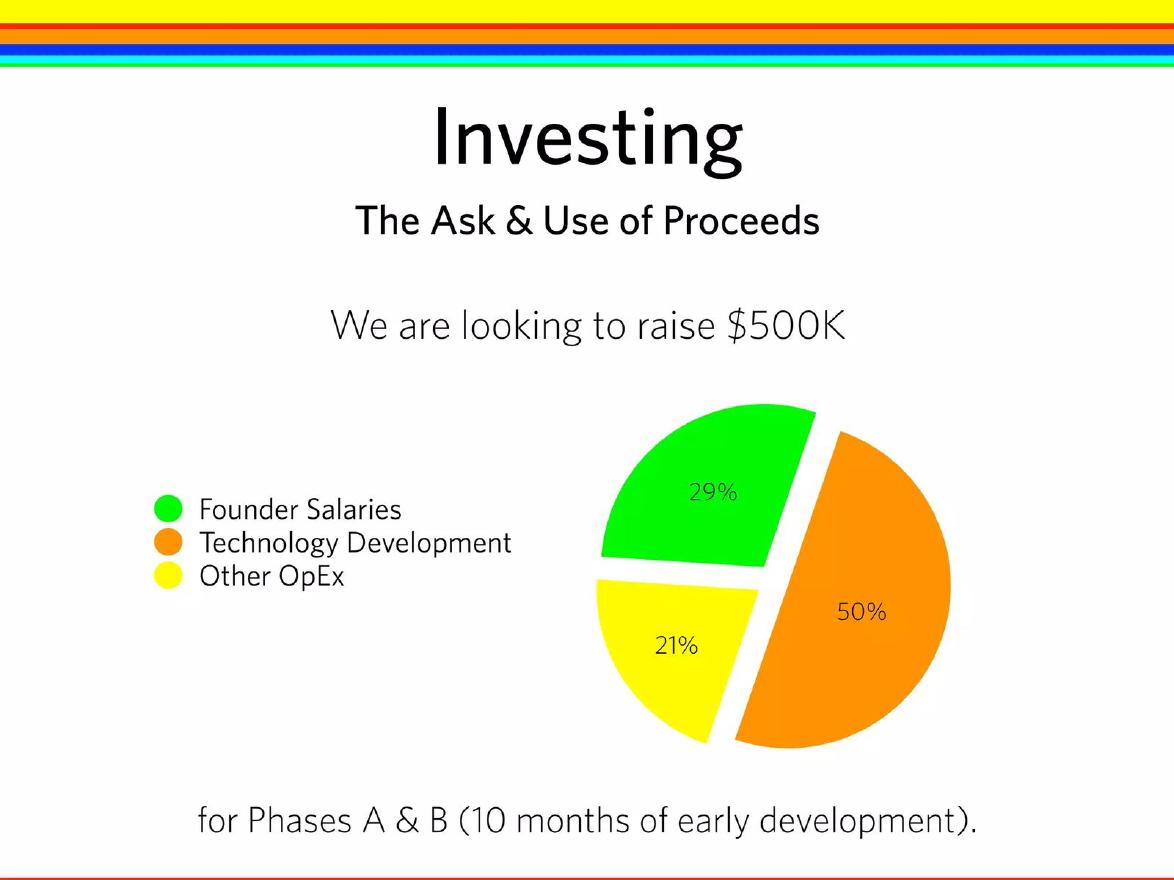
Lollipop Audio, which was developing audio technology, has a slide headed 'Investing' with the subtitle 'The Ask & Use of Proceeds'. It reads 'We are looking to raise $500K' above a pie chart with three slices: 'Founder Salaries' 29%, 'Technology Development' 50% and 'Other OpEx' 21%. Below: 'for Phases A & B (10 months of early development).'
This slide does two useful things. It gives founder pay its own slice rather than hiding it, and it states the period, ten months. With those two facts an investor can calculate that founder salaries come to about $145,000, or roughly $14,500 a month in total, by our arithmetic.
What it leaves out is how many founders share that amount, which decides whether it reads as modest or generous. $14,500 a month is very different for one founder than for three. A pie chart also shows shares well but hides amounts, so the reader has to do the multiplication. 'Founder salaries: [N] founders at $[X] a month for 10 months ($145K, 29%)' as a label on the slice would make the chart complete. The phrase 'Phases A & B' would also be stronger if the slide said what the founders will have delivered at the end of each phase.
What to write
Amount: 'Founder salaries: [N] founders at $[X] a month each, [currency].'
Period: 'for [M] months', matching the runway on the same slide.
Total and share: '$[total], [P]% of the round.' Investors will calculate it anyway; stating it shows you have.
Reason: one line on why, such as 'so both founders can work full time from [month]' or 'below previous salaries; lean team, no office'. Paper's 'Lean Team' heading does this in two words.
Separation: keep founder pay apart from new hires and overheads, as Tattle does, so each line can be judged on its own.
Should founder pay appear at all?
If the round will pay founders, yes. Investors will find out from the budget, the financial model or due diligence, and it reads better when you have stated it plainly. If the founders will not draw a salary from this round, a short note such as 'founders unpaid until [milestone]' answers the question before it is asked, though it may lead investors to ask how the founders will support themselves.
Where the amount is a large share of the round, as in Tattle's case, explain it rather than shrink it. A founder who is leaving a job to work full time, and whose salary is the main cost of building the product, can say that. What makes investors uneasy is a large figure with no explanation, not a large figure in itself.
What these examples can and cannot show
These four slides show how early founders have presented their own pay on an ask or use-of-funds slide. They can't show whether the amounts were reasonable for those companies, what the founders were actually paid, or how investors reacted. Calculated figures in this guide come from the numbers printed on the slides; we have not checked any of them against outside sources.
Treat them as patterns of presentation. Paper's monthly figure and reason are the model to follow, with a founder count added. Tattle's separate line is easy to copy and needs a share and a reason. M&A Nexus and Lollipop Audio show what is lost when pay is only a percentage.
Common mistakes
Hidden in overheads. Founder pay folded into G&A or operations.
Percentage only. A share of the round with no amount per person.
No founder count. A total that can't be judged per person.
No period. Pay with no months attached.
Numbers that don't reconcile. Pay, burn and runway that disagree.
Diagnostic checklist
Founder pay is its own line.
Monthly amount per founder given, with currency.
Number of paid founders stated.
Months covered match the runway.
Share of the round stated.
One line on what full-time founders will deliver.
Frequently asked questions
Is it acceptable to pay founders from a seed round?
Commonly, yes. Most investors expect founders to draw modest pay so they can work full time. What they want is a clear amount and a reason.
Should I show salary as a percentage or an amount?
Both. The monthly amount per founder lets investors judge whether it is modest; the share shows the trade-off with other spending.
How we chose these examples
Corpus: published pitch deck teardowns on StartupFundraising.com. Founder-uploaded private decks are excluded.
Selection (2026-10-01): we searched extracted slide text for 'founder salary' and 'founder salaries', excluded listed companies and slides with no amount or share, and kept four slides each presenting founder pay in a different format.
Review: the four slides were rendered from the source decks on 2026-10-01 and read in full at full size against company, deck and page number (editorial model review, with AI assistance in drafting; not human-reviewed). Calculated figures are arithmetic from the printed numbers. No figure was checked against company accounts or outside sources.