Paperplane presents a solution for Indian doctors to transition into digital practice without the overhead of complex software or high operational costs. By utilizing WhatsApp as the core interface, they provide virtual receptionists, personalized websites, and brand-building tools. The deck identifies key pain points such as the high cost of running independent practices and the disconnect between offline and online operations. While the team slide highlights strong technical and product backgrounds from companies like Zoho and Tezos, the provided slides lack critical financial data, market…
Key takeaways
- The company positions itself as a 'Digital clinic on WhatsApp' to lower the barrier to entry for doctors (Slide 1).
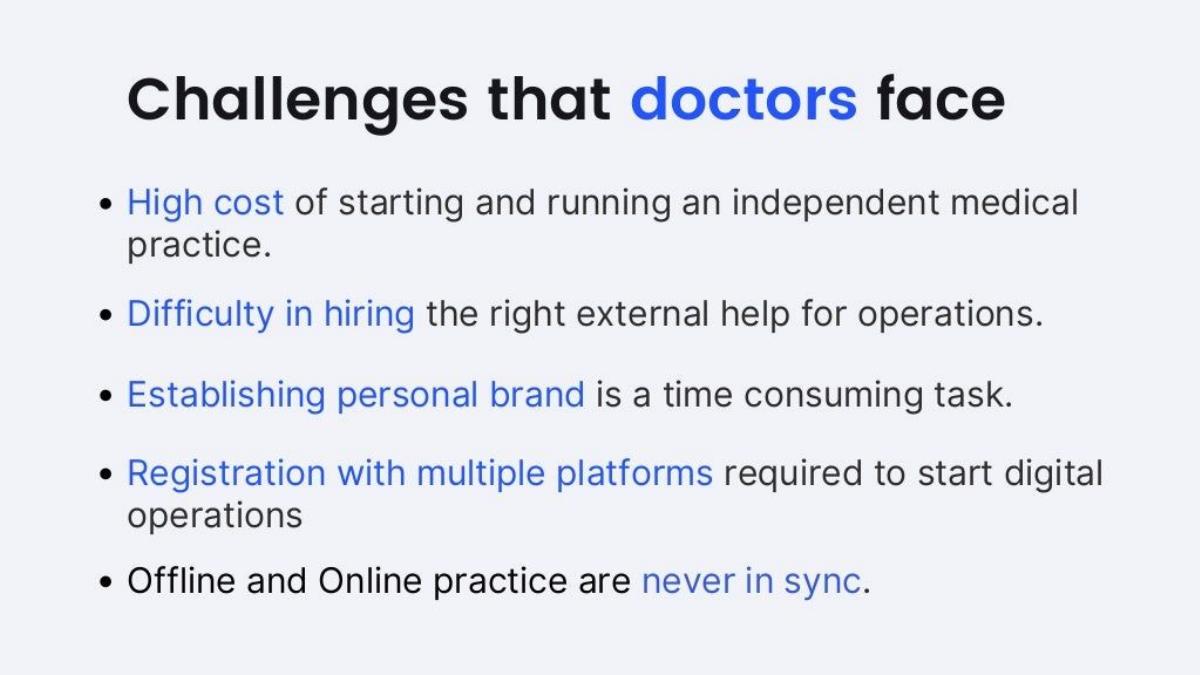
- Five specific challenges for doctors are identified, including high operational costs and the lack of sync between offline and online practices (Slide 2).
- The product offering includes virtual receptionists, personalized websites, and brand-building capabilities (Slide 3).
- A core value proposition is the ability to reach the 'next billion users' using vernacular language support (Slide 4).
- The founding team consists of four members who are college batch-mates and have worked together for three years (Slide 5).
- Team experience includes previous roles at Zoho, Tezos, Frontrow, and Upraised (Slide 5).
- Customer validation is provided through testimonials from a General Consultant and an MD Medical Officer (Slide 6).
- The deck omits market size (TAM/SAM/SOM), business model details, and a specific investment ask in the provided slides.
Slide-by-Slide Analysis
Slide 1: Title Slide
The deck opens with a clean, minimalist title slide. The logo features a blue medical cross integrated with a paper plane icon, effectively merging the healthcare and 'delivery/speed' themes. The tagline, "Digital clinics on WhatsApp," is highly specific and immediately tells the investor the platform and the sector. The inclusion of the WhatsApp icon reinforces the medium, and the URL paperplanetech.co is clearly displayed at the bottom.
Slide 2: Challenges that doctors face
This slide outlines the problem statement using five bullet points. It identifies "High cost of starting and running an independent medical practice" as the primary hurdle. Other points include the difficulty of hiring operational help, the time-consuming nature of brand building, and the friction of registering with multiple platforms. Crucially, it mentions that "Offline and Online practice are never in sync," which suggests that Paperplane intends to be the bridge between these two worlds. The text is legible, though it relies entirely on qualitative statements rather than data-backed pain points (e.g., specific costs or hours lost).
Slide 3: What are we selling?
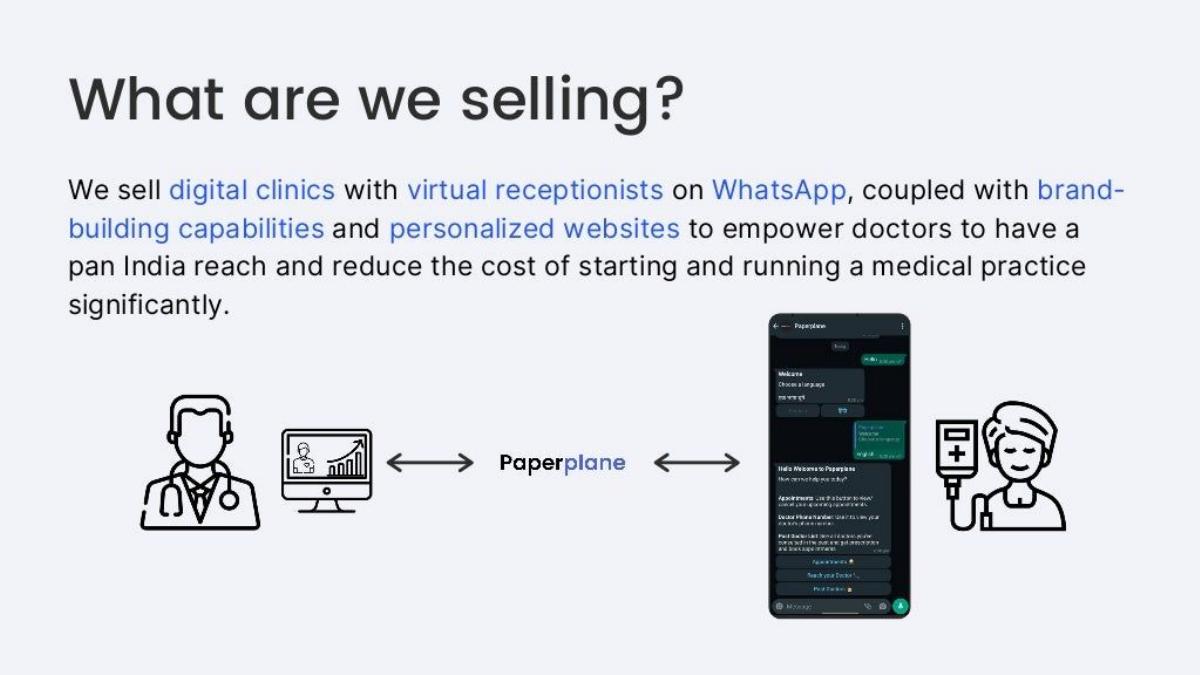
This slide serves as the solution and product overview. It defines the offering as "digital clinics with virtual receptionists on WhatsApp," supplemented by "brand-building capabilities and personalized websites." The goal stated is to empower doctors with a "pan India reach" while significantly reducing costs. The visual diagram shows a doctor on one side, a patient on the other, and a smartphone displaying a WhatsApp chat interface in the middle. The chat interface shows automated options like "Appointments," "Reach your doctor," and "Past Records," giving a concrete look at the user experience.
Slide 4: Market Reach and Localization
Slide 4 uses a skyline graphic of Indian landmarks (including the Taj Mahal and Lotus Temple) to emphasize its geographic focus. The text, "Empowering Doctors to reach out to the next billion users with Vernacular language on WhatsApp," highlights a key differentiator: localization. By supporting vernacular languages, Paperplane positions itself to capture the massive demographic in India that is mobile-first but not necessarily English-fluent. This is a common theme in Indian tech pitches targeting the 'Bharat' market.
Slide 5: Paperplane Team
The team slide presents four co-founders: Devansh Swarup (CEO), Aryan Pandey (CPO), Dhruv Upadhyay (COO), and Varun Goel (CTO) . The slide notes they are "College batch-mates" and have been "Working together for last 3 years," which addresses the common investor concern regarding founder chemistry and longevity. The professional pedigree is strong for an early-stage startup, citing experience at Zoho, Tezos, Frontrow, and Upraised . Using logos of these well-known companies next to the headshots provides instant social proof of their technical and product capabilities.
Slide 6: Our customers love us
The final slide in this set provides social proof through two testimonials. Dr. Sumana Mukherji highlights the ability to manage "overseas clients without much hassle," suggesting the platform has utility beyond just local Indian clinics. Dr. Sushil Kumar , identified as an "MD Medical Officer, IMA," emphasizes the "advantage of consulting Pan India." These quotes validate that the product is functional and providing the 'reach' promised in earlier slides. However, the slide lacks quantitative metrics like Net Promoter Score (NPS) or user retention rates.
What Paperplane Does Well
The deck excels at clarity of purpose. Within the first three slides, an investor knows exactly what the product is (a WhatsApp-based clinic), who it is for (independent doctors in India), and what the primary interface looks like. The choice of WhatsApp as a platform is a strategic masterstroke for the Indian market, as it requires zero user education for the patients and minimal technical overhead for the doctors.
The team slide is also a highlight. Highlighting that they are college batch-mates who have worked together for three years mitigates 'founder conflict' risk. The specific logos (Zoho, Tezos) suggest a high level of technical competency, which is necessary for building a seamless automation layer on top of a third-party messaging app.
What is Missing from the Deck
While the product and team are well-defined, the business side of the startup is largely absent from these slides. There is no Market Size (TAM/SAM/SOM) slide to show the scale of the opportunity. There is no Business Model slide explaining how Paperplane generates revenue—is it a SaaS subscription for doctors, a per-consultation fee, or a freemium model?
Furthermore, there is no Traction slide beyond two qualitative quotes. Investors need to see growth metrics: number of doctors onboarded, number of patient interactions, or Month-over-Month (MoM) growth. Finally, the Investment Ask is missing. A pitch deck is a tool for fundraising, and without stating how much capital is needed and what milestones it will fund, the deck remains a product presentation rather than a business proposal.
Founder Takeaways: What to Copy
The 'Platform-as-Interface' Strategy: If you are building for a market where app fatigue is high, follow Paperplane's lead by building on top of an existing ecosystem (like WhatsApp or Slack). It lowers the barrier to entry significantly. · Pedigree and History: If your team has worked together for years, state it clearly. Investors value 'time in the trenches' as much as they value individual resumes. · Visualizing the UX: Slide 3 does a great job of showing the 'middle-man' nature of the tech. Using a simple mockup of a chat screen is often more effective than a complex architectural diagram. · Localized Value Prop: The mention of 'vernacular language' (Slide 4) is a specific answer to a specific market problem. Founders should always highlight how their product adapts to local cultural or linguistic needs.
Frequently asked questions
- What is the primary problem Paperplane is trying to solve?
- According to slide 2, Paperplane addresses the high cost and operational complexity of running an independent medical practice. They specifically note that doctors struggle with hiring help, building a personal brand, and managing the disconnect between their offline and online patient interactions. By moving these functions to a familiar platform like WhatsApp, they aim to reduce these frictions.
- How does Paperplane's technology actually work for a doctor?
- Slide 3 illustrates a three-way connection between the doctor's dashboard, the Paperplane platform, and the patient's WhatsApp interface. The service includes a 'virtual receptionist' that handles patient inquiries and appointments. This allows the doctor to maintain a digital presence and a 'pan India reach' without needing to manage multiple complex software platforms.
- What makes Paperplane specifically suited for the Indian market?
- Slide 4 highlights their focus on 'vernacular language on WhatsApp' to reach the 'next billion users.' In India, where English is not the primary language for a vast portion of the population, providing medical services in local languages via a ubiquitous app like WhatsApp is a significant localized strategy for scale.
- What is the background of the Paperplane founding team?
- The team (Slide 5) consists of Devansh Swarup (CEO), Aryan Pandey (CPO), Dhruv Upadhyay (COO), and Varun Goel (CTO). They are college batch-mates with three years of history working together. Their professional backgrounds include product and developer roles at established firms and startups like Zoho, Tezos, Frontrow, and Upraised.
- What critical information is missing from this pitch deck?
- The provided slides do not include a business model (how they make money), market sizing (the total addressable market), or a roadmap. Most importantly for a fundraising deck, there is no 'Ask' slide detailing how much capital they are seeking or how they intend to use the funds to achieve specific milestones.